In the 1920s, British archaeologist Leonard Woolley climbed a sun-baked brick mountain in southern Iraq and thought he had found the Bible’s “Tower of Babel.” He was wrong about the story, but right about the drama. The Ziggurat of Ur, a stepped temple raised over 4,000 years ago, loomed out of the desert like a fossilized skyscraper.
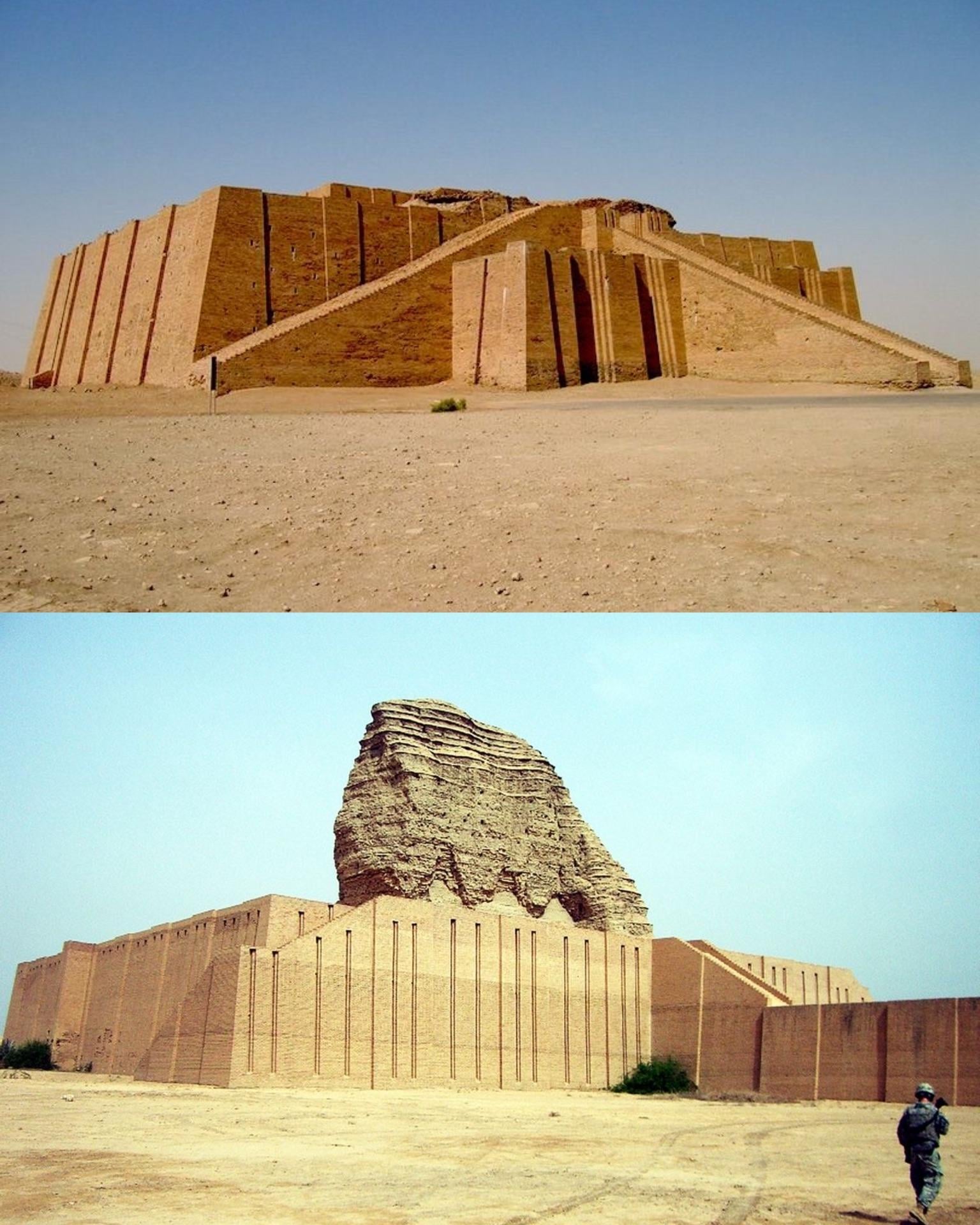
Drive a few hours northwest from Ur’s ruins and there is another giant staircase of mudbrick, half collapsed and much less photographed: the ziggurat of Dur Kurigalzu, near modern Aqar Quf. Same basic shape. Same Mesopotamian obsession with building artificial mountains on a flat plain. Very different moment in history.
They look similar because Mesopotamian ziggurats followed a shared religious and architectural idea: a tiered platform that lifted a temple toward the sky. But the Ziggurat of Ur and the Ziggurat of Dur Kurigalzu were built centuries apart, for different gods, by rival dynasties trying to solve different political problems.
The Ziggurat of Ur is a massive stepped temple built around 2100 BCE by King Ur-Nammu for the moon god Nanna. The Ziggurat of Dur Kurigalzu was built around the 14th century BCE by Kassite king Kurigalzu I for the god Enlil. Same type of building, two very different imperial projects.
Origins: Two empires, two gods, one idea
Start with Ur. Around 2100 BCE, southern Mesopotamia had just crawled out of a political crash. The Akkadian Empire had fallen. City-states were jostling for power. Into this mess stepped Ur-Nammu, founder of the Third Dynasty of Ur, who wanted to make his city the center of the world again.
Ur-Nammu chose a powerful patron: Nanna (also called Sin), the moon god. Ur was Nanna’s city. Building a colossal ziggurat there was not just piety. It was a political manifesto in brick: the gods favor Ur, and Ur-Nammu is their chosen king.
So around 2100–2050 BCE, Ur-Nammu and his successor Shulgi ordered the construction of a huge stepped platform, about 64 by 46 meters at the base and originally perhaps 30 meters high. On top, they placed a temple for Nanna. This was the religious and symbolic heart of a new Sumerian revival.
Fast forward roughly 700 years. The world has changed. The Sumerian language is fading from daily use. New ethnic groups have moved into Mesopotamia. One of them, the Kassites, have taken control of Babylon after the fall of Hammurabi’s dynasty.
Some time in the 14th century BCE, a Kassite king named Kurigalzu I founded a new city northwest of Babylon. He named it Dur Kurigalzu, “Fortress of Kurigalzu.” This was a royal showpiece, not an ancient sacred city like Ur. At its core he raised a ziggurat to Enlil, the chief god of the Mesopotamian pantheon, whose main cult center was at Nippur.
By building a massive ziggurat to Enlil in his own new capital, Kurigalzu tried to pull divine authority away from older cities and tie it directly to his dynasty. If Ur-Nammu used a ziggurat to revive Sumerian prestige, Kurigalzu used one to legitimize Kassite rule over a Babylonian world.
So what? The origins show that both ziggurats were political tools as much as religious monuments, each tied to a different empire’s attempt to claim divine backing and reorder Mesopotamia’s map.
Methods: How were the two ziggurats built?
From a distance, both structures look like giant stair-stepped pyramids. Up close, the differences in construction and planning start to matter.
The Ziggurat of Ur was built mostly of sun-dried mudbricks, the basic building material of Mesopotamia, with an outer shell of fired bricks set in bitumen. Bitumen is a natural asphalt that made the exterior more durable and water resistant. Archaeologists have found bricks stamped with Ur-Nammu’s name, a king literally signing his work.
The ziggurat had three main levels. A monumental triple staircase on the southeast side led worshippers up to the first terrace, then on to the higher levels. The top platform held the shrine of Nanna, probably a relatively small temple compared to the huge base that supported it.
The whole structure was carefully oriented. One corner points roughly to the cardinal directions. The staircases created a dramatic approach, a controlled path for processions and rituals. This was architecture as theater.
The Ziggurat of Dur Kurigalzu followed the same basic recipe: mudbrick core, fired-brick facing, bitumen mortar. It too probably had multiple levels, though erosion and later damage make the original height and exact tier count less certain. Estimates suggest it may have been even taller than Ur’s ziggurat when complete.
But Dur Kurigalzu’s ziggurat was part of a very different urban plan. The city was new, laid out as a Kassite royal center with palaces, administrative buildings, and residential quarters. The ziggurat rose near the palace complex, tying royal power and divine power into one visual package.
There is another difference. Ur’s ziggurat was built in a city with deep religious roots. The builders had to work around older sacred spaces and traditions. Dur Kurigalzu was a blank slate. Kurigalzu could design his ziggurat and city together, a planned capital rather than an ancient shrine upgraded.
So what? The methods show that while both used the same Mesopotamian building technology, Ur’s ziggurat was a monumental upgrade of an old cult center, while Dur Kurigalzu’s was a centerpiece in a brand-new royal city, tying architecture more tightly to state planning.
Functions and outcomes: What actually happened around them?
Neither ziggurat was a public temple in the modern sense. Ordinary people did not stroll up the steps to chat with the gods. Ziggurats were restricted, sacred platforms, with the main rituals carried out by priests and the king.
At Ur, the ziggurat anchored a larger temple complex for Nanna. Around it were courtyards, storage rooms, housing for priests and temple staff, and facilities for offerings. The ziggurat itself was the raised foundation for the god’s dwelling. Its height symbolized the meeting point of heaven and earth.
Ur’s ziggurat functioned during the height of the Ur III dynasty, roughly 21st century BCE, and continued to be used and restored by later rulers. Babylonian and Assyrian kings centuries later repaired it, which tells you it never fully lost its religious pull.
The political outcome was clear. The ziggurat helped turn Ur into a religious and administrative powerhouse. The Ur III state collected taxes, organized labor, and issued some of the earliest known law codes. The ziggurat was the visual anchor for a bureaucratic empire that reached far beyond the city’s walls.
At Dur Kurigalzu, the ziggurat played a similar symbolic role but in a different setting. It was part of a royal foundation that tried to shift the center of gravity away from older cities. The temple on top was dedicated to Enlil, but the whole complex projected Kassite royal ideology.
The city did become an important Kassite center, but it never eclipsed Babylon or Nippur in long-term prestige. After the Kassite dynasty fell, Dur Kurigalzu declined. The ziggurat remained as a landmark, but the city around it did not keep the same religious weight that Ur enjoyed for centuries.
So what? The outcomes show that Ur’s ziggurat anchored a long-lived religious and administrative hub, while Dur Kurigalzu’s ziggurat was tied more tightly to a single dynasty’s project, which faded when that dynasty lost power.
Restoration, ruin, and survival: Why does Ur look better today?
One reason the Ziggurat of Ur is famous and Dur Kurigalzu is not is very simple: Ur looks better in photos.
Ur’s ziggurat has been heavily restored. In the 20th century, especially under Saddam Hussein in the 1980s, large sections of the outer brickwork and staircases were rebuilt. The work was not always archaeologically gentle, but it made the structure visually impressive and recognizable.
That restoration, plus Woolley’s excavations in the 1920s and 1930s, pushed Ur into textbooks and documentaries. The site became a symbol of “ancient Mesopotamia” in the modern imagination.
Dur Kurigalzu’s ziggurat, by contrast, is more eroded and less restored. Its upper levels have collapsed. The core is exposed. The site has suffered from weathering, neglect, and in recent decades, damage from conflict and looting in Iraq.
There were some conservation efforts in the 20th century, but nothing on the scale of Ur. So when people search images of “ziggurat,” they usually see Ur’s clean, stepped silhouette, not Dur Kurigalzu’s crumbling mass.
There is a historical irony here. In antiquity, Dur Kurigalzu’s ziggurat may have been taller and more imposing than Ur’s. But survival and modern politics have flipped their reputations.
So what? The different states of preservation have shaped modern memory, turning Ur into the poster child for ziggurats while leaving Dur Kurigalzu in the footnotes, even though both were major monuments in their own time.
Legacy: How did each ziggurat shape later history?
Mesopotamian ziggurats influenced how later cultures imagined sacred mountains and towers. The Ziggurat of Ur, in particular, has been tied in popular imagination to the biblical “Tower of Babel,” even if scholars now think Babel was more likely in Babylon itself.
Ur’s ziggurat also kept attracting attention from later Mesopotamian rulers. Kings like Nabonidus of Babylon in the 6th century BCE claimed to restore it. That long chain of repairs means the site stayed part of the religious map for more than a thousand years.
In the modern era, Ur’s ziggurat has become a symbol of early urban civilization. It appears in schoolbooks, museum exhibits, and tourist brochures as shorthand for “ancient Mesopotamia.” When people picture a ziggurat, they are usually picturing Ur.
Dur Kurigalzu’s legacy is quieter but still important. Archaeologically, it tells us about the Kassites, a dynasty that ruled Babylonia for centuries but left relatively few grand monuments compared to earlier empires.
The ziggurat at Dur Kurigalzu shows that the Kassites did not simply copy Babylonian culture. They used its religious forms, like ziggurats and Enlil’s cult, to build their own royal identity and urban experiments. The city’s layout and palace complex have given historians a better sense of how Kassite kings thought about power and space.
Both ziggurats also feed into a broader story. They show how the same architectural form could be reused across centuries to solve new political and religious problems. A ziggurat was not just a type of building. It was a reusable tool for claiming that the gods had chosen your city and your dynasty.
So what? The legacy of Ur and Dur Kurigalzu shows how a shared religious architecture could anchor very different empires, and how modern visibility, not ancient importance alone, decides which ruins become famous and which remain obscure.
Why they look similar, and why the differences matter
If you strip away the dates and dynasties, the comparison is simple. Both the Ziggurat of Ur and the Ziggurat of Dur Kurigalzu are multi-tiered mudbrick platforms, faced with fired brick, built to lift a temple closer to the divine realm. They look similar because they come from the same Mesopotamian religious idea: the god’s house should sit on an artificial mountain.
But the differences are the story.
Ur’s ziggurat rose from an ancient sacred city in a Sumerian revival, tied to the moon god Nanna and a bureaucratic empire that helped define early statehood. Dur Kurigalzu’s ziggurat rose from a brand-new Kassite capital, tied to Enlil and a dynasty trying to anchor its rule in a Babylonian world it did not originally own.
Ur’s ziggurat stayed in use and in memory for more than a millennium, then got a second life through excavation and modern restoration. Dur Kurigalzu’s ziggurat had a shorter ancient career and a rougher modern one, which is why it is less photographed and less famous even though it once dominated the horizon.
So what? Seeing the two together turns “a ziggurat” from a generic Mesopotamian icon into a timeline of changing empires, gods, and political gambles, all written in mudbrick that still clings to the Iraqi desert.
Frequently Asked Questions
Why do the Ziggurat of Ur and Dur Kurigalzu look so similar?
They look similar because both follow the standard Mesopotamian ziggurat design: a stepped mudbrick platform with multiple levels, faced with fired brick, and topped by a temple. Ziggurats were meant to be artificial mountains lifting a god’s shrine toward the sky. Ur’s was built for the moon god Nanna around 2100 BCE, and Dur Kurigalzu’s for the god Enlil around the 14th century BCE, but both used the same religious and architectural concept.
Which ziggurat is older, Ur or Dur Kurigalzu?
The Ziggurat of Ur is older. It was built around 2100–2050 BCE by Ur-Nammu and his successor Shulgi of the Third Dynasty of Ur. The Ziggurat of Dur Kurigalzu was built roughly 700 years later, in the 14th century BCE, by the Kassite king Kurigalzu I as part of his new capital city, Dur Kurigalzu.
Why is the Ziggurat of Ur more famous than Dur Kurigalzu?
The Ziggurat of Ur is better preserved and was heavily restored in the 20th century, which makes it visually striking and easy to recognize. It was also excavated early and promoted in books and documentaries as the classic example of a ziggurat. Dur Kurigalzu’s ziggurat is more eroded, less restored, and its city declined after the Kassite dynasty fell, so it never gained the same modern visibility even though it was a major monument in its own time.
Were the Ziggurat of Ur and Dur Kurigalzu used for the same purpose?
Both were religious monuments, but they served slightly different political roles. Ur’s ziggurat anchored an ancient cult center and helped legitimize a Sumerian revival under the Ur III dynasty. Dur Kurigalzu’s ziggurat was part of a new royal capital and helped the Kassite kings tie their rule to the chief god Enlil and to Babylonian religious traditions. In both cases, the ziggurats were tools for claiming divine support for a specific city and dynasty.