In the late 1990s, villagers on the banks of the Euphrates in southeastern Turkey watched the water rise, meter by meter, knowing an ancient city was about to disappear. Bulldozers roared, archaeologists sprinted, and crates of stone and glass were hauled away. Then the Birecik Dam closed its gates. Half of the ancient city of Zeugma, once a thriving Greco-Roman hub, slipped under the new reservoir.
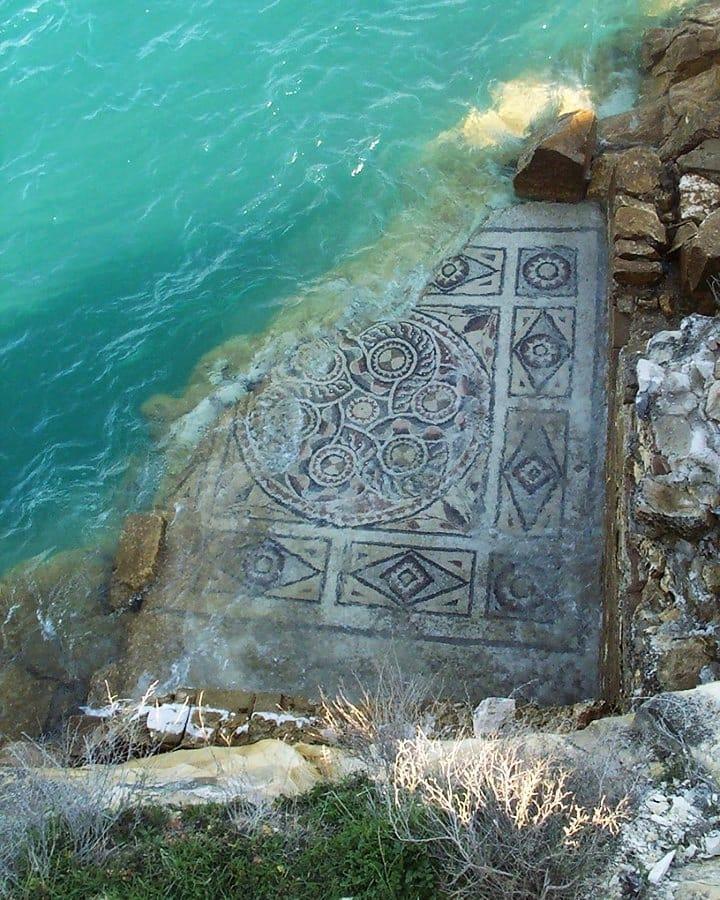
And that is when the waves began to give things back.
As the water level shifted with the seasons, 2,000-year-old mosaics appeared at the shoreline: mythic figures with expressive eyes, delicate borders of vines and birds, the famous “Gypsy Girl” staring out from the mud. The same project that drowned Zeugma helped reveal some of the finest Roman mosaics ever found.
Zeugma was a major city on the Euphrates, founded in the Hellenistic period and absorbed into the Roman Empire. It grew rich on trade, military garrisons, and taxes, then declined and was buried. The modern dam project forced a frantic archaeological rescue that changed what historians thought they knew about life on Rome’s eastern frontier.
Zeugma is an ancient city on the Euphrates in modern Turkey, founded by a general of Alexander the Great and later turned into a Roman garrison town. The construction of the Birecik Dam in the 1990s flooded much of the site but triggered a massive salvage excavation that uncovered world-class mosaics and artifacts.
Why was Zeugma built here in the first place?
Start with the river. The Euphrates has always been a highway of sorts, a long wet road cutting through what is now Turkey, Syria, and Iraq. If you wanted to move armies, goods, or ideas between the Mediterranean and Mesopotamia, you had to cross it somewhere.
In the early 3rd century BCE, Seleucus I Nicator, one of Alexander the Great’s successors, founded twin cities on opposite banks of the river. On the west bank he created Seleucia, on the east Apamea. Together they controlled a major ford and a bridge of boats. The Greek word for “bridge” is zeugma. Over time, that practical term became the city’s name.
This was not a sleepy crossing. Caravans from the east brought spices, textiles, and luxury goods. From the west came wine, olive oil, and manufactured products. The city sat at a choke point where taxes could be collected and soldiers could watch who came and went.
When Rome pushed into the region in the 1st century BCE, it inherited this strategic knot. By the 1st century CE, Zeugma was a key base for the Roman army on the eastern frontier, housing the Legio IV Scythica and later other units. The city became a staging ground for campaigns against the Parthian and later Sasanian empires.
So Zeugma was born out of geography and empire. It existed because the Euphrates could not be ignored and because big states needed to control crossings. That basic fact set up everything that followed: wealth, mosaics, and eventually, its drowning under a modern dam.
By anchoring a bridge and a garrison at a major Euphrates crossing, Zeugma became a magnet for trade and military power, which explains why such a rich and cosmopolitan city grew in what might otherwise look like a remote corner of Turkey.
How did Zeugma become so rich and cosmopolitan?
On paper, Zeugma was a frontier town. In reality, it looked more like a small Mediterranean metropolis transplanted to the Euphrates.
The Roman legion brought thousands of soldiers, officers, and support staff. Where soldiers went, so did merchants, craftsmen, innkeepers, and families. The city swelled, especially in the 2nd century CE, when the Roman Empire was near its peak.
Archaeology confirms what the ancient texts only hint at. Excavations have revealed large terraced villas climbing the slope above the river, with colonnaded courtyards, private baths, and floors covered in mosaics. These were not barracks. They were the homes of wealthy officers, local elites, and merchants who had money to spend and a taste for Greek culture.
The mosaics show that taste clearly. Gods and heroes from Greek mythology, personifications of the seasons, theatrical masks, marine scenes. The imagery would not look out of place in Antioch or even in parts of Italy. Yet the inscriptions and some artistic details show local influences and eastern names. This was a cultural borderland where Greek, Roman, and Near Eastern traditions mixed.
Trade routes running through Zeugma brought more than goods. They brought artisans, ideas, and fashions. Imported tableware, coins from distant cities, and luxury items found in the excavations all point to a population plugged into wider Mediterranean and Near Eastern networks.
So Zeugma’s wealth came from its position as a toll booth on a major river crossing and as a supply and logistics hub for the Roman army. That money fed into houses, baths, and mosaics, turning what could have been a dusty garrison into a city of art and comfort.
By showing how a frontier garrison city could become rich, artistic, and culturally mixed, Zeugma forces historians to rethink the old picture of Rome’s eastern border as a thin military line instead of a dense, urbanized zone of exchange.
What destroyed ancient Zeugma and buried its mosaics?
For centuries, Zeugma thrived in the shadow of empire. Then the frontier shifted against it.
From the 3rd century CE, Rome’s control over the east grew shakier. The Sasanian Persians replaced the Parthians as Rome’s main rival. They were more aggressive and better organized. The Euphrates frontier turned from a managed boundary into a war zone.
Ancient sources mention a major disaster in 256 CE. The Sasanian king Shapur I attacked Roman positions along the Euphrates. Archaeological evidence at Zeugma lines up with this. There are burn layers, collapsed buildings, and signs of sudden abandonment.
In one house, archaeologists found a hoard of bronze coins hidden under a floor, never retrieved. In another, unfinished repairs and scattered objects suggest people left in a hurry. The city was sacked and partially burned. Many residents fled. Some never came back.
Zeugma did not vanish overnight, but it never fully recovered its earlier prosperity. Trade routes shifted. The Roman state had fewer resources to pour into frontier cities. Over the next centuries, earthquakes, smaller raids, and economic change chipped away at what was left.
By the early medieval period, the old Roman city was largely ruins. New, smaller settlements grew nearby, using stones from the ancient buildings. Over time, soil, rubble, and later construction buried the mosaics and walls. What had been the polished floors of elite villas became underground time capsules.
The destruction of Zeugma in the 3rd century CE and its gradual decline after show how fragile even a rich city could be when imperial power faltered and the frontier turned violent.
How did a modern dam drown and reveal Zeugma?
Fast forward to the late 20th century. Turkey launched the Southeastern Anatolia Project (GAP), a massive effort to build dams and irrigation works on the Tigris and Euphrates. One of those dams, Birecik, was planned right where ancient Zeugma lay.
By the early 1990s, archaeologists knew there were ruins in the area, but the scale was not fully appreciated. Local farmers had been finding mosaic fragments and carved stones for years. Some mosaics were already exposed on the surface, eroding in the sun and rain.
As construction on the dam advanced, warnings grew louder. Once the reservoir filled, much of the ancient city would be under water. There was a deadline: either excavate now or lose the site.
In 1998, Turkish archaeologists began more systematic work. In 2000, after media reports and pressure from scholars, international funding and teams joined in. The Packard Humanities Institute provided major support. Suddenly Zeugma became a race against the clock.
Excavation seasons turned frantic. Crews worked long days, cutting into the hillside above the river, exposing entire villa complexes in a matter of weeks. As they dug, they found mosaic after mosaic, many of them in excellent condition. The water level was rising while they worked.
When the dam gates closed and the reservoir began to fill, lower parts of the city disappeared under the new lake. Some areas had been recorded but not fully excavated. Others were left untouched. At the same time, the changing waterline eroded banks and exposed new fragments. Villagers and archaeologists alike began to see mosaic panels appear at the edge of the water, then vanish again as levels shifted.
The Birecik Dam destroyed part of Zeugma but forced a rescue operation that revealed how large and rich the city had been. It turned a half-known ruin into one of the most important archaeological sites of the Roman East.
What makes the Zeugma mosaics so special?
Roman mosaics are not rare. They turn up from Britain to Tunisia. So why did the Zeugma mosaics cause such a stir?
First, the sheer number and density. In a relatively small area, archaeologists uncovered dozens of mosaic floors, many of them large, complex, and well preserved. This suggests that mosaic decoration was standard in elite housing at Zeugma, not an occasional luxury.
Second, the quality. The mosaics use tiny tesserae, often just a few millimeters across, which allows for fine shading and expressive faces. Figures have depth and personality. Drapery folds, hair, and eyes are rendered with painterly care.
Third, the themes. The mosaics draw heavily on Greek mythology: Dionysus and Ariadne, Oceanus and Tethys, Achilles on Skyros, and many others. These scenes were not random decoration. They reflected the education and cultural aspirations of the owners, who wanted to be seen as part of the Greek-speaking elite world even while living on Rome’s eastern frontier.
The most famous image is the so-called “Gypsy Girl” mosaic. It is actually a fragment, probably part of a larger scene, showing a young woman with large, intense eyes and tousled hair. Her identity is debated. Some suggest she is Gaea, the earth goddess, or a personification of a season. The nickname “Gypsy Girl” is modern and inaccurate, but it stuck because of the haunting expression.
Fourth, the context. Because many mosaics were found in situ, in houses with preserved walls, courtyards, and sometimes frescoes, archaeologists can study how they fit into the overall design of the home. This turns them from isolated art objects into evidence about domestic life, social status, and taste.
Zeugma’s mosaics are among the finest Roman mosaics found in Turkey, rivaling those of Antioch. They give a vivid, floor-level view of how wealthy people in a frontier city wanted to see themselves and what stories they literally walked over every day.
By combining high artistic quality with clear archaeological context, the Zeugma mosaics let historians study not just Roman art, but the everyday world of provincial elites on the empire’s edge.
What happened after the rescue, and where are the mosaics now?
As the dam reservoir rose, conservators cut many mosaics out of the ground in large sections. These were moved to storage and then to museums. It was a brutal process, but leaving them in place would have meant slow destruction underwater.
The main collection is now housed in the Zeugma Mosaic Museum in Gaziantep, which opened in 2011. For a time it was described as one of the largest mosaic museums in the world by floor area. The “Gypsy Girl” became its unofficial icon, reproduced on posters and tourist brochures.
The museum does more than display pretty floors. It reconstructs parts of the villas, shows how the mosaics were found, and explains the story of the dam and the rescue excavations. That narrative of loss and salvage is now part of Zeugma’s identity.
Not everything was saved. Large parts of the ancient city are underwater, inaccessible to normal excavation. Some mosaics and buildings were documented only partially before flooding. Future underwater archaeology might recover more, but for now, the reservoir is both a protector and a barrier.
The rescue of Zeugma also changed how Turkey and the international community think about heritage and development. Later dam projects faced more scrutiny about their impact on archaeological sites. Zeugma became a case study in what can be lost and what can be saved when modern infrastructure meets ancient ruins.
By moving the mosaics to a dedicated museum and telling the story of their near-loss, the post-dam era turned Zeugma from a local ruin into a global reference point in debates over cultural heritage and development.
Why does Zeugma matter today?
Zeugma hits a nerve because it is both a success story and a warning.
On one hand, the rescue excavations recovered a huge amount of information and art that would otherwise have been destroyed or eroded slowly. The mosaics, sculptures, and architecture have reshaped our understanding of Roman Syria and Anatolia, especially the social life of frontier cities.
On the other hand, the story is framed by loss. Half the city is underwater. Some areas were never dug. The decision to build the dam was about electricity, irrigation, and regional development, not about archaeology. That tension is not unique to Turkey. It plays out wherever modern states build big projects on old ground.
For historians, Zeugma proves that Roman frontiers were not just lines of forts but dense, wealthy, and culturally sophisticated zones. For the public, the mosaics offer a direct, almost unsettling connection to individuals who lived 2,000 years ago and cared about home décor, status, and myth in ways that feel oddly familiar.
And then there is the image that started this whole Reddit fascination: mosaics emerging from the water, half-submerged, half-exposed, as if the past is trying to surface. That is not just a striking photograph. It is a reminder that ancient cities are not frozen in time. They are caught between erosion and excavation, between dams and museums, between forgetting and remembering.
Zeugma matters because it shows, tile by tile, how much of the ancient world still lies hidden, and how quickly it can be lost or found when modern decisions reshape old rivers.
Frequently Asked Questions
What is the ancient city of Zeugma in Turkey?
Zeugma is an ancient Greco-Roman city on the Euphrates River in southeastern Turkey. Founded in the 3rd century BCE by a successor of Alexander the Great, it became a major Roman garrison and trade hub. The city is famous today for its well-preserved mosaics discovered during rescue excavations before the Birecik Dam flooded much of the site.
Why were Zeugma mosaics found underwater or near the waterline?
The construction of the Birecik Dam on the Euphrates in the late 1990s created a large reservoir that flooded much of ancient Zeugma. As the water level in the reservoir rose and fell seasonally, erosion exposed buried parts of the ancient city along the banks. This process revealed mosaic floors that had been preserved under soil for nearly 2,000 years, leading to dramatic images of mosaics emerging from the water.
What is special about the Zeugma “Gypsy Girl” mosaic?
The “Gypsy Girl” is a fragment of a Roman mosaic from Zeugma, showing a young woman with large, expressive eyes and tousled hair. Her true identity is unknown, and the nickname is modern and not historically accurate. The piece is famous because of its lifelike expression and fine craftsmanship, and it has become an emblem of the Zeugma excavations and the Gaziantep Zeugma Mosaic Museum.
Can you visit Zeugma and see the mosaics today?
You cannot visit most of the original city because large areas are underwater behind the Birecik Dam. However, many of the mosaics and artifacts recovered before the flooding are on display at the Zeugma Mosaic Museum in Gaziantep, Turkey. Some parts of the ancient site that remain above water can still be visited, but the main experience of Zeugma today is through the museum collections.