He is maybe six years old, standing on a Washington D.C. sidewalk in April 1948, drowning in confidence but not in fabric. The suit fits perfectly. The trousers break just right over polished shoes. The jacket hangs clean. On his head, a fedora that would not look out of place on a Wall Street banker.
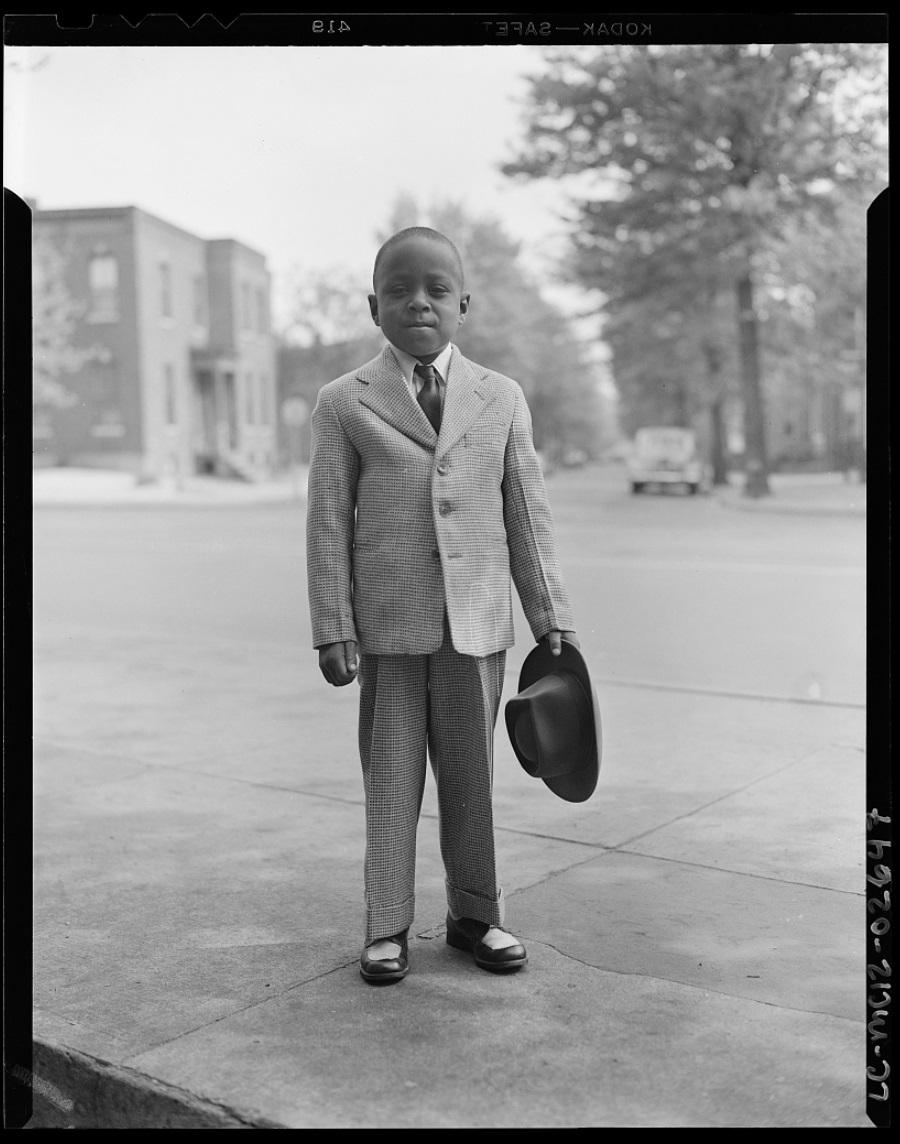
To modern eyes, the Reddit-famous photo of a little boy in a two-piece suit and matching fedora looks almost like a costume. In 1948, it was just how you dressed when you wanted the world to take you seriously. Especially if you were Black in the nation’s capital.
That one image captures a whole postwar world: children dressed like miniature adults, parents investing hard-earned money in “Sunday best,” and a Black middle class using clothing as armor in a segregated city. By the end of this story, that small boy in a big hat will make more sense as a product of war, migration, racism, and hope.
What was going on in 1948 Washington D.C. fashion?
In 1948, American city streets were full of hats and suits. Men wore fedoras, not baseball caps. Women wore dresses, not yoga pants. Children, especially on Sundays or special occasions, were dressed as scaled-down versions of their parents.
Postwar children’s fashion in cities like Washington D.C. followed adult styles: tailored jackets, pressed trousers, leather shoes, and brimmed hats for boys. Ready-to-wear manufacturers made “junior” versions of adult suits, and department stores sold them as signs of respectability and good upbringing.
For Black families in particular, clothing had extra weight. In a segregated city, looking “sharp” was not just vanity. It was a way to claim dignity in a society that tried to deny it. A well-dressed Black child in 1948 was a visual argument: we are respectable, we are serious, our kids deserve the same future as yours.
So that little boy in the Reddit photo is not overdressed for his time. He is dressed for church, a family event, or maybe a trip downtown, in the standard uniform of postwar respectability.
This matters because it reminds us that what looks like formality or cosplay to us was ordinary life in 1948, and clothing was a quiet but powerful language of class, race, and aspiration.
What set this style off? War, migration, and respectability
The roots of that tiny suit and fedora run through the Great Depression, World War II, and the Great Migration.
During the 1930s, even in hard times, adults clung to suits and hats as symbols of stability. Then came World War II. Fabric rationing through the War Production Board cut back on extra pockets, wide lapels, and long jackets. When the war ended in 1945, there was a pent-up demand for clothing that felt generous and adult again.
By 1948, the American clothing industry was booming. Department stores in cities like Washington D.C. offered mass-produced, affordable suits for men and “dress-up” versions for boys. Tailors, many of them immigrants or Black craftsmen, altered off-the-rack garments so even a child’s suit could look custom.
At the same time, hundreds of thousands of Black Americans were moving from the rural South to cities in the North and border states. Washington D.C. was a major destination. Between 1940 and 1950, the city’s Black population jumped from roughly 187,000 to over 280,000. Many of these newcomers were veterans, clerks, teachers, and federal workers.
They entered a city that was segregated by law and custom. Restaurants, theaters, and many neighborhoods barred Black patrons. In that environment, clothing became part of what historians call “respectability politics.” You dressed impeccably to counter racist stereotypes and to demand, without words, to be treated as a citizen.
For parents who had grown up under Jim Crow, putting a son in a well-cut suit in 1948 was not just cute. It was a declaration: our child will not be poor, uneducated, or invisible the way we were forced to be.
This matters because the boy’s outfit was not just a fashion choice. It was the product of postwar prosperity, industrial clothing, and a Black middle class using style as quiet resistance.
What was the turning point from kids-in-suits to casual kids?
Looking at that 1948 photo, the obvious question is: when did we stop dressing kids like that?
The short answer is: the 1950s started the shift, and the 1960s finished it.
In the late 1940s, children’s clothing was already changing. Manufacturers were discovering a new market: teenagers. The word “teenager” itself took off in the 1940s. By the early 1950s, high school kids wanted their own style, not just hand-me-down adult looks.
Jeans, once workwear, became youth fashion. T-shirts moved from underwear to outerwear. Boys might still wear suits to church or formal events, but everyday life was loosening up. Suburbanization helped. In new suburbs around D.C., kids rode bikes, played in yards, and needed clothes they could get dirty in.
The real break came in the 1960s. The postwar baby boom generation hit adolescence, and the culture shifted. The civil rights movement, rock and roll, and student protests all pushed against formality and hierarchy. Suits and fedoras started to look like uniforms of the old order.
By the 1970s, a boy in a full suit and hat on an ordinary day would have looked out of place. Special occasions still called for dressing up, but the baseline had changed. Casual clothing became the default, not the exception.
This matters because that 1948 boy marks the tail end of an era when childhood was expected to look disciplined and adult, right before American culture swung hard toward comfort and youth rebellion.
Who drove this look? Parents, Black professionals, and the clothing trade
No one person invented the “little man in a suit” look. It came from overlapping groups with shared interests.
First, parents. In 1948, many adults had lived through the Depression and a world war. They were not casual about appearance. A neat child reflected on the family. A boy in a suit signaled that his parents were responsible, ambitious, and watching over him.
Among Black families in Washington D.C., that pressure was even stronger. The city had a long-established Black middle class centered around institutions like Howard University, Black churches, and professional associations. Teachers, postal workers, Pullman porters, and federal clerks formed a community that prized education and decorum.
Photographs from Black neighborhoods in D.C. in the 1940s show boys in suits on Easter Sunday, at graduations, and on trips downtown. The famous “Easter parade” tradition, where families walked the streets in their best clothes after church, was especially strong in Black communities. A child’s suit was part of that ritual.
Then there were the people who made and sold the clothes. Washington D.C. had segregated shopping patterns. White department stores downtown often treated Black customers poorly or limited what they could try on. In response, Black-owned clothing stores, tailors, and hat shops built loyal clienteles.
These businesses advertised in Black newspapers like the Washington Afro-American. Ads from the late 1940s show boys’ suits, dress shoes, and hats marketed for church, school ceremonies, and “important occasions.” The message was clear: dress your child for the future you want him to have.
Even the fedora on the boy’s head had its own ecosystem. Hatters shaped and cleaned felt hats. Men’s magazines and Hollywood films made the fedora the standard male headgear. Children’s versions followed, so a boy could mirror his father exactly.
This matters because the look in that photo was not an accident. It was created by families, Black institutions, and a clothing industry all invested in the idea that appearance could open doors, or at least keep some of them from slamming shut.
What did this change for Black families and American childhood?
Putting a small boy in a serious suit in 1948 did not change segregation laws. But it did shape how Black families moved through a hostile city and how Americans thought about childhood itself.
For Black Washingtonians, careful dress was a survival strategy. A Black man in a suit might still be refused service, but he was harder to dismiss as “out of place.” A well-dressed child could soften white suspicion in public spaces. None of this erased danger, but it gave families a sense of control in a system designed to strip it away.
Inside the community, clothing helped mark status and aspiration. A boy in a tailored suit was often a boy whose parents had steady jobs, maybe in the federal government or a skilled trade. That suit might be worn for school pictures, church pageants, or visits to relatives. The photo would go on the mantel or in a family album as proof that the next generation was moving up.
For American childhood more broadly, the 1940s and 1950s were a hinge moment. On one side was the older idea of children as small adults, expected to be quiet, neat, and serious in public. On the other side was the emerging idea of childhood as a protected, playful stage with its own culture and clothing.
The boy in the 1948 photo is right on that hinge. He is dressed like a miniature man, but he is also part of the first generation that would grow up with comic books, kid-focused radio and TV shows, and, soon, rock and roll. By the time he was a teenager in the late 1950s or early 1960s, he might have swapped that fedora for a flat cap or no hat at all, and those pressed trousers for jeans.
This matters because the image captures both the weight of respectability politics on Black families and the moment when American childhood was about to tilt toward the more casual, youth-centered world we know.
Why does that 1948 boy in a fedora still matter now?
The Reddit thread around the photo is full of modern reactions: “Why is he dressed like a 40-year-old?” “Kids were so much more formal back then.” “That suit is nicer than anything I own.” Behind the jokes is a sense that the past was stricter, sharper, and somehow more serious.
There is some truth in that. Clothing norms have relaxed dramatically since 1948. Today, a child in a full suit on a city sidewalk would probably be headed to a wedding, a funeral, or a photo shoot. Daily life no longer requires a hat and tie.
But the photo also pushes back against the myth that the past was simply “classier.” That boy’s outfit was not just about taste. It was about race, class, and fear. His parents dressed him that way because they believed the world would treat him better if he looked like he belonged in the most respectable spaces.
In that sense, the picture connects directly to current conversations about “respectability politics” in Black communities, school dress codes, and what we expect kids to look like in public. The idea that clothing can protect you, or at least reduce suspicion, has not gone away. It has just shifted from fedoras and suits to debates over hoodies and sagging pants.
The image also challenges our assumptions about childhood. We tend to think of kids as naturally casual and adults as the ones who impose formality. The 1948 boy reminds us that childhood has been shaped by adult anxieties, economic conditions, and social rules that change over time.
So when a little boy in a perfect suit and fedora pops up on Reddit and racks up thousands of upvotes, it is not just nostalgia. It is a window into a world where a six-year-old in Washington D.C. carried, on his small shoulders, his family’s hopes, his community’s strategy for survival, and a whole era’s idea of what a respectable future looked like.
This matters because that single, stylish child lets us see how something as simple as a suit can carry the weight of war, migration, racism, and changing ideas about what it means to grow up in America.
Frequently Asked Questions
Why did kids wear suits and hats in the 1940s?
In the 1940s, children’s clothing often copied adult styles. Suits and hats were seen as signs of good manners and respectability, especially for church and special outings. For many Black families, sharp clothing was also a way to claim dignity and demand better treatment in a segregated society.
When did children stop dressing like little adults?
The shift began in the 1950s and accelerated in the 1960s. Teen culture, suburban life, and the rise of casual clothing led kids to wear jeans, T-shirts, and sneakers more often. By the 1970s, everyday suits and hats for children had mostly disappeared outside of formal events.
Why were Black families in 1940s Washington D.C. so focused on dressing well?
Washington D.C. was segregated in the 1940s, and Black residents faced discrimination in housing, jobs, and public spaces. Dressing well was a way to counter racist stereotypes, show middle-class status, and protect themselves and their children in a hostile environment. Clothing became part of a broader strategy of respectability and quiet resistance.
What does the 1948 boy in a fedora tell us about childhood back then?
The photo shows that childhood in 1948 was more formal and closely tied to adult expectations. Kids were often dressed as miniature adults, especially for public outings. It also reveals how Black parents used clothing to prepare their children for a world shaped by segregation and to signal their hopes for a better future.