They look similar because, on paper, they are a perfect medieval power duo: the divinely inspired warrior-maid and the hesitant prince who becomes a crowned king. Joan of Arc and Charles VII both claimed God’s favor, both fought for the same cause, and both needed each other to survive. Yet when Joan was captured in 1430 and put on trial by the English and their Burgundian allies, Charles VII did not ride to her rescue, did not pay a ransom, did not even publicly protest. She went to the stake in Rouen in 1431. He stayed in his palace.
So what actually happened? Why did Charles VII, the king whose throne Joan had saved, fail to save her in return? To answer that, you have to compare them side by side: where they came from, how they operated, what they each got out of the war, and what history did with their reputations afterward.
Origins: a peasant visionary and a half-disinherited prince
Start with who they were before they met.
Joan of Arc was born around 1412 in Domrémy, a small village in eastern France. She was a peasant girl, illiterate, from a family that owned a few acres and some animals. Her world was war and rumor. English armies and their Burgundian allies raided the region. People fled. Fields burned. She grew up hearing about the “Dauphin,” the uncrowned heir of France, and about prophecies that a maiden from the borders of Lorraine would save the kingdom.
By her own later testimony, around age 13 she began hearing voices she identified as Saint Michael, Saint Catherine, and Saint Margaret. These voices told her to live piously and, eventually, to go to the Dauphin and help him reclaim his kingdom. To her neighbors she was a devout, slightly intense village girl. To herself, she was on a mission from God.
Charles, by contrast, was born into power and humiliation at the same time. Born in 1403, he was the son of King Charles VI of France, who suffered from bouts of mental illness, and Queen Isabeau of Bavaria. The French royal house was split by civil war between the Armagnacs and Burgundians. English armies under Henry V smashed French forces at Agincourt in 1415.
Then came the disaster that shaped Charles’s life: the Treaty of Troyes in 1420. Charles VI, under English and Burgundian pressure, disinherited his own son. The treaty recognized Henry V of England and his heirs as the legitimate successors to the French crown. The Dauphin Charles was branded a bastard and a usurper by his enemies. When his father died in 1422, the English proclaimed the infant Henry VI king of both England and France. Charles, in Bourges, was mocked as the “king of Bourges,” a pretender with a shrinking domain.
So Joan came from the margins with an absolute sense of divine purpose. Charles came from the center of power with a shaky claim and deep political trauma. That mismatch in origins shaped how each of them thought about risk, loyalty, and what could be sacrificed. It set up a relationship where Joan could gamble everything, and Charles could not.
So what? Their backgrounds meant Joan treated the war as a holy mission, while Charles treated it as a long, dirty political struggle, which made him far less likely to risk his fragile kingship for one person, even her.
Methods: Joan’s holy war vs. Charles’s cautious politics
They also fought the same war in very different ways.
Joan’s method was shock and faith. In early 1429 she pushed her way through local officials to reach Charles at Chinon. She convinced him, after theological vetting at Poitiers, that her mission was from God. She dressed in male armor, took up a banner with Christ and the fleur-de-lis, and rode with the army to relieve the English siege of Orléans.
At Orléans in April–May 1429, she became a symbol and a field commander. She urged aggressive assaults on English positions, pressed hesitant captains to attack, and personally stood in the front lines. She was wounded by an arrow but returned to the fight. Within days, the English lifted the siege. French morale, which had been in the gutter for years, surged.
Then she pushed for the “road to Reims.” In a whirlwind campaign, French forces took several towns along the Loire and advanced through territory held or threatened by the English and Burgundians. On 17 July 1429, Charles was anointed and crowned King of France in Reims cathedral. That coronation was the centerpiece of Joan’s mission: to turn a disinherited Dauphin into a consecrated king.
Her method was simple and radical. Claim God’s will. Move fast. Accept personal risk. Treat hesitation as faithlessness.
Charles’s method was almost the opposite. He was cautious, suspicious, and deeply political. Before accepting Joan, he ordered theologians to examine her. He hedged his bets, never putting his entire army under her sole command. After Reims, when Joan urged an immediate march on Paris, he hesitated. He opened negotiations with the Duke of Burgundy, hoping to peel him away from the English. That meant pulling back from risky offensives that Joan wanted.
Where Joan saw a holy war to be won by bold action, Charles saw a dynastic conflict to be managed through diplomacy, patience, and survival. He had been nearly erased once by a treaty signed over his head. He was not eager to let a teenage visionary dictate his strategy.
This difference in methods mattered when Joan was captured at Compiègne in May 1430. She was taken by Burgundian forces, not directly by the English. Under the customs of the time, a high-value prisoner could be ransomed. In theory, Charles could have tried to negotiate or pay for her release.
But here their methods diverged again. Joan would have risked everything to save a comrade. Charles weighed costs and benefits. Was it worth angering Burgundy, jeopardizing delicate talks, and making himself look like the patron of a heretic in the eyes of the English and the University of Paris? His answer, in practice, was no.
So what? Joan’s aggressive, faith-driven style had helped win Charles his crown, but his cautious, diplomatic style meant he saw her capture as a problem to contain, not a mission to fulfill, which made non-intervention his default.
Outcomes: who gained what from Joan’s rise and fall?
From the outside, it seems obvious: Charles owed Joan everything. Without her, no Orléans, no coronation, no moral revival. So why not repay the debt?
The answer lies in what each of them actually got, and what they still needed, by 1430.
By the time Joan was captured, Charles VII had the thing she had promised: a legitimate, sacramental crown. The coronation at Reims was not just a ceremony. In medieval French political culture, it was the act that made a king truly king. It wrapped him in sacred oil, tradition, and legal continuity. It blunted the English claim that Henry VI was the rightful king of France.
Joan’s presence at Reims, her banner near the altar, her story of divine voices, all gave that coronation a powerful narrative. God had chosen Charles. The Maid had delivered him. For Charles, that was the jackpot. He could now negotiate, tax, and command as a consecrated monarch.
For Joan, though, the job was not done. She wanted Paris back. She wanted the English driven out entirely. She kept riding, kept fighting, even as court enthusiasm cooled. After a failed attack on Paris in September 1429, she was wounded again. Charles, already leaning toward negotiations, pulled back.
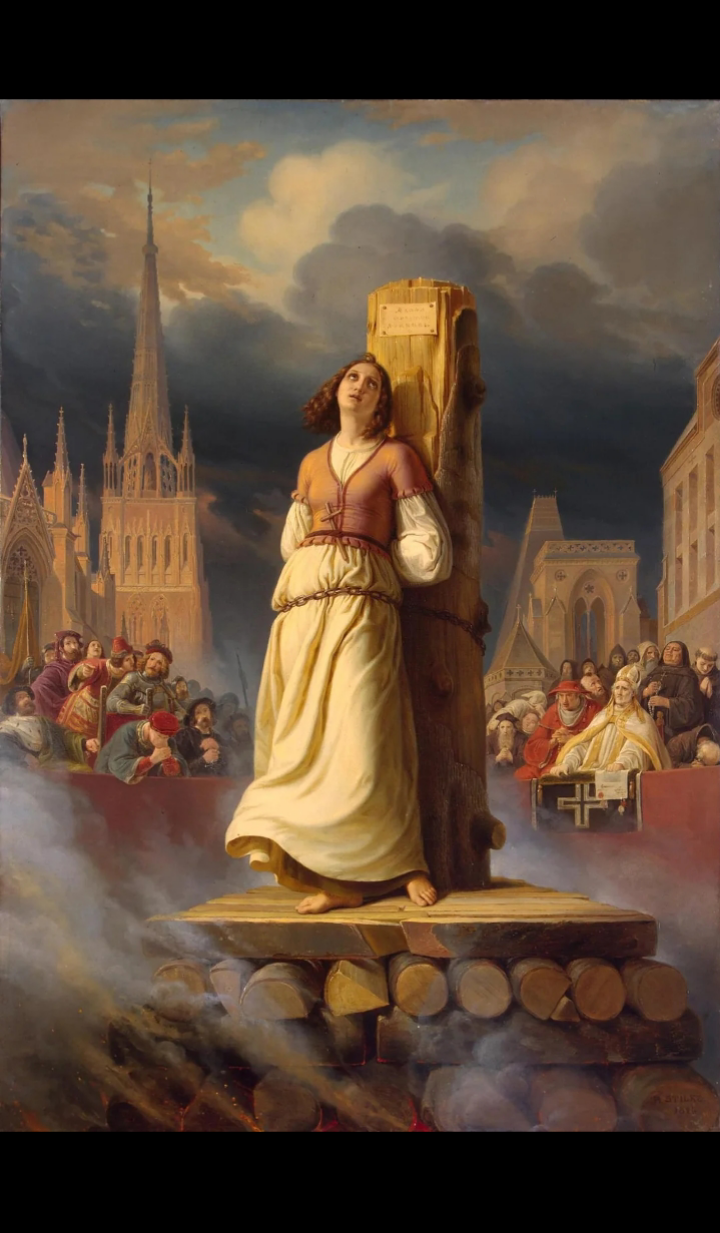
When she was captured outside Compiègne, the Burgundians held a bargaining chip. The English, desperate to discredit the idea that God favored the French king, were eager to get their hands on her. They paid the Burgundians to transfer Joan to English custody. She was taken to Rouen, tried by a church court dominated by pro-English clergy, and condemned as a heretic and relapsed offender. She was burned on 30 May 1431.
What did Charles do in that time? Publicly, very little. There is no record of a serious royal attempt to ransom her. No dramatic embassy. No military rescue. Some historians think quiet feelers may have been put out, but if so, they went nowhere and were not pressed.
Why? Because from a cold political perspective, Charles had more to lose than to gain. If he intervened strongly, he would be admitting that this accused heretic was his agent. If he failed, he would look weak. If he succeeded, he would bring back a woman the English and their clerical allies had branded a witch and blasphemer. That could stain his own legitimacy.
By staying silent, he let his enemies take the risk. The English burned Joan to discredit Charles’s divine narrative. In the short term, that seemed to work. In the long term, it backfired badly, but Charles could not see that future in 1430.
Joan’s outcome was martyrdom. Charles’s outcome was survival and, eventually, victory. By the end of his reign in 1461, the English had been driven from all of France except Calais. He had reformed parts of his administration and army, and his kingship looked solid. He did that without Joan, and without ever publicly tying himself to her memory during his lifetime.
So what? Once Joan had delivered the coronation, Charles calculated that saving her brought more diplomatic risk than strategic gain, so her death became, for him, an acceptable loss in a long war he still needed to win.
Why didn’t Charles VII rescue Joan of Arc? The political logic
This is the core question people ask: why didn’t he try harder?
Historians usually point to four overlapping reasons: political risk, legal cover, personal distance, and sheer habit of caution.
Political risk. In 1430–1431, Charles was still not secure. Large parts of northern France were under English or Burgundian control. Paris was lost. The University of Paris, a major theological authority, leaned toward the Anglo-Burgundian side. If Charles loudly defended Joan, he would be picking a fight not just with the English crown but with influential churchmen who were about to brand her a heretic.
A king defending an alleged heretic could himself be tainted. Heresy trials were not just about theology. They were political weapons. Charles had spent his youth watching how quickly reputations and legal statuses could be destroyed. He had been declared illegitimate by treaty. He was not eager to hand his enemies a new line of attack.
Legal cover. Joan’s trial was run by Bishop Pierre Cauchon, a French bishop loyal to the English, under the authority of an ecclesiastical court. That gave everyone a fig leaf. This was, formally, a church matter. Secular rulers were not supposed to interfere directly in church trials. Of course, they did all the time when it suited them, but the existence of a church court gave Charles an excuse to stay out. He could say, in effect, that the case was in God’s hands, via the Church.
Personal distance. The popular image is that Charles and Joan were close allies, even friends. The sources do not really support that. They met. They worked together. He listened to her when she was useful and ignored her when she was not. After Reims, he began to sideline her. By 1430, she was operating with less direct royal backing, taking risks that did not always align with his plans.
When she was captured, she was not a central figure at court. That made it easier to let her go. She was, in the eyes of many courtiers, a dangerous symbol: a lowborn girl claiming direct access to God, criticizing the sins of the great, and pushing for constant war. That kind of figure makes bureaucrats and nobles nervous.
Habit of caution. Charles’s entire political personality had been shaped by fear of overreach. He had seen his father’s authority crumble. He had seen bold French offensives end in disaster. His own survival had depended on retreat, compromise, and waiting for better moments. Not rescuing Joan fit that pattern. It was the safer, quieter choice.
None of this makes his inaction morally attractive. Even some of his contemporaries seem to have been uneasy about it. But it does make it understandable within his logic. He was not a romantic hero. He was a survivor.
So what? Charles’s failure to save Joan was not simple ingratitude or stupidity, it was a calculated non-action rooted in his fear of heresy politics, his tenuous position, and his own cautious character, which shaped the kind of king he became.
Legacy: Joan the saint, Charles the survivor
Here is where their stories finally diverge completely.
Joan died in 1431 as a condemned heretic, mocked and feared by her enemies. Yet within a generation, the political weather shifted. The English position in France collapsed. Charles VII’s armies retook Normandy and Guyenne. The French crown, now secure, had an interest in revisiting the trial that had branded the king’s former helper a heretic.
In the 1450s, under Charles VII, a rehabilitation process began. Witnesses from Joan’s life and trial were questioned. In 1456, a papal court formally annulled the verdict against her. She was declared innocent and her trial was denounced as corrupt and politically motivated. This was not pure piety. It was also propaganda. By clearing Joan, the French crown could retroactively claim that God really had favored Charles, and that the English had murdered a holy woman.
So the same king who had not saved her in 1431 allowed her name to be cleaned in 1456. That is the pattern again: avoid risk when weak, embrace the symbol when strong.
Over the centuries, Joan’s reputation only grew. She became a national heroine, a symbol of resistance, faith, and French identity. In 1920, the Catholic Church canonized her as a saint. Today she is one of the most famous figures of the Middle Ages. Her burning is remembered as a crime. Her courage is celebrated across political and religious lines.
Charles VII’s legacy is quieter. He is remembered by specialists as the king who, after a miserable start, presided over the recovery of France. He reorganized taxation, supported the creation of a more permanent royal army, and saw the English pushed back to the Channel coast. He is sometimes called “Charles the Victorious.” But he does not live in popular memory the way Joan does.
When people ask “Why didn’t Charles VII try to save Joan of Arc?” they are, in a way, passing judgment on his legacy. They instinctively side with the teenager who risked everything, not the middle-aged king who played it safe. History has rewarded Joan’s moral clarity more than Charles’s political caution.
Yet their legacies are entangled. Without Charles, Joan’s mission would have had no crown to validate. Without Joan, Charles might never have reached Reims. His silence helped kill her. His later rehabilitation helped sanctify her. They needed each other, and they also used each other.
So what? Joan’s rise as a sainted national icon and Charles’s quieter reputation as a cautious restorer of the monarchy show that moral courage and political calculation age very differently in memory, even when they once marched under the same banner.
Why it still matters: gratitude, power, and expendable heroes
The question behind that Reddit thread is not just about one medieval king. It is about how power treats the people who save it.
Joan of Arc is a clear example of a pattern that repeats across history. Outsiders with vision and bravery help a regime survive a crisis. Once the crisis passes, those same figures become awkward, even dangerous. They remind everyone that the rulers once needed help. They claim a direct link to ideals or to God that can compete with official authority. So they are sidelined, discredited, or, in Joan’s case, abandoned.
Charles VII’s choice not to save Joan shows how gratitude often loses to calculation in high politics. He did not forget what she had done. He simply weighed it against what he thought he might lose by defending her and chose his crown over her life.
That is why the story still bites. It forces a hard question: when we praise heroic individuals who “save” nations or institutions, what happens to them once they are no longer useful? Joan’s ashes in Rouen and Charles’s quiet survival in Bourges and beyond are two sides of that answer.
So when people ask why Charles VII did not try to save Joan of Arc, they are noticing a crack between ideals and reality that has never really closed.
So what? The contrast between Joan’s sacrifice and Charles’s caution keeps this 15th‑century story alive as a sharp reminder that power often treats its bravest defenders as expendable once their work is done.
Frequently Asked Questions
Did Charles VII try to ransom Joan of Arc?
There is no solid evidence that Charles VII made a serious attempt to ransom Joan of Arc. Under medieval custom, a prisoner like Joan could be ransomed, but the Burgundians sold her to the English instead. If any quiet approaches were made on Charles’s behalf, they were weak and quickly abandoned. Most historians agree that he chose not to press the issue.
Could Charles VII have saved Joan of Arc if he wanted to?
He probably could not have guaranteed her rescue, but he could have tried harder. Charles might have offered a large ransom, applied diplomatic pressure on Burgundy, or publicly protested her trial. None of that would have ensured success, since the English were determined to destroy her, but his near-total silence removed any chance that royal pressure might change her fate.
Why did the English execute Joan of Arc?
The English executed Joan of Arc in 1431 after a church court in Rouen convicted her of heresy and of relapsing into her alleged errors. Politically, they wanted to discredit her claim that God supported Charles VII. If she was a heretic or witch, then her victories and the coronation at Reims could be portrayed as demonic trickery rather than divine favor for the French king.
How did Charles VII treat Joan of Arc’s memory later?
During his lifetime, Charles VII did not publicly honor Joan of Arc. He kept his distance from her memory while his position was still fragile. Only in the 1450s, when France was more secure, did he allow and support a rehabilitation inquiry into her trial. In 1456, a papal court annulled her condemnation, which helped strengthen the story that God had truly favored Charles’s cause.