Imagine waking up one morning in the year 536 and realizing the sun has gone wrong.
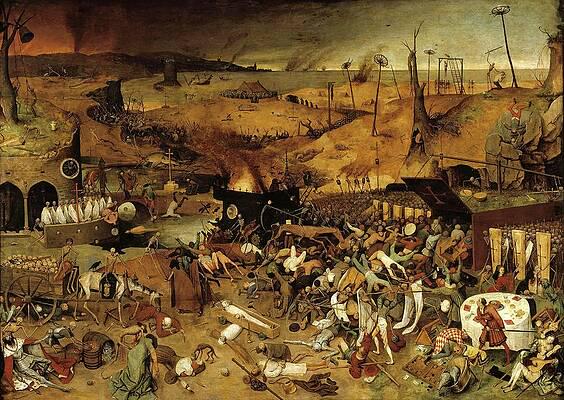
Not gone, exactly. Still there. But dim, weak, a pale disc in a gray sky that never quite turns bright. Days feel like a permanent late afternoon. The air is cold, the seasons are off, and the harvests fail. People start to wonder if God has abandoned the world.
That is what several writers from late antiquity described. Modern scientists now argue that 536 AD may have been the single worst year to be alive in recorded history. A mysterious atmospheric event dimmed the sun, triggered a sharp global cooling, wrecked crops, and helped set up one of the deadliest pandemics ever recorded: the Justinianic Plague.
By the end of this story, you will see why a foggy year in late antiquity still shapes how we think about climate, pandemics, and the fragility of complex societies.
What was the “worst year” event of 536 AD?
When historians talk about 536 as the “worst year in history,” they are referring to a cluster of events that began that year and unfolded over roughly a decade.
In 536 AD, much of the Northern Hemisphere experienced an unexplained dimming of the sun. Contemporary writers in the Mediterranean, Middle East, and Asia describe a strange, hazy sky and a sun that gave light but little warmth. This atmospheric veil lasted more than a year in some regions.
That dimming coincided with a sharp drop in temperatures, failed harvests, and widespread famine. Scientific evidence from tree rings and ice cores backs this up: the mid-sixth century saw one of the coldest decades of the last 2,000 years in the Northern Hemisphere.
Historians now group 536 and the years that followed into what some call the “Late Antique Little Ice Age.” It was a period of abrupt climate cooling, repeated volcanic eruptions, and social stress that hit the Eastern Roman (Byzantine) Empire, Sasanian Persia, and many other societies across Eurasia.
This matters because “the worst year” was not just a bad winter. It was the start of a climate shock that helped weaken empires, deepen famines, and set the stage for one of history’s first recorded bubonic plague pandemics.
What set it off? The mysterious fog and volcanic eruptions
People at the time had no idea what caused the dim sun of 536. They reached for the language they had: omens, divine anger, cosmic disorder.
The historian Procopius, writing in Constantinople, described it like this: the sun “gave forth its light without brightness, like the moon, during the whole year.” Cassiodorus, a Roman statesman in Italy, wrote that the sunlight was weak, the sky colorless, and the cold unseasonal, as if “summer had been defeated by winter.”
For centuries, these accounts sounded like exaggerations. Then scientists started drilling ice cores from Greenland and Antarctica.
In those ice cores, researchers found layers rich in volcanic sulphate dated to 536, 540, and 547 AD. These are chemical fingerprints of large volcanic eruptions that blasted ash and aerosols high into the stratosphere. Up there, particles can spread around the globe and reflect sunlight back into space, cooling the planet for a year or more.
Tree-ring data from Europe, Asia, and North America show stunted growth starting in 536 and continuing through the 540s. That is what you would expect if summers suddenly became shorter and colder.
Which volcano blew? That is still debated. Candidates include eruptions in North America, Iceland, and possibly the tropics. Some scientists suggest a major eruption in 536 followed by another in 540, a one-two punch that deepened and prolonged the cooling. Others argue for a tropical volcano because the effects were so widespread. No single site has been definitively proven.
What is clear is the mechanism. A massive volcanic eruption, or more than one, hurled material into the upper atmosphere. That created the “mysterious fog” described by Procopius and Cassiodorus, dimmed the sun, and dropped temperatures across the Northern Hemisphere.
The significance is simple: a natural event far from imperial capitals altered the climate on a continental scale and set off a chain reaction that human societies could not control.
How did cooling turn into famine and social crisis?
A drop of 2 to 2.5 degrees Celsius does not sound like much on paper. On the ground, in a pre-industrial world, it was brutal.
Most people in 536 lived by farming. Yields were already at the mercy of weather. A shorter, colder growing season meant crops did not ripen, or ripened poorly. In some places, snow and frost came at the wrong time. In others, rains failed.
Written sources tell us that harvests failed across large parts of Europe and Asia. Irish annals mention “a failure of bread” in 536 and 539. In the Eastern Mediterranean and Middle East, chroniclers report hunger and high grain prices. In the Byzantine Empire, where the state tried to regulate grain supplies, the strain showed up in tax complaints and local unrest.
Famine is never just about weather. It is about distribution, storage, and power. In the 530s, the Eastern Roman Empire was already stretched. Emperor Justinian I was fighting expensive wars in Italy and North Africa to reconquer lost western territories. Those campaigns demanded men, money, and food.
When harvests failed, the empire had fewer reserves to draw on. Peasants who lost their crops could not pay taxes. Armies in the field needed grain that local communities could barely spare. In regions without strong state structures, local elites hoarded food or used scarcity to tighten control over tenants and laborers.
In cities, food shortages translated into unrest. In the countryside, they meant migration, banditry, and quiet demographic decline. Malnutrition weakened immune systems. Diseases that people might normally survive became more deadly.
China, too, recorded strange phenomena and famines around this period. The Northern Wei dynasty had already fractured, and climate stress did not help. While the exact timing and severity differ by region, the pattern is familiar: bad weather, bad harvests, hungry people, political strain.
The so what: climate cooling in 536 did not just make people cold. It exposed how fragile food systems were and pushed already stressed societies closer to the edge.
From hunger to plague: how did the Justinianic Plague emerge?
Five years after the dim sun of 536, another disaster hit: plague.
In 541 AD, a deadly disease appeared in the Egyptian port of Pelusium, at the eastern edge of the Nile Delta. From there it spread along trade routes to Alexandria, then north to Constantinople, and then across the Mediterranean and beyond. This is what historians call the Justinianic Plague, after Emperor Justinian I, who ruled the Eastern Roman Empire at the time.
Most scholars agree this was bubonic plague, caused by the bacterium Yersinia pestis, the same pathogen behind the Black Death of the 14th century. Victims developed swollen lymph nodes (buboes), fever, and delirium. Many died within days.
Procopius, who had already described the strange sun, now described a city overwhelmed by death. He claimed that at the height of the epidemic in Constantinople, thousands died each day. We cannot verify his numbers, but the scale was clearly enormous. Some modern estimates suggest that the first wave of the Justinianic Plague may have killed between 30 and 50 million people across the Mediterranean world and beyond, perhaps a third or more of the population in some regions.
So how does this connect to 536?
Bubonic plague is a zoonotic disease. It circulates in rodent populations, especially in wild rodents like gerbils and marmots in Central Asia. Fleas carry the bacterium from rodents to humans. Human trade networks then move infected fleas and rats into new areas.
Climate and famine do not create plague out of nothing. But they can change how humans and animals interact. When harvests fail, grain stores shrink. Rats and other rodents search more aggressively for food, moving into closer contact with humans. Malnourished people are more vulnerable to infection. Crowded, stressed cities become perfect breeding grounds for disease.
Some scientists argue that the climate shifts of the 530s and 540s may have altered rodent populations in Central Asia, pushing plague reservoirs into new patterns. Others are more cautious. What is clear is that the mid-sixth century combined three things: dense trade networks, stressed food systems, and a weakened population.
That combination turned an outbreak into a pandemic.
The so what: the Justinianic Plague shows how environmental shock, economic strain, and global connectivity can turn a local disease into a civilization-scale crisis.
Who were the key figures living through 536 and its aftermath?
No single person “drove” the disaster of 536. It was mostly a story of geology and germs. But some human figures shaped how societies responded.
Justinian I (r. 527–565) was the emperor of the Eastern Roman Empire during the crisis. He was ambitious, determined to restore Roman control over the western Mediterranean. His generals Belisarius and Narses had early successes in North Africa and Italy.
Then came the climate shock, then plague. Justinian himself caught the disease in 542 and survived. His empire did not bounce back so easily. Tax revenues collapsed as populations fell. Military campaigns stalled. The state tried to regulate burials and grain prices, but its capacity was eroding.
Justinian’s legal and architectural projects, like the codification of Roman law and the construction of Hagia Sophia, often get the spotlight. The darker side of his reign is that his expansionist wars and heavy taxation left the empire less able to absorb environmental and epidemiological shocks.
Procopius of Caesarea, a lawyer and historian, is our main narrative source. He wrote about the wars of Justinian, the strange sun of 536, and the plague. He also wrote a bitter secret work, the “Anecdota” or “Secret History,” attacking Justinian and his wife Theodora as corrupt and demonic.
Procopius was not an objective reporter. He had grudges and agendas. But without him, we would know far less about how the disasters of the 530s and 540s looked from inside the imperial court.
Cassiodorus, a Roman aristocrat and official serving the Ostrogothic kings in Italy, left letters and state documents that mention the dim sun and strange weather. He tried to interpret these events within a Christian framework, as signs in a world under God’s control.
On the scientific side, the “protagonists” are anonymous: the geologists, dendrochronologists, and climate historians of the late 20th and early 21st centuries who stitched together ice cores, tree rings, and old texts to reconstruct what happened.
The so what: these figures show how leaders and observers tried, and often failed, to manage a crisis that was bigger than any one empire or ideology.
What did 536 and the Justinianic Plague change?
Disasters do not automatically cause the fall of empires. But they can tilt the balance.
For the Eastern Roman Empire, the mid-sixth century was a turning point. Justinian’s wars had stretched resources. The climate shock and plague cut population, tax revenue, and military manpower. The empire held on, but it emerged weaker.
In Italy, the Gothic War dragged on for nearly two decades. The combination of warfare, famine, and disease devastated the peninsula. When the Lombards invaded in 568, they found a fractured, depopulated land. Roman authority in the West shrank further.
In the eastern provinces, especially in Syria and Egypt, the plague and economic strain eroded local resilience. When the Sasanian Persians and then the early Islamic armies challenged Byzantine control in the 7th century, they were pushing against societies that had already been battered for generations.
Some historians argue that the mid-sixth century disasters helped accelerate Europe’s slide into what older textbooks called the “Dark Ages”: a period of smaller cities, reduced long-distance trade, and more localized power. That term is loaded and oversimplified, but there is no question that the economic and demographic hit was severe.
Beyond the Mediterranean, the story is patchier. There is evidence of social change and political realignment in Scandinavia, the British Isles, and Central Asia around this time. Some scholars link the climate shock to migrations and mythic memories of a “Fimbulwinter” in Norse tradition, a long winter before the end of the world. The connections are suggestive, but not all are proven.
On a longer timescale, the Justinianic Plague did not vanish after one wave. It recurred in outbreaks for two centuries. That repeated hammering likely kept populations lower than they would otherwise have been, slowing urban recovery and state consolidation.
The so what: 536 and its aftermath did not single-handedly create the medieval world, but they helped close the chapter on the ancient Mediterranean order and made later political and religious shifts easier to achieve.
Why does 536 AD still matter today?
Calling 536 “the worst year in history” is a bit of a stunt. It invites arguments. What about 1348, when the Black Death ravaged Europe? What about 1914 or 1918, with world war and flu? What about 1943 in the middle of the Second World War, or 2020 with COVID-19?
The point is not to crown a winner in the misery Olympics. It is to see patterns.
The 536 crisis shows how a sudden climate shock can ripple through food systems, politics, and health. It shows how global connections, which bring trade and wealth, also move pathogens. It shows that societies already under strain are more likely to break when nature throws a punch.
Modern science gives us tools people in 536 could not imagine. Satellites track volcanic plumes. Public health systems monitor outbreaks. We understand bacteria and viruses. We can, in theory, store food and coordinate responses on a global scale.
Yet the COVID-19 pandemic reminded the world that we are still vulnerable to disease, misinformation, and political short-termism. Climate change is not a single volcanic eruption, but it is a long, human-driven alteration of the same basic system: the air, the oceans, the energy balance of the planet.
Studying 536 does not give us a script for the future. It gives us a warning: when environmental stress, inequality, and disease collide, the damage is not just measured in bodies. It reshapes economies, empires, and the stories people tell about their gods and their rulers.
That is why a dim sun in late antiquity still matters. It reminds us that history’s worst years are rarely accidents. They are collisions between nature’s power and human choices.
Frequently Asked Questions
Why do historians call 536 AD the worst year in history?
Many historians single out 536 AD because written sources and scientific evidence show a sudden dimming of the sun, sharp global cooling, failed harvests, and famine across large parts of the Northern Hemisphere. This climate shock began a decade of cold known as the Late Antique Little Ice Age and helped set the conditions for the Justinianic Plague, one of the deadliest pandemics in history.
What caused the mysterious fog and darkened sun in 536 AD?
The “mysterious fog” described by writers like Procopius and Cassiodorus was likely caused by a massive volcanic eruption, or a series of eruptions, that injected ash and sulphate aerosols into the stratosphere. These particles reflected sunlight and dimmed the sun for more than a year in some regions. Ice cores from Greenland and Antarctica show large volcanic sulphate deposits dated to 536, 540, and 547 AD, which match the historical reports of darkened skies and cooling.
How is the year 536 related to the Justinianic Plague?
The climate shock of 536 did not directly create the Justinianic Plague, which was caused by the bacterium Yersinia pestis. However, the cooling and resulting famines weakened populations, disrupted economies, and altered human–animal contact patterns. When plague emerged in 541 AD, starting in Egypt and spreading across the Mediterranean, it hit societies already stressed by hunger and war, making the pandemic more devastating.
Did the disasters of 536 cause the fall of the Roman Empire?
The Western Roman Empire had already fallen by 476 AD, decades before 536. The Eastern Roman (Byzantine) Empire survived, but the climate shock and Justinianic Plague badly damaged its population, finances, and military strength. These disasters did not directly “cause” the empire’s decline, but they weakened it and made it harder to sustain Justinian’s expansionist wars, contributing to long-term shifts in power around the Mediterranean.