In the photo, the North Vietnamese officer is laughing.
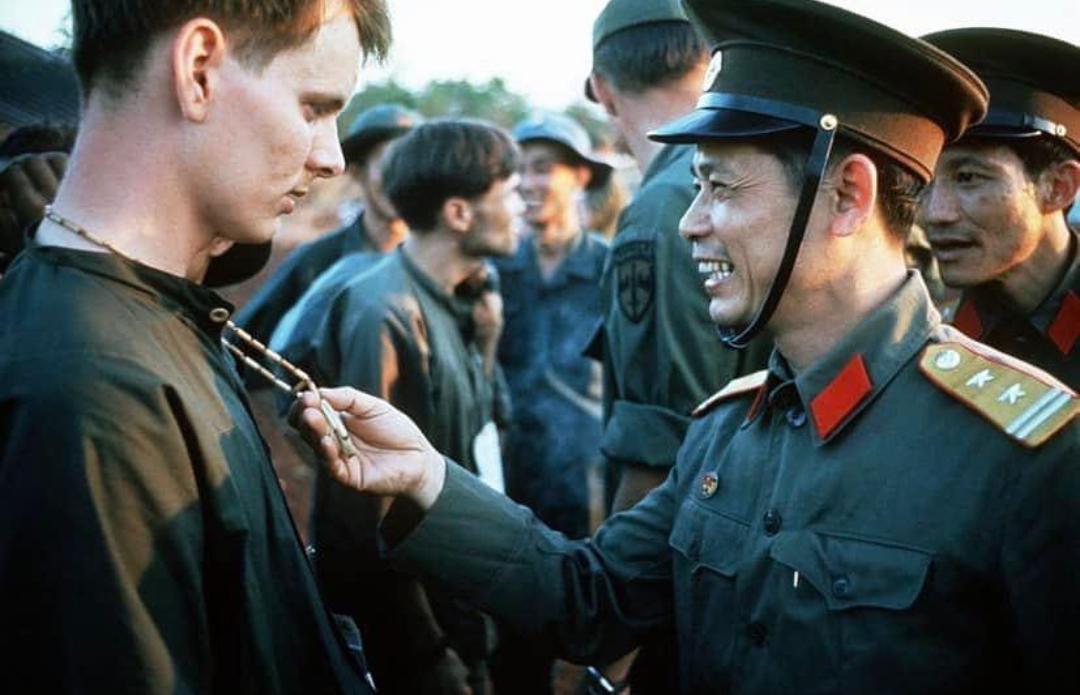
He is looking at a captured American soldier, a prisoner of war in 1973, and at the small peace symbol hanging from the man’s neck. The officer’s uniform is pressed. The prisoner’s is not. One has the gun. The other has the necklace.
It is a perfect Vietnam War irony. The American soldier wears the symbol of a movement that wanted him out of that country. The North Vietnamese officer, who has spent years fighting to drive Americans away, finds the whole thing funny.
The image is from 1973, the year the Paris Peace Accords were signed and American POWs began to go home. By then, more than 58,000 Americans and hundreds of thousands of Vietnamese were dead. The United States had spent well over $100 billion. Saigon would fall two years later anyway.
So the natural counterfactual question hangs over that peace necklace: what if the Vietnam War had ended earlier? What if the peace symbol had matched the reality?
Counterfactual history is not fantasy. Done right, it asks “what if” while staying chained to real constraints: budgets, public opinion, geography, logistics, the actual people in charge. Here, we will walk through three grounded scenarios for an earlier end to the Vietnam War, then weigh which one comes closest to something that could have happened.
Why the Vietnam War dragged on until 1973
The Vietnam War lasted as long as it did because Washington and Hanoi were locked into political goals that did not match the military reality on the ground.
By 1965, when President Lyndon Johnson sent in combat troops and began Operation Rolling Thunder, the basic structure of the conflict was set. North Vietnam, led by Ho Chi Minh and later Le Duan, wanted national unification under a communist government. South Vietnam’s government wanted to survive. The United States wanted to prevent another country from going communist, in line with its Cold War “domino theory.”
American leaders thought massive firepower and economic aid could prop up South Vietnam long enough to force Hanoi to back down. North Vietnamese leaders thought they could outlast American patience, just as they had outlasted the French. Both sides misread the other.
By 1968, the Tet Offensive shattered the illusion of quick victory. The communists suffered heavy losses, but the offensive exposed that they could hit cities and bases across South Vietnam. American public support plunged. Walter Cronkite went on television and said the war looked like a stalemate. Johnson decided not to run for re-election.
Yet the war did not end. Richard Nixon campaigned in 1968 with a promise of “peace with honor.” He expanded the war into Cambodia and Laos, then began “Vietnamization,” pulling out American troops while training and arming South Vietnamese forces. Peace talks in Paris dragged on for years over issues like a ceasefire line, the future of South Vietnam’s government, and the presence of North Vietnamese troops in the South.
The Paris Peace Accords were finally signed in January 1973. American POWs, like the man in the photo with the peace necklace, were released. U.S. combat troops left. But North Vietnamese units stayed in the South, and the fighting between North and South continued. In April 1975, Saigon fell. The war’s political outcome was the one Hanoi had wanted from the start.
The war dragged on because both sides tried to square a circle: Washington wanted to leave without “losing,” and Hanoi wanted unification on its terms. Neither aim fit the battlefield realities, so the killing continued.
That mismatch between goals and reality is the starting point for any serious “what if” about an earlier end to the war.
Scenario 1: No major escalation in 1965
In this scenario, Lyndon Johnson never takes the big step. No large-scale combat deployment in 1965. No long bombing campaign like Rolling Thunder. The United States stays in an advisory and aid role, as it had under Eisenhower and Kennedy, and keeps the footprint relatively small.
This is not wild speculation. In early 1965, Johnson’s advisers were split. Some, like Undersecretary of State George Ball, warned that a big commitment would be a trap. The Joint Chiefs wanted more troops, but there was no iron law saying Johnson had to send them. He worried constantly about his Great Society domestic agenda and feared Vietnam would wreck it.
If Johnson had decided to cap U.S. involvement at, say, 50,000 advisers and support troops, several things follow.
First, South Vietnam’s government would probably have continued to wobble. The Saigon regime was plagued by coups, corruption, and low legitimacy. Without hundreds of thousands of American troops and massive air support, the Army of the Republic of Vietnam (ARVN) would have faced an even tougher fight against the Viet Cong and North Vietnamese units infiltrating down the Ho Chi Minh Trail.
Second, North Vietnam and the National Liberation Front (the Viet Cong’s political arm) would likely have pushed harder, sensing an easier path. But they would still have faced U.S. airpower used more selectively and a stream of American money and equipment into the South.
The likeliest outcome is not a stable, democratic South Vietnam. It is a drawn-out, lower-intensity civil war, with the U.S. playing something like the role the Soviets played in Afghanistan in the 1980s: lots of aid, limited personnel, and constant frustration.
Could Saigon have survived long term under those conditions? Possibly, but the odds are not great. The communists had deeper rural networks and a clearer political project. ARVN could fight, but it depended heavily on U.S. support for logistics, air cover, and morale. Without the giant American build-up, the South might have collapsed earlier, perhaps in the late 1960s.
So what would have changed? The war would have been shorter for Americans, with far fewer U.S. dead and less domestic trauma. There might have been no draft crisis on the same scale, no giant antiwar movement, and no 1968-style political meltdown. For Vietnam, though, the end state might have looked similar: communist victory, but sooner and after a civil war that was more Vietnamese and less American.
So what? An early decision not to escalate in 1965 could have spared the United States years of blood and political division, but it probably would not have saved South Vietnam as a separate state.
Scenario 2: A negotiated settlement after Tet 1968
Another plausible exit ramp came after the Tet Offensive in early 1968. Tet was a military setback for the communists but a political shock for the United States. It punctured the idea that victory was near. It also opened a window for a different kind of decision.
By mid-1968, Johnson had halted most bombing of North Vietnam and opened talks in Paris. He had also announced he would not run for re-election. Inside the administration, some advisers argued that the United States should use Tet as a reason to change course, accept that South Vietnam might not survive in its current form, and negotiate hard for a coalition government or neutralization.
What would that have looked like in practice?
Imagine Washington going to Saigon’s leaders and saying, bluntly: we will not support an indefinite war. We are ready to accept a political settlement that includes the National Liberation Front in a coalition government, perhaps with international guarantees from powers like the Soviet Union, China, and France. In return, North Vietnam agrees to stop sending regular units into the South and to respect some kind of demilitarized zone.
This would have been a bitter pill for South Vietnam’s President Nguyen Van Thieu, who distrusted any deal that put communists in his government. It also would have been hard to sell in American politics in 1968, an election year when Nixon was promising “peace with honor” and Hubert Humphrey was trying to hold together a fractured Democratic Party.
But it is not impossible. The United States had accepted coalition or neutralized outcomes elsewhere, like in Laos in 1962 and Austria in 1955. The key question is whether Hanoi would have agreed.
After Tet, North Vietnam was battered but not broken. Some leaders, especially Ho Chi Minh and General Vo Nguyen Giap, were more cautious, worried about losses. Others, like Le Duan, pushed for continued offensive pressure. A serious American offer in 1968 that included a clear timetable for withdrawal and acceptance of the NLF as a political actor might have strengthened the more cautious faction in Hanoi.
The result could have been a 1969 or 1970 peace deal that looked somewhat like the 1973 Paris Accords, but with fewer dead and less destruction. U.S. troops would have left earlier. POWs, including the man in the photo with the peace necklace, might have gone home years sooner. South Vietnam might have entered a messy coalition period, with the NLF gaining legal political space.
Would that coalition have survived? History suggests it would have been fragile. In Laos, coalition arrangements repeatedly collapsed. Given the balance of forces, the communists in Vietnam would still have had a strong incentive to push for full control once U.S. troops were gone.
So what? A serious push for a negotiated settlement right after Tet could have shortened the American phase of the war and reduced casualties on all sides, but it probably would have delayed, not prevented, communist unification.
Scenario 3: Nixon accepts a face-saving withdrawal in 1969–70
The third scenario focuses on Richard Nixon and his National Security Adviser, Henry Kissinger. When Nixon took office in January 1969, there were about 540,000 U.S. troops in Vietnam. He inherited an unpopular war and a public that was losing patience.
In our timeline, Nixon tried to thread a needle. He began withdrawing troops and training ARVN, but he also widened the war into Cambodia and Laos and kept bombing to pressure Hanoi. He wanted to avoid the image of “cutting and running.”
But Nixon had another option. He could have treated Vietnam as a sunk cost and moved quickly to a face-saving withdrawal, using his political capital as a new president to argue that the war was a mistake he would not prolong.
Imagine Nixon in 1969 announcing a firm timetable: U.S. combat troops out within 18 months, air support tapering off, and a shift to economic aid and diplomatic backing for Saigon. At the same time, he could have opened secret talks with Hanoi, as he did in reality, but with a different bottom line: the United States would not insist on North Vietnamese withdrawal from the South as a precondition. Washington would focus on POW release and safe withdrawal.
This would have meant swallowing the risk, and likelihood, that South Vietnam might fall after American departure. Nixon feared exactly that outcome, both for Cold War credibility and for his own political reputation. But he also had something he later used in other contexts: the ability to reframe a setback as part of a larger strategy.
Nixon and Kissinger were already thinking about opening to China and pursuing détente with the Soviet Union. They could have argued that ending the Vietnam War quickly was necessary to realign U.S. foreign policy for a new era. In private, they might have accepted that Saigon’s survival was doubtful.
What happens then? U.S. casualties drop sharply after 1970. The antiwar movement loses some of its fuel. The Cambodian and Laotian bombings either never happen or are far more limited, sparing those countries some of the devastation that fed the rise of the Khmer Rouge.
South Vietnam, deprived of years of extra American support, likely faces a major offensive from the North earlier than 1975. Without the massive U.S. air intervention that helped beat back the Easter Offensive in 1972 in our timeline, ARVN might crack sooner. Saigon could fall in the early 1970s instead of 1975.
From Hanoi’s perspective, this is still victory. From Washington’s, it is a faster amputation instead of a slow bleed. The domestic scars of Vietnam might be less deep. The image of helicopters on the embassy roof might appear in 1972 instead of 1975, but it would be attached to a war that Americans had already mentally written off.
So what? A rapid Nixon withdrawal in 1969–70 could have shortened the war, reduced regional damage, and freed U.S. attention for other Cold War moves, but it likely would have meant an even earlier fall of Saigon.
Which early-ending Vietnam War is most plausible?
All three scenarios share a hard truth: there was no tidy way for the United States to win the Vietnam War on its own terms without a far more extreme commitment, and even that might not have worked. The more realistic question is not “how could America have won,” but “how could America have left sooner and at lower cost.”
Of the three, the most plausible is Scenario 1: no massive escalation in 1965.
That choice required the fewest moving parts. It did not depend on Hanoi changing its mind, or on Saigon accepting a coalition government, or on Nixon being willing to take a political hit. It depended on one president, Lyndon Johnson, listening to the cautious voices in his own administration and deciding that Vietnam was not worth a big war.
Johnson was not blind to the risks. He worried that Vietnam would be his “Korea,” that China might intervene, that the war would wreck his domestic agenda. He also knew that the South Vietnamese government was weak. In another version of 1965, he might have decided that limited aid and advisers were the most he was willing to risk for a shaky ally.
If that had happened, the photo from 1973 might not exist. There might still have been American advisers captured, but not thousands of POWs held for years. The peace symbol necklace would not be hanging from the neck of a man who had spent long months in a North Vietnamese prison, while his captor laughed at the irony.
The other scenarios, while possible, run into bigger political and psychological walls. Johnson in 1968 was already deeply invested in the war. Nixon in 1969 was obsessed with not being the president who “lost” Vietnam. Both men were trapped by their own fears of looking weak.
That is the quiet lesson of the photo. The peace symbol around the POW’s neck reflects a movement that tried to force an earlier end to the war. The laughter of the North Vietnamese officer reflects a leadership that believed time was on its side. Between them sat American presidents and generals who could not quite bring themselves to admit that the war’s basic terms were unwinnable.
So what? The most believable early end to the Vietnam War is not a clever diplomatic trick or a dramatic battlefield victory, but a choice never to turn a messy regional conflict into a massive American war. The fact that this choice was available, and not taken, is part of why that peace necklace feels so bitterly out of place in a North Vietnamese prison yard in 1973.
Why this counterfactual still matters
Vietnam is not just history. It is a reference point that keeps coming back whenever the United States debates intervention abroad.
When American troops went into Iraq in 2003 or Afghanistan in 2001, veterans and historians immediately reached for Vietnam analogies. Questions about mission creep, weak local allies, and exit strategies sounded very familiar. The same structural problem appeared: political goals that did not match the realities on the ground.
Thinking through “what if the Vietnam War had ended earlier” is not an exercise in wishful thinking. It is a way of mapping the real choices leaders had, the trade-offs they faced, and the costs of not changing course. It reminds us that wars rarely drag on by accident. They drag on because powerful people decide that leaving is worse than staying, even when the evidence says otherwise.
The photo of the laughing officer and the POW with the peace symbol captures that gap between symbol and policy. The peace movement had a clear, simple demand: end the war. The governments in Washington and Hanoi had far more complicated, and more rigid, aims.
If any of the early-exit scenarios had happened, the world would still have had a communist Vietnam. What it might not have had is a generation of Americans shaped by a long, bitter, televised war, and a region scarred by years of bombing and invasion.
So what? The counterfactuals around Vietnam are a reminder that the real “lost cause” was not on the battlefield, but in the refusal to match ambitions to reality. That is why a single peace necklace, hanging from the neck of a captured soldier in 1973, still feels like an accusation.
Frequently Asked Questions
Could the United States have won the Vietnam War?
A clear-cut U.S. victory in Vietnam was very unlikely without an extreme escalation, such as invading North Vietnam or risking war with China. Given the strength of Vietnamese communist networks, the weakness of the South Vietnamese government, and Cold War limits, the more realistic options were different ways of limiting or ending involvement, not winning outright.
What if the U.S. had not escalated the Vietnam War in 1965?
If Lyndon Johnson had kept U.S. forces limited to advisers and support troops, the war would likely have remained a lower-intensity civil war. South Vietnam might have fallen earlier, but American casualties and domestic turmoil would probably have been far lower. The final outcome, a unified communist Vietnam, might still have occurred, just with less direct U.S. involvement.
Could the Vietnam War have ended after the Tet Offensive in 1968?
Tet opened a political window for negotiations. A bold U.S. move toward a coalition government or neutralization of South Vietnam might have produced a peace deal by 1969 or 1970. However, such a settlement would have been fragile, and the balance of power still favored an eventual communist takeover once U.S. troops left.
Why did the Paris Peace Accords not really end the Vietnam War?
The 1973 Paris Peace Accords ended direct U.S. combat involvement and led to the release of American POWs, but they did not resolve the core issue of who would rule Vietnam. North Vietnamese forces stayed in the South, and fighting between North and South Vietnam continued. Without sustained U.S. support, South Vietnam could not hold, and Saigon fell in 1975.