On a clear day in Athens in 2024, for the first time in about two centuries, people could walk around the Parthenon and see its exterior with no scaffolding at all. No cranes. No metal cages. Just the battered marble shell of a 2,460‑year‑old temple that has survived explosions, looting, conversions and pollution.
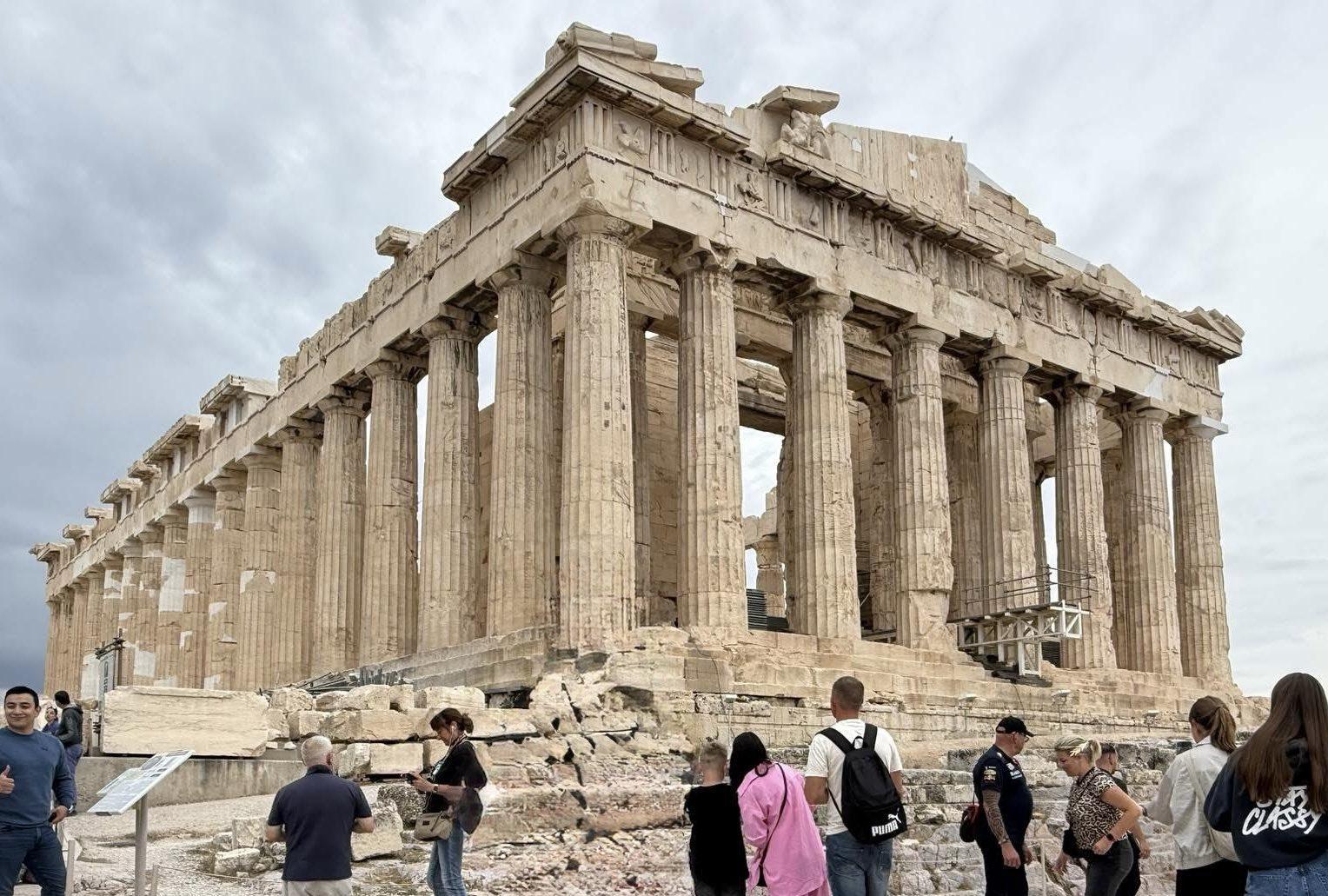
That clean view was so rare that Greeks pointed out an odd fact: at least six generations had never seen the Parthenon unobstructed. For most of modern history, the building has either been under repair or under attack.
The Parthenon today is a damaged survivor. Its roof is gone, many sculptures are missing, and huge chunks of its walls were blown out in 1687 when a Venetian mortar shell hit an Ottoman gunpowder store inside the temple. That single explosion changed what we think the Parthenon is.
So what if the explosion never happened? What if the Parthenon had survived into the 21st century almost intact, with its roof, sculptures and structure largely in place? Grounded in real politics, economics and conservation science, those alternate timelines tell us a lot about why the real Parthenon looks the way it does, and why people care so much about seeing it free of scaffolding now.
The Parthenon is a 5th‑century BCE marble temple on the Acropolis of Athens, dedicated to Athena. It has been a pagan temple, a church, a mosque, a gunpowder magazine and a ruin. Its damage was not inevitable. It was the result of specific choices in war and peace.
What actually happened to the Parthenon?
When people see the Parthenon today, they often assume they are looking at the natural decay of time. That is only part of the story.
The Parthenon was built between 447 and 432 BCE under Pericles. For nearly a thousand years it functioned as a temple with a massive gold‑and‑ivory statue of Athena inside. In late antiquity it became a Christian church. Around the 15th century, after the Ottoman conquest, it became a mosque with a minaret.
The real catastrophe came in 1687, during the Morean War. Venetian forces under Francesco Morosini besieged Ottoman‑held Athens. The Ottomans used the Parthenon as a gunpowder magazine, betting that the Europeans would not fire on an ancient monument. They guessed wrong.
On 26 September 1687 (the exact day is fairly secure in the sources), a Venetian mortar shell hit the building. The explosion blew out the center of the temple, collapsed most of the roof, and hurled marble blocks and sculptures down the Acropolis slopes. Contemporary reports describe flames and dust clouds visible for miles.
That blast turned a functioning, if altered, building into a ruin. It also scattered sculptures that would later be removed by collectors, most famously by Thomas Bruce, 7th Earl of Elgin, around 1801–1812. Elgin’s agents took about half of the surviving sculptural decoration to Britain, where it became the “Elgin Marbles” in the British Museum.
In the 19th and 20th centuries, Greek and foreign archaeologists stripped later additions, tried early restorations with iron clamps that later rusted, and then began a long, careful conservation project. Since the 1970s, scaffolding and cranes have been a near‑permanent feature as Greek teams dismantled and reassembled parts of the temple with titanium clamps and precise anastylosis.
So the Parthenon we know is the product of an explosion, imperial collecting, national archaeology and modern conservation. The 1687 blast did not just damage marble. It created a ruin that 19th‑century Europeans romanticized, a legal battleground over ownership, and a permanent construction site. That is the baseline for any “what if.”
So what? Because the Parthenon’s current state is the outcome of specific disasters and decisions, changing one of them, like the 1687 explosion, plausibly reshapes everything from Greek nationalism to museum politics.
Scenario 1: If the 1687 explosion never happened
Start with the simplest switch: the Venetian shell misses, or the Ottomans never store gunpowder in the Parthenon. The building in 1700 is still a mosque, altered but structurally sound, with roof, walls and many sculptures in place.
What does that change?
First, the physical fabric. Without the blast, the central cella walls and much of the roof survive. Many metopes and frieze blocks stay in situ. Some sculptures might still be damaged by later earthquakes or minor shelling, but the iconic “broken temple” silhouette never appears.
Second, the collecting story. Elgin’s agents in the early 1800s worked on a ruin. They could pry off fallen blocks and argue that they were “rescuing” fragments from neglect. If the Parthenon is an active mosque with a mostly intact structure, large‑scale removal becomes harder politically and logistically.
Elgin did secure firmans, or permits, from Ottoman authorities, but even those were vague. Removing major structural elements from a working religious building would have been a different order of interference. The Ottomans had reasons to cooperate with British diplomats, but they also had limits. In this scenario, Elgin might still get some loose pieces, but the majority of the sculptural program likely stays in Athens.
Third, the symbolism. When the Greek War of Independence breaks out in 1821, an intact Parthenon mosque is a more obvious symbol of Ottoman rule than a ruin. Greek fighters did besiege the Acropolis in reality. In this alternate timeline, they might damage the building in the fighting, but they also might try to capture it relatively intact to convert it into a church or national shrine.
By the time the modern Greek state is recognized in the 1830s, the new monarchy under King Otto still wants to “purify” the Acropolis of post‑classical structures. In our world, archaeologists stripped away the minaret and medieval additions from a ruin. In this world, they face a harder choice: demolish a functioning, largely intact mosque‑church hybrid to reveal the classical core, or keep some later layers.
Given 19th‑century romanticism about ancient Greece, the pressure to Hellenize the site would be intense. The Parthenon might still lose its minaret and Christian additions. Yet the demolition would be more controversial, and some parts of the interior might be preserved.
Conservation looks very different. Instead of a 20th‑century emergency project to stabilize a shattered shell, Greek authorities in the 1900s and 2000s are managing an aging but whole building. There is still scaffolding, but more like periodic maintenance on a cathedral than a century‑long rescue operation.
Tourism changes too. An intact roof and partial interior might allow controlled access inside the temple, something impossible today. The Parthenon would feel less like a ruin and more like a living monument, closer to how people experience Notre‑Dame or the Pantheon in Rome.
Finally, the politics of the marbles. If most sculptures never left Athens, there is no Elgin Marbles dispute on the current scale. The British Museum might hold a handful of pieces, but not the centerpiece of its Greek galleries. Greece’s most famous cultural dispute either never happens or is much smaller.
So what? A Parthenon that dodges the 1687 explosion is less of a romantic ruin and more of a contested, functioning building, which likely keeps more of its sculpture in Athens and shifts 200 years of museum politics and conservation from rescue to maintenance.
Scenario 2: If Elgin never removed the Parthenon Marbles
Now keep the explosion, but change the early 19th century. The Parthenon is a ruin, but Thomas Bruce never manages to remove large portions of its sculpture. Maybe the Ottoman authorities refuse, maybe Elgin’s finances collapse earlier, or maybe British public opinion turns against the project before it starts.
In this world, the Parthenon enters the age of archaeology and nationalism as a shattered but more complete ruin. The frieze, metopes and pediments are still mostly on the building or lying nearby when the Greek state is formed.
That has an immediate effect on early Greek identity. In our timeline, the new kingdom in the 1830s used the Acropolis as a symbol of rebirth, but its most famous sculptures were in London. Greek intellectuals had to argue for cultural continuity with missing pieces.
Without Elgin’s removals, Athens becomes the unrivaled center for studying classical sculpture. The first major casts and drawings of the Parthenon sculptures go out from Greece, not Britain. The British Museum still builds a classical collection, but it lacks the Parthenon as its star. The “Elgin Marbles” never become a household phrase.
Archaeological practice shifts slightly too. In the 19th century, many European powers treated Ottoman‑controlled antiquities as fair game for removal. The Elgin case gave them a precedent. If that case never happens, or is much smaller, the moral and legal argument for large‑scale removal is weaker. You do not get the same pattern of “rescue” narratives used to justify taking artifacts to London, Paris or Berlin.
Inside Greece, conservation pressures are heavier. More original sculpture left on the exposed ruin means more damage from weather and pollution. Athens in the 20th century suffered severe air pollution. Acid rain ate into marble surfaces. Greek conservators would face a harsh trade‑off: leave masterpieces in place and watch them erode, or move them into a museum and replace them with casts.
In our world, that is exactly what happened with the surviving sculptures. Many originals were moved into the Acropolis Museum, with replicas on the building. In this scenario, that process is bigger and starts earlier. By the late 20th century, the Parthenon might look even barer on the outside, but the Acropolis Museum would hold nearly the full sculptural program.
International politics change in a quieter way. There is no long‑running Greek campaign to “reunite” the marbles, because they are already in Athens. Britain avoids a very public cultural dispute that has dragged on for decades. UNESCO conferences have one less high‑profile case when they talk about repatriation.
For visitors, the experience shifts. You still see a ruin on the hill, but the story you hear is less about loss to foreign museums and more about local damage and protection. The emotional focus moves from “they took our marbles” to “we almost lost these to pollution and neglect.”
So what? A world without Elgin’s removals keeps the Parthenon’s story centered in Athens, weakens the precedent for large‑scale artifact removal, and turns modern Greek debates from repatriation toward conservation choices at home.
Scenario 3: If modern Greece never restored the Parthenon
For many people on Reddit, the surprise in 2024 was not that the Parthenon exists, but that it is almost never free of scaffolding. That raises another counterfactual: what if Greece, after independence, chose minimal intervention instead of long, intensive restoration?
In the real world, Greek authorities began serious structural work on the Parthenon in the late 19th century. Early efforts used iron clamps and concrete that later caused damage. In 1975, after worrying signs of instability, Greece launched a major, long‑term restoration program. Teams dismantled and reassembled parts of the temple, replaced corroded iron with titanium, and carefully repositioned blocks.
This kind of anastylosis is slow, expensive and visually disruptive. Cranes and scaffolding have been a near‑constant feature for decades. That is why the 2024 moment, with the exterior finally clear on all sides, felt historic.
Imagine instead that, in the 1970s, Greece decided to stabilize the worst cracks, remove dangerous pieces, then leave the ruin largely as it was. No massive dismantling. No decades‑long structural surgery.
The first consequence is structural risk. The Parthenon was not just pretty. It was heavy. The explosion, earlier earthquakes and bad 19th‑century repairs left blocks out of alignment and metal clamps rusting inside the marble. Without the modern project, some sections might have collapsed in the late 20th or early 21st century, especially under seismic stress.
So you trade scaffolding for more dramatic loss. Tourists would see fewer cranes, but also fewer columns and architraves. By 2024, the Parthenon might look more like a low, fragmented shell than a recognizable temple outline.
Tourism economics matter here. The Acropolis is one of Greece’s main attractions, feeding hotels, restaurants and airlines. The Greek state has strong incentives to keep the Parthenon visually legible. Long‑term restoration is expensive, but so is the loss of an icon.
International pressure would push toward action too. UNESCO inscribed the Acropolis as a World Heritage Site in 1987. If Greece had let the structure decay visibly, it might have faced warnings or even a place on the “in danger” list. That kind of label affects national prestige and tourist confidence.
On the other hand, a lighter‑touch approach would have preserved more of the “romantic ruin” atmosphere. Some critics argue that modern interventions, with new marble inserts and clean joints, make parts of the Parthenon look too fresh. In the low‑intervention scenario, you get more patina and less geometry.
Public perception shifts as well. Without constant scaffolding, generations of Athenians would not grow up thinking of the Parthenon as a permanent construction site. The 2024 Reddit post about a scaffold‑free exterior would not exist, because the temple would have been visually stable for decades. The trade‑off is that future generations might inherit a much smaller, more damaged ruin.
So what? A Greece that chose minimal restoration would have preserved the romantic image of a ruin in the short term, but at the likely cost of larger structural losses, a weaker tourist draw, and international criticism for letting an emblematic monument crumble.
Which alternate Parthenon is most plausible?
Of these three scenarios, which world is closest to something that could really have happened, given the constraints of war, empire and modern conservation?
The 1687 non‑explosion is the hardest to sustain. Gunpowder storage in large, solid buildings was common in early modern warfare. Venetian artillery officers knew the Ottomans used the Parthenon as a magazine. Even if one shell missed, another might have hit. Avoiding the explosion entirely would have required either different Ottoman logistics or a rare level of restraint from besieging gunners. Both are possible, but they cut against the grain of 17th‑century siege warfare.
The “no Elgin” scenario is more plausible. Elgin’s project was contingent on personal ambition, Ottoman politics and British taste. His finances were shaky. His marriage broke down. The Ottoman Empire might have refused broader permissions, or a different British ambassador might have lacked the same obsession. In that case, the marbles stay in Athens by default.
We actually have a partial real‑world test: many other major sites under Ottoman rule did not lose their primary sculptures to London. The Parthenon was unusual, not inevitable. So a world where its sculptures remained in place is easy to imagine without breaking historical logic.
The “no modern restoration” path is the least likely in the long term. By the late 20th century, Greece depended heavily on cultural tourism and was deeply invested in projecting itself as the steward of classical heritage. Once engineers raised alarms about structural risks, political leaders had strong incentives to fund restoration. International bodies like UNESCO and ICOMOS also pushed for active conservation.
There was room to debate methods, but not whether to act. A wealthy, democratic Greece that simply let the Parthenon crumble would have faced domestic outrage and international embarrassment.
So the most plausible alternate Parthenon is the one where the building is just as shattered as today, but its sculptures never left Athens. That world changes museum galleries in London, shifts the tone of Greek cultural politics, and makes the Acropolis Museum an even more dominant global destination.
That brings us back to the 2024 scaffolding‑free moment. In our reality, people were amazed to see the Parthenon unobstructed because they are used to two things: a damaged ruin and a permanent repair job. Both are the products of specific past choices. A different shell in 1687, a different British diplomat in 1801, or a different conservation plan in 1975 would have given us a very different monument to photograph.
The Parthenon is often treated as a symbol of timelessness. Its actual history, and the plausible ways it could have gone differently, show how fragile that timelessness really is.
So what? The most believable alternate Parthenon is not a pristine survivor, but a ruin whose sculptures never left Athens, a reminder that what feels “inevitable” about cultural heritage is usually the sum of very specific, very human decisions.
Frequently Asked Questions
What caused the Parthenon to be ruined in the first place?
The Parthenon was badly damaged in 1687 during a Venetian siege of Ottoman‑held Athens. The Ottomans were using the temple as a gunpowder magazine. A Venetian mortar shell hit the building, igniting the powder and causing a massive explosion that blew out much of the central structure and roof. Later looting, earthquakes, pollution and clumsy early restorations worsened the damage.
Could the Parthenon have survived intact into modern times?
Yes, it is plausible that the Parthenon could have survived in much better condition. If the Ottomans had not stored gunpowder inside, or if Venetian artillery had not scored a direct hit in 1687, the building might have kept its roof and more of its walls. It still would have aged, been altered as a church and mosque, and suffered some damage, but it could have resembled other large ancient buildings like the Pantheon in Rome more than the ruin we see today.
What would have happened if the Elgin Marbles had never left Greece?
If Thomas Bruce, Earl of Elgin, had not removed large parts of the Parthenon’s sculpture between about 1801 and 1812, those works would likely have stayed in Athens. The new Greek state would have controlled them from the 19th century onward, probably moving many indoors for protection in the 20th century. The British Museum would not have the famous “Elgin Marbles” collection, and there would be no major repatriation dispute between Greece and the United Kingdom over those pieces.
Why has the Parthenon been covered in scaffolding for so long?
Since the 1970s, Greece has run a major structural restoration program on the Parthenon. Engineers found that earlier repairs used iron clamps and concrete that were corroding and destabilizing the marble. To prevent further collapse, teams dismantled and reassembled sections with titanium clamps and precise anastylosis. This long, careful process required cranes and scaffolding, which is why several generations only knew the Parthenon as a permanent construction site.