On a gray autumn morning in 1930, a Polish customs officer near Wilno (Vilnius) checked a cart rolling in from Latvia. The border post was new, the uniforms were new, and the countries on both sides of the line were even newer. A decade earlier, this had all been the Russian Empire. Now it was a jagged patchwork of small, nervous states: Poland, Lithuania, Latvia, Estonia, and, to the south, a fragile independent Latvia and Estonia facing a Soviet colossus.
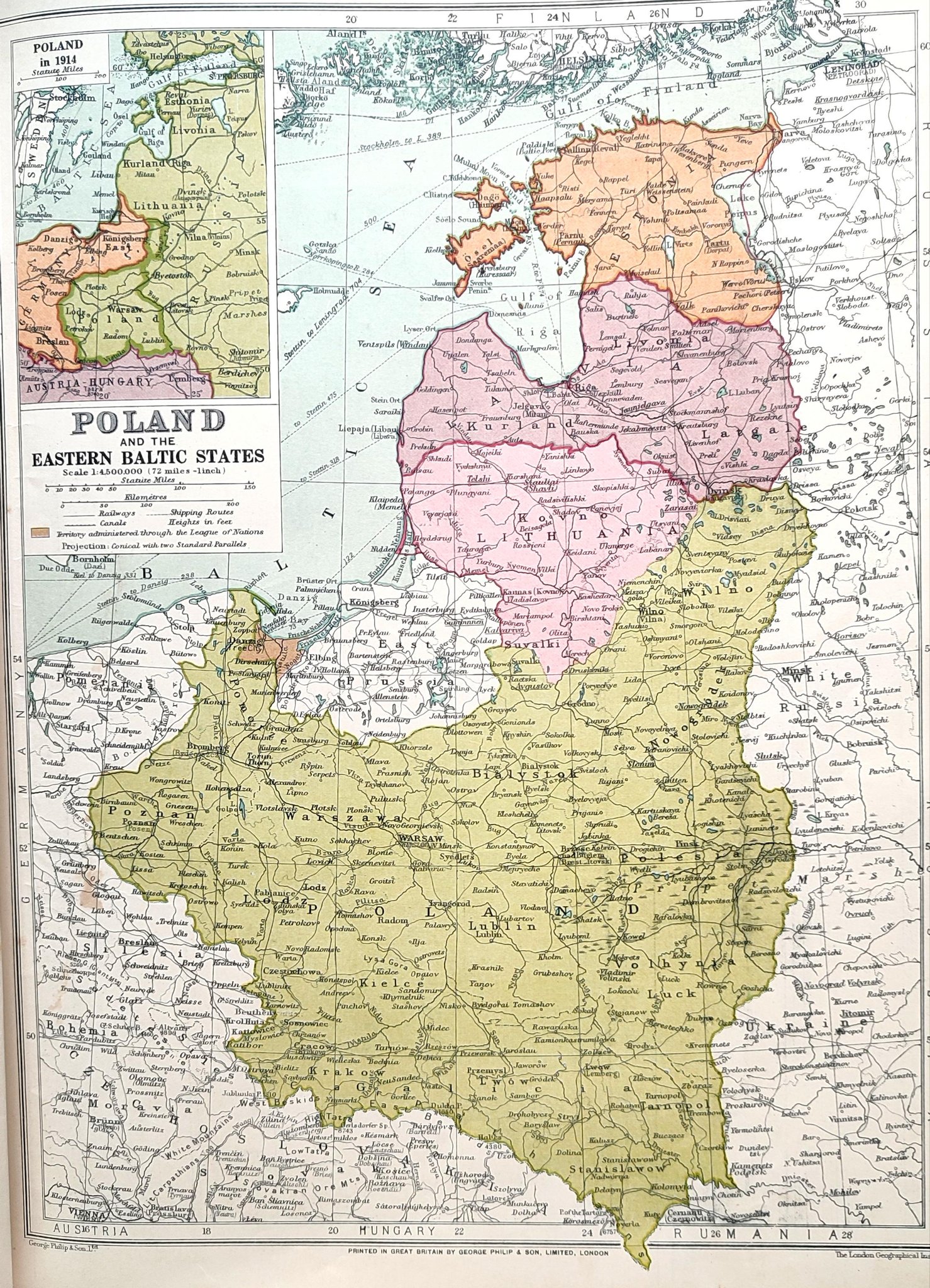
Look at a map of Poland and the eastern Baltic around 1930 and you see the problem at a glance. Poland is long and exposed, with a narrow corridor to the sea and enemies on both sides. Lithuania is sulking over Vilnius. Latvia and Estonia are thin strips of coast with almost no depth. All of them are terrified of Moscow, wary of Berlin, and suspicious of each other.
So the natural question for anyone staring at that map is: what if they had done it differently? What if Poland and the Baltic states had formed tighter unions, federations, or alliances in the interwar years? Could the map of 1930 have led to a different 1939?
Counterfactual history asks what might have happened if plausible decisions had gone another way, while keeping real-world limits in place. The goal is not fantasy cartography. It is a way to test how much room for maneuver small states actually had between Nazi Germany and the Soviet Union.
Below are three grounded scenarios, all starting from that 1930 map of Poland and the eastern Baltic, and an assessment of which one had the best shot in the real world.
How the real 1930 map boxed in Poland and the Baltics
By 1930, the borders in the eastern Baltic were mostly fixed, but the grudges were not.
Poland had reappeared in 1918 after more than a century of partition. By 1922 it had fought wars with Soviet Russia, Ukraine, and Lithuania, and had grabbed Vilnius and its region. The result was a big but awkward country of about 27 million people, with a long eastern frontier and a narrow outlet to the Baltic through the so‑called Polish Corridor. Germany hated that corridor. Lithuania broke diplomatic relations with Poland over Vilnius in 1920 and did not restore them until 1938.
To the north, three small republics hugged the Baltic coast. Lithuania had about 2.4 million people, Latvia 1.9 million, Estonia 1.1 million. All three had fought for independence between 1918 and 1920, often with German and then Allied help. All three feared a Soviet comeback. All three had sizable minorities: Germans and Russians in Latvia and Estonia, Poles and Jews in Lithuania, and in Lithuania’s case a large Polish-speaking population in the disputed Vilnius region that it did not control.
On paper, these states had common interests. In practice, they were divided by border disputes, minority questions, and clashing national projects. Poland’s leader Józef Piłsudski dreamed of a loose federation of East European peoples, a revived “Międzymorze” or Intermarium stretching from the Baltic to the Black Sea. Lithuanian nationalists wanted a compact Lithuanian nation-state with Vilnius as its capital, not a Polish-led federation. Latvian and Estonian elites looked west to Britain and Scandinavia for security guarantees, not south to Warsaw.
By 1930, the only real regional structure was the Baltic Entente, a loose diplomatic cooperation between Latvia, Estonia, and later Lithuania. Poland was outside it. The Soviet Union and Germany both preferred it that way.
This fractured map mattered because it meant that when Hitler and Stalin started redrawing borders in 1939, there was no single bloc in the eastern Baltic that could bargain, deter, or even coordinate surrender. Each state was picked off in turn. The weakness of the 1930 alignment set the stage for the disasters of 1939–1940.
Scenario 1: A Polish–Lithuanian federation revived
The first counterfactual starts from the most emotionally charged fault line on that map: Vilnius.
In the real 1920s, Poland and Lithuania treated each other as enemies. Poland backed a coup in Vilnius in 1920, annexed the region, and made it part of Poland. Lithuania refused to recognize this, kept its capital in Kaunas, and broke relations. The League of Nations failed to find a compromise. By 1930, the quarrel had hardened into dogma on both sides.
Yet there was another path, and Piłsudski knew it. He had grown up in the old Polish‑Lithuanian Commonwealth tradition, where Poles, Lithuanians, Belarusians, and others had shared a political union for centuries. His Intermarium idea was a modern echo of that. A revived Polish–Lithuanian federation in the 1920s or early 1930s is not impossible, but it would have required several big changes.
First, Poland would have had to offer Lithuania something real on Vilnius. One plausible compromise: Vilnius as a shared federal capital or a special autonomous district, with Lithuanian cultural rights guaranteed and Lithuanian as a co‑official language in the region. Poland keeps the strategic depth, Lithuania regains symbolic ownership. That would have been a hard sell in Warsaw, where national democrats wanted a unitary Polish state, but Piłsudski’s camp held power through much of the 1920s.
Second, Lithuania would have needed a different political elite. In the real world, Lithuanian leaders in the 1920s defined their nation in sharp opposition to Poland. They saw Polish culture as a threat, not a partner. A more pragmatic Lithuanian leadership, perhaps one more worried about Soviet Russia than about Polish influence, might have accepted a federal deal if it guaranteed security and economic access to Polish markets and railways.
Third, the Western powers would have had to tolerate a larger Polish‑Lithuanian entity. Britain and France were wary of anything that looked like a regional hegemon, but they also wanted a buffer against both Germany and the USSR. A federal Poland–Lithuania of around 30 million people, stretching from the Baltic to the Bug, might have looked like a useful buffer, especially if it promised minority protections.
If such a federation had formed by, say, 1925–1928, what would it change by 1930? The map would show a larger, more coherent state with a clear Baltic coastline including both the Polish Corridor and Lithuanian ports. Klaipėda (Memel), which Lithuania seized in 1923, could be integrated as a federal port. The border with Germany would still be tense, but the internal Lithuanian–Polish quarrel would be muted.
By the late 1930s, a Polish–Lithuanian federation might have had a stronger bargaining position. It could coordinate defense of the Baltic coast, build shared fortifications, and present a united front to both Berlin and Moscow. It might even have drawn Latvia into some kind of customs union or defense pact, since Riga would be less afraid of being squeezed between Poland and Lithuania.
It would not make the bloc invincible. Germany would still want Danzig and the corridor. The USSR would still want its 1914 borders back. But a federal Poland–Lithuania would have more manpower, more economic resources, and a clearer strategic depth than two small, bickering states. That could raise the cost of aggression and complicate any secret deal like the Molotov–Ribbentrop Pact.
So what? A revived Polish–Lithuanian federation could have turned one of the region’s most poisonous disputes into a source of strength, giving the eastern Baltic a bigger, more coherent player instead of two vulnerable rivals.
Scenario 2: A true Baltic League from Estonia to Poland
The second scenario takes the opposite approach. Instead of resurrecting an old Commonwealth, imagine a modern collective security pact from Tallinn to Warsaw.
In the real 1930s, there were half‑hearted steps in this direction. Estonia and Latvia signed a defense treaty in 1923. Lithuania joined them in a Baltic Entente in 1934, but this was mostly diplomatic coordination, not a firm military alliance. Poland, for its part, had a non‑aggression pact with the Soviet Union (1932) and with Germany (1934), and separate treaties with France and Romania. There was no single, binding security system tying all these states together.
For a true Baltic League to exist by 1930, three things would have to change.
First, the Vilnius dispute would need at least a cold peace. Lithuania would not join any alliance that treated Vilnius as Polish without some face‑saving formula. A neutral status for the city, or a long‑term League of Nations mandate, might have provided that. This is not impossible, since the League was involved in the dispute in the early 1920s, but it would have required more pressure from Britain and France and more flexibility from both Warsaw and Kaunas.
Second, the Baltic states and Poland would need to align their threat perceptions. In the 1920s, Latvia and Estonia feared the USSR more than Germany. Poland feared both, but saw the USSR as the main enemy until Hitler’s rise. A Baltic League would only work if all members agreed that any attack on one by either great power was a threat to all. That is a NATO‑style clause, and it was a big mental leap for governments that preferred to hedge between Berlin and Moscow.
Third, the alliance would need real military planning. That means joint staff talks, standardized equipment where possible, and coordinated mobilization plans. In the real world, such planning was minimal. Estonia and Latvia had some coordination. Lithuania was isolated. Poland planned mostly alone.
Imagine instead that by 1928 there is a formal Baltic–Polish Defense Pact. Estonia, Latvia, Lithuania, and Poland agree that their armies will fight together in case of attack. They run joint exercises on the Daugava and Neman rivers. They coordinate fortifications along the eastern frontiers. They share intelligence on Soviet troop movements in Belarus and on German rearmament in East Prussia.
By 1930, the map looks the same, but the meaning of the borders is different. Any Soviet move against Estonia or Latvia risks a war with Poland. Any German move against the corridor risks a war with all four states. The alliance cannot defeat both giants at once, but it can raise the expected costs.
Would this deter Hitler or Stalin? Probably not by itself. But it could change the timing and the bargains. A stronger regional bloc might push Britain and France to take Eastern Europe more seriously earlier. It might make a secret partition deal like Molotov–Ribbentrop less attractive, since the line of contact would be with a coordinated defense, not a series of isolated small armies.
There are limits. The combined population of Poland and the three Baltic states in the 1930s would be around 32–33 million. Germany alone had over 65 million, the USSR more than 160 million. Industrially, the bloc would still lag behind. Geography is also unkind. The alliance would be long and thin, with no natural barriers against German armor from East Prussia or Soviet forces from Belarus.
Yet alliances are not only about winning wars. They are about shaping expectations. A real Baltic League anchored by Poland could have made it harder for the great powers to assume that Eastern Europe was up for grabs.
So what? A genuine Baltic–Polish alliance could have turned four isolated states into a single strategic problem for Berlin and Moscow, forcing both dictatorships to think twice and perhaps to move more cautiously.
Scenario 3: A neutral cordon between Germany and the USSR
The third scenario flips the script. Instead of arming and aligning, what if Poland and the Baltic states tried to survive by strict neutrality?
Neutrality had some appeal in the 1920s. The horrors of World War I were fresh. Small states looked at Belgium’s fate in 1914 and drew mixed lessons. Some thought armed neutrality with great‑power guarantees might work. Others saw that guarantees were only as good as the guarantors’ will.
In reality, the Baltic states tried a version of this. Estonia, Latvia, and Lithuania declared neutrality in the 1930s and tried to balance between Germany and the USSR. They signed non‑aggression pacts with Moscow. They traded with both sides. It did not save them in 1940 when the Red Army marched in under the cover of the Molotov–Ribbentrop Pact.
Poland’s path was different. It signed non‑aggression pacts with both Germany and the USSR, but it also had a formal alliance with France and looser ties to Britain. It tried to be a regional power, not a neutral buffer. When Hitler demanded Danzig and a corridor revision, Warsaw said no. When Germany invaded in September 1939, the USSR followed two weeks later.
For a real neutral cordon to exist, all four states would have had to commit to a shared neutrality regime, probably underwritten by Britain, France, and maybe the League of Nations. Think of something like interwar Austria or Switzerland, but stretched across the Baltic region.
That would require several unlikely steps. Poland would have to give up on being a regional power and accept limits on its army and foreign policy. Germany and the USSR would have to formally recognize and guarantee this neutrality, which runs against both Hitler’s and Stalin’s long‑term goals. The Western powers would have to be willing to enforce the guarantee, which their behavior in the 1930s does not support.
Even if such a neutral belt were declared in the late 1920s, its survival would be shaky. Hitler’s foreign policy from 1933 onward was openly revisionist. He wanted to overturn Versailles, expand east, and secure resources. Stalin wanted strategic depth and to push Soviet borders west. A neutral cordon blocking both would look less like a respected buffer and more like an obstacle to be removed at the first opportunity.
Economically, neutrality would not solve the region’s dependency. Poland and the Baltics relied heavily on exports of timber, grain, and raw materials, and on transit trade through their ports. Their main customers were Germany and Britain. Any serious crisis would leave them vulnerable to economic pressure from Berlin. The USSR could also squeeze them by cutting off transit routes and trade from the east.
Neutrality works best when great powers accept the status quo. In the late 1930s, neither Berlin nor Moscow did. A neutral cordon would be a legal fiction, not a shield.
So what? A shared neutrality strategy might have delayed conflict or changed the diplomatic language, but given the ambitions of Hitler and Stalin, it was unlikely to keep tanks off that map for long.
Which scenario was most plausible, and would it have mattered?
Of the three, the most plausible in real 1930s conditions is the second: a tighter Baltic–Polish alliance.
A revived Polish–Lithuanian federation required deep changes in national identity on both sides. Lithuanian politics in the 1920s were built on rejecting Polish influence. Polish politics were drifting toward a more ethnic, centralizing model after Piłsudski’s death in 1935. There was a narrow window in the early 1920s when a federation could have been negotiated, but it would have had fierce opposition in both capitals. It is possible, but it asks a lot from two societies still in the middle of building their own nation‑states.
A strict neutral cordon, on the other hand, runs into the hard wall of great‑power ambition. Neutrality without credible enforcement is just a word. Britain and France were unwilling to fight early to defend far‑off borders in Eastern Europe. Germany and the USSR were both revisionist. The odds that they would respect a neutral belt that blocked their expansion are slim.
The Baltic–Polish alliance scenario fits better with actual behavior. These states did sign treaties with each other and with larger powers. They did worry about Soviet and German threats. They did, at times, talk about closer cooperation. The obstacles were serious but not insurmountable: mutual suspicion, border disputes, and different foreign policy priorities.
Could a real alliance have changed the outcome of 1939–1940? It is unlikely to have prevented war altogether. The power imbalance was too great. But it could have changed the sequence and the cost.
For example, a coordinated defense plan might have allowed Polish and Baltic forces to retreat in better order, preserving more troops for a long war or for exile armies. Shared intelligence might have given earlier warning of Soviet intentions in 1939–1940. A united diplomatic front could have pressured Britain and France to extend security guarantees not just to Poland, but also to the Baltic states, making Soviet occupation more diplomatically costly.
There is also the possibility that a stronger eastern bloc would have slightly altered Hitler’s risk calculus in 1939. If attacking Poland meant a wider war on a longer front from the start, he might have delayed or sought different terms. That does not mean peace. It means a different war, perhaps at a different time, with different early moves.
Counterfactuals cannot give certainty. They can, however, strip away the illusion that the map of 1930 made disaster inevitable. The real constraints were harsh: weak economies, hostile neighbors, and a Europe sliding toward another war. But choices about alliances, borders, and grudges still mattered.
So what? The most plausible alternative path for Poland and the eastern Baltic in 1930 was not a romantic federation or a safe neutrality, but a harder, more pragmatic alliance. Its absence left each state to face the storms of 1939–1940 alone, which is exactly what the map’s two biggest neighbors wanted.
Frequently Asked Questions
What was the Intermarium and how did it involve Poland and the Baltic states?
The Intermarium was Józef Piłsudski’s idea for a loose federation of states between the Baltic and Black Seas, led by Poland. It would have included, in theory, Lithuania, Latvia, Estonia, and possibly other countries like Czechoslovakia and Romania. The goal was to create a bloc strong enough to resist both Germany and Soviet Russia. In practice, national rivalries and border disputes, especially between Poland and Lithuania over Vilnius, kept the Baltic states from joining any Polish-led federation.
Could a stronger alliance between Poland and the Baltic states have stopped World War II?
A stronger alliance between Poland and the Baltic states was unlikely to stop World War II, because Germany and the Soviet Union were both determined to revise borders and expand. However, a real Baltic–Polish defense pact could have raised the cost of aggression, complicated German and Soviet planning, and perhaps changed the timing or shape of the early war. It might have helped these countries coordinate defense, preserve more of their forces, and secure better support from Britain and France.
Why did Lithuania and Poland not form a federation again after World War I?
Lithuania and Poland did not form a federation after World War I mainly because of clashing national projects and the Vilnius dispute. Lithuanian leaders wanted a compact Lithuanian nation-state with Vilnius as its capital and feared Polish cultural dominance. Polish leaders, especially national democrats, preferred a unitary Polish state rather than a multiethnic federation. When Poland took Vilnius and its region in 1920–1922, Lithuania refused to recognize the annexation, broke diplomatic relations, and built its politics around opposition to Poland. That made a shared federation politically toxic on both sides.
Were the Baltic states really neutral before the Soviet occupation in 1940?
The Baltic states declared neutrality in the 1930s and tried to balance between Germany and the Soviet Union. They signed non-aggression pacts with the USSR and traded with both neighbors. However, their neutrality was not guaranteed by strong Western powers, and they lacked the military strength to enforce it. After the Molotov–Ribbentrop Pact in 1939, the Soviet Union forced them to accept bases, then occupied and annexed them in 1940. Their formal neutrality did not protect them once the great powers decided to redraw borders.