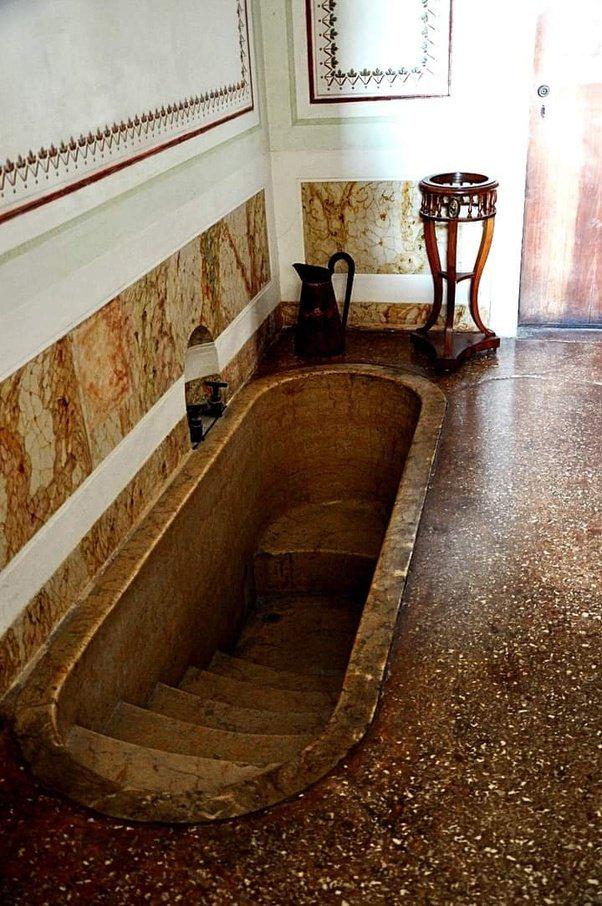
In a quiet room off a grand corridor in northern Italy, there is a bathroom that looks like it belongs to a 20th‑century hotel, not to the age of muskets and monarchs. The tub is recessed into the floor, the walls are lined with smooth surfaces, and the whole space feels oddly modern. This is Napoleon’s private bathroom at Villa Pisani in Stra, near Venice, part of the apartment arranged for him when the French ruled northern Italy.
Napoleon’s bathroom at Villa Pisani fascinates people because it feels intimate and domestic. It raises a question that goes beyond plumbing: what if Napoleon had not just passed through, but really lived there? What if this villa had become a true imperial base, or even his retirement home? By looking at the real history of the villa and Napoleon’s Italian rule, we can sketch three grounded what‑if scenarios and ask how each might have changed European history.
Napoleon’s apartment at Villa Pisani was created when the French administration controlled the former Venetian territories. The bathroom, with its recessed tub, reflects early 19th‑century elite hygiene and the emperor’s taste for comfort. A private bathtub in a palace apartment was a sign of power, wealth, and changing ideas about the body.
Why did Napoleon have an apartment at Villa Pisani at all?
Before we twist history, we need the straight version. Villa Pisani was built in the 18th century by the Pisani family, one of Venice’s richest clans, as a country palace along the Brenta Canal. When Napoleon crushed the Venetian Republic in 1797, its properties were carved up. The villa passed into state hands and, under French rule, became a convenient symbol of new power in the region.
By the early 1800s, northern Italy was a key piece of Napoleon’s system. The Kingdom of Italy, with Napoleon as king and his stepson Eugène de Beauharnais as viceroy, used villas and palaces like Pisani as administrative and residential hubs. The emperor did not live there full‑time, but an apartment was fitted out for him, including that recessed bathtub. It was a way to make sure that if he came through, everything looked and felt imperial.
Napoleon was not some filthy field general. He bathed more than many of his contemporaries, liked hot baths, and spent long stretches soaking and dictating letters. A sunken tub in a private suite fit his habits and his rank. It also reflected a broader shift among European elites toward more frequent bathing, helped by better plumbing and the growing availability of servants to haul water and manage waste.
So we have a French emperor, a conquered Venetian palace, and a surprisingly modern bathroom. That combination gives us a plausible anchor for counterfactuals: Napoleon had the space, the infrastructure, and the political control to use Villa Pisani as more than a decorative stop. The question is how far that could have gone, given the real constraints of war, money, and politics. The existence of the apartment and bathroom shows that Napoleon seriously integrated northern Italy into his imperial world, which makes the idea of him basing himself there more than pure fantasy.
Scenario 1: Napoleon makes Villa Pisani his Italian power base
First scenario: Napoleon survives the Russian disaster of 1812 in better shape, or wins a cleaner victory at Leipzig in 1813, and chooses to spend long stretches of time ruling from northern Italy. Villa Pisani, near Venice, becomes one of his main residences, not just a prepared suite he rarely uses.
This is not as far‑fetched as it sounds. Napoleon already wore two crowns: Emperor of the French and King of Italy. He had been crowned in Milan in 1805. He understood the strategic value of the Po Valley and the Adriatic. A base near Venice gave him access to trade routes, shipyards, and a buffer against Austria.
Logistically, it could work. The Brenta Canal linked the villa to Venice. Roads improved under French rule. An imperial household could be installed there with relative ease, as it was in other palaces across the empire. Water for the recessed bathtub came from servants hauling and heating it, not from modern pipes, but that was standard for the time.
Politically, though, this choice would send a message. If Napoleon spent more time in Stra and Venice than in Paris, it would signal that the Italian crown was not just a side title. He might pour more resources into Italian infrastructure, ports, and administration. The Kingdom of Italy could shift from satellite to near‑equal partner in his mind.
That has knock‑on effects. A stronger Italian base could mean:
• A tougher position against Austria, which still held Lombardy and looked hungrily at the Adriatic.
• More investment in the Venetian Arsenal and Adriatic fleet, pressuring British naval dominance in the Mediterranean.
• A stronger Italian political identity under Napoleonic institutions, from the Code Napoléon to conscription.
Would this keep his empire alive? Probably not forever. Britain’s economic weight and Russia’s size were not going away. But if Napoleon split his time between Paris and Villa Pisani, he might lean harder into an “Empire of two capitals,” with Italy as a permanent pillar instead of a front line.
So what? Turning Villa Pisani into a true power base could have accelerated Italian state‑building under French influence, making the later 19th‑century unification of Italy faster, more centralized, and more tied to Napoleonic legal and administrative traditions.
Scenario 2: Napoleon retires to Villa Pisani instead of Elba
Second scenario: after his defeat in 1814, the Allies choose a different exile. Instead of shipping Napoleon to the small island of Elba off the Tuscan coast, they confine him to Villa Pisani and its grounds, under tight Austrian and British supervision.
Why would they do that? The Congress of Vienna was all about balance. Austria wanted control in northern Italy. Britain wanted Napoleon away from French politics but not dead, since a show trial or execution risked turning him into a martyr. A guarded villa on Austrian‑influenced soil, far from Paris but close to Habsburg troops, could have looked like a safer, more controllable option than an island with its own mini‑sovereignty.
Could they trust him there? That is the problem. Elba gave Napoleon a tiny court and a small navy, but it also isolated him. Villa Pisani sat on a major waterway, near Venice, in a region full of people who had lived under his rule. The Austrians would have to ring the place with soldiers, control visitors, and censor letters. They might, in effect, turn a grand villa with a fancy bathtub into a gilded prison.
From Napoleon’s perspective, this exile would be more comfortable. He would have a proper palace, a familiar environment, and access to better medical care. His health, which declined sharply by 1818 on Saint Helena, might have held up longer in the milder, less isolated climate of the Brenta.
But comfort cuts both ways. A healthier, less desperate Napoleon might not have gambled on a dramatic return like the Hundred Days in 1815. Or, if he did try to escape, he would need help from Italian sympathizers and would have to cross heavily policed Austrian territory, which is harder than slipping past a few British ships from Elba to the French coast.
Two outcomes look plausible:
• He accepts his fate, writes his memoirs in a grand Venetian villa, and dies there in the 1820s. His legend is still strong, but without the final act of Waterloo.
• He becomes a focus for Italian discontent. Young Italian nationalists, already angry at Austrian control, might see the exiled emperor as a symbol of resistance, even if he is under guard.
In both cases, Villa Pisani turns into a political shrine. Pilgrims visit the rooms where Napoleon walked, the bathroom where he soaked and dictated, the garden paths where he paced. The villa’s role in 19th‑century memory shifts from “one of many aristocratic palaces” to “the place where the empire ended.”
So what? Exiling Napoleon to Villa Pisani instead of Elba could have erased the Hundred Days and Waterloo from history, softening the restoration of the Bourbons and tying Napoleon’s myth much more closely to Italian, not just French, political memory.
Scenario 3: A long Italian rule turns Villa Pisani into a symbol of early Italian unity
Third scenario: imagine Napoleon’s empire survives in some reduced form after 1815. He loses parts of Germany and Spain, but clings to a compact Franco‑Italian block. The Allies accept this because they are exhausted and fear endless war more than a trimmed‑down Bonaparte.
In this world, the Kingdom of Italy remains under Napoleonic control for decades. Napoleon himself might eventually die, but his son, the so‑called “King of Rome,” or another Bonaparte relative, keeps the crown. Villa Pisani, already an imperial residence, becomes a regular royal stop, maybe even a favored retreat.
Economically, this is not impossible. Northern Italy was one of the richer parts of the empire, with agriculture, trade, and early industry. A stable Franco‑Italian state could draw revenue from French taxes and Italian commerce. The cost is diplomatic: Austria would hate a Bonapartist Italy on its border. Russia and Britain would watch it closely.
Over time, though, the institutions Napoleon planted in Italy would sink deeper roots. The Napoleonic Code, standardized administration, secular education, and conscription would shape a generation of Italians. Instead of the patchwork of duchies and kingdoms that actually existed in the 1820s and 1830s, you would have a long‑standing “Kingdom of Italy” under a Bonaparte line.
That changes the story of Italian unification. In real history, figures like Cavour, Garibaldi, and Victor Emmanuel II built a new Italy out of pieces, fighting Austria and negotiating with France. In this scenario, much of the north is already unified under a French‑Italian crown. Southern Italy and the Papal States become the remaining prizes.
Villa Pisani’s role in this story is symbolic but real. It is one of the main royal residences in a state that calls itself Italy decades before 1861. Its art, ceremonies, and even that odd recessed bathtub become part of the public image of a modern, centralized Italian monarchy with French roots.
By the mid‑19th century, Italian nationalists might split between those who accept a Bonapartist Italy and those who want a more independent, perhaps republican, version. Either way, the idea that “Italy” is a single political unit would be older and more familiar than in our timeline.
So what? A durable Napoleonic Italy with Villa Pisani as a royal residence could have made Italian unity earlier and more stable, but also more tied to French influence, changing the balance of power in Europe and the later politics of nationalism.
Which scenario fits the real constraints best?
All three scenarios start from the same concrete fact: Napoleon had a private apartment, including a recessed bathtub, at Villa Pisani in Stra. That means the infrastructure and symbolism for a deeper connection were already in place. The question is which path lines up best with the hard limits of the era.
Scenario 1, making Villa Pisani a major power base during Napoleon’s peak, is the most plausible in terms of logistics and politics. He already ruled northern Italy, already wore the Italian crown, and already used Italian palaces for administration. Spending more time there would not require a miracle, just different strategic priorities. The main constraint is his obsession with confronting Britain and Russia, which kept dragging him north and west rather than south.
Scenario 2, exile at Villa Pisani, runs into Allied fear. After 1814, the victors wanted Napoleon away from any dense population that might rally to him. An Italian villa on a busy canal is exactly the kind of place they would avoid. They chose Elba and then Saint Helena for a reason: water is a better prison wall than a ring of soldiers. So while the villa exile is imaginable, it cuts against the basic logic of Vienna.
Scenario 3, a long‑lasting Napoleonic Italy, hits the hardest wall of all: the combined weight of Britain, Russia, Prussia, and Austria. Keeping a Bonaparte on an Italian throne into the mid‑19th century would require those powers to accept a permanent French‑Italian block on the map. Their behavior in 1813–1815 suggests they would not. They fought until Napoleon fell, then kept him far away. A trimmed‑down empire was not on their menu.
So the most grounded what‑if is the first: Napoleon uses Villa Pisani as a serious governing base while his empire still holds. That scenario does not need the Allies to act differently or the wars to end sooner. It only requires Napoleon to invest more time and attention in his Italian crown.
That brings us back to the bathroom. The recessed tub in Stra is a small physical trace of a larger truth. Napoleon did not just conquer Italy. He tried to live in it, rule from it, and reshape it. If he had leaned a bit harder in that direction, Villa Pisani could have gone from a curious Reddit image to one of the most famous “imperial capitals that almost were.”
So what? The very existence of Napoleon’s private apartment and modern‑looking bathroom at Villa Pisani reminds us that empires are not only made on battlefields. They are also made in the quiet choices of where rulers sleep, bathe, and sign papers, and a few different choices in northern Italy could have nudged European history onto a slightly different track.
Frequently Asked Questions
Did Napoleon actually live at Villa Pisani in Stra?
Napoleon had a private apartment prepared for him at Villa Pisani in Stra, including a recessed bathtub, during French rule in northern Italy. He did not live there permanently, but the villa was used by the Napoleonic administration and arranged to host him when he was in the region.
Why did Napoleon have such a modern-looking bathtub?
Napoleon liked hot baths and bathed more frequently than many contemporaries. The recessed bathtub at Villa Pisani reflects early 19th-century elite hygiene, where wealthy rulers could afford private bathing spaces, servants to haul and heat water, and more comfortable, semi-modern bathroom designs in their palace apartments.
Could Napoleon have been exiled to an Italian villa instead of Elba?
In theory, the Allies could have confined Napoleon to a guarded Italian villa like Villa Pisani after 1814, but they feared his influence over any nearby population. They chose Elba, and later Saint Helena, because islands were easier to control and reduced the risk of escape or political agitation on the mainland.
Did Napoleon influence Italian unification through his rule in Italy?
Yes. Napoleon’s rule in northern Italy introduced the Napoleonic Code, centralized administration, and new political identities. These reforms did not create a lasting Napoleonic Italy, but they shaped elites and institutions that later played roles in the 19th-century movement for Italian unification.