Just before sunrise at Karnak, the stone is cold.
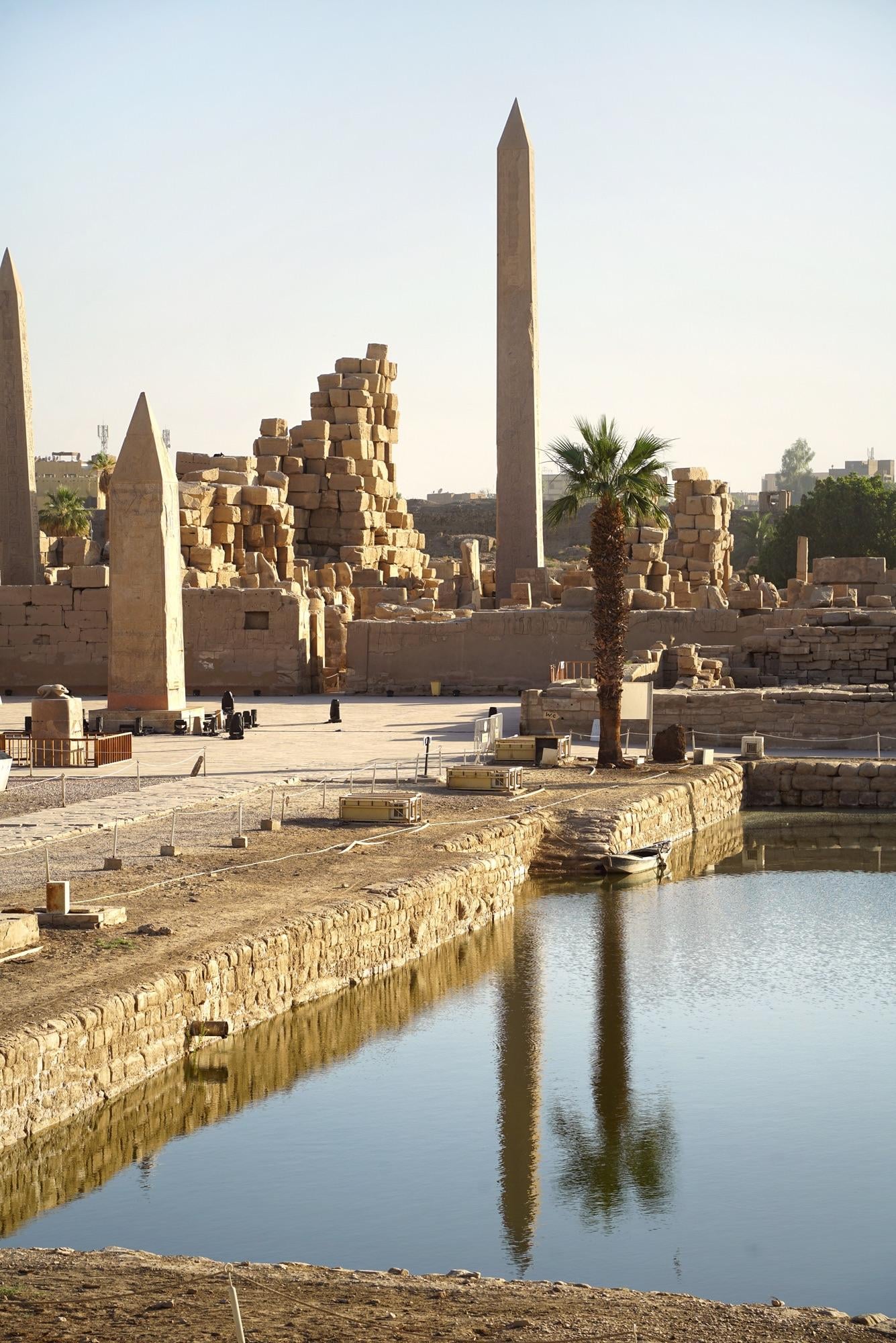
The great columns of the Hypostyle Hall fade into the dark like a forest turned to rock. As the sun edges over the eastern bank of the Nile, carved processions of pharaohs and gods catch the first light. This is not just a temple. It is 2,000 years of Egyptian history poured into sandstone.
Karnak Temple in ancient Thebes was the largest religious complex in Egypt. It grew from a modest Middle Kingdom shrine into a sprawling, 200-acre maze of pylons, obelisks, and sanctuaries. Dozens of kings left their mark here, from Senusret I around 1970 BCE to the Ptolemies in the last centuries BCE.
So what happens to Egyptian history if this place never exists, or if it takes a very different form?
Counterfactual history is not fantasy. It asks, within real limits of geography, economics, and politics, how events might have gone differently. Here we will ground three specific what-ifs in the hard realities of the Nile Valley.
We will look at three scenarios: an Egypt where Karnak is never built, one where it is finished rapidly under a single king, and one where it becomes the political capital instead of a cult center. Then we will ask which of these worlds is actually plausible and what that tells us about why Karnak mattered.
Karnak Temple was the main cult center of Amun at Thebes. It functioned as a religious, economic, and ideological engine for the New Kingdom. Without Karnak, Egyptian state power, art, and theology would have developed very differently.
What if Karnak Temple had never been built at Thebes?
Start with the most radical question: no Karnak at all.
Strip away the Hypostyle Hall, the obelisks of Hatshepsut, the festival courts of Thutmose III and Ramesses II. Imagine that the early Middle Kingdom kings never invest in a temple to Amun at Thebes. The site remains a provincial town on the Nile, with small shrines at most.
Is that even possible? Yes, but only if we rewind to the political map around 2000 BCE.
In the late First Intermediate Period, Thebes was a regional power base. The 11th Dynasty, especially Mentuhotep II (reigned c. 2055–2004 BCE), used Thebes as a launching pad to reunify Egypt. The cult of Amun, a local Theban god, rose with them. When the 12th Dynasty shifted the royal residence north, they still kept investing in Amun at Thebes. That decision is the seed of Karnak.
For Karnak to “never happen,” two things would need to change:
1) Thebes fails to become the reunifying power in the south.
2) Amun never becomes a national god.
Both are plausible. Another southern city, like Elephantine near modern Aswan, might have taken the lead. Or a northern house, based near Memphis or Herakleopolis, might have reunited Egypt earlier and crushed Theban ambitions. In that world, Thebes could remain a secondary town with a local cult, never upgraded to a national shrine.
What follows from that?
Religious power stays in the north. In our timeline, by the New Kingdom, Amun of Thebes merges with the old sun god Ra to become Amun-Ra, “king of the gods.” His priesthood at Karnak controls vast estates, workshops, and fleets. They rival the pharaoh in wealth and influence, especially by the late Ramesside period.
Without Karnak, that concentration of power in Thebes never occurs. The main cult center might remain at Heliopolis for Ra, or Memphis for Ptah. The priesthood that grows too rich and independent would be northern, not Theban.
No Theban empire ideology. The New Kingdom (c. 1550–1070 BCE) is built on a story: Amun of Thebes chose the Theban kings to expel the Hyksos and rule “all lands in his name.” Karnak is the stage where this story is carved in stone. Reliefs show Thutmose III and others smiting foreigners before Amun, who grants them victory.
If there is no Karnak, that ideological center shifts. The story of divine election might be tied to a different god, perhaps Ra at Heliopolis. The geographical focus of empire ceremonies, coronations, and royal jubilees would be closer to the Delta. The south loses its special aura as the place where kingship is renewed.
Art and architecture look different. The Hypostyle Hall at Karnak, built mainly under Seti I and Ramesses II (13th century BCE), is not just big. It becomes a model. Later Egyptian columned halls, from Luxor Temple to smaller shrines, echo its forest of papyrus columns and raised central nave.
If there is no Karnak, there is no Hypostyle Hall in that form. Egyptian architects still build columned spaces, but the scale and specific style might never emerge. Our mental picture of “Egyptian temple” would be closer to earlier Middle Kingdom sanctuaries: lower, more compact, less theatrical.
Different religious crisis under Akhenaten. When Akhenaten launches his Aten-centered religious revolution around 1350 BCE, he is attacking the power of Amun’s priesthood at Thebes. Karnak is his main target. He halts its funding, builds Aten temples nearby, and orders Amun’s name erased.
Without Karnak and its Amun machine, what does his revolution look like? Possibly smaller. If the main cult center is at Heliopolis and more directly under royal control, there is less of a separate priestly empire to break. Akhenaten might still promote the Aten, but the conflict would be less about smashing a rival power bloc and more about reshaping traditional solar worship.
That could mean a shorter, less traumatic religious experiment and a smoother restoration under Tutankhamun.
So what? In a world without Karnak, Thebes never becomes the spiritual capital of Egypt. Religious and political gravity stay in the north, the Amun priesthood never rivals the throne from a southern base, and the New Kingdom’s ideology of Theban empire takes a different form or never emerges at all.
What if Karnak had been finished quickly under one powerful king?
Back to our world. Karnak is not a single project. It is a construction habit.
From the Middle Kingdom through the Ptolemaic period, nearly every ambitious king adds something: a pylon here, a court there, a new sanctuary tucked behind an older one. The result is a layered site where Thutmose III builds over Hatshepsut, and Ramesses II squeezes his inscriptions into any free space.
Now imagine a different pattern. Suppose one dominant pharaoh, say Thutmose III (reigned c. 1479–1425 BCE), decides to complete Karnak in a single, massive, coordinated building program. He has the resources. Thutmose III campaigns from Syria to Nubia and brings back tribute, prisoners, and raw materials. He is one of Egypt’s most successful warrior-kings.
Could he have done it? Logistically, yes, within limits.
New Kingdom Egypt can mobilize tens of thousands of workers for major projects. The quarrying at Gebel el-Silsila, the transport of obelisks from Aswan, and the labor organization seen at Deir el-Medina show a state capable of sustained building. If Thutmose III had focused his efforts on creating a “finished” Karnak, he could have erected a grand, unified complex in 20–30 years.
What changes if Karnak is essentially “done” by 1400 BCE?
Later kings lose a key propaganda stage. In real history, each pharaoh uses Karnak to write himself into the sacred story. Hatshepsut raises obelisks and claims Amun chose her. Seti I and Ramesses II carve battle scenes that link their victories to Amun’s favor. Even minor kings add small chapels to say “I was here, Amun knows my name.”
If Thutmose III presents a complete, harmonious Karnak and then issues a strong taboo against major alterations, later rulers face a dilemma. Do they break the aesthetic and religious unity of the complex, or do they respect it and find other venues?
Many would likely shift their propaganda to other sites: Luxor Temple, Abydos, Memphis. Karnak would become more like a fixed national monument and less like a living political billboard.
Less architectural palimpsest, more canonical style. One of the reasons Karnak fascinates modern visitors is that it is messy. You can see walls erased and recarved, shrines moved, pylons left unfinished. It is a physical argument between dynasties.
In the “finished under one king” scenario, Karnak becomes a frozen standard. Later temples across Egypt copy Thutmose III’s style more rigidly. Architectural experimentation shifts to other cities. The visual story of Egyptian history becomes flatter, with fewer visible layers in one place.
Priestly power might centralize even faster. A completed, monumental Karnak by the mid-15th century BCE would give the Amun priesthood a strong, stable base earlier. Instead of constantly adapting to new wings and chapels, they would administer a coherent complex with clear rituals tied to specific spaces.
That could accelerate the growth of their economic and ideological power. The more fixed and grand the temple, the easier it is to argue that its rituals are eternal and non-negotiable. By the time of the late 18th Dynasty, the high priests of Amun might already be edging toward semi-royal status.
In that case, Akhenaten’s reaction could be even more extreme. He would be attacking a more entrenched institution, which might push him to move the capital away from Thebes earlier and more decisively.
Less room for erasure and rewriting. Historically, Hatshepsut’s monuments at Karnak are partly dismantled or hidden by Thutmose III and later kings. Akhenaten’s Aten temples are smashed and recycled. Ramesses II overwrites predecessors’ inscriptions.
If the core of Karnak is a unified Thutmosid design, there is less physical space and political will to play this game. Erasing a predecessor means damaging the sacred whole. That could limit later damnatio memoriae campaigns or push them to other sites.
So what? A Karnak finished quickly under one powerful king would be more visually coherent but less politically flexible. It would turn the temple into a fixed national monument early on, likely centralizing priestly power faster and forcing later rulers to fight their ideological battles elsewhere.
What if Karnak had become Egypt’s political capital?
For most of its history, Karnak is a religious and economic center, not the day-to-day seat of government.
Pharaohs in the New Kingdom use Thebes as a royal residence at times, especially early on, but the administrative machinery of the state often operates from Memphis or other northern sites closer to the Delta and foreign frontiers. Thebes is where you celebrate the Opet festival, not where you process tax records.
Now flip that. Imagine a world where a major king decides to make Karnak and Thebes the permanent political capital.
The best candidate is probably Amenhotep III (reigned c. 1390–1352 BCE). He is wealthy, relatively peaceful, and fond of building. He already invests heavily in Thebes: Luxor Temple, his mortuary temple on the west bank, and extensive work at Karnak.
What would it take for him to move the capital fully south?
Geographically, Thebes is about 700 km south of the Mediterranean. That is a long way from the main foreign policy hotspots in Syria, Canaan, and the Libyan frontier. To make Thebes the administrative center, Amenhotep III would need to:
1) Strengthen river transport and communication along the Nile.
2) Build large bureaucratic quarters near Karnak.
3) Accept slower response times to northern crises.
He could do the first two. The Nile is a natural highway, and the state already uses it heavily. Building offices and palaces near Karnak is within his means. The third is the real constraint. A southern capital makes sense in a relatively peaceful era, less so in a time of constant border wars.
Assume he does it anyway. What changes?
Priests and scribes share the same streets. In reality, the high priests of Amun are powerful but geographically separated from the main northern administrative hubs. That distance gives pharaohs some room to balance interests.
If the royal bureaucracy, treasury, and foreign office are all in Thebes, the overlap between temple and state becomes tighter. Priests and scribes intermarry more. Temple estates and royal estates are managed by people who drink in the same beer halls.
That could cut two ways. It might integrate temple and state more smoothly, making the Amun cult a direct arm of royal policy. Or it might create a fused elite that can collectively pressure weaker kings.
Akhenaten’s revolution looks different again. In this scenario, when Akhenaten comes to power, he inherits a capital where Amun’s temple and the royal palace are neighbors.
If he still tries to suppress Amun and elevate the Aten, the conflict is not just religious. It is an attack on the city that houses the entire government. Moving the capital to Akhetaten (modern Amarna) becomes even more disruptive, tearing the administration away from both Thebes and Memphis.
Alternatively, Akhenaten might not move at all. He could try to build Aten temples inside or near Karnak, turning the existing capital into a battleground of cults. That would make the post-Akhenaten restoration messier and perhaps bloodier, as factions fight over the same urban space.
Later Theban priest-kings might rule a richer realm. In the 21st Dynasty (starting c. 1070 BCE), Egypt fragments. The high priests of Amun in Thebes control Upper Egypt, while kings based in Tanis rule the north. The Theban priests are powerful, but their region is poorer and less connected to Mediterranean trade.
If Thebes had been the long-term capital, with entrenched administrative infrastructure and trade networks, the southern regime in the Third Intermediate Period would be stronger. The “priest-kings” of Thebes might have a better shot at reuniting Egypt under their own line, not as a junior partner to northern dynasties.
That could shift the later history of Egypt’s foreign relations. A more Theban-centered state might look more to Nubia and the Red Sea than to the Levant and the Mediterranean.
Archaeology and tourism change for us. One modern twist. If Thebes had been the political capital for centuries, the archaeological layers around Karnak would be even denser: more palaces, archives, and administrative buildings. We might have more written records from the New Kingdom, but also more later destruction and rebuilding on the same site.
Modern visitors would not walk through a mostly religious complex at sunrise. They would be walking through the ruins of a combined temple-palace city, more like a Pharaonic Rome.
So what? If Karnak had become Egypt’s political capital, the fusion of temple and state in Thebes would reshape power struggles from Akhenaten to the priest-kings, tilt Egypt’s later orientation more toward the south, and leave us a very different archaeological record.
Which Karnak what-if is most plausible, and what does it tell us?
We have three alternate Karnaks on the table:
1) No Karnak at all.
2) A Karnak finished quickly under one king.
3) A Karnak that doubles as Egypt’s long-term political capital.
Which of these sits closest to the real constraints of ancient Egypt?
The “no Karnak” world is possible but requires an early fork. For Karnak never to rise, Thebes must fail to win the reunification struggle around 2050 BCE, or the 12th Dynasty must ignore Amun’s cult. That is not impossible, but it asks us to rewrite the outcome of the First Intermediate Period.
Once Thebes wins and Amun gains royal favor, a major temple complex there is almost guaranteed. Egyptians do not centralize cults without building in stone.
The “finished under one king” Karnak is constrained by Egyptian religion itself. Pharaohs liked to present their monuments as perfect and eternal, but the religious system thrived on continual renewal. Each king wanted to be seen as the one who “made it as new.” Leaving room for expansion at Karnak was not a bug. It was a feature.
Thutmose III could have built more, faster, but he could not have stopped his successors from adding their own marks without breaking a deep cultural habit. The whole point of a national cult center was that it stayed alive, with new festivals, new chapels, new processions.
The political capital scenario is the closest near-miss. Thebes already functioned as a royal residence and ceremonial capital in parts of the New Kingdom. Amenhotep III’s building spree nearly turns it into a full capital. The main obstacle was strategic: the need to keep a strong presence in the north.
If the international situation had been slightly calmer, or if a king had been more willing to accept slower northern response times, Thebes could have become the permanent seat of government. That would not require overturning early dynastic history, just a different strategic calculation in the 18th Dynasty.
So the most plausible what-if is the one where Karnak’s religious gravity pulls the rest of the state apparatus south and keeps it there.
What does that tell us about the real Karnak?
First, it shows how powerful geography and foreign policy were. The Nile’s north-south axis and the location of Egypt’s enemies kept the administrative center closer to the Delta, even as religious prestige drifted south to Thebes.
Second, it explains why Karnak feels so layered. The temple was never meant to be finished. Its unfinished pylons and patched walls are not failures. They are the material trace of a system where every king needed to renew the link between himself and the god of empire.
Third, it helps answer a modern visitor’s unspoken question at sunrise: why here? Why this much stone in this one place?
Because Karnak was where Egyptian kings negotiated with eternity. They did it with real constraints, from quarry logistics to priestly politics. The temple we walk through today is the fossil of those negotiations.
So what? Thinking through these alternate Karnaks shows that the temple we have is not an accident. It is the product of Thebes’ early military success, the rise of Amun, the geography of the Nile, and a religious system that preferred constant renovation over finished perfection. That mix is why sunrise at Karnak feels less like a ruin and more like a paused conversation.
Frequently Asked Questions
Why was Karnak Temple built at Thebes instead of Memphis?
Karnak grew from a local shrine to Amun at Thebes after Theban rulers of the 11th Dynasty reunified Egypt around 2050 BCE. Their success elevated Amun from a regional god to a national one. Later dynasties kept investing in his cult at Thebes, even when the royal residence moved north. Memphis remained an administrative and military hub, but Thebes became the religious capital because of this early political victory and the association of Amun with Theban kingship.
How long did it take to build Karnak Temple?
Karnak was not built in a single project. Construction and modification continued for about 2,000 years, from the Middle Kingdom (around 1970 BCE under Senusret I) through the Ptolemaic period. Major phases include 18th Dynasty expansions under Hatshepsut and Thutmose III, the Hypostyle Hall under Seti I and Ramesses II in the 13th century BCE, and later additions by Libyan, Kushite, Saite, and Ptolemaic rulers. It is better seen as a continuous building tradition than a completed monument.
What role did Karnak play in ancient Egyptian politics?
Karnak was the main cult center of Amun, who became the chief state god in the New Kingdom. Pharaohs used the temple to legitimize their rule, depicting themselves receiving power and victory from Amun. The priesthood of Amun controlled large estates, workshops, and resources, giving them major economic and political influence. By the late New Kingdom, high priests of Amun in Thebes were powerful enough to rival the kings in the north, and in the 21st Dynasty they effectively ruled Upper Egypt.
Did Akhenaten destroy Karnak Temple during his religious reforms?
Akhenaten did not destroy Karnak itself, but he attacked the cult of Amun that centered there. He cut funding, ordered Amun’s name erased from many inscriptions, and built new open-air Aten temples near Karnak. After his death, the Aten temples were dismantled and reused as building material, while the cult of Amun and the main structures at Karnak were restored and expanded by later kings like Horemheb and Seti I.