They tied him up, stripped him, and brought out the shells.
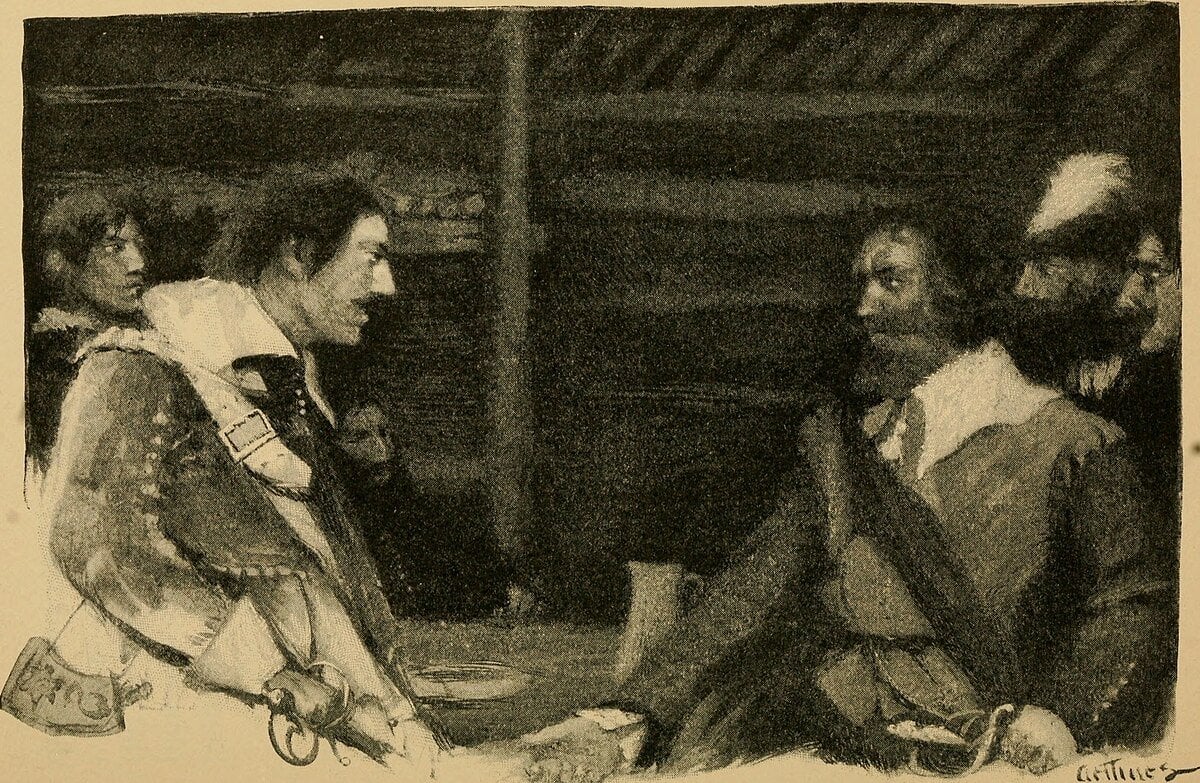
In the winter of 1609, Jamestown governor John Ratcliffe walked into what he thought was a food trade with the Powhatan. Instead, according to English accounts, he was ambushed, captured, and tortured to death. Powhatan women are said to have flayed him with mussel shells, feeding bits of his skin into a fire while he watched. His face, they saved for last. Then they burned him at the stake.
Disney turned Ratcliffe into a cartoon villain obsessed with gold. The real man was less theatrical and more pathetic: an ambitious but deeply unpopular leader who helped steer England’s first permanent American colony toward chaos. His death became one of the most lurid stories in early colonial propaganda.
So what if that horror never happened? What if John Ratcliffe had survived the ambush, or avoided it entirely? Counterfactual history cannot change the past, but it can clarify it. By asking what might have happened, we see more clearly what did.
John Ratcliffe was an early governor of Jamestown who died in a Powhatan execution in 1609. His death removed a divisive leader at the start of Jamestown’s worst crisis, the Starving Time. Thinking through his survival shows how leadership, native relations, and English politics shaped the colony’s odds of survival.
Who was John Ratcliffe, really, and why did he die so horribly?
Before we twist the story, we need the straight version.
John Ratcliffe arrived in Virginia in 1607 with the first group of about 100 colonists sent by the Virginia Company of London. He captained the ship Discovery. We do not know his exact birth year, but he was an experienced mariner, not an aristocrat. In the rigid social world of early 1600s England, that mattered. He had ambition, but not much pedigree.
In September 1607, Ratcliffe helped push out Edward Maria Wingfield, Jamestown’s first president, on charges of hoarding food and mismanagement. Ratcliffe took the job himself. He inherited a swampy fort, a sick and hungry population, and a very uneasy relationship with the Powhatan chiefdom that surrounded them.
He did not handle it well. Ratcliffe oversaw the building of a new fort and sent men to cut timber for export, but he failed to solve the colony’s food problem. He quarreled with other leaders, especially John Smith. By 1608 he was replaced as president and slid into the background, but he remained on the colony’s council.
By late 1609, Jamestown was in freefall. A drought had hit the region. English demands for corn strained Powhatan patience. John Smith had sailed back to England after an injury. The new governor, George Percy, was sick and indecisive. Relations with the Powhatan had deteriorated into open hostility.
Some time in the second half of 1609, Ratcliffe led a party inland to trade for corn with a Powhatan group. English sources say the Powhatan pretended to welcome them, then sprang an ambush. Ratcliffe and several others were captured. What followed was described by George Percy in a letter: Powhatan women used mussel shells to cut off Ratcliffe’s skin in strips, feeding them into a fire. They left his face for last, then burned him.
We cannot verify every detail. English writers had reasons to emphasize Powhatan “savagery” to justify harsh retaliation and to stir support back home. But that Ratcliffe was tortured and killed is not in doubt. His death became a symbol of native cruelty in English memory, and it removed one of Jamestown’s most divisive figures just as the colony entered the Starving Time of 1609–1610.
Ratcliffe’s real story matters because it sets the baseline: a weak leader, a failing colony, a violent rupture with the Powhatan. Any alternate path has to wrestle with those hard limits.
Scenario 1: Ratcliffe survives and doubles down on war with Powhatan
First possibility: Ratcliffe survives the ambush, either because the Powhatan decide to ransom him, or because his party escapes with losses but not a massacre. What then?
Ratcliffe was not loved in Jamestown. He had already been ousted once as president. But survival from a near-fatal attack would have given him something he never had before: a martyr’s aura and a clear case for hard-line policy.
In late 1609, Jamestown had perhaps 200–300 people left after disease and desertion. They were short on food, surrounded by a Powhatan population that could field several thousand warriors across its chiefdom. The English had steel weapons, armor, and firearms, but they lacked cavalry, had limited powder, and were dependent on local corn. They could not simply “wipe out” Powhatan power, no matter how much they wanted to.
Ratcliffe’s likely response to an ambush would have been to argue that all attempts at diplomacy were naive. He had already backed aggressive moves. Surviving such an attack would have confirmed his belief that the Powhatan were treacherous enemies, not trading partners.
With John Smith gone and George Percy ill, Ratcliffe could have used the crisis to claw back leadership on the council. He might have pushed for:
• More raids on Powhatan villages to seize corn and hostages.
• A policy of burning fields and houses to terrorize nearby groups.
• Less tolerance for colonists who tried to trade or fraternize with Powhatan people on their own.
Some of this actually happened without him. During the Starving Time, desperate English parties did raid native settlements. Later governors like Thomas Dale and Thomas Gates fought brutal wars against the Powhatan. Ratcliffe’s survival would likely have accelerated that shift. Instead of a slide into war after 1610, Jamestown might have embraced a war footing months earlier.
Would that have helped the colony survive the Starving Time? Probably not. In the short term, more raids might have captured some corn. In the longer term, it would have united more Powhatan groups against the English and cut off any remaining trade. War consumes food and manpower. Jamestown had little of either.
There is also London to consider. The Virginia Company was a joint-stock enterprise. Its investors wanted profit, not endless war bills. Reports of a governor pushing an aggressive war that failed to secure food would have damaged Ratcliffe’s standing with the company. He had no powerful aristocratic patrons to protect him.
So in this scenario, Ratcliffe survives, pushes for harsher war, and probably presides over an even bloodier Starving Time. The colony might still survive, because new relief fleets arrived in 1610, but with even worse relations with the Powhatan and an even blacker reputation on both sides.
That matters because it would have hardened the pattern of English colonization in Virginia: less room for any middle ground, more pressure for total subjugation of native groups from the very beginning.
Scenario 2: Ratcliffe survives and is sidelined, Jamestown collapses
Second possibility: Ratcliffe survives but fails to regain power. The colony limps on with weak leadership, and this time it does not make it.
In reality, Jamestown came very close to being abandoned. During the winter of 1609–1610, known as the Starving Time, perhaps 60 out of 300 colonists survived. Some resorted to cannibalism. In June 1610, the survivors boarded ships to leave Virginia for good. They were literally sailing down the James River when they met a relief fleet led by the new governor, Lord De La Warr, who forced them to turn back.
That razor-thin save depended on several things: the Virginia Company’s decision to send more supplies and settlers, ships surviving Atlantic storms, and the timing of De La Warr’s arrival. Change any of those slightly, and Jamestown could have died.
Where does Ratcliffe fit? If he survived but remained unpopular, the council might have kept him away from top office. George Percy, sick and cautious, would still be in charge. Without a strong hand, the colony might have been even less able to organize food raids, ration supplies, or maintain defenses.
Imagine this chain:
• Ratcliffe returns from a botched trade mission, wounded and discredited.
• Percy, already ill, refuses to hand him power.
• Factional infighting worsens as food runs out.
• More colonists slip away to live with native groups or die trying.
• By the time De La Warr’s fleet arrives, there is almost no one left, or disease on the ships delays or kills key leaders.
In that scenario, De La Warr might have judged the colony unsalvageable. The Virginia Company was already bleeding money. Investors were unhappy. If the first colony looked like a total loss, London might have cut its losses or shifted focus to other ventures, like the East India trade.
Would England have abandoned North America? Probably not. The fishing grounds off Newfoundland and the fur trade in the north were already drawing interest. The English crown was also watching Spanish and French moves. But a failed Jamestown would have delayed permanent English settlement in the Chesapeake by years, maybe a decade.
That delay would have changed the balance of power. The Powhatan chiefdom would have had more time without a fortified English base on its river. Spanish influence from Florida and the Caribbean might have pushed further up the Atlantic. French traders might have moved down from the St. Lawrence.
In that world, John Ratcliffe becomes a footnote: a failed leader in a failed colony. The familiar story of Jamestown as the “first permanent English settlement” vanishes. Instead, some later, better-planned colony, perhaps in New England or the Carolinas, takes that symbolic role.
That matters because it would shift the origin story of English America. Less about a swampy tobacco colony run by a chartered company, more about whatever came next. The mythology of Pocahontas, John Smith, and the “starving time” might never have taken root in the same way.
Scenario 3: Ratcliffe survives and stumbles into a fragile peace
Third possibility: Ratcliffe survives and, against type, becomes a reluctant pragmatist. Not because he turns into a Disney reformer, but because he has no choice.
Strip away the rhetoric and the Virginia Company’s instructions to its governors were clear: secure food, find marketable commodities, and avoid total war you cannot win. The company wanted a return on investment. Dead colonists did not ship back timber, sassafras, or glass.
Ratcliffe had already seen that open conflict with the Powhatan was costly. He had also seen John Smith’s rough-and-ready diplomacy work, at least for a time. Smith bullied and bargained for corn, took hostages, and tried to play different Powhatan groups against each other. It was not pretty, but it kept Jamestown alive.
If Ratcliffe survived an ambush, he might have read it as a warning that the English were overreaching. With Smith gone, he could try a more cautious version of Smith’s approach:
• Tight control of armed parties leaving the fort, to avoid freelance violence that sparked reprisals.
• Renewed efforts to trade metal tools and weapons for corn, even at high prices.
• Attempts to secure a more formal agreement with Wahunsenacawh (often called Powhatan) that recognized English presence at Jamestown in exchange for tribute or military support against rival native groups.
None of this would have created harmony. The Powhatan had their own political logic. Wahunsenacawh had tolerated the English as a potential subordinate group or useful ally, not as equals. The English, for their part, believed they had a royal patent to the land. But there was a narrow space where both could see advantage in avoiding all-out war, at least for a few years.
We know that a sort of truce did emerge later, after Ratcliffe’s death, through the 1614 marriage of Pocahontas and John Rolfe. That “Peace of Pocahontas” lasted about eight years. It did not erase conflict, but it reduced open fighting.
If Ratcliffe had survived and pushed earlier for a similar arrangement, Jamestown might have avoided the worst of the Starving Time. Better trade in 1609–1610 could have meant fewer deaths, less cannibalism, and less desperation. A somewhat healthier colony would have been in better shape to plant tobacco when John Rolfe’s experiments took off in the 1610s.
That has economic consequences. Tobacco exports from Virginia exploded from the 1610s onward, reshaping the colony around plantation agriculture and, eventually, African slave labor. A less traumatized, more stable Jamestown might have moved into that model faster, with more continuity in leadership and fewer desperate policy swings.
Ratcliffe himself would not become a hero. At best he would be remembered as a stopgap governor who kept the colony alive long enough for others to profit. But his survival, paired with a grudging peace, could have smoothed the colony’s early trajectory.
That matters because it would have nudged Virginia toward a slightly less catastrophic origin story. Still violent, still exploitative, but with fewer spectacular collapses and perhaps a slower slide into total war with the Powhatan.
Which scenario is most plausible, and why does it matter?
So which of these alternate paths fits the real constraints of 1609 Virginia?
Scenario 1, Ratcliffe as hard-line war leader, matches his personality and the colony’s mood. But the English were too weak to win a decisive war. War without food is suicide. London investors wanted corn and commodities, not endless fighting. Ratcliffe could have pushed for harsher raids, but structural limits would have checked him. This scenario is psychologically plausible but strategically self-defeating.
Scenario 2, Jamestown collapse, is always lurking in the background. The colony nearly died even without Ratcliffe. A few different winds in the Atlantic, a delayed relief fleet, or a worse winter could have finished it off. Ratcliffe’s survival or death is almost incidental here. The real drivers are disease, drought, supply lines, and London’s patience.
Scenario 3, a grudging, fragile peace, is the most consistent with what we know happened later. The English and Powhatan did manage periods of tense coexistence when both sides saw benefit. The Virginia Company’s instructions pushed governors toward trade and treaties when possible. Ratcliffe was not a visionary, but he was not suicidal either. Facing starvation and an angry native confederacy, he had incentives to imitate the parts of John Smith’s approach that worked.
So the most plausible alternate history is not a heroic Ratcliffe saving Jamestown, nor a single bad decision dooming it. It is a slightly more competent, slightly luckier version of the same messy story: a struggling colony that survives by cutting deals with its neighbors, then grows rich on tobacco and land, at immense cost to the people already living there.
That matters because it strips away the cartoon logic that one villain or one torture scene “made” American history. John Ratcliffe’s horrific death did not cause English expansion, and his survival would not have stopped it. The real engines were money, hunger, imperial rivalry, and the hard math of who controlled food and weapons on a contested river in 1609.
Thinking about what might have happened if Ratcliffe had walked away from that ambush does not redeem him. It does something more useful. It reminds us that early American history was not a morality play with clear heroes and villains, but a series of desperate gambles by people with limited choices. Change one man’s fate, and the broad arc of colonization still looks grimly familiar.
Frequently Asked Questions
How did John Ratcliffe really die at Jamestown?
John Ratcliffe, an early governor of Jamestown, was killed in 1609 after a failed trading mission with the Powhatan. English accounts say he was captured, tortured by Powhatan women who cut off his skin with mussel shells and burned the pieces in a fire, then burned at the stake. While the exact details may be exaggerated for propaganda, historians agree he was captured and killed in a brutal public execution.
Was John Ratcliffe in Pocahontas a real person?
Yes. The villainous Governor Ratcliffe in Disney’s Pocahontas is loosely based on the real John Ratcliffe, an early leader at Jamestown. The film exaggerates and simplifies his character, turning him into a gold-obsessed aristocrat. The real Ratcliffe was a ship captain and colonial official who became unpopular in Jamestown and died violently after being captured by Powhatan people in 1609.
Could Jamestown have failed if John Ratcliffe had survived?
Jamestown almost failed even without Ratcliffe. During the Starving Time of 1609–1610, only about 60 of 300 colonists survived, and the survivors briefly abandoned the fort before a relief fleet forced them back. If supplies had been delayed or disease worse, the colony could have collapsed regardless of Ratcliffe’s fate. His survival might have changed details of leadership and native relations, but the colony’s survival depended more on food, disease, and resupply from England.
Did John Ratcliffe cause the Starving Time at Jamestown?
No single person caused the Starving Time. The famine of 1609–1610 came from a mix of drought, poor planning, dependence on Powhatan corn, disease, and leadership problems. Ratcliffe was one of several flawed leaders, but by the time of the Starving Time he had already lost the presidency and then died on a failed trading mission. Structural problems in the colony and environmental stress mattered more than his individual decisions.