On a desert morning outside Cairo, a 3,200-year-old king greets the traffic.
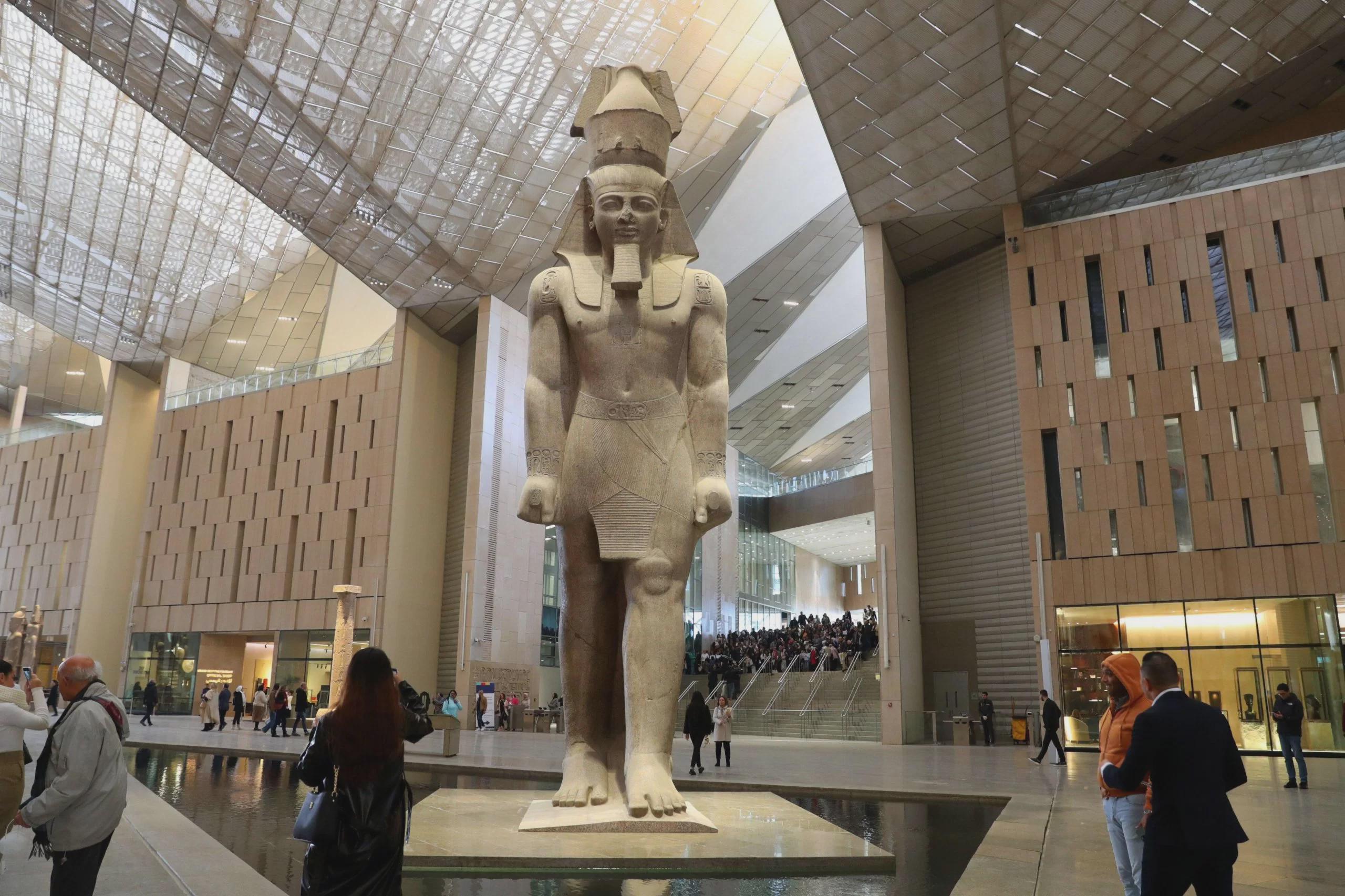
The colossal statue of Ramses II, hauled from Ramses Square in downtown Cairo in 2006, now rises inside the Grand Egyptian Museum (GEM) near the Giza pyramids. Around him: more than 100,000 artifacts, from the intact treasures of Queen Hetepheres to the full Tutankhamun collection, finally gathered under one roof after decades of promises, delays, and construction cranes frozen by budget crises and political upheaval.
The Grand Egyptian Museum is Egypt’s long-delayed attempt to build one of the largest archaeological museums on earth. Planned in the early 2000s and repeatedly postponed, it became a running joke among Egypt-watchers and a symbol of how politics, economics, and heritage can collide. Now that it has opened, it invites a tempting question: what if things had gone differently?
This is a counterfactual history of the Grand Egyptian Museum. What if it had opened on time in the early 2010s? What if Egypt had somehow finished it even earlier, before the Arab Spring? And what if the project had collapsed and the museum never opened at all? Each scenario is grounded in real constraints: tourism numbers, state budgets, political shocks, and the very practical problem of moving tens of thousands of fragile objects across Cairo.
Why was the Grand Egyptian Museum delayed so long?
To understand the “what if,” you need the “what actually happened.” The idea for a new mega-museum near the Giza Plateau took shape in the late 1990s. The existing Egyptian Museum in Tahrir Square, opened in 1902, was overflowing. Artifacts were crammed in storerooms, labels were outdated, and the building was never designed for 21st-century conservation standards.
In 2002, Egypt announced an international competition for the Grand Egyptian Museum. By 2003, a Dublin-based firm, Heneghan Peng, had won the design. The site: about 2 kilometers from the pyramids, on a 50-hectare plot. Early estimates put the cost around 550–600 million USD, much of it to come from Japanese loans and international donors.
Then reality intervened. The 2008 global financial crisis hit tourism and tightened credit. Construction, which formally began around 2006, slowed. The Arab Spring in 2011 and the years of political turmoil that followed hammered Egypt’s economy. Tourism, which had brought in over 14 million visitors in 2010, collapsed to roughly half that in 2011 and stayed weak for years. A Russian passenger plane was bombed over Sinai in 2015. The COVID-19 pandemic arrived just as Egypt was again hoping for a tourism rebound.
Every shock mattered. The GEM’s cost estimates ballooned to over 1 billion USD. Phased openings were announced, then quietly abandoned. Engineers and conservators did move thousands of objects, especially from Tutankhamun’s tomb, into new labs and storerooms at Giza. But the grand public opening kept slipping: 2013, 2015, 2018, 2020, 2022. Each missed date turned the museum into a meme.
The Grand Egyptian Museum was delayed by a mix of financial shocks, political upheaval, and the sheer complexity of building a mega-museum next to one of the world’s most famous archaeological sites. Those delays reshaped how Egypt used its heritage in politics and tourism.
So what? Because the delays created a gap between Egypt’s ambitions and its actual capacity, any alternate timeline where GEM opens earlier would have to solve those same problems differently.
Scenario 1: What if the Grand Egyptian Museum had opened around 2012?
Imagine the museum opens not long after the 2011 revolution, say in 2012 or 2013, roughly on the early optimistic timelines. The statue of Ramses II is already in place. The galleries are at least partially ready. Tutankhamun’s treasures are moved out of Tahrir and into their new home near Giza.
On paper, this looks like a tourism coup. In 2010, Egypt had its best tourism year in modern history. A brand-new mega-museum at Giza could have ridden that wave. In this alternate timeline, construction is more efficient in the mid-2000s, financing is locked in before the 2008 crash, and the project hits an early 2010s opening date.
Then the revolution hits anyway.
Here is the hard constraint: the Arab Spring was driven by deep political and social pressures that had nothing to do with museum schedules. Even if GEM had opened on time, Egypt still would have seen mass protests, the fall of Hosni Mubarak, military rule, the brief presidency of Mohamed Morsi, and the 2013 coup.
In that context, the new museum becomes something different. Instead of a triumphant symbol of a stable, rising Egypt, it turns into a stage for a state trying to project continuity in the middle of chaos. The government could use the GEM’s opening ceremonies to signal that Egypt is “open for business” and that 5,000 years of pharaonic glory dwarf a few years of political turmoil.
Tourism numbers in this alternate 2012–2014 still fall, because tourists are not reassured by a new museum when they see images of street battles in Cairo. But the drop might be slightly softened. A few more package tours might be salvaged by marketing the new museum as a once-in-a-lifetime attraction.
There is also a security angle. In our real timeline, the Egyptian Museum in Tahrir was looted in the chaos of January 2011. Some artifacts were stolen or damaged. If Tutankhamun’s treasures and other key pieces had already been moved to the more isolated, securable GEM complex near Giza, the risk of looting might have been lower. The new museum’s location, away from the political center, would have made it easier for the army to secure.
On the other hand, the GEM site itself could have become a target. Large, symbolic buildings are magnets in times of unrest. A half-year-old museum packed with world-famous artifacts would have required a permanent security cordon. That would have shaped how Egyptians and tourists experienced the site from day one.
Financially, an early-2010s opening means the government is now maintaining and staffing a huge new institution while tourism revenues are in freefall. That strains the budget. Some galleries might stay closed. Conservation work might slow. The museum risks becoming a half-finished monument to pre-revolution ambitions.
If the Grand Egyptian Museum had opened around 2012, it would have been a powerful symbol of continuity during Egypt’s political upheaval, but it would not have prevented the tourism collapse and might have strained the state’s finances at the worst possible moment.
So what? In this scenario, the GEM exists, but as a slightly hollow flagship: open, impressive, yet underused and underfunded during the very years it was supposed to pay off.
Scenario 2: What if Egypt had finished the museum before the Arab Spring?
Push the clock back further. Suppose Egypt had moved faster in the 2000s. The international competition is wrapped up quickly. Financing from Japan and other partners is secured early. Construction is aggressive during the mid-2000s boom. The Grand Egyptian Museum opens around 2008 or 2009, just before the global financial crisis and a couple of years before the Arab Spring.
This is the most optimistic timeline. In 2008, Egypt is stable under Mubarak. Tourism is strong. The new museum becomes the centerpiece of a national branding campaign: modern infrastructure, ancient heritage, easy access from Cairo to Giza with a single mega-site that combines the pyramids and the best of the old Tahrir museum.
In this world, tour operators redesign their itineraries. Instead of shuttling buses between downtown Cairo and Giza, they focus on the plateau. The GEM complex becomes a full-day experience: pyramids in the morning, Tutankhamun in the afternoon, air-conditioned cafes and gift shops in between. The Tahrir museum is gradually repositioned as a research and special-exhibitions space.
Economically, the timing is good. Even with the 2008 financial crisis, Egypt’s tourism dip was less severe than what came after 2011. A functioning GEM in 2008–2010 could have helped Egypt claw back visitors more quickly by offering something genuinely new. The country might have pushed harder into high-end cultural tourism, not just cheap Red Sea beach packages.
Then 2011 arrives. The revolution and its aftermath still hit tourism, but the GEM is already an established institution. It has staff, routines, and security protocols. The government can close it temporarily if needed, then reopen when things calm down. The building is not a construction site that can be frozen for years. It is a sunk cost that must be protected.
Politically, the optics are different too. Mubarak’s regime had used pharaonic heritage as part of its legitimacy narrative. A completed GEM would be part of that story. After 2011, any new government, whether Islamist or military-backed, would inherit the museum. They would be unlikely to neglect it, because it is a global symbol and a major foreign-currency earner.
There is a soft-power angle. A pre-2011 GEM gives Egypt more leverage in cultural diplomacy. High-profile loans, traveling exhibitions, and joint research projects would be negotiated from a position of strength. Cairo could say: we have a world-class facility, we can care for our own artifacts, and we are less inclined to send masterpieces abroad.
For Egyptians, the museum’s existence before the revolution might subtly shape how they see their own state. A gleaming complex near Giza, accessible to school groups and local families, would be a visible sign of state investment in culture. It would not change the grievances that drove people to Tahrir, but it might slightly soften the image of a regime seen as corrupt and indifferent.
The catch is cost. Building and opening the GEM before 2010 would require even heavier borrowing in the 2000s. When the post-2011 economic shocks arrive, Egypt would be servicing large debts from a mega-project while tourism revenue collapses. That could force cuts elsewhere or push the state into deeper dependence on Gulf aid.
If the Grand Egyptian Museum had opened before the Arab Spring, it would have reshaped tourism flows around Giza, strengthened Egypt’s cultural diplomacy, and given every post-2011 government a high-profile asset to protect and exploit.
So what? This scenario gives the GEM the longest and most stable runway, but at the price of higher pre-2011 borrowing and an even sharper contrast between glittering heritage projects and the economic frustrations that fueled the revolution.
Scenario 3: What if the Grand Egyptian Museum had never opened?
Now take the darker path. The project is announced in the early 2000s, the design competition is held, Ramses II is moved in 2006, but then the money runs out. The 2008 crisis hits. The Arab Spring arrives. Japanese loans are frozen or reduced. Egyptian governments change. By the mid-2010s, the GEM site is a half-finished shell on the desert edge, a giant white elephant visible from the road to the pyramids.
This is not far-fetched. Many large cultural projects around the world have died this way. In this scenario, the Egyptian Museum in Tahrir remains the main national museum. Its overcrowding gets worse. Conservation labs are outdated. The Tutankhamun collection stays in the old cases, in a building that was already struggling to cope with visitor numbers in the 1990s.
Tourism still fluctuates with politics and security. Without the GEM, Egypt has fewer tools to rebrand itself after each crisis. Marketing campaigns lean on the same images of the pyramids and the old museum. Some high-end tourists drift to other destinations that have invested heavily in their own heritage infrastructure, like the Louvre Abu Dhabi or new museums in China and the Gulf.
Internationally, the failure of the GEM project would be used as an argument by those who want key Egyptian artifacts to stay abroad. Museum directors in Europe and North America could say, with some justification: Cairo cannot even finish its own flagship museum, so why send back contested objects?
Domestically, the half-built GEM becomes a symbol. For some Egyptians, it is a reminder of the corruption and mismanagement of the Mubarak years. For others, it is a sign that post-2011 governments cannot deliver large projects either. The giant statue of Ramses II, stuck in a construction site, turns into a dark joke about ancient kings outlasting modern states.
There is also a scientific cost. One of the real GEM’s underappreciated features is its conservation center, which has already been used to study and stabilize thousands of objects, including organic materials from Tutankhamun’s tomb. Without that facility, more artifacts would remain in subpar conditions. Some would deteriorate faster. Egypt’s ability to train its own conservators and archaeologists at scale would be limited.
On the other hand, a canceled GEM frees up some future budgets. The state might invest more modestly in upgrading the Tahrir museum and regional museums in Luxor, Aswan, and Alexandria. The heritage network would be more decentralized, less focused on one mega-site near Giza.
If the Grand Egyptian Museum had never opened, Egypt’s heritage sector would be stuck with an overstretched Tahrir museum, a damaged international image, and a permanent concrete reminder of how grand plans can fail.
So what? This scenario avoids the financial burden of finishing the GEM, but at the cost of conservation quality, tourism appeal, and cultural prestige.
Which alternate Grand Egyptian Museum is most plausible?
Of these three timelines, the most plausible is the first: an opening around 2012–2013, slightly earlier than in reality but still colliding with the Arab Spring and its aftermath.
Why? Because the constraints that slowed the real project are stubborn. The 2008 financial crisis made large-scale borrowing harder. The Arab Spring and subsequent instability scared off investors and cut tourism revenue. Even with better project management, it would have been hard to finish a billion-dollar museum by 2008 or 2009 without taking on unsustainable debt.
A pre-2011 opening requires Egypt to move with unusual speed in the 2000s, lock in financing before the global crash, and keep the project insulated from domestic politics. That is a tall order for any state, let alone one with Egypt’s bureaucracy and patronage networks. It is not impossible, but it is the least likely of the three.
The “never opened” scenario is more plausible. There were real moments when the GEM looked like it might stall permanently. But several factors made outright cancellation unlikely. Japan had already sunk serious money and political capital into the project. Egyptian elites, across regimes, saw pharaonic heritage as a key soft-power asset. And every government since Mubarak has wanted a big, visible success to point to.
That leaves the middle path: an opening a bit earlier than reality, but still in the shadow of revolution. In that world, the GEM becomes a survival project. Governments change, but none wants to be the one that let Tutankhamun’s new home fail. The museum opens, perhaps in phases, with some galleries unfinished and some systems improvised.
In our real timeline, the Grand Egyptian Museum’s long delay turned it into a kind of national cliffhanger. When it finally opened, it did so in a very different Egypt from the one that conceived it. The counterfactuals show that this gap between ambition and arrival was not just about construction schedules. It was about how a modern state tries to use 5,000 years of history to navigate 21st-century shocks.
So what? Thinking through these alternate timelines makes one thing clear: the GEM was never just a building. It was a bet that ancient Egypt could still shape modern Egypt’s economy, diplomacy, and identity, and that bet was always going to be tested by forces far beyond the museum’s walls.
Frequently Asked Questions
Why was the Grand Egyptian Museum delayed for so many years?
The Grand Egyptian Museum was delayed by a mix of financial, political, and technical problems. The 2008 global financial crisis made borrowing harder, the 2011 Arab Spring and later instability cut tourism revenue and disrupted planning, and the sheer scale of building a billion-dollar museum with advanced conservation facilities near Giza slowed progress. Announced opening dates in 2013, 2015, 2018, 2020, and 2022 were all missed before the project finally reached completion.
What would have happened if the Grand Egyptian Museum opened before the Arab Spring?
If the Grand Egyptian Museum had opened around 2008–2009, it likely would have reshaped tourism around Giza, concentrating visits at a modern complex combining the pyramids and major artifacts like Tutankhamun’s treasures. It would have strengthened Egypt’s cultural diplomacy and given later governments a high-profile asset to protect. However, it would also have increased Egypt’s debt burden before the 2011 revolution and left the state servicing an expensive project during years of economic and political turmoil.
Could the Grand Egyptian Museum project have failed completely?
Yes, there was a real risk the project could have stalled permanently, leaving a half-finished shell near Giza. That could have happened if funding dried up after the 2008 crisis and the Arab Spring, or if later governments decided the cost was too high. However, Japanese loans, sunk costs, and the importance of pharaonic heritage to Egypt’s image made outright cancellation unlikely. Instead of failure, the project experienced long delays and repeated rescheduling.
How does the Grand Egyptian Museum change what happens to Tutankhamun’s treasures?
The Grand Egyptian Museum brings the entire Tutankhamun collection together in a purpose-built space with modern climate control and conservation labs. In counterfactual scenarios where the GEM opened earlier, the treasures would have been moved out of the older Tahrir museum sooner, possibly reducing their exposure to looting risks during the 2011 unrest. In a scenario where the GEM never opened, the artifacts would remain in an overcrowded, less advanced facility, with more pressure to send pieces abroad for exhibitions and a higher risk of long-term deterioration.