She is standing in the living room, 1963, on the edge of adulthood and on the edge of the rug. The TV hums in the corner. Her father is fiddling with the flash. Her mother steps back, smoothing an invisible wrinkle in the skirt she cut and stitched herself after work.
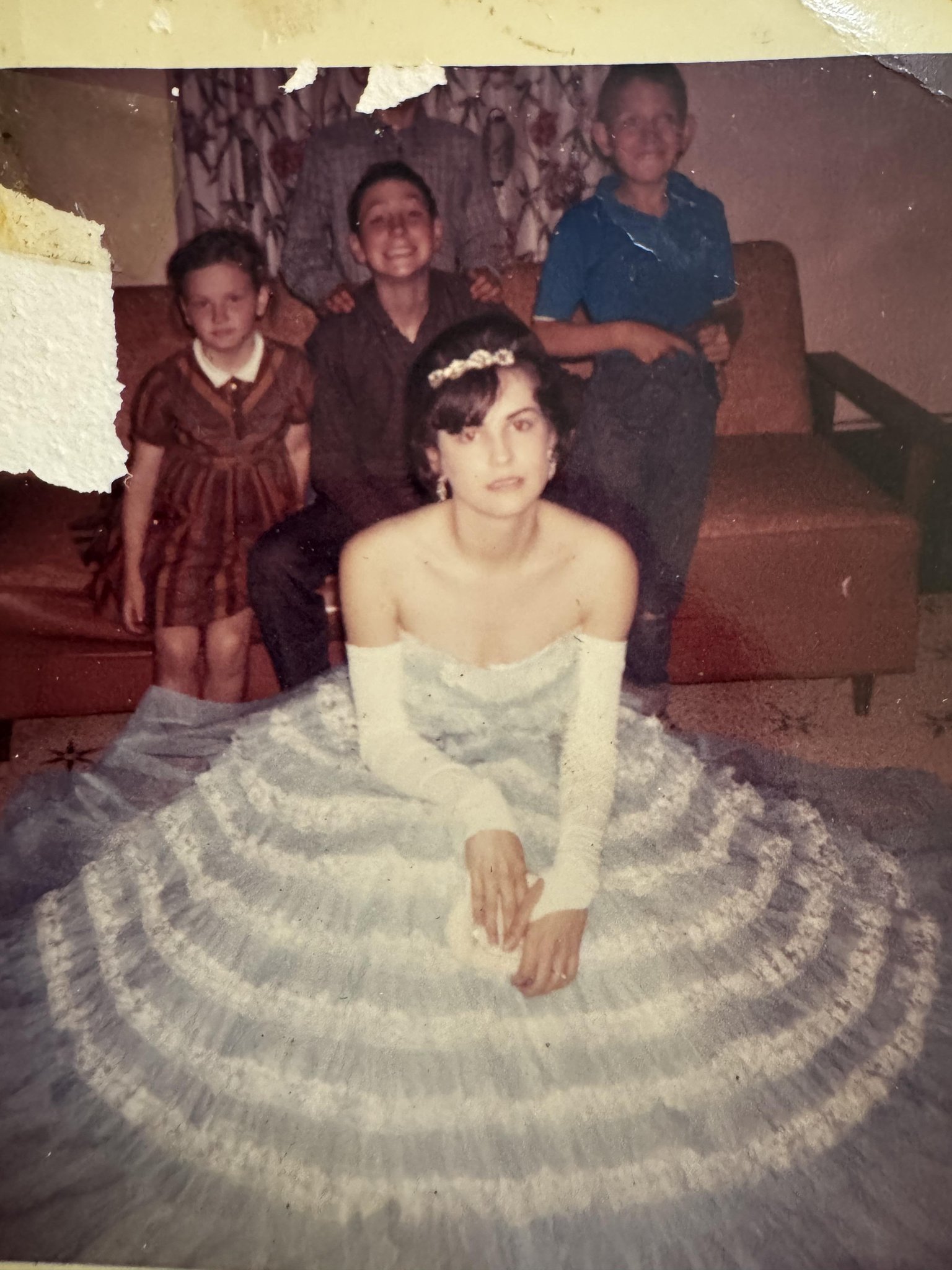
The dress is not from Sears, not from a downtown department store. It is from the kitchen table, pattern paper weighted with coffee cups, seams ripped and resewn by a woman who learned to sew in the 1940s and never stopped. Sixty years later, her granddaughter posts the photo on Reddit: “My Nana in the dress her mom made for her prom 1963.”
That one image opens a bigger question. In 1963, homemade prom dresses were still common. Within a generation, fast fashion and mall culture would push that world to the margins. So what if that shift had gone differently? What if the homemade dress had stayed normal, even dominant?
This is a counterfactual history of a prom dress. Grounded in real economics, real factories, and real teenagers with limited budgets, it asks: how would American life look if sewing machines had beaten shopping malls, if DIY fashion had stayed at the center of youth culture instead of becoming a niche hobby?
Why homemade dresses were normal in 1963
Before we bend history, we need to remember how it actually looked.
In 1963, the average American household still knew its way around a sewing machine. The Singer company had been selling machines since the 1850s. By the mid‑20th century, millions of homes had one. Home economics classes in high schools taught girls to sew. Pattern companies like Simplicity and Butterick sold prom‑worthy designs for a dollar or two.
Ready‑to‑wear fashion existed, of course. Department stores and catalogs offered prom dresses. But for many families, especially outside big cities or in working‑class neighborhoods, sewing was cheaper and more flexible. A commercial prom dress might cost $25 to $40 in 1963, which could be a week’s wages for a part‑time teenage job. Fabric and a pattern could come in under $10, plus time and skill.
Home sewing in the 1960s was a way to stretch money and express taste. A homemade prom dress in 1963 was not a quirky retro choice. It was a normal, practical option that still carried social weight. If your mother or aunt was a good seamstress, you could walk into the gym on prom night wearing something nobody else had.
Within twenty years, that balance would flip. By the 1980s, imported clothing from East Asia and Latin America undercut the economics of home sewing. A prom dress from the mall, mass‑produced in South Korea or Hong Kong, could be cheaper than fabric, especially if you counted the value of time. Sewing shifted from necessity to hobby.
Homemade prom dresses were common in 1963 because labor at home was cheaper than factory labor abroad. As global trade expanded and wages rose in the United States, that equation reversed. That reversal is what this what‑if will test.
So what? Understanding why homemade dresses were normal in 1963 shows us the pressure points we have to change if we want a world where that normal never faded.
Scenario 1: What if trade policy had protected home sewing?
One way to keep Nana’s world alive is to change the rules of the global game.
In our timeline, the 1960s and 1970s saw a steady expansion of textile imports into the United States. The Kennedy Round of GATT negotiations (1964–1967) and later trade deals made it easier for American companies to source clothing from lower‑wage countries. The Multi‑Fiber Arrangement (MFA), which began in 1974, tried to manage this with quotas, but it still allowed a large flow of cheap garments into the U.S. market.
Now imagine a different path. Say Congress in the late 1960s, under pressure from domestic textile mills and garment unions, passes much stricter import quotas and higher tariffs on finished clothing. The political logic is there. The textile and apparel industries were major employers in the South and Northeast. Unions like the International Ladies’ Garment Workers’ Union had real clout.
In this scenario, the MFA is tighter from the start. Instead of allowing a gradual rise in imports, it caps them at low levels and keeps tariffs on finished garments high. American retailers can still import some specialty items, but the bulk of clothing on racks is either made in U.S. factories or cut and sewn at home.
What changes on the ground?
First, prices. Without a flood of low‑wage imports, ready‑made prom dresses stay relatively expensive. A mid‑range dress in 1983 might cost the inflation‑adjusted equivalent of $200 or more, while fabric, patterns, and notions might still come in at half that. The economic case for home sewing stays strong.
Second, skill. If sewing remains a way to save serious money, home economics classes keep their practical edge. High schools in the 1970s and 1980s continue to teach pattern reading and garment construction, not just nutrition and basic cooking. Sewing machine manufacturers keep innovating for the home market instead of pivoting mainly to industrial clients.
Third, culture. If a significant share of teenage girls in 1985 still show up to prom in dresses made by mom, grandma, or themselves, the social meaning of “homemade” is different. It is not a sign you could not afford the mall. It is normal. Magazines like Seventeen and teen sections in newspapers might still run pattern‑based prom features: “Five looks you can sew in a weekend.”
There are trade‑offs. American consumers in this world pay more for most clothing. The U.S. textile and garment industries employ more people for longer, which means slower job loss in Southern mill towns and New York’s Garment District. On the other hand, workers in exporting countries like South Korea, Bangladesh, and China lose a key path to industrialization and wage growth, at least in apparel.
Home sewing remains economically rational because trade policy keeps imported clothing relatively expensive. Homemade prom dresses stay a mass practice, not a niche craft.
So what? A protectionist trade regime keeps the price gap between store‑bought and homemade wide, which keeps sewing skills alive and makes the 1963 prom photo feel normal well into the late 20th century.
Scenario 2: What if fashion media had glamorized DIY instead of the mall?
Economics is one lever. Culture is another.
In our reality, the 1980s and 1990s tied teenage identity to brands and malls. John Hughes movies, MTV, and glossy magazines sold the idea that the right store‑bought look could define who you were. The mall was not just where you shopped. It was where you existed as a teenager.
Now imagine a small but meaningful shift starting in the late 1960s. The youthquake of that era already had a DIY streak. Hippies made their own clothes, embroidered jeans, and crocheted tops. London’s boutique scene in places like Carnaby Street mixed custom work with ready‑to‑wear. Sewing and customizing were part of youth rebellion.
In this scenario, key tastemakers lean harder into that thread. A few things have to line up:
• Magazines such as Seventeen, Mademoiselle, and later Sassy and YM invest more in sewing and customization content. They hire editors who treat DIY fashion as aspirational, not just thrifty.
• A couple of visible pop stars in the 1970s and 1980s openly wear self‑made or mom‑made outfits and talk about it. Think of a Debbie Harry or Madonna type who brags on TV about cutting up thrift store dresses and sewing them into something new.
• Pattern companies modernize their branding. Instead of dowdy catalogues, they collaborate with youth designers and musicians, putting out limited‑run patterns tied to music videos or teen movies.
None of this breaks the laws of economics. Imported clothes still get cheaper. But the status hierarchy around them changes. A prom dress from JCPenney is safe. A dress you designed and made, or had made by a relative, is interesting.
By the 1990s, this could look like a parallel prom culture. Some teens still save up for a mall or boutique dress. Others proudly wear “one‑of‑one” creations. Zines and early internet forums share patterns and hacks. The line between fashion student and regular teen blurs a bit.
Fast fashion still rises. Chains like The Limited, Express, and later H&M and Forever 21 still spread through malls. But instead of swallowing youth fashion whole, they coexist with a visible DIY stream. Buying a dress off the rack is not the only way to participate in style.
The effect compounds when you hit the 2000s and social media. In our world, YouTube and Instagram eventually did create a DIY fashion scene, but it was late and often framed as quirky or eco‑conscious. In this alternate world, those platforms amplify an already respectable tradition. Prom season hashtags fill with sewing progress photos, pattern reviews, and side‑by‑side shots of inspiration dresses and homemade versions.
Here is a clean way to say it: If media in the 1970s and 1980s had treated homemade fashion as aspirational instead of second‑best, DIY prom dresses could have stayed a mainstream status symbol. Cultural validation can keep a practice alive even when it is no longer the cheapest option.
So what? A media‑driven DIY fashion culture keeps homemade prom dresses socially prestigious, which means more teens demand sewing skills from schools, families, and brands even as ready‑made clothes get cheaper.
Scenario 3: What if the sewing machine had gone digital earlier?
There is a third path. Change the technology.
Home sewing in the 1950s and 1960s was labor‑intensive. Even with a good machine, you needed skill and patience to cut, fit, and finish a dress. That labor cost is what cheap imports undercut later. But what if the tools had evolved faster?
Computerized sewing and embroidery machines began to appear in the 1970s and 1980s, but they were expensive and aimed mostly at professionals. Home cutting remained a manual chore. Patterns were paper, static, and sized to a narrow range of body types.
Imagine that in the late 1960s, a combination of Japanese and American firms push hard into consumer‑friendly, semi‑automated sewing. Companies like Brother, Janome, and Singer see home garment making as a growth market, not a sunset one. They invest in:
• Early, affordable programmable stitch patterns tied to simple cartridges or punch cards.
• Home cutting aids, such as electric rotary cutters with guides, or even rudimentary plotter‑style cutters for fabric by the late 1970s.
• Pattern systems that use basic body measurements to adjust templates, sold through department stores and mail‑order.
By the 1980s, a middle‑class household could buy a “smart” sewing station for the price of a mid‑range TV. You input your height, bust, waist, and hip measurements. The system prints or plots a customized pattern and guides you through assembly with lights or a simple screen. Think of it as the VCR of sewing, clunky but workable.
Fabric stores adapt. Chains like Jo‑Ann and Hancock become more like tech‑craft hybrids, selling both cloth and pattern cartridges. They run in‑store classes on “90‑minute dresses” and “Weekend prom gowns.” Department stores partner with them, offering fabric and pattern bundles inspired by their ready‑to‑wear lines.
This does not eliminate the time cost, but it cuts it. A skilled home sewer in 1963 might spend 10 to 20 hours on a prom dress. With better tools and patterns in 1983, that could drop to 4 to 8 hours for an intermediate user. For a family where a parent already sews, that is a realistic weekend project.
At the same time, the line between home and small‑scale professional blurs. Neighborhood seamstresses use these tools to offer semi‑custom prom dresses at prices between mall and homemade. A teen could bring in a magazine photo and walk out with a similar dress for less than boutique prices, because the tech speeds up the work.
Fast fashion still exists, but it faces a more capable rival. When you can semi‑automate parts of sewing at home, the labor advantage of overseas factories shrinks a bit. The cost comparison between a $120 mall dress and $60 in fabric plus a few hours of guided sewing looks different.
Here is another snippet‑ready claim: If sewing technology had cut home labor time in half by the 1980s, home garment making could have stayed competitive with imported clothing for longer. Technology that empowers consumers can slow the shift to pure consumption.
So what? An earlier wave of user‑friendly sewing tech keeps home garment making economically and practically viable, which means more families keep sewing prom dresses instead of defaulting to the mall.
Which world is most plausible, and what would it change today?
All three scenarios are grounded in real levers: trade, culture, and technology. None require magic. They do require different choices.
The most plausible, if we are being cold about it, is the cultural one.
Trade policy in the United States has always been a tug‑of‑war between producers and consumers. Protecting textiles and apparel more aggressively in the 1960s and 1970s was possible, but it would have run into the same pressures that opened up other sectors. Retailers wanted cheaper stock. Consumers wanted lower prices. Exporting countries wanted access. You can tighten quotas for a while, but holding back that tide for decades would have been hard.
The technology scenario is tempting, but also constrained. The kind of cheap, user‑friendly computing that would make home cutting and pattern adjustment easy did not really exist until the late 1970s and 1980s. Even then, early home computers were expensive and limited. Sewing companies were conservative. They followed, rather than led, the digital wave.
Culture, by contrast, is more malleable. Magazines could have hired different editors. A few stars could have talked differently about their clothes. Pattern companies could have marketed harder to teens. Those shifts do not require new hardware or massive laws. They require a slightly different sense of what is cool.
If DIY fashion had stayed cool, here is what might feel different in 2024.
• Thrift and sewing would be less about retro or sustainability and more about continuity. Many adults under 40 would have learned to sew in school, because their parents expected it.
• Prom season would still involve mall trips, but also fabric store runs and late nights at the kitchen table. Reddit and TikTok would be full of multigenerational sewing stories, not just rare ones.
• The environmental impact of clothing might be slightly lower. If more people invested time in making or commissioning dresses, they might buy fewer disposable outfits. Fast fashion would still exist, but it would share space with a stronger repair and customization culture.
• The emotional weight of garments would be heavier. A dress your mother made for you is hard to throw away. That changes how memory and material culture work. Family closets would hold more stories and fewer anonymous tags.
The real 1963 Nana photo hits so hard online because it feels both familiar and lost. Many commenters on posts like that express a mix of nostalgia and confusion: Was it really common for moms to sew prom dresses? Why did that stop? Could we get it back?
The honest answer is that economics, culture, and technology all pushed in the same direction for a while. Cheaper imports, mall culture, and slow‑moving sewing tech made the store‑bought dress the default. But none of that was automatic. With slightly different choices, the homemade dress could have stayed in the center of the story instead of the edges.
So what? Thinking through these alternate paths makes that 1963 living room scene less quaint and more instructive. It reminds us that the way we dress, shop, and make things is not inevitable. It is a stack of choices, and some of them can still be changed.
Frequently Asked Questions
Were homemade prom dresses common in the 1960s?
Yes. In the early 1960s many American families still sewed at home. Fabric and patterns were often cheaper than ready-made dresses, and home economics classes taught sewing skills. A homemade prom dress in 1963 was a normal, practical option, especially outside big cities or in working-class households.
Why did people stop sewing their own clothes at home?
Home sewing declined mainly because imported clothing became much cheaper from the 1970s onward. As U.S. trade policy opened up and factories moved abroad, store-bought clothes often cost less than fabric. At the same time, malls and fashion media glamorized branded, ready-made styles, and schools cut back on sewing instruction.
Could homemade prom dresses become common again?
They could become more common, but probably not dominant. For that to happen, sewing would need better support in schools, more user-friendly home technology, and strong cultural status. Social media trends around thrift, upcycling, and sustainability are already nudging in that direction, but fast fashion is still cheaper and more convenient for most people.
Was sewing your own clothes actually cheaper than buying them?
In the mid-20th century, yes, especially for dresses and formal wear. Fabric and patterns cost less than finished garments, and home labor was “free” in cash terms. By the 1980s and 1990s, mass-produced imports drove prices down so far that sewing was often more expensive in money and time, which pushed it toward hobby status instead of economic necessity.