Two women stand in front of a camera, nearly thirty years apart, each holding a small pile of groceries. A sign in both photos reads the same thing: “What $1.34 will buy.”
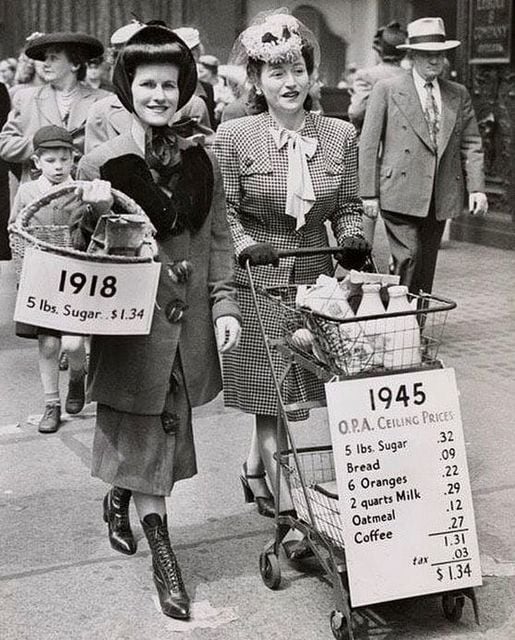
In the 1918 image, the woman’s arms are full. In the 1945 version, the haul is smaller, thinner, more packaged. Same dollar amount, same country, same basic foodstuffs. Very different world.
Those side‑by‑side photos, often colorized and shared online, are more than a fun “then vs now” meme. They are a snapshot of how war, inflation, industrial food, and women’s work changed daily life between World War I and the end of World War II.
Price comparisons across time are not just trivia. They are a simple way to see how wars and policy decisions change what ordinary families can put on the table.
Here are five things those $1.34 photos quietly reveal.
1. Inflation: Why the same $1.34 bought less by 1945
Start with the obvious: the 1918 woman is holding more food. That is inflation in action. The value of a dollar fell between World War I and World War II, and the photos make that abstract idea painfully visible.
In 1918, in the middle of World War I, $1.34 could buy a meaningful chunk of a week’s food for a small family. A pound of round steak might be around 30–35 cents. A dozen eggs could run 40–50 cents depending on region. A loaf of bread was often under 10 cents. You could walk out of a grocer’s with meat, bread, potatoes, and a few extras and still stay under $1.34.
By 1945, after the Great Depression and six years of global war, prices had climbed. Wartime price controls in the United States held some numbers down on paper, but the real cost of living still rose. A pound of round steak was closer to 40–50 cents. A dozen eggs could be 60 cents or more. Bread was still under 15 cents a loaf, but you needed more dollars to feed the same family.
Economists estimate that 1 dollar in 1918 had the purchasing power of roughly 15–20 dollars in early 21st‑century terms. By 1945, 1 dollar was closer to 15 dollars in today’s money, but the path between those two wars was not smooth. Prices spiked after World War I, then fell in the Depression, then rose again with World War II.
A concrete example: the U.S. Bureau of Labor Statistics consumer price index shows that the cost of living roughly doubled between the late 1910s and the mid‑1940s, even with wartime controls. The $1.34 experiment in the photos is a homemade version of that chart, translated into bread, meat, and canned goods.
Inflation is a rise in the general price level that reduces what each dollar can buy. The 1918 and 1945 $1.34 photos are a visual definition of inflation using groceries instead of graphs.
So what? Because those price shifts hit food first, inflation shaped daily choices about diet, work, and family size, and it pushed governments to intervene in the economy in ways that would have been unthinkable before 1914.
2. War and rationing: How $1.34 met the needs of the front
The second thing hiding in those photos is war. Both 1918 and 1945 were wartime years, and what the women are holding is not just a shopping list. It is a map of national priorities.
In World War I, the United States Food Administration, led by Herbert Hoover, urged Americans to practice “meatless Mondays” and “wheatless Wednesdays.” The goal was to free up grain and meat to ship to Allied armies and starving civilians in Europe. Rationing in the formal coupon sense was limited, but social pressure and patriotic campaigns were intense.
By World War II, the system was far more organized. From 1942 on, the U.S. Office of Price Administration issued ration books. Sugar, coffee, canned goods, meat, butter, and gasoline all required stamps. You needed both money and the right coupons to buy them. The woman in the 1945 photo is shopping inside that system.
Think of a specific kitchen: a housewife in Cleveland in 1943, ration book in hand, planning meals for a week. She might use red stamps for meat, blue stamps for canned goods, and save sugar coupons for a birthday cake. Even if she had extra cash, she could not simply buy more butter or steak. The state had entered her pantry.
The $1.34 comparison misses something important here. In 1918, $1.34 might buy more calories, but the U.S. was only beginning to experiment with food controls. By 1945, the dollar amount matters less than the ration book. The smaller pile in the later photo reflects not only higher prices but also the fact that certain foods were reserved for soldiers and allies.
Rationing was a system of controlled distribution of scarce goods during wartime. It limited what civilians could buy so that armies and war industries got first claim on resources.
So what? The rationing system turned private shopping into a patriotic act and normalized the idea that the federal government could manage prices and supplies, a habit that would shape postwar debates about welfare, subsidies, and economic planning.
3. Industrial food: From sacks of flour to branded cans
Look closer at the photos and you see another change. The 1918 haul leans heavy on bulk staples: flour, potatoes, maybe a hunk of cheese wrapped in paper. The 1945 version has more branded packaging, tins, and processed items. Same dollar, different kind of food.
Between the wars, American food production industrialized at high speed. Canning expanded. Refrigerated rail cars spread perishable goods across the country. Companies like Campbell Soup, Kraft, and General Foods turned what used to be home tasks into factory products. By the 1940s, you could buy boxed macaroni and cheese, canned spaghetti, and powdered desserts instead of making everything from scratch.
Take one example: Kraft processed cheese. James L. Kraft patented a method for processed cheese in 1916. By the 1930s and 1940s, Kraft cheese products were standard items in American pantries and military rations. They were cheap, lasted longer than fresh cheese, and fit perfectly into rationing and mass feeding.
Industrial food did not just respond to war. It fed it. The U.S. military needed shelf‑stable, calorie‑dense, easily shipped rations. Canned meat, powdered eggs, instant coffee, and dehydrated soups all grew out of that demand. After the war, those same products followed soldiers back into civilian kitchens.
By 1945, $1.34 might buy fewer pounds of food, but more of it would be processed and branded. That meant more salt, sugar, and preservatives, but also less time spent cooking from raw ingredients.
Processed and packaged foods shifted the balance from home production to factory production of meals. They turned cooking into assembly and made national brands part of everyday life.
So what? The shift toward industrial food changed not just what families ate but who had power in the food system, moving control from local farmers and home cooks to national corporations and federal regulators.
4. Women’s work: From home cooks to wage earners
Those two women with their $1.34 hauls are not just props. They are clues to how women’s roles changed between 1918 and 1945.
In 1918, most American women were still legally shut out of voting and many professions. Their economic power ran through the household budget. They stretched their husband’s wages, kept gardens, canned produce, and baked bread. Managing that $1.34 was part of a larger unpaid job description.
By 1945, the picture had shifted. Women had won the vote in 1920. The Great Depression had pushed many into low‑paid jobs. World War II then opened factory doors. “Rosie the Riveter” was not just propaganda. By 1944, almost 19 million American women were in the workforce, many in war industries.
Imagine a woman in Detroit in 1943, working at the Ford Willow Run plant building B‑24 bombers. She earns her own paycheck, buys her own groceries, and stands in line with her ration book after a shift. Her $1.34 is not her husband’s money. It is hers.
At the same time, wartime propaganda still framed shopping and cooking as patriotic duties. Government pamphlets taught women how to plan “victory meals” that met nutrition guidelines while using rationed ingredients. The female shopper was cast as a home‑front quartermaster.
So the 1945 woman in the photo is juggling two roles that would have been rarer in 1918: wage earner and ration‑book strategist. The smaller pile of food is not just about inflation. It is about a world in which women’s time and labor are being pulled in new directions.
Women’s growing participation in paid work changed how much time they could spend cooking from scratch and how they thought about convenience foods and eating out.
So what? The shift in women’s economic power and time use helped drive demand for processed food, reshaped family dynamics, and fed postwar debates over gender, domesticity, and who controlled the household budget.
5. Inequality and “average” prices: Who could afford that $1.34?
There is one more thing those photos hide: not everyone in 1918 or 1945 had the same $1.34 to spend. The images show a kind of average consumer, but real families lived on very different budgets.
In 1918, wage gaps were stark. Industrial workers, farm laborers, and domestic servants earned far less than skilled tradesmen or professionals. Black Americans, immigrants, and women were clustered in the lowest‑paid jobs. For a middle‑class family, $1.34 might be a routine grocery run. For a poor family, it could be most of the week’s cash food budget.
By 1945, the U.S. had higher average wages, but inequality remained. White male workers in war industries often saw their incomes rise. Many Black workers were locked out of those jobs until civil rights pressure, including A. Philip Randolph’s threatened March on Washington in 1941, pushed President Franklin Roosevelt to issue Executive Order 8802 against defense‑industry discrimination. Even then, pay gaps persisted.
Consider a sharecropping family in Mississippi in 1945. They might be paid in crop shares rather than cash, buy food on credit at the plantation store, and face inflated prices that never matched official government lists. For them, the $1.34 experiment was almost theoretical. Their problem was not how much food $1.34 could buy, but how rarely they had $1.34 in hand.
Average price comparisons often erase these differences. A statistic like “the cost of living doubled between 1918 and 1945” hides the fact that some families could absorb that change and others could not. Relief programs in the New Deal era, like food stamps (first tested in 1939) and school lunch programs, grew out of that gap between official prices and real hunger.
So what? The neat $1.34 side‑by‑side photos risk turning history into a flat meme, but they also open the door to asking who had money, who did not, and how policy choices widened or narrowed that gap.
The two women with their $1.34 groceries are not just before‑and‑after models. They are bookends on a period when the United States fought two world wars, endured a depression, invented mass consumer culture, and pulled millions of women into paid work.
In 1918, $1.34 bought more food, but in a world where women could not vote, where federal power over the economy was limited, and where industrial food was just emerging. By 1945, the same $1.34 bought less, but in a country with ration books, national brands, women in factories, and a federal government deeply entangled in daily life.
That is why those colorized images keep circulating online. They give a simple, almost childlike question, “What can this amount of money buy?,” a very adult answer about war, work, and who gets to eat well. The pile of groceries shrank, but the story behind that shrinkage is about how modern America was built.
Frequently Asked Questions
What did $1.34 buy in 1918 compared to 1945?
In 1918, $1.34 could buy a substantial mix of staples like meat, bread, eggs, and potatoes, enough to cover a big part of a small family’s food needs for several days. By 1945, due to inflation and wartime rationing, the same $1.34 bought fewer items and more processed, packaged foods, and purchases were limited by ration coupons as well as cash.
How much has $1 from 1918 or 1945 changed in value today?
Estimates vary, but economists generally put 1 US dollar in 1918 at roughly 15–20 modern dollars in purchasing power. A 1945 dollar is often estimated around 15 modern dollars. Exact conversions depend on what index you use, but both periods show that the nominal dollar amount hides big changes in what people could actually buy.
Did World War II rationing make food cheaper or more expensive?
World War II rationing in the United States was designed to keep basic foods available and to prevent runaway price spikes. Official prices were controlled, and ration coupons limited how much civilians could buy. That held some prices down on paper, but shortages, black markets, and changing wages meant that many families still felt food as more expensive in practice.
Why do old photos compare grocery prices like $1.34?
Photos showing what a fixed amount like $1.34 could buy were often used by newspapers, advertisers, or government agencies to make economic changes visible to the public. They turned abstract issues like inflation, rationing, or wage changes into something people could see in a single glance: more or fewer groceries in someone’s arms.