On a hot day in 1965, a photographer caught Johnny Cash walking out of a Texas courthouse with his wife at his side. He had just pleaded guilty to a minor drug charge. The picture that ran in newspapers across the South did not spark outrage over pills or fame or sin. It was his wife’s face that did it.
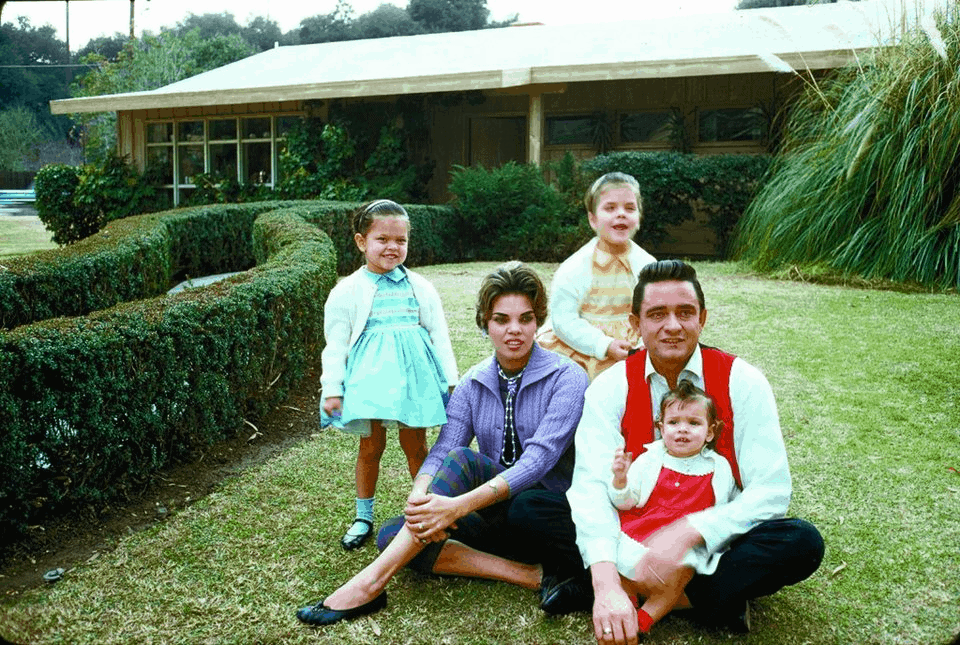
Vivian Liberto Cash, dark-haired and olive-skinned, looked to many white Southerners like a Black woman. Within days, the hate mail started. White supremacists accused Johnny Cash of being in an illegal interracial marriage. The Ku Klux Klan printed her photo in their newspaper. Death threats followed.
Vivian Liberto was the Italian-Irish first wife of Johnny Cash. In the mid-1960s she became the target of a racist panic, not because of who she was, but because of what white America thought she looked like. Her story exposes how race in the United States has never just been about ancestry. It has been about perception, power, and fear.
Who was Vivian Liberto before she became “Johnny Cash’s wife”?
Vivian Dorraine Liberto was born in 1934 in San Antonio, Texas, to Thomas Liberto and Irene Robinson. Her father was the son of Sicilian immigrants. Her mother was mostly German and Irish. On paper, she was a white Catholic girl from a white Catholic family in a segregated city.
She grew up attending white schools in a Jim Crow South that sorted people relentlessly by race. School records, church life, neighborhood lines, all told her and everyone around her the same thing: she was white. That classification would later be used as legal ammunition.
In 1951, at a San Antonio roller skating rink, 17‑year‑old Vivian met a lanky 19‑year‑old Air Force recruit named J.R. Cash. He was about to be shipped to West Germany. They skated, talked, and within three weeks they were engaged in the kind of whirlwind young romance that fills old shoeboxes with letters.
For three years, while Cash was stationed overseas, they wrote each other constantly. Hundreds of letters, sometimes several a day. Those letters, which she kept, later became the backbone of her memoir, I Walked the Line: My Life with Johnny.
When Cash came home in 1954, they married in a Catholic ceremony in San Antonio. Her uncle, a Roman Catholic priest, officiated. The marriage certificate listed her as white. No one in that church, in that city, in that era, questioned it.
Their early years show how firmly she was understood as white in her own time. That baseline matters because it exposes how quickly and violently that status could be challenged when a photograph hit the wrong audience.
How did Johnny and Vivian’s marriage unravel?
After the wedding, the young couple moved to Memphis, then to California as Johnny’s music career took off. Between 1955 and 1961, Vivian gave birth to four daughters: Rosanne, Kathy, Cindy, and Tara. While he toured, she changed diapers, paid bills, and tried to build a stable home in a life that was anything but stable.
Johnny Cash’s rise was fast and messy. The hit records came. So did amphetamines and barbiturates, grueling tour schedules, and a growing mythology around the “Man in Black.” Vivian watched him disappear into the road and the pills, then reappear as a stranger.
By the early 1960s, the marriage was fraying. Cash was using drugs heavily and cheating on Vivian, including with June Carter, who traveled with him on the road. Vivian, rooted in Catholicism and a traditional sense of marriage, tried to hold the family together. She did not seek the spotlight. She stayed home in California, raising four girls while her husband’s public life grew louder and wilder.
They separated in 1962. Even then, she did not walk away. When he was arrested in October 1965 in El Paso, Texas, for bringing pills across the border from Mexico, she flew in to support him in court. She believed, or wanted to believe, that he could still be saved.
Their unraveling matters because it set the stage for that courthouse photo. Vivian had spent a decade deliberately out of public view. The first time most of America saw her face was not at a concert or a family portrait. It was outside a courthouse, attached to a scandal.
Why did a single courthouse photo trigger white supremacist rage?
When newspapers published the photo of Johnny and Vivian leaving the El Paso courthouse, readers saw a famous country singer and a woman many had never known existed. Her dark hair, olive skin, and facial features led some white Southerners to a conclusion: she must be Black or of mixed race.
In 1965, interracial marriage was still illegal in 16 states, mostly in the South. The Supreme Court would not strike those bans down until Loving v. Virginia in 1967. In that legal and cultural climate, the idea that a white country star might be married to a Black woman was not just gossip. It was framed as criminal and moral outrage.
White supremacist groups seized on the image. The Ku Klux Klan’s newspaper reportedly ran the photo, accusing Cash of violating segregation laws and betraying the white race. They called for boycotts of his records and concerts. Cash, already disliked in some circles for speaking up for Native Americans, became an even bigger target.
Johnny Cash had publicly supported Native American rights, including with his 1964 concept album Bitter Tears: Ballads of the American Indian. That alone had already angered segregationists and hardline racists. The idea that he might also be in an interracial marriage fit neatly into their narrative that he was a race traitor.
Hate mail and death threats poured in. According to later accounts from their daughters, Vivian was terrified that the KKK might attack or kill her. She had not sought fame, yet now her face was on racist flyers and in hate publications, her safety suddenly a matter of public rage and private fear.
This moment matters because it shows how racial identity in America could be weaponized based on a photograph and a rumor. It also reveals how celebrity could drag a private person into the crosshairs of organized hate.
How did Johnny Cash’s team “prove” Vivian was white?
Under siege, Johnny Cash’s manager, Saul Holiff, went into damage-control mode. He did not argue that interracial marriage bans were unjust. He argued that they did not apply. His strategy was to prove, on paper and in public, that Vivian was white.
Holiff gathered evidence: Vivian’s birth certificate, school records from segregated white schools, the marriage certificate listing her as white. He compiled her family background, pointing to her Sicilian and German-Irish ancestry. He presented this to the press as a kind of racial audit.
In other words, Cash’s camp fought racism with a different kind of racism. They did not challenge the idea that marrying a Black woman should be controversial. They insisted that Johnny had not done that. The argument was not “this law is wrong,” but “this law does not apply to us.”
That strategy worked in a narrow sense. The immediate controversy cooled. Promoters in the South, reassured that Cash was not breaking miscegenation laws, booked him. The Klan’s campaign lost momentum. The family, at least on that front, could breathe a little easier.
Yet the episode left scars. Vivian had been publicly dissected as a racial object. Her looks, her ancestry, her paperwork, all turned into evidence in a trial she never asked for.
This response matters because it captures how even those under attack often had to argue within the racist rules of the game. To protect Vivian and Cash’s career, the team reinforced the very system that had put her in danger.
Did Vivian Liberto actually have African ancestry?
For decades, the story ended with the manager’s paperwork and the family’s insistence that Vivian was white. Then, in 2023, their daughter Rosanne Cash went on Henry Louis Gates Jr.’s genealogy TV show Finding Your Roots. Gates specializes in using DNA and archival research to map family histories.
On the show, Gates told Rosanne that her mother’s family tree included a Black ancestor several generations back. The details, as aired, suggested that somewhere in the 19th century, one of Vivian’s forebears was Black. That would mean Vivian was, by blood, part Black, though far removed.
Genealogical findings like this are not unusual in the American South, where centuries of slavery, sexual violence, and passing created tangled family trees. What is striking is how neatly this revelation intersects with the 1965 panic. White supremacists had attacked Vivian on the basis of appearance and rumor. Decades later, science suggested that their guess about some African ancestry, in a very distant sense, was not entirely wrong.
That does not vindicate them. It exposes how absurd the whole system was. In the 1960s, many Southern states used the “one-drop rule,” treating any Black ancestry as enough to classify someone as Black. A woman whose life experience, community, and legal documents all said “white” could be reclassified based on a photo and a whisper.
Rosanne Cash has spoken about how the Finding Your Roots revelation complicated her understanding of her mother’s story. It added another layer to a life already shaped by race, even when that race was misread and weaponized.
This matters because it shows how American ideas about race have always been both biological fiction and social reality. Vivian’s case reveals how ancestry, appearance, and law collided in one woman’s life.
What happened to Vivian after the divorce from Johnny Cash?
By the time the racial controversy cooled, the marriage was beyond repair. Johnny and Vivian divorced in 1966. Two years later, in 1968, both remarried. He married June Carter, his fellow performer and long-time emotional partner. Vivian married Dick Distin, a police officer in Ventura, California.
Vivian built a quieter second life. She raised her daughters, stayed active in her Catholic parish, and kept a distance from the music industry that had brought her so much pain. She and Distin stayed married until her death in 2005.
Her relationship with Johnny did not end entirely with the divorce. Over the years, as he battled addiction and then found a measure of stability, they reached a kind of peace. Their daughters moved between households. Family events brought them into the same rooms. By many accounts, they developed a friendly, if complicated, relationship that lasted until Johnny’s death in 2003.
In the early 2000s, Vivian decided to tell her side of the story. With help, she shaped those old love letters and her memories into a memoir, I Walked the Line: My Life with Johnny. Johnny, before his death, had reportedly supported her desire to publish it. The book came out in 2007, two years after she died from complications after lung cancer surgery.
Shortly before her death, according to one of her daughters, Vivian admitted that she was still in love with Johnny Cash. That confession, if accurate, adds a human ache to a story often flattened into gossip about a famous man and his two wives.
Her later life matters because it reminds us that she was more than a footnote in Johnny Cash’s legend or a face in a racist panic. She was a woman who rebuilt her life, kept her faith, and raised four daughters while carrying the weight of a very public hurt.
How does Vivian Liberto’s story change how we see Johnny Cash and race in America?
Johnny Cash’s public image has often leaned on redemption arcs and rebel mythology. The story of Vivian Liberto complicates that. It shows a young star whose private failures helped wreck a marriage, and a management team that fought racist attacks by appealing to racist laws.
It also widens the frame. Vivian’s harassment was not just about one celebrity couple. It was a case study in how white supremacy policed the boundaries of whiteness. A Catholic woman of Sicilian, German, and Irish descent could become a target because her face did not fit a narrow, Anglo ideal.
Her story also exposes how women attached to famous men often absorb the collateral damage. Johnny Cash chose to speak out for Native Americans. He chose a public life. Vivian did not. Yet she was the one whose safety was threatened, whose ancestry was dissected, whose very right to be married was questioned.
Today, Vivian Liberto’s life sits at the intersection of several conversations: about colorism, about the “one-drop rule,” about how Southern Europeanness was once suspect in American racial hierarchies, and about how celebrity magnifies private vulnerabilities. Her story is a reminder that race in the United States has always been less a clear category and more a weapon, pointed where it is politically useful.
That is why a single courthouse photograph in 1965 mattered. It turned a quiet woman into a symbol, exposed the violence under segregation-era respectability, and left a paper trail that still forces us to ask who gets to be called white, and why.
Frequently Asked Questions
Who was Johnny Cash’s first wife, Vivian Liberto?
Vivian Liberto was Johnny Cash’s first wife, born in 1934 in San Antonio to a Sicilian American father and a German-Irish mother. They met in 1951, married in 1954, had four daughters, and divorced in 1966 as his drug use and infidelity worsened.
Why did people think Johnny Cash’s first wife was Black?
After a 1965 drug possession hearing in El Paso, a newspaper photo showed Johnny Cash leaving court with Vivian. Her dark hair and olive skin led some white Southerners to assume she was Black or biracial, sparking racist outrage in a region where interracial marriage was still illegal.
Did the Ku Klux Klan target Johnny Cash and Vivian Liberto?
Yes. White supremacists, including the Ku Klux Klan, used the 1965 courthouse photo to accuse Cash of being in an illegal interracial marriage. They called for boycotts, spread her image in hate publications, and the couple received hate mail and death threats.
Did Vivian Liberto actually have African ancestry?
Decades later, on the TV show Finding Your Roots, genealogist Henry Louis Gates Jr. told their daughter Rosanne Cash that Vivian’s family tree included a Black ancestor several generations back. That finding complicates her story but does not justify the racist attacks she endured in the 1960s.