In the grainy 1856 photograph, the giant stone face of Ramesses II stares past the camera, expression fixed in royal calm. On his lap, a European man stands casually, boots planted on the pharaoh’s thighs as if he has climbed a boulder on a country walk.
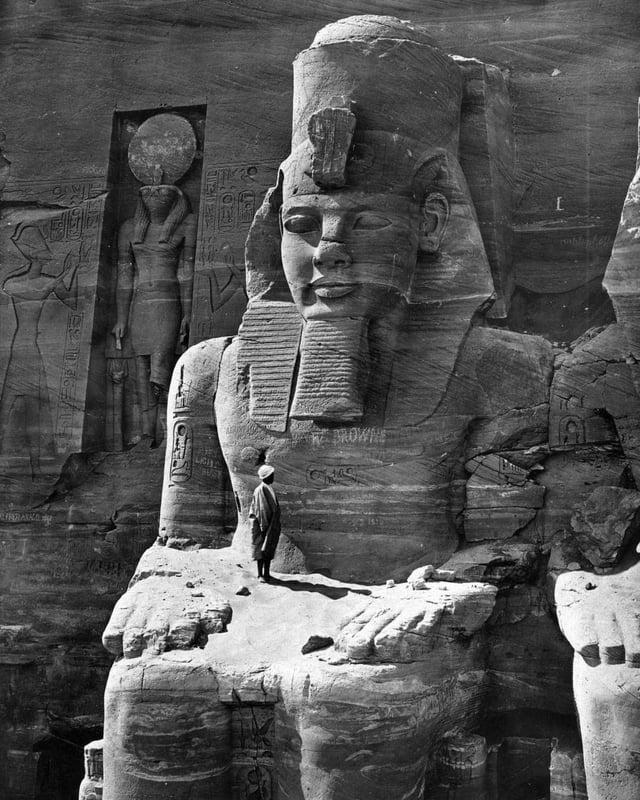
No guard rails. No ropes. No signs. Just a tourist using a 3,000-year-old king as a viewing platform.
That image, shared online today, looks shocking. But in the mid‑19th century, this was normal. Early visitors to Egypt climbed on statues, chipped off souvenirs, and posed on monuments that modern archaeologists treat like intensive care patients.
This is a story about what that photo really shows: the birth of mass tourism to ancient Egypt, the casual damage it caused, and the colonial mindset behind it. By the end, you will see why a man on Ramesses’ lap in 1856 is not just a quirky old photo, but a snapshot of how the modern world first met the ancient one.
What was going on in that 1856 Ramesses photo?
The photo shows a European traveler standing on the lap of a colossal statue of Ramesses II, probably at Thebes (modern Luxor) or one of the major temple sites along the Nile. The exact photographer and tourist are uncertain, but the date, 1856, fits the early era of photography in Egypt.
By the 1850s, Egypt had become a destination for wealthy European and American travelers. They arrived by steamship, hired local boat crews to sail them up the Nile, and visited temple sites with guides and dragomans (interpreters). Photography was new, expensive, and slow, so early photos often doubled as status symbols and souvenirs.
In that context, standing on Ramesses was not seen as vandalism. It was a way to show scale, bravado, and proximity to the ancient world. The statue was a prop. The real subject was the tourist and his adventure.
Early tourists in Egypt often treated ancient monuments like outdoor scenery rather than fragile archaeological sites. That attitude shaped how much was lost, damaged, or exported from Egypt in the 19th century.
What set it off: Why did Western tourists swarm ancient Egypt?
Three big forces pushed Westerners toward Egypt in the early 1800s: Napoleon, steam power, and Orientalist fantasy.
First, Napoleon’s invasion of Egypt in 1798, though a military failure, turned ancient Egypt into a European obsession. His army brought scholars and artists who recorded temples, inscriptions, and ruins. The multi-volume Description de l’Égypte, published from 1809 onward, filled Europe with engravings of colossal statues and hieroglyph-covered walls. Egypt stopped being a biblical backdrop and became a place you could recognize and, if you had money, visit.
Second, steamships and new routes made the journey easier. By the 1840s and 1850s, British and French steamship companies were running regular services to Alexandria. Thomas Cook, the British travel entrepreneur, organized his first Nile tour in 1869. Even before Cook’s package tours, the trip had become manageable for the upper middle classes, not just aristocrats and diplomats.
Third, there was the fantasy. Romantic writers and painters fed a European appetite for the “Orient” as exotic, timeless, and available for Western consumption. Egypt, with its ruins and desert, fit perfectly. Travelers wrote about it as a place outside of history, frozen since the pharaohs, which made climbing a statue feel less like damaging a national monument and more like walking on a fossil.
All of this unfolded within a colonial frame. Egypt in the mid‑19th century was formally under Ottoman suzerainty and ruled by the Muhammad Ali dynasty, but British and French influence was heavy and growing. Many Western visitors moved through the country with the confidence of people who expected the world to accommodate them.
So by 1856, when a European man stepped onto Ramesses’ lap for a photograph, he was acting out a new role: the imperial-age tourist, treating the ancient world as both playground and trophy cabinet.
The turning point: From souvenir hunting to preservation
To modern eyes, the man on the statue looks like he is committing a small crime. In his own time, he was behaving like most visitors. The real change came later, as archaeology professionalized and the damage became impossible to ignore.
In the early 1800s, the line between archaeologist and treasure hunter was thin. Men like Giovanni Battista Belzoni, an Italian strongman turned explorer, blasted and levered colossal statues out of temples to ship them to Europe. The famous head of Ramesses II in the British Museum was removed from Thebes in 1816 with brute force and a lot of grease. Locals and foreign collectors hacked off reliefs and statues. Tourists chipped away at walls for keepsakes.
Photography changed the game. Early photographers such as Maxime Du Camp and Francis Frith documented temples and statues in the 1840s and 1850s. Their images circulated widely and made the damage visible. You could compare plates and see fresh scars, missing heads, new graffiti.
At the same time, scholars like Auguste Mariette, a French archaeologist who became head of Egyptian antiquities in the 1850s, began pushing for controls. Mariette founded the Egyptian Antiquities Service in 1858 and tried to stop uncontrolled digging and export. Laws were uneven and often ignored, but a new idea was taking shape: ancient monuments were not just quarries or souvenir shops, they were a finite record that needed protection.
By the early 20th century, climbing on statues and chipping off pieces had gone from normal to frowned upon to illegal. The shift was slow and uneven, but it happened. The 1856 photo sits near the end of the old era, when the ancient world was still treated like a giant, ownerless ruin.
The move from souvenir hunting to preservation changed what survived of ancient Egypt, and it shaped the rules and ethics that now govern archaeology worldwide.
Who drove it: Tourists, scholars, and Egyptian power brokers
Several groups of people, with very different motives, converged on those statues of Ramesses.
First were the tourists themselves. In the 1850s, they were mostly wealthy Europeans and Americans: writers, artists, clergymen, minor aristocrats, and merchants with money. They traveled with trunks of clothes, servants, and sometimes their own photographers. Many left diaries and travelogues describing climbing pyramids, scrambling over temple roofs, and sitting on statues. They rarely saw themselves as doing harm. They saw themselves as brave and cultured.
Then there were the scholars and early Egyptologists. People like Jean‑François Champollion, who deciphered hieroglyphs in the 1820s, and Karl Richard Lepsius, who led a Prussian expedition in the 1840s, treated the monuments as texts to be read and copied. They often relied on the same local labor and methods as treasure hunters, but their goals were different. They wanted knowledge, not just trophies. Their work, and the photographs that followed, made the ancient sites legible to a wider audience.
Local Egyptians were not just background figures. Boatmen, dragomans, guards, and laborers made these tours possible. Some helped tourists climb statues or reach high reliefs. Others tried to protect sites or restrict access, especially as the Egyptian state began to care more about antiquities. The rulers of Egypt, from Muhammad Ali to Isma’il Pasha, saw ancient monuments as both a source of prestige and a bargaining chip. They granted and denied excavation rights, gifted obelisks to European powers, and later backed preservation projects.
Finally, colonial powers hovered over everything. British and French diplomats and soldiers moved through the same spaces as tourists and scholars. Their governments pressured Egypt for economic and political concessions, especially after the Suez Canal opened in 1869. The ease with which foreign museums acquired Egyptian artifacts was tied directly to that imbalance of power.
The man on Ramesses’ lap was just one individual, but he was standing on a structure of tourism, scholarship, local labor, and imperial politics that shaped what we see in museums and at archaeological sites today.
What it changed: From casual damage to global heritage
The behavior captured in that 1856 photo had long-term consequences for Egypt’s monuments and for how the world thinks about ancient heritage.
First, there was physical damage. Climbing, scraping, and souvenir hunting weakened statues and reliefs that had already endured thousands of years of weathering. Graffiti carved by 19th‑century visitors still scars temple walls. Some of it is now treated as historical in its own right, but it came at a cost to the original art.
Second, the era of casual access fed a massive outflow of artifacts. Colossal statues, obelisks, mummies, and small objects left Egypt in huge numbers. Many were legally exported under the rules of the time, often through partage systems that split finds between Egypt and excavating missions. Others were simply smuggled. The result is the global spread of Egyptian artifacts in museums from London to New York to Berlin.
Third, the shock of that damage helped create the idea of “world heritage.” As more people saw photographs and read accounts of crumbling statues and looted tombs, calls grew for protection. By the mid‑20th century, organizations like UNESCO were framing ancient sites as a shared human inheritance. The rescue of the temples of Abu Simbel in the 1960s, when they were cut and moved to avoid flooding from the Aswan High Dam, was a direct descendant of the preservation mindset that began forming in the 19th century.
Finally, the old attitudes baked in some lasting problems. Debates over repatriation of Egyptian artifacts, questions about who gets to control and interpret ancient heritage, and the tourist pressures that still threaten sites like Luxor and Giza all trace back to this first great wave of visitors who treated the ancient world as theirs to climb and collect.
The 1856 photo is a small moment, but it sits at the hinge between an era of near-total disregard and a slow awakening to the idea that ancient monuments are not just props, but fragile evidence of past lives.
Why it still matters: Seeing the statue, and ourselves, clearly
When people online react to that old photo with disbelief or anger, they are really reacting to a clash of values. We live in a world where touching a museum object can get you ejected. He lived in a world where a pharaoh’s lap was a scenic overlook.
That gap tells us how much attitudes have shifted. Archaeological ethics, conservation science, and national heritage laws have turned ancient monuments from playgrounds into protected sites. The idea that you might climb a 3,000‑year‑old statue for fun now feels absurd. That is progress, but it is recent.
The image also forces a look at the colonial context of early Egypt tourism. The man on Ramesses is not just being careless. He is acting out a sense of entitlement to another country’s past. That same entitlement helped fill Western museums and shaped which stories about ancient Egypt were told, and which were ignored.
At the same time, the photograph is a historical source. It shows the condition of the statue in 1856. It records clothing, posture, scale, and the casual norms of the time. Conservationists and historians use such images to track erosion and past repairs. What looks like a thoughtless snapshot is also data.
So when you see that man on Ramesses’ lap, you are looking at more than bad tourist behavior. You are seeing the early days of mass tourism, the birth of Egyptology as a public fascination, and the long shadow of empire on the ancient world.
And you are seeing a reminder that the way we treat the past is not fixed. It changes. One day, someone may look at our own travel photos and wonder how we ever thought that was acceptable.
Frequently Asked Questions
Why were people allowed to climb on Egyptian statues in the 1800s?
In the 1800s, ancient Egyptian sites were not managed as tightly controlled archaeological parks. Tourism was new, conservation laws were weak or unenforced, and many visitors saw monuments as rugged ruins rather than fragile artifacts. Climbing statues or pyramids was considered part of the adventure, not vandalism, and local guides often helped because it pleased paying clients.
When did Egypt start protecting its ancient monuments?
Serious protection efforts began in the mid‑19th century. In 1858, Auguste Mariette helped create the Egyptian Antiquities Service, which tried to regulate excavations and exports. Over the late 19th and early 20th centuries, Egypt introduced laws restricting removal of artifacts and controlling access to sites. Modern-style conservation and site management, with strict rules for tourists, took shape in the 20th century.
How did early tourism affect ancient Egyptian artifacts?
Early tourism contributed to both damage and documentation. Visitors climbed on monuments, carved graffiti, and bought or removed artifacts, which weakened structures and stripped sites. At the same time, travelers, artists, and photographers recorded temples and statues in detail. Their images and notes now help archaeologists track what has been lost and how monuments have changed over time.
Why are so many Egyptian artifacts in European museums?
During the 19th and early 20th centuries, European and American expeditions excavated extensively in Egypt, often under colonial pressure and unequal agreements. Artifacts were removed through legal partage systems that split finds between Egypt and foreign missions, diplomatic gifts like obelisks, and outright smuggling. Weak local control and strong foreign demand meant many objects ended up in museums abroad, which is why repatriation debates are so intense today.