He stands on a London pavement in 1877, a wooden box at his side, a hand-painted sign promising relief from coughs, burns and inflamed eyes. His coat is worn but tidy. His gaze is slightly unfocused. Once he drove carriages for a city firm. Failing sight pushed him off the payroll and onto the street.
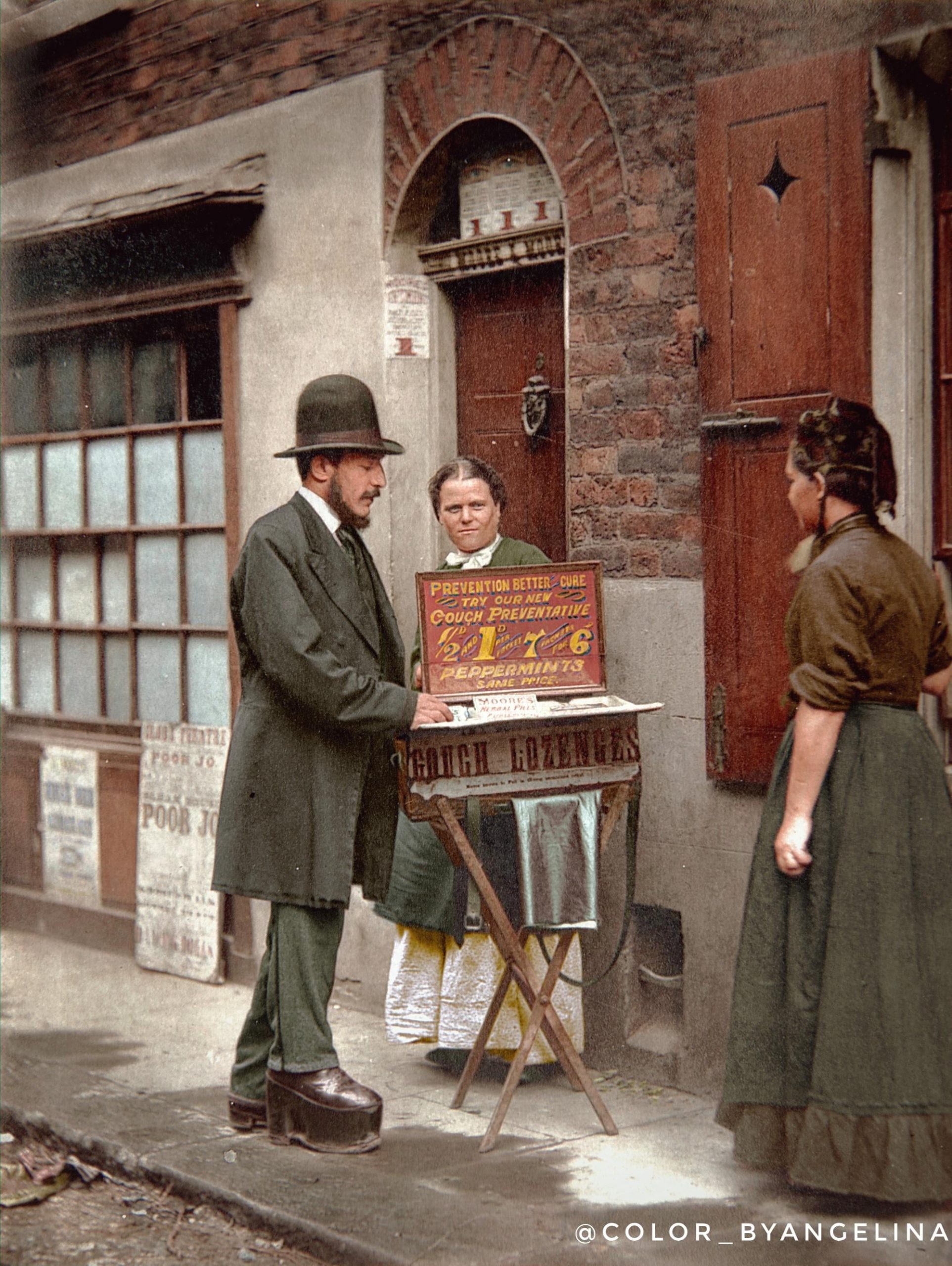
Now he is a “street doctor,” selling cough lozenges and something grandly named “Arabian Family Ointment” to anyone who will stop and listen.
The colorized photograph that circulates online today comes from Street Life in London, the 1877 project by photographer John Thomson and writer Adolphe Smith. It shows a man who is both ordinary and emblematic. He is one of thousands of Londoners who survived by selling cheap remedies in the open air, operating in the gap between formal medicine and everyday need.
A Victorian street doctor was a self-employed seller of cheap medicines who worked the pavements, markets and alleys of the city. He mixed sales pitch with medical advice, targeting the poor who could not afford regular doctors. His world tells us a lot about how people coped with illness, poverty and distrust of authority in late 19th century London.
What was a Victorian street doctor, really?
The man in the 1877 photograph is not a licensed physician. He is a street vendor of patent medicines, part-healer, part-hawker, part-showman.
Victorian “street doctors” were usually unqualified sellers of home-made or bought-in remedies. They worked outside the formal medical system, offering ointments, pills, tonics and lozenges. Some claimed exotic origins for their products: “Arabian,” “Indian,” “American,” anything that sounded mysterious and powerful.
In the quoted passage, the vendor explains his trade in plain terms:
“I find the most of my customers in the street, but I am now making a private connexion at home of people from all parts of London. The prices for the Arabian Family Ointment, which can be used for chapped hands, lips, inflamed eyes, cuts, scalds, and sores, are from a penny to half-a-crown a box. Medicated cough lozenges a halfpenny and a penny a packet.”
That short speech tells us a lot. He works both in public and from home. He has repeat customers. His goods are cheap enough for the poor, but the top price of half a crown (2 shillings and 6 pence) is a serious outlay for a working family. His ointment is marketed as a cure-all: skin, eyes, burns, sores. His lozenges are pitched as medicine, not sweets.
Victorian street doctors were part of the wider patent medicine trade, a huge industry selling branded remedies without prescription. The difference is that street doctors did not have shopfronts or big newspaper ads. Their pharmacy was a box, a barrow or a stall, and their marketing was their own voice.
Seeing them clearly matters because they filled a real medical role for people who had few other options, blurring the line between quackery and care.
What set it off: why did street medicine flourish in Victorian London?
Street doctors did not appear out of nowhere. They thrived in a specific city with specific problems.
First, there was poverty on a scale that is hard to exaggerate. In the 1870s, London had more than 3 million people. A large share lived in overcrowded slums in areas like the East End, Southwark and parts of Westminster. Casual labor, irregular wages and no welfare state meant that sickness could push a family into destitution within weeks.
Formal medical care existed, but it was fragmented and often out of reach. There were charitable hospitals and dispensaries, but they had limited beds, long waits and strict rules. Poor Law infirmaries were tied to the hated workhouse system. To get care you might have to enter the workhouse, lose your independence and accept a stigma that many feared more than illness.
Private doctors charged fees. Even a single visit could equal several days’ wages for a laborer. Middle-class families might scrape together the money. The very poor often did not even try.
Second, the 19th century saw a boom in patent medicines. Before modern drug regulation, almost anyone could mix herbs, alcohol, opium, sugar and flavorings, give the mixture a catchy name and sell it as a cure for everything. Newspapers were full of ads for “cure-alls.”
Street doctors were the low-budget, face-to-face end of that trade. Instead of glossy adverts, they used personal testimony, patter and the authority of their own story. A man who had “been cured” by a certain ointment might start selling it himself.
Third, there was a deep mistrust of official medicine. Victorian doctors bled patients, prescribed harsh purgatives and sometimes did more harm than good. Germ theory was only just gaining ground in the 1870s. Many people believed in traditional remedies, herbal cures and “old wives’” knowledge as much as, or more than, professional advice.
Street doctors slotted neatly into this world. They offered something familiar, cheap and immediate, no appointment needed.
This matters because it shows that the street doctor was not just a colorful character. He was a product of structural poverty, weak public health systems and a booming unregulated medicine market.
The turning point: documenting street life in 1877
Most Victorian street vendors left no written record. They did not write memoirs. Census entries might list them vaguely as “hawker” or “general dealer.” Without someone paying attention, their lives would vanish.
The turning point for our street doctor is that he was noticed. In the mid-1870s, Scottish photographer John Thomson and radical journalist Adolphe Smith set out to document London’s poor. Their series, Street Life in London, ran first as monthly articles from 1876, then as a book in 1877.
Thomson used relatively new photographic technology to capture people in their working environments. Smith interviewed them and wrote essays that mixed description, social commentary and the subjects’ own words. The street doctor appears as one of these case studies.
They explain that he had been a car-driver for a city firm, forced out when his eyesight failed. That detail matters. It shows how fragile working-class security was. One bodily failure, and your entire trade could vanish. There was no disability benefit. No retraining scheme. You improvised or you starved.
Thomson and Smith are not neutral observers. Smith was involved in socialist and labor politics. He used these portraits to argue that poverty was not a moral failing but a social problem. The street doctor is presented as industrious, respectable, trying to maintain dignity by working for himself.
By photographing and quoting him, they turned a nameless vendor into a documented life. That single act of attention is why we can talk about him at all today.
This matters because Street Life in London froze a moment when informal medicine, precarious work and early social reform collided, giving us rare evidence of people usually left out of the historical record.
Who drove it: the street doctor, his customers and his chroniclers
Three sets of people shaped this small story: the vendor himself, the Londoners who bought from him, and the men who recorded him.
The vendor is both salesman and patient. His failing sight pushed him into this trade. That likely shaped what he sold. Ointments for inflamed eyes and chapped skin were cheap to make and easy to market. They did not require precise dosing like some internal medicines.
His quote about building a “private connexion at home” shows ambition. He is not just shouting in the street. He is trying to build a steady client base, people who will come to his lodgings from “all parts of London.” In modern terms, he is moving from street stall to home-based practice.
His customers are mostly anonymous, but we can sketch them. They are people with sore hands from manual labor, chapped lips from winter winds, children with coughs in damp rooms, workers with minor burns from factories or kitchens. For them, a penny packet of lozenges or a small box of ointment is a manageable risk. If it helps, good. If it does nothing, at least it was cheaper than a doctor.
Many buyers probably did not fully believe the grand claims. Victorian consumers were not stupid. They balanced hope, habit and cost. A familiar vendor who treated them decently might earn more trust than a distant institution.
Then there are the chroniclers. John Thomson, born in Edinburgh in 1837, had worked in Asia before turning his camera on London. Adolphe Smith, born in France in 1846, was a committed socialist and translator. Together, they chose which street figures to show: flower sellers, cabmen, chimney sweeps, and this street doctor.
They could have mocked him as a quack. Instead, their tone is often sympathetic. They present him as a man pushed into petty entrepreneurship by physical decline and lack of options. That framing nudged middle-class readers to see him less as a fraud and more as a symptom of a sick society.
This matters because the story of the street doctor is not just about one man. It is about how ordinary Londoners improvised healthcare, and how a few observers tried to turn those improvisations into arguments for reform.
What it changed: from quack cures to regulated medicine
On the surface, one man selling “Arabian Family Ointment” did not change Victorian medicine. He was a tiny part of a huge informal market. Yet his world fed into larger shifts.
First, the sheer scale of patent medicine and street remedies pushed governments toward regulation. Britain passed the Pharmacy Act in 1868, which began to restrict the sale of dangerous poisons to qualified pharmacists. Later laws, like the Sale of Food and Drugs Acts (from 1875 onward), targeted adulteration and false claims.
These early regulations were patchy, and many quack cures survived well into the 20th century. But the direction was clear. The state was starting to see unregulated medicine as a public problem, not just a matter of buyer beware.
Second, the visibility of poverty and makeshift healthcare fed debates about public health. The same decades saw major sanitary reforms, slum clearances and the growth of municipal responsibility for clean water and sewage. If the poor were relying on street doctors, that was a sign that the system was failing them.
Third, projects like Street Life in London influenced later social investigators. Charles Booth’s famous poverty maps of the 1880s and 1890s, and Seebohm Rowntree’s studies in York, built on the idea that you could systematically document how the poor lived and use that data to argue for change.
By the early 20th century, Britain had school medical inspections, national insurance for some workers and, eventually, the National Health Service in 1948. The street doctor did not cause these reforms, but his existence was one small piece of the evidence that ad hoc, market-based medicine left many people exposed.
This matters because the world that produced the street doctor helped force the slow shift from “every man for himself” healthcare to the idea that access to treatment should not depend entirely on your wallet or your eyesight.
Why it still matters: what a colorized photo can and cannot tell us
So why are people in the 2020s fascinated enough by this image to colorize it and share it on Reddit?
Part of the appeal is visual. Colorization makes the past feel close. The man’s face looks like someone you might pass on a modern street. His sign, his box, his coat all feel less distant when they are not in sepia.
But the deeper pull is recognition. The story is familiar. A worker loses his job because of a health problem. With no safety net, he turns to self-employment, selling health-related products in a crowded market. He relies on personal branding, word of mouth and low prices. That could be a 19th-century street, or a 21st-century online marketplace.
There is also a modern echo in the way people still navigate between official medicine and informal cures. Today, the “Arabian Family Ointment” might be a herbal supplement, an essential oil blend or a wellness influencer’s product. Regulation is tighter now, and modern medicine is far more effective, but distrust, cost and access still push some people toward alternative sellers.
The photo also raises questions about how we look at poverty. Thomson and Smith wanted middle-class readers to feel sympathy and perhaps guilt. Today, we risk turning such images into aesthetic objects, stripped of context. Knowing the man’s words and situation pushes back against that flattening. He is not just “Victorian color.” He is a worker, disabled by failing sight, trying to hold onto independence.
Finally, the street doctor reminds us that history is not just about politicians and famous doctors. It is about the people who bought a penny packet of lozenges because that was all they could afford, and the people who sold them because that was all they could do.
This matters because when we look at that colorized face on a London pavement, we are looking at the long, messy struggle over who gets care, who pays for it, and what people do when the official system leaves them on the curb.
Frequently Asked Questions
What was a Victorian street doctor in London?
A Victorian street doctor was an unlicensed seller of cheap medicines who worked on the pavements and in markets, offering ointments, pills and lozenges directly to passersby. They were part of the wider patent medicine trade and filled a gap for poor Londoners who could not easily afford or access formal medical care.
Was the 1877 London street doctor a real doctor?
No. The 1877 street doctor photographed in “Street Life in London” was not a qualified physician. He had previously worked as a car-driver but lost his job because of failing eyesight. He then supported himself by selling cough lozenges and a home-made “Arabian Family Ointment” in the streets and from his home.
What was in Victorian patent medicines like Arabian Family Ointment?
The exact recipe for the “Arabian Family Ointment” is not recorded, but many Victorian patent medicines used cheap fats or waxes mixed with herbs, turpentine, camphor or other irritants. Some remedies contained alcohol or opiates. Ingredients were rarely listed, and regulation was weak, so effectiveness varied widely.
Why did poor Victorians use street doctors instead of hospitals?
Poor Victorians often turned to street doctors because formal medical care was expensive, limited and sometimes tied to the workhouse system. Charitable hospitals had strict rules and long waits. A penny packet of lozenges from a familiar vendor was cheaper, quicker and did not involve the stigma or bureaucracy of official institutions.