In 1954, a waitress in Salt Lake City smiled for the camera, holding a hamburger with a joke name: the “Uranium-Burger.” The bun was plain. The patty was ordinary beef. The radioactivity was zero. The name did all the work.
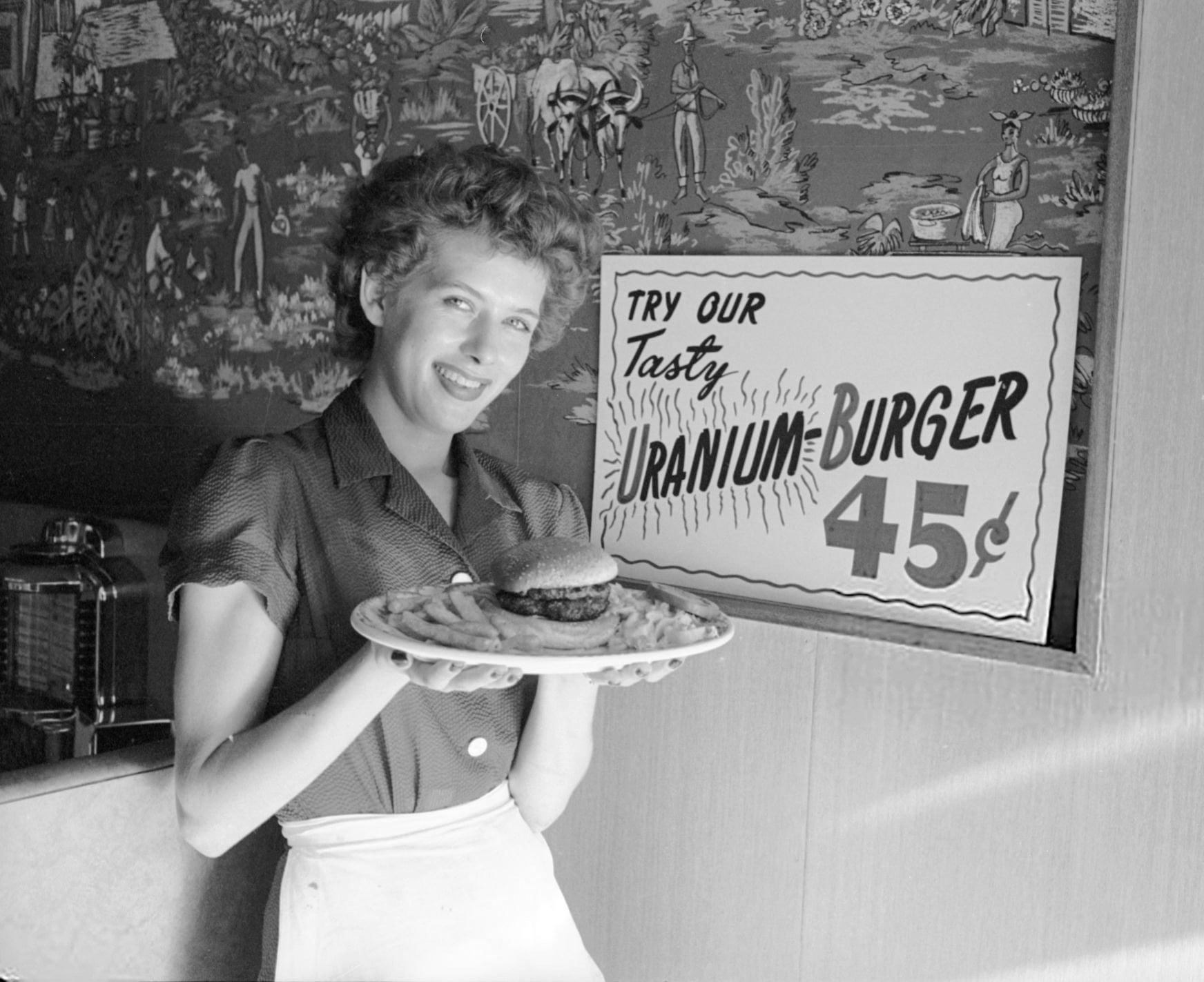
The gag only makes sense if you know what was happening outside that diner. From the late 1940s into the 1950s, the American West went through a second gold rush, except this time the treasure was uranium ore. Prospectors fanned out across Utah, Colorado, New Mexico, and Arizona, Geiger counters in hand, chasing the metal that fed nuclear weapons and promised atomic power.
The uranium burger was a marketing stunt, but it came out of a very real boom. It captured the mix of excitement, ignorance, and casual bravado that defined the early atomic age. By tracing how a hamburger got that name, you can see how Cold War fear, federal money, and Western boosterism collided on the Colorado Plateau.
Why was there a uranium “gold rush” in the 1950s?
Uranium did not suddenly appear in the 1950s. Miners had been pulling uranium-bearing ores out of the Colorado Plateau since the late 19th century, mostly for their radium and vanadium content. Radium lit up watch dials and medical devices. Vanadium hardened steel. Uranium itself was usually the unwanted byproduct.
World War II changed that. The Manhattan Project, launched in 1942, needed uranium for atomic bombs. The first priority was rich deposits in places like the Belgian Congo and Canada, but American ore from the Southwest also fed the program. For security, the government kept most of this quiet. There was no public uranium rush in the 1940s, just controlled wartime procurement.
After the war, the arms race with the Soviet Union turned uranium into a strategic resource. The newly created Atomic Energy Commission (AEC) was tasked with securing supplies. In 1948, the AEC announced a guaranteed minimum price for uranium ore and a system of bonuses for new discoveries in the United States, especially on the Colorado Plateau.
That decision lit the fuse. A government-backed price floor meant that if you could find ore that met certain standards, Washington would buy it. The AEC published maps, guides, and even how-to pamphlets for would-be prospectors. The agency set up buying stations in small Western towns. Geology became a kind of lottery ticket.
Uranium prospecting in the 1950s was a government-created boom. The AEC’s price guarantees and bonuses turned obscure rock formations into speculative assets and pulled thousands of people into the hunt.
That policy choice mattered because it shifted uranium from a niche industrial mineral into the center of a public craze, setting the stage for both economic booms and long-term health disasters.
How did uranium fever hit Utah and Salt Lake City?
The best uranium deposits in the United States lay in the Four Corners region: southeastern Utah, southwestern Colorado, northwestern New Mexico, and northeastern Arizona. Names like Moab, Monticello, and Grants became synonymous with yellowcake and Geiger counters.
Utah, with its long mining history and friendly state government, leaned into the rush. By the early 1950s, Moab was calling itself the “Uranium Capital of the World.” Prospectors in battered trucks dragged Geiger counters over sandstone mesas, camping rough and dreaming of striking a rich vein. Some did. Many did not.
Salt Lake City sat hundreds of miles from the richest ore bodies, but it was the state’s financial and political hub. It was where mining companies incorporated, where stockbrokers sold shares in hopeful ventures, and where newspapers hyped the next big strike. The city became the nerve center of what locals sometimes called “uranium fever.”
Newspapers ran breathless stories about schoolteachers who quit their jobs to prospect, or ranchers who found ore while fixing a fence. Ads pushed “penny uranium stocks” to small investors. Some companies were legitimate exploration outfits. Others were little more than letterheads and a hole in the ground.
In this atmosphere, uranium was not just a mineral. It was a brand. Slapping the word on anything suggested modernity, excitement, and a whiff of danger, but in a fun, cartoonish way. Diners, motels, and roadside attractions joined in. A “Uranium-Burger” in a Salt Lake City diner was part of that branding wave, a joke that also advertised the city as plugged into the atomic age.
By turning uranium into a civic identity and marketing hook, Utah’s capital helped normalize the idea that atomic materials were just another Western resource to be mined, traded, and joked about, not something to fear.
What exactly was the “Uranium-Burger” and why name food after a radioactive metal?
The 1954 photograph of the waitress with a Uranium-Burger comes from this moment of atomic enthusiasm. The sandwich itself was “really just a nonradioactive hamburger,” as the caption dryly notes. No one was sprinkling uranium oxide on the fries.
So why call it that? In the early 1950s, Americans were surrounded by atomic branding. There were Atomic Cafes, Atomic Cocktails, Atomic Age motels, and even the “Atomic Energy” exhibit at Disneyland. The word “atomic” suggested power, speed, and the future. “Uranium” added a more technical, insider flavor. It sounded like something straight from a lab or a mine shaft.
Restaurants and bars have always borrowed from current events. During World War II, you could order Victory Stew or Liberty Sandwiches. In the 1950s, the same logic applied to the Cold War. A Uranium-Burger said: we are up-to-date, we are part of the boom, and we do not take this scary new world too seriously.
There was also a kind of macho bravado at work. Eating a “Uranium-Burger,” even as a joke, played into the idea that Americans could domesticate the atom, turn something terrifying into a lunch special. It was a way of whistling past the graveyard of Hiroshima and Nagasaki, and of the nuclear tests going on not very far away in Nevada.
The Uranium-Burger mattered less as a food item and more as a cultural artifact. It showed how deeply atomic language had seeped into everyday life, and how humor and marketing softened public anxiety about nuclear weapons and radiation.
Who got rich, who got sick, and what did people miss at the time?
Like most rushes, the uranium boom produced a few big winners, a larger group of modestly successful players, and a long tail of people who lost money or health or both.
Some prospectors genuinely struck it rich. The most famous was probably Charlie Steen, a geologist who, after years of failure and near-poverty, hit a major uranium deposit near Moab in 1952. His Mi Vida mine made him a millionaire. Stories like Steen’s kept hope alive for thousands of others.
Stock promoters in cities like Salt Lake also did well, at least for a while. They sold shares in exploration companies to small investors who dreamed of catching the next Mi Vida. This was the “penny uranium stock boom” mentioned in the Reddit post. Many of these stocks never paid off. Some were outright scams. When the AEC later cut back its buying program, a lot of these paper fortunes evaporated.
The people who paid the highest long-term price were often the miners and mill workers. Many were Navajo or from other Native communities. They worked underground or in poorly ventilated tunnels, breathing in radon gas and radioactive dust. In the 1950s, the health risks were downplayed or ignored. Protective gear was minimal. Warnings were scarce.
By the 1960s and 1970s, patterns of lung cancer and other diseases among uranium workers became hard to ignore. Studies linked uranium mining to elevated cancer rates, especially among Navajo miners who had been given little or no information about the dangers. Families watched breadwinners die young, long after the boomtowns had quieted.
At the same time, downwind communities from the Nevada Test Site, including parts of Utah, were exposed to fallout from above-ground nuclear tests. While not directly tied to uranium mining, it was part of the same atomic project that the Uranium-Burger joked about. People in those areas later reported clusters of cancers and other illnesses, leading to decades of controversy and compensation efforts.
The gap between the lighthearted Uranium-Burger and the real health toll of the uranium economy shows how 1950s atomic optimism often drowned out or delayed serious discussion of risk.
When did the uranium boom fizzle out, and what came after?
The uranium rush of the early 1950s depended heavily on one buyer: the U.S. government. The AEC’s guaranteed prices and bonuses had created the frenzy. When the agency decided it had enough uranium for weapons and planned reactors, the economics shifted.
By the late 1950s and early 1960s, the AEC began scaling back its purchasing program. The richest deposits were already under claim. New discoveries were less dramatic. Private demand for uranium, for nuclear power plants, did grow later, especially in the 1960s and 1970s, but it never quite replicated the open-handed federal buying of the early Cold War.
Mining towns that had boomed with uranium money faced familiar bust cycles. Some adapted, turning to tourism or other minerals. Others shrank. The speculative uranium stocks that had been pushed in places like Salt Lake City lost their shine. Investors moved on to the next hot sector.
By the 1980s, a mix of low uranium prices, public concern about nuclear power after accidents like Three Mile Island (1979) and Chernobyl (1986), and growing awareness of environmental and health costs pushed much of the American uranium industry into decline. Mines closed. Mills shut down. Tailings piles and contaminated groundwater remained.
In 1990, the U.S. government passed the Radiation Exposure Compensation Act (RECA), which provided limited payments to some uranium miners, millers, ore transporters, and downwinders who developed certain cancers and other diseases. It was an acknowledgment, however partial, that the atomic boom had left a long shadow.
The rise and fall of the uranium rush mattered because it showed how a resource boom built on federal policy and national security can leave behind environmental damage and human suffering long after the market has moved on.
How does a silly burger connect to the wider atomic age culture?
The Uranium-Burger was not an isolated oddity. It belonged to a larger 1950s habit of turning the atom into a brand, a joke, and a lifestyle.
In popular culture, the atomic age was everywhere. Magazines ran cheerful illustrations of atomic-powered cars and homes. Toy companies sold atomic science kits to children. Bars mixed “atomic cocktails,” usually just strong drinks with dramatic names. In Las Vegas, tourists watched nuclear tests from hotel rooftops and bought postcards of mushroom clouds.
At the same time, schoolchildren practiced duck-and-cover drills in case of nuclear attack. Civil defense pamphlets explained how to build backyard fallout shelters. The threat of annihilation was real, but it coexisted with a strange kind of atomic chic.
Uranium burgers, atomic diners, and similar gimmicks helped people live with that contradiction. They took something terrifying and made it banal, even goofy. If you could joke about eating uranium, maybe the bomb was not so paralyzing. Humor and consumerism became coping mechanisms.
From a historical distance, that mix of fear and fun is one of the defining features of the 1950s. The Uranium-Burger is a tiny but sharp example of how Cold War anxieties were absorbed into everyday American life.
What is the legacy of the uranium boom and its atomic optimism?
Today, the idea of naming a burger after uranium feels darkly ironic. We know far more about radiation, cancer, and environmental contamination than a 1950s diner owner did. The joke lands differently when you have decades of data on uranium miners’ lungs and downwinders’ thyroids.
Yet the photograph of that smiling waitress is valuable. It captures a moment when Americans were trying to domesticate the atom, to turn a weapon of mass destruction into a symbol of progress and regional pride. It shows how quickly a strategic mineral became a marketing hook, and how little space there was in that moment for caution.
The uranium boom reshaped parts of the American West. It left behind contaminated sites that are still being cleaned up. It altered the lives of Native communities whose lands were mined and whose people were exposed. It fed the stock market fantasies of small investors in cities like Salt Lake. It also helped build the nuclear arsenal that defined the Cold War balance of terror.
When you look at the Uranium-Burger, you see more than a kitschy menu item. You see a whole system: federal policy, Cold War strategy, Western boosterism, and American consumer culture, all compressed into a single, slightly absurd sandwich.
That is why the image still hooks people on Reddit and elsewhere. It is not just nostalgia. It is a snapshot of how a society tried to eat the future, without quite understanding what it was swallowing.
Frequently Asked Questions
What was the uranium boom in the 1950s?
The uranium boom was a rush for uranium ore in the American West, especially on the Colorado Plateau, from the late 1940s into the 1950s. Driven by the Atomic Energy Commission’s guaranteed prices and bonuses, thousands of prospectors, mining companies, and small investors tried to profit from the demand for uranium used in nuclear weapons and planned reactors.
Was the 1954 Uranium-Burger in Salt Lake City actually radioactive?
No. The Uranium-Burger was just a regular hamburger with a trendy name. It was a marketing gimmick tied to Utah’s booming uranium industry and the wider atomic-age craze. Contemporary descriptions make clear it was “really just a nonradioactive hamburger,” meant as a joke and a nod to the uranium rush.
Did uranium miners in the 1950s know about the health risks?
Many miners, especially Navajo and other Native workers, were not fully informed about the risks of radiation and radon gas exposure. Ventilation and protective measures were often poor. By the 1960s and 1970s, elevated rates of lung cancer and other diseases among uranium workers were documented, leading to later compensation efforts like the 1990 Radiation Exposure Compensation Act.
Why did the uranium boom in the American West end?
The boom faded as the U.S. Atomic Energy Commission scaled back its uranium purchasing program in the late 1950s and early 1960s after building up sufficient stockpiles. The richest deposits had been claimed, and later private demand for nuclear power never fully replaced the earlier government-driven market. Falling prices, environmental concerns, and nuclear accidents in later decades further weakened the industry.