In a glass case in Vienna, under soft museum lights, sits a crown that looks wrong at first glance. It is not round. It is not symmetrical. It is a heavy, eight-paneled gold object that seems more like a reliquary than a royal hat. This is the Reichskrone, the Imperial Crown of the Holy Roman Empire, and for centuries it was the physical object that said: this man is emperor.
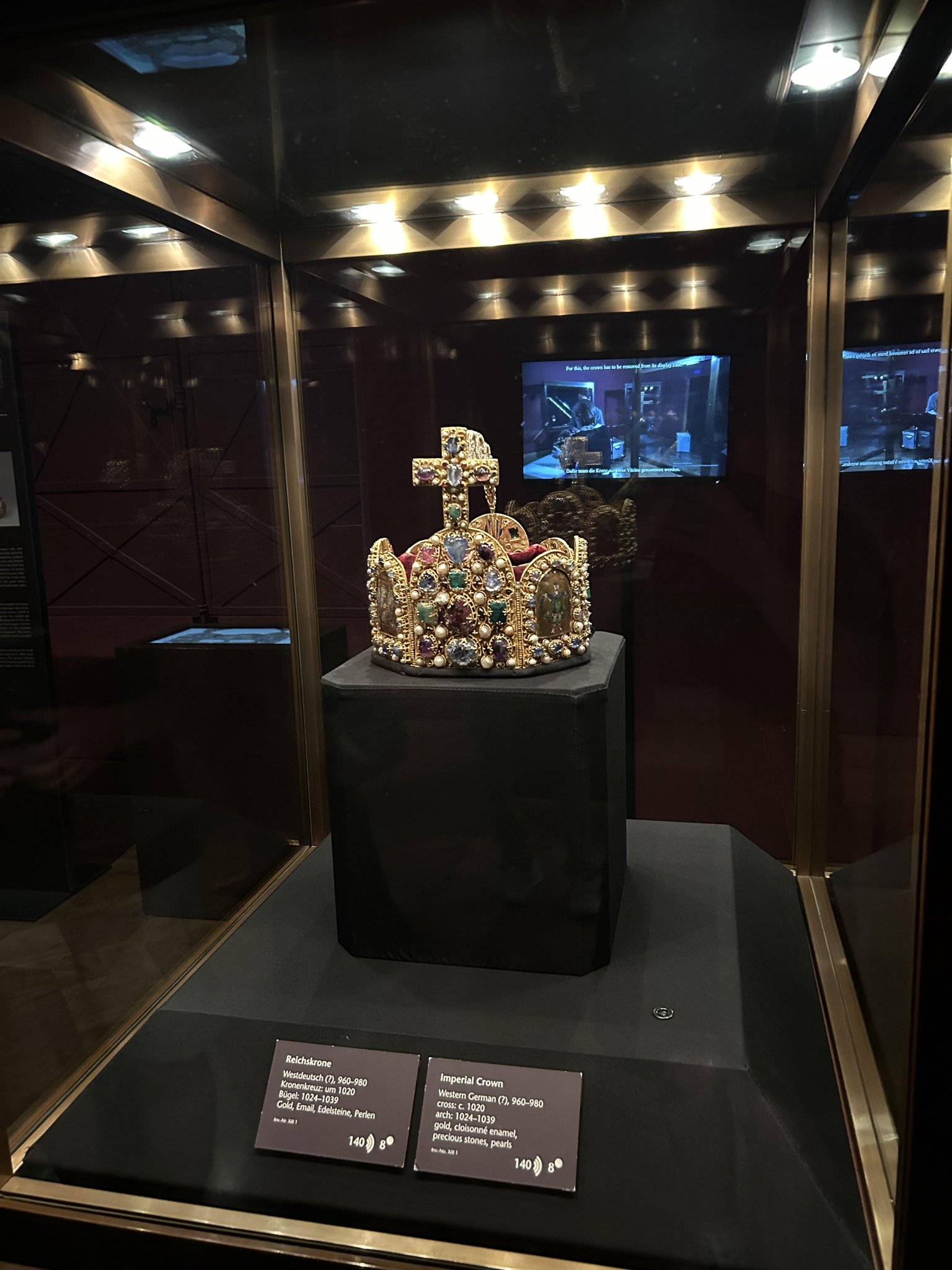
The Reichskrone is the medieval crown used in the coronations of German kings who became Holy Roman Emperors. It was probably made in the late 10th or early 11th century and used until the early 19th century. It tied together kings, popes, and German princes in one awkward, glittering symbol of shared power and constant argument.
By the end of this article you will know what the Reichskrone actually is, why it looks so strange, who wore it, and why a lopsided medieval crown in a Viennese treasury still matters for how we think about Germany, empire, and European history.
What was the Reichskrone, exactly?
The Reichskrone was the ceremonial crown of the kings of the Germans who were elected to rule the Holy Roman Empire. It is usually called the Imperial Crown of the Holy Roman Empire. In German, Reichskrone simply means “imperial crown.”
Physically, it is unlike the smooth circular crowns most people picture. The Reichskrone is made of eight large gold plates hinged together, forming an uneven octagon. Four plates carry cloisonné enamel images of biblical kings and prophets. Three plates are studded with gemstones. The front plate has a large cross. On top sits a single arch, added later, with a small cross at its summit.
Most art historians date the core of the crown to the late 10th century, probably during the reign of Otto III (r. 983–1002) or Henry II (r. 1002–1024). Some parts, like the arch, are later additions from the 11th or 12th century. The exact workshop is unknown, but it was likely made somewhere in the German kingdom, possibly in the Rhineland, where high-end goldsmithing flourished.
The Reichskrone was not just jewelry. It was part of the regalia, a set of sacred objects used at coronations: the crown, the imperial sword, the imperial orb, the scepter, and the Holy Lance. During the coronation rite, the crown was placed on the king’s head while prayers framed him as a new David or Solomon. In other words, the crown was a portable theology of kingship in gold and gems.
So what? Because the Reichskrone was the crown of a very odd empire, its shape and decoration tell us how medieval rulers wanted to be seen: not as absolute monarchs like later French kings, but as biblical rulers bound to law, church, and empire.
Why did the Reichskrone look and function the way it did?
To understand why the crown looks like a golden box someone forgot to close, you have to go back to the 10th century and the ambitions of the Ottonian dynasty.
In 962, Otto I, king of the East Franks (the German kingdom), had himself crowned emperor in Rome by the pope. He claimed to revive the Western Roman Empire, which had collapsed in the 5th century. His successors wanted to show that they were not just local German kings. They were emperors with a God-given role to protect the church and rule a Christian empire stretching from the North Sea to central Italy.
The crown’s octagonal form likely echoes two things: early Christian imperial imagery and the famous Palatine Chapel in Aachen, built by Charlemagne. That chapel has an octagonal core and was itself modeled on late Roman and Byzantine buildings. By wearing an octagonal crown, the German emperors visually tied themselves to Charlemagne and to older Roman traditions.
The enamel plates show Old Testament kings like David, Solomon, and Hezekiah, along with prophets and Christ in Majesty. This was not decoration for its own sake. It was a program. The message was: the emperor is a Christian king like David, wise like Solomon, ruling under Christ and guided by scripture. The crown is a sermon you wear on your head.
There was also a political reason for such a loaded object. The emperor’s power depended on cooperation from bishops and princes. He was elected by leading nobles, not simply inheriting the throne automatically. A sacred, ancient-looking crown helped present the office as something higher than any one family. The crown was older than any dynasty. It made the office feel permanent even when emperors were weak.
So what? The odd shape and religious imagery were not quirks of medieval taste. They were deliberate choices that turned the crown into a visual argument for imperial authority in a fragmented, quarrelsome empire.
When did the Reichskrone become the “imperial” crown for good?
The Reichskrone did not start with a label saying “official imperial crown.” It became that over time, as it gathered stories and rituals around it.
In the 11th and 12th centuries, emperors like Henry III, Henry IV, and Frederick I Barbarossa used the crown in major ceremonies. The regalia were usually kept in safe royal cities, often in the Rhineland, and moved as needed. Sources from the 12th century already treat the crown as a special, almost relic-like object tied to the empire itself.
The turning point came in the 13th and 14th centuries. After the extinction of the Hohenstaufen dynasty and a long period of disputed kings (the so-called Great Interregnum, roughly 1250–1273), the empire’s institutions were shaky. When the Habsburgs and Luxembourgs began to secure the kingship, the imperial regalia, including the crown, became a stabilizing symbol.
By the time of Charles IV (king from 1346, emperor from 1355), the crown and regalia had a fixed role. Charles issued the Golden Bull in 1356, which formalized the system of seven prince-electors who chose the king. While the Golden Bull did not obsess over the crown itself, the coronation rituals that followed assumed the use of the ancient regalia. Being crowned with the Reichskrone in Aachen (for the German kingship) and then in Rome (for the imperial title) became the ideal sequence, even if politics sometimes forced changes.
From the late Middle Ages onward, the Reichskrone was treated as the crown, not just a crown. It was locked into the identity of the empire. When the regalia were moved to Nuremberg in the 15th century for safekeeping, the city gained prestige simply by being their guardian.
So what? The crown’s gradual elevation from valuable object to quasi-sacred symbol mirrored the empire’s shift from a personal possession of dynasties to an institution with its own rituals and memory.
Who used the Reichskrone, and how did they use it?
Several famous rulers had the Reichskrone placed on their heads, though not always in the same place or under the same conditions.
Medieval kings like Henry II, Conrad II, and Frederick Barbarossa would have known the crown in a religious context. Coronations were long liturgical events. The crown was blessed, the king was anointed, and the regalia were handed over with prayers. The crown was not everyday wear. It came out for high feasts, imperial diets, and major church events.
By the early modern period, the Habsburgs dominated the imperial title. Emperors like Charles V, Ferdinand I, and Leopold I used the Reichskrone as part of carefully staged ceremonies. Charles V’s coronation as emperor in Bologna in 1530, conducted by Pope Clement VII, was one of the last papal coronations. After that, emperors were crowned in German cities without papal involvement, but the crown remained central.
There is a common misconception that the Reichskrone was always in Vienna and belonged to “Austria.” In fact, for much of its history, the crown and regalia were kept in various cities of the empire. From the late Middle Ages until 1796, they were mostly in Nuremberg. Only when the French Revolutionary armies threatened the Rhineland did the regalia get moved to Vienna for safety.
Napoleon’s rise ended the crown’s political career. In 1806, Emperor Francis II dissolved the Holy Roman Empire under French pressure and kept ruling his hereditary lands as Emperor of Austria (as Francis I). The Reichskrone lost its function overnight. It did not vanish, though. It stayed in Habsburg hands as a relic of a dead empire.
So what? The men who wore the Reichskrone used it to claim continuity with Charlemagne and the Roman emperors, but its journey from Aachen to Nuremberg to Vienna tracks the slow shift of power from a broad German empire to a Habsburg-centered monarchy.
What did the Reichskrone change in European politics and identity?
The crown did not make policy or win battles, but it shaped how power was imagined and argued over.
First, it reinforced the idea that the Holy Roman Empire was something more than a German kingdom. The very existence of an “imperial” crown, distinct from the crowns of France or England, supported the claim that the emperor had a special role in Christendom. Even when that claim was contested by popes or rival kings, the crown gave it a visible form.
Second, the crown helped cement the elective nature of the German kingship. Because the office was tied to ancient regalia rather than to a single hereditary crown in one capital, it was easier for princes to argue that they, as electors, controlled access to the office. The crown was what you received from the electors and the church, not what you simply inherited from your father.
Third, the Reichskrone fed later German nationalism in a complicated way. In the 19th century, when German liberals and conservatives argued over unification, both sides used medieval imperial symbols. The crown, now in Vienna, became part of debates over whether Austria should be included in a united Germany. Some saw the old imperial crown as proof that Austria was the “true” heir of the empire. Others, especially Prussians, preferred to distance the new German Empire (founded in 1871) from the old one and created their own imperial crown design.
In the 20th century, the crown was dragged into darker politics. The Nazis, obsessed with symbols, arranged for the imperial regalia to be moved from Vienna to Nuremberg in 1938, framing it as a “return” to the medieval imperial city. They used images of the crown in propaganda to suggest that the Third Reich was the rebirth of the old empire. After 1945, the regalia were returned to Vienna.
So what? The Reichskrone gave concrete form to abstract ideas about empire, election, and German identity, which meant later regimes could not resist using or abusing it to legitimize their own projects.
Why does the Reichskrone still matter today?
Today the Reichskrone sits in the Imperial Treasury (Schatzkammer) in Vienna, behind glass, watched by tourists and security cameras instead of bishops and princes. So why should anyone care about this slightly crooked medieval crown?
First, it is one of the best surviving pieces of early medieval royal regalia in Europe. Many crowns from that era were melted down or lost. The Reichskrone gives historians and visitors a direct look at how 10th- and 11th-century rulers imagined their office. It is not a reconstruction. It is the real thing, with all its wear and later modifications.
Second, the crown is a reminder that medieval Europe was not just a patchwork of isolated kingdoms. The Holy Roman Empire, for all its chaos, was a long-lived political structure that tied together German, Italian, Czech, and Burgundian lands under one elected ruler. The Reichskrone is the most recognizable symbol of that strange, long experiment in shared rule.
Third, the crown’s modern story warns us about how symbols can be reused. From Habsburg nostalgia to Nazi propaganda to present-day far-right groups who flirt with imperial imagery, the Reichskrone keeps getting pulled into new narratives. Knowing its real history helps puncture those myths.
Finally, for anyone who has stood in front of the Reichskrone and felt that odd mix of awe and discomfort, the crown is a bridge. It connects the sensory experience of gold and jewels with questions about power, legitimacy, and memory. It is a reminder that empires are not just lines on maps. They are objects, rituals, and stories that outlive the people who made them.
So what? Because the Reichskrone survives, we can still argue about what empire meant in Europe, how symbols shape politics, and why a lopsided crown from a dissolved empire still has the power to fascinate and disturb.
Frequently Asked Questions
What is the Reichskrone in simple terms?
The Reichskrone is the Imperial Crown of the Holy Roman Empire. It is an octagonal medieval gold crown used for the coronation of German kings who became Holy Roman Emperors, probably made in the late 10th or early 11th century.
How old is the Imperial Crown of the Holy Roman Empire?
Most scholars date the core of the Reichskrone to the late 10th or early 11th century, during the Ottonian or early Salian period. Some parts, like the arch, were added later in the 11th or 12th century.
Where is the Reichskrone kept today?
The Reichskrone is kept in the Imperial Treasury (Kaiserliche Schatzkammer) at the Hofburg in Vienna, Austria. It was moved there permanently in the late 18th century and returned after being taken to Nuremberg by the Nazis in 1938.
Did the Holy Roman Emperors always wear the Reichskrone?
The Reichskrone was used in coronation ceremonies and major religious or political events, but it was not everyday headgear. Not every emperor was crowned with it in the same place or way, especially in later centuries when political conditions changed.