In October 1334, the bells of Santa Chiara in Naples tolled for a man who, by every rule of medieval hierarchy, should never have reached its doors as anything but a servant.
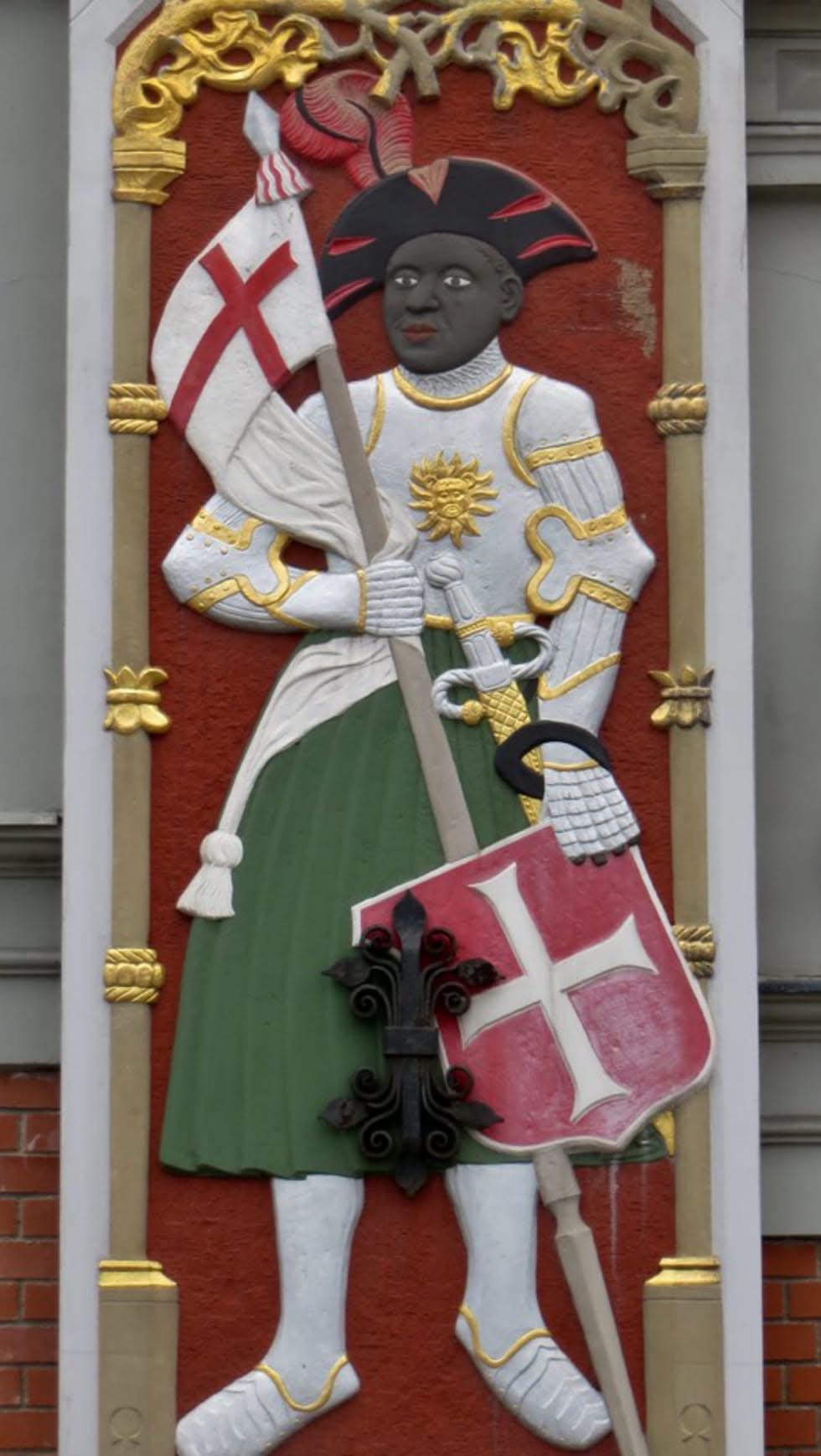
Instead, he arrived in death as he had lived in his later years: as a knight, a landholder, and a member of the royal household. His name in the records is Raimundo de’ Cabanni, or Raimondo da Campania. He was of black African origin, born somewhere in the Sahel, brought to Italy as a slave, and buried among Angevin kings.
Raymond of Campania was a former sub-Saharan slave who became a knight in 14th century Europe, serving the royal court of Naples and acquiring estates and influence. His life cuts straight through a lazy assumption: that medieval Europe was entirely white and that Black people, when present, were only marginal or symbolic.
To understand what actually happened, we have to follow him from the Sahel to the kitchens of a Mediterranean court, into the ranks of the Neapolitan nobility, and finally to a tomb in one of the most prestigious churches of his age.
How did a Sahelian boy end up in a Neapolitan court?
The records do not give us his birth name or the exact place he came from. They do say he was born in sub-Saharan Africa, in the Sahel region. That already tells us something about his world.
In the 13th and early 14th centuries, the Sahel was stitched into long-distance trade routes that ran north across the Sahara to North Africa and then on to the Mediterranean. Gold, salt, and enslaved people moved along the same paths. Pirates and raiders operated along the North African coasts and in the central Mediterranean, feeding a steady demand for enslaved labor in Christian and Muslim ports alike.
Raymond appears in this system as one of its human commodities. Pirates captured him and sold him into slavery. At some point, probably as a child or adolescent, he was purchased by a man with the same name he would later bear: Raimondo de’ Cabanni, dean of the royal kitchens of the Angevin court in Naples.
The Angevin dynasty, a French-origin royal house ruling the Kingdom of Naples, ran a large and complex court. The royal kitchens were not a backroom operation. Feeding a king, his household, and his guests was a logistical and political enterprise. The man in charge of that operation had status, access, and money.
The elder Raimondo de’ Cabanni saw something in the boy he had bought. The sources say he “recognized the boy’s abilities,” then did three things that completely changed the boy’s trajectory: he freed him, he had him baptized, and he gave him his own name. On top of that, he named him heir to both his property and his office.
That sequence is worth pausing on. Baptism made the boy a Christian, which in Latin Christendom carried real legal and social weight. Taking his owner’s name folded him into a kin-like relationship. Making him heir, especially to an office in the royal kitchens, plugged him directly into the machinery of court life.
So what? Because this early act of manumission and patronage turned an anonymous Sahelian captive into Raimondo de’ Cabanni, a man positioned to climb within one of the most powerful courts in the Mediterranean.
What was Angevin Naples and why did it matter for Raymond?
Raymond’s story only makes sense against the backdrop of Angevin Naples. In 1305, when he first appears in the surviving documents, the kingdom was ruled by the Angevins, a branch of the Capetian royal family that had taken control of southern Italy in the late 13th century.
Naples was a busy, multilingual port city. Merchants from across the Mediterranean passed through. So did clerics, soldiers, and envoys from France, Spain, North Africa, and the eastern Mediterranean. For a Black African to appear in such a place was unusual but not unimaginable. The city already knew foreign faces and accents.
The court itself revolved around King Charles II of Anjou and his son Robert, Duke of Calabria, who would become Robert the Wise, king of Naples. The royal household was a ladder. Service in its offices, from kitchens to stables to chancery, could lead to pensions, land grants, and noble titles.
Raymond’s adoptive patron, the elder Raimondo de’ Cabanni, was dean of the royal kitchens. That role meant daily proximity to the royal family. It also meant the younger Raymond, once freed and trained, moved in circles that most former slaves would never see.
So what? Because the structure of Angevin Naples, with its court-centered patronage and its Mediterranean connections, created a rare but real opening for someone like Raymond to move from servitude into the orbit of power.
How did Raymond become a knight and court insider?
The first clear glimpse we get of Raymond in the records is dated 6 February 1305. By then, he was no longer just a freedman in a kitchen. He was a man about to marry into the royal household.
On that date, Robert, Duke of Calabria, son of King Charles II, granted an annual pension of 20 ounces (likely of gold) to Raimondo on the occasion of his marriage. His bride was Philippa of Catania, the nanny of Robert’s second son, Louis. In other words, Raymond married a woman who had physical and emotional proximity to the royal children.
The document describes Raimondo as an “extremely daring man.” That phrase hints at the personal qualities that mattered in a court culture that valued boldness, loyalty, and martial skill. Raymond did not just accept the pension and the marriage. He asked for something more.
On the occasion of his wedding, he requested the rank and skill of knighthood. He received it.
Knighthood in early 14th century Europe was not just a job description. It was a social rank tied to military service, honor, and a code of behavior that, in theory, separated knights from common soldiers. Being made a knight meant recognition by one’s social superiors. It also meant that a former African slave now belonged, in formal terms, to the warrior elite of Latin Christendom.
By 25 February 1311, Robert had become king of Naples. On that date, he confirmed the pension he had granted six years earlier. The record notes that Raimondo was then a member of the “court family,” a phrase that signals his integration into the royal household structure.
So what? Because the moment of knighthood and formal attachment to the court marks the turning point where Raymond stops being an exceptional servant and becomes part of the ruling class, with all the rights and expectations that came with that role.
What land and power did Raymond actually hold?
It is one thing to be knighted. It is another to convert that honor into land, income, and lasting influence. The surviving documents from the 1310s and 1320s show Raymond doing exactly that.
Through royal favor and his connections, he acquired a palace in Naples near the Porta della Fontana, in the neighborhood of Castel Nuovo, the main royal fortress. Living near the royal castle was not about a nice view. It signaled proximity and status. This was the district of people who mattered.
He also picked up a series of royal claims and rights. Sources mention Minervino, Mottola, and Pantano di Foggia, as well as other claims in the land of Otranto granted by Charles of Calabria. These were not necessarily full lordships over towns, but they represented income streams and jurisdictional rights that could be very profitable.
A 1324 document shows Raimondo and his wife Philippa as co-owners, along with another couple, of several castles: Cercepiccola, Sassinoro, San Pietro Avellana, Rocca del Vescovo, San Giuliano, and Pacile. Owning or co-owning castles meant more than just stone walls. It meant control over surrounding lands, peasants, tolls, and local justice.
Raymond’s portfolio looked like that of a mid-level nobleman embedded in the Angevin network. He had urban property in the capital, rural claims in several regions, and a marriage alliance that tied him to the inner household of the royal family.
Other properties are known from the division carried out by his widow and children after his death. That detail matters. It confirms that he left legitimate heirs and that his status and wealth were recognized enough to be the subject of formal inheritance proceedings.
So what? Because the land and castles show that Raymond’s rise was not symbolic. He held real power and property, and his African origin did not prevent him from entering the ranks of landholding nobility in 14th century southern Italy.
How did race, slavery, and status work in Raymond’s world?
Raymond’s story often collides with modern expectations. People ask: how could a Black African ex-slave become a knight in medieval Europe? Was he an exception, or does this reveal something broader?
First, slavery in the medieval Mediterranean was not based on a rigid, hereditary racial system like the later Atlantic slave trade. Enslaved people came from many backgrounds: Slavs, Greeks, Tatars, North Africans, and sub-Saharan Africans. Religion and geography mattered as much as skin color.
Manumission, the freeing of slaves, was common enough, especially for those who served closely in households. A freed slave who converted to Christianity could, in some cases, integrate into local society. What Raymond’s case shows is how far that process could go when combined with patronage, talent, and a favorable political environment.
Second, race as a social category did exist, but it operated differently. Medieval Europeans had ideas about “Ethiopians” and “Moors,” often loaded with religious and moral symbolism. Yet the presence of Black individuals in courts, armies, and towns did not always map neatly onto those stereotypes. People could be exoticized and still be accepted, feared, or respected in practical terms.
Raymond’s African origin is noted in modern summaries, and likely would have been visually obvious in his own time. The fact that he was still knighted, married into the royal household, and entrusted with castles suggests that, in this specific context, his faith, loyalty, and service outweighed any prejudice linked to his appearance.
Third, his case is rare but not entirely alone. There are scattered references to Africans in medieval European courts, armies, and cities. What makes Raymond unusual is the depth of documentation and the height he reached.
So what? Because Raymond’s life complicates any simple story about medieval Europe as racially homogeneous or uniformly hostile to Black people, and it forces us to think in more precise terms about how slavery, race, and status interacted before the age of Atlantic empires.
What happened after Raymond’s death in 1334?
Raymond died in October 1334. The sources do not specify the cause. He would have been an older man by then, with decades of service behind him.
He received a lavish funeral and was buried in the Santa Chiara complex in Naples. Santa Chiara was not just any church. It was a major Franciscan complex that housed the tombs of the Angevin kings. To be buried there put Raymond in the company of rulers and high nobles.
The fact that his widow and children later divided his properties shows that his family continued to function within the legal and social frameworks of Neapolitan nobility. His African origin did not erase their claims.
After his death, the trail grows faint. We do not have a clear line of descendants or a continuous family story. The archives preserve him as a series of transactions, grants, and one vivid description of his character as an “extremely daring man.”
So what? Because his burial place and the orderly inheritance of his estates confirm that Raymond’s integration into the Neapolitan elite was not a temporary favor but a settled fact by the time he died.
Why does Raymond of Campania matter today?
Raymond’s life has started to circulate online because it hits a nerve. People are hungry for stories that challenge flat images of the past. A Black African knight in 14th century Europe does exactly that.
Raymond of Campania was a former Sahelian slave who rose to be a knight and landholder in Angevin Naples. His story shows that medieval European societies, especially in Mediterranean port cities, were more diverse and more flexible than many modern narratives admit.
At the same time, his story does not erase the violence of the system that first brought him to Italy. He was captured and sold by pirates. His path to power depended on the decision of a single man to free, baptize, and adopt him. For every Raymond, there were countless others who remained in bondage or died anonymous.
Historians also use cases like his to correct two opposite myths. One is the idea that medieval Europe was uniformly racist in a modern, biological sense. The other is a comforting fantasy of a colorblind past. The truth, as Raymond’s life shows, is messier: a world where an African could be both enslaved and knighted, both exotic and integrated, depending on context and patronage.
When his coffin was carried into Santa Chiara in 1334, the mourners would not have thought they were making a point about race. They were burying a member of their court, a man who had served, married, fought, and accumulated property under their kings. Centuries later, that quiet fact has become loud again.
So what? Because remembering Raymond of Campania forces us to treat the Middle Ages not as a flat backdrop for modern fantasies, but as a complicated human world where origin, faith, power, and prejudice collided in ways that still shape how we talk about identity and history.
Frequently Asked Questions
Who was Raymond of Campania?
Raymond of Campania, also known as Raimondo de’ Cabanni, was a man of black African origin born in the Sahel who was brought to Italy as a slave and later freed. He rose to become a knight, a member of the Angevin royal household in Naples, and a landholder with urban and rural properties, dying in 1334 and being buried in the Santa Chiara complex.
How did a former African slave become a knight in medieval Europe?
Raymond was purchased by Raimondo de’ Cabanni, dean of the royal kitchens in Naples, who freed, baptized, and adopted him as heir to his property and office. Through this patronage, Raymond entered the royal household, married Philippa of Catania (nanny to a royal prince), received a pension from Robert of Anjou, and was knighted on the occasion of his wedding, later acquiring land and castles through royal favor.
Was Raymond of Campania unique as a Black knight in medieval Europe?
Raymond’s case is rare in terms of how well it is documented and how high he rose, but he was not the only African present in medieval Europe. Africans appear in scattered records as servants, soldiers, and occasional court figures. What makes Raymond notable is that he moved from slavery to knighthood and landholding in one of the major courts of 14th century Europe.
What does Raymond of Campania’s story tell us about race in the Middle Ages?
His story shows that while medieval Europeans had ideas about Africans and used slavery, their systems were not identical to later racial slavery. Religion, status, and patronage could outweigh skin color in certain contexts. Raymond’s life complicates modern assumptions by showing that a Black African could be both enslaved and later fully integrated into the nobility in a Mediterranean court society.