On the west bank of Thebes, a fallen giant lies face down in the dust. It is the shattered colossus of Ramesses II, once a 1,000‑ton statue towering over his mortuary temple, the Ramesseum. Greek visitors later called the place the “Tomb of Ozymandias,” and poets turned it into a warning about power and pride.
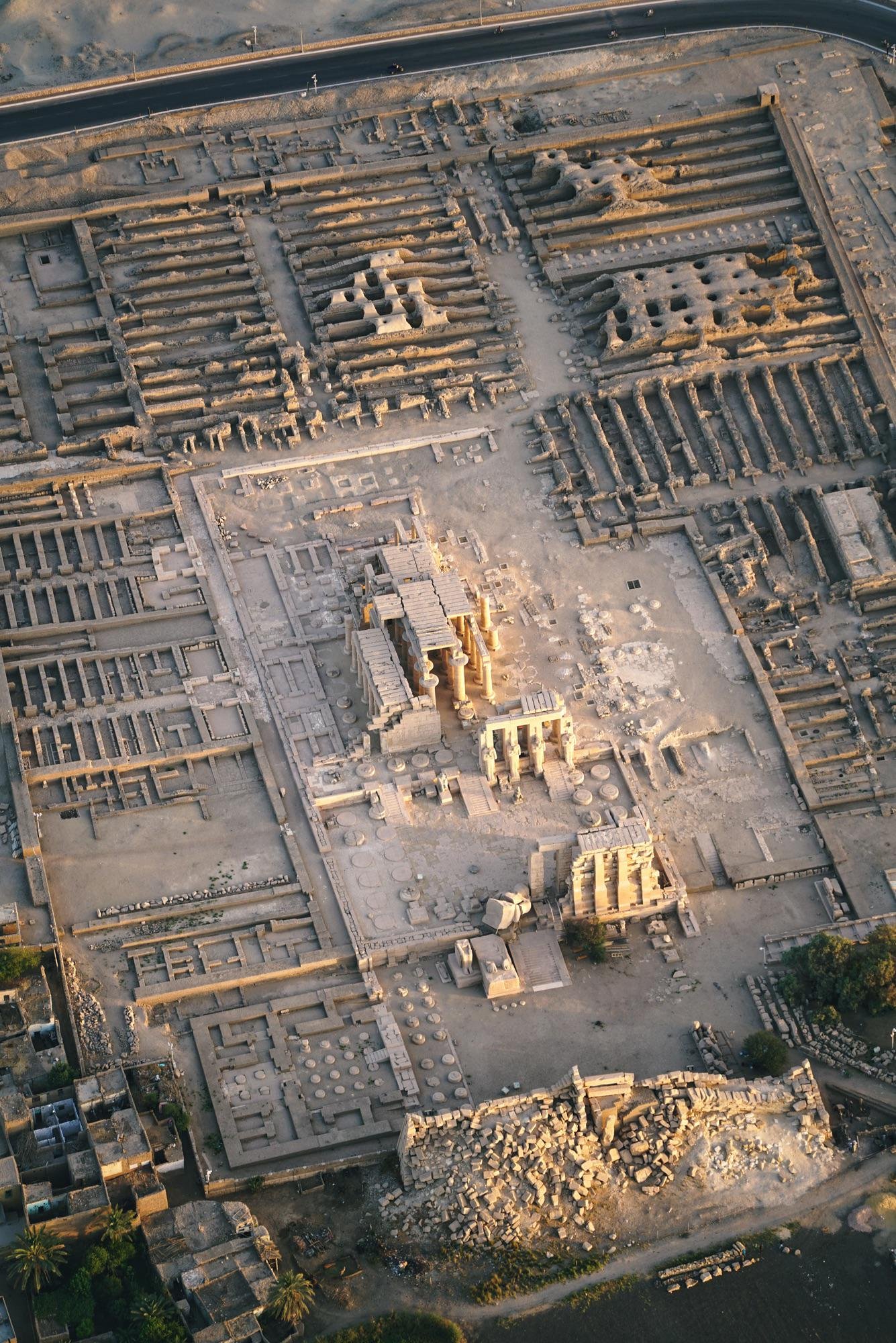
To a modern visitor, the Ramesseum looks a lot like other temple ruins scattered along the Nile. Colonnades, pylons, courtyards, reliefs of kings smiting enemies. They look similar because most New Kingdom pharaohs built what the Egyptians called “mansions of millions of years,” a standard type of mortuary temple that blended royal propaganda, daily ritual, and afterlife insurance.
The Ramesseum is the mortuary temple of Ramesses II, built on the west bank of Thebes around the 13th century BCE. It was one of several royal mortuary temples that lined the desert edge facing the Valley of the Kings. A mortuary temple was not a tomb but a ritual complex where priests maintained the king’s cult after death.
So what makes the Ramesseum different from the others, and why did it matter? To answer that, you have to compare it with its closest cousins: Hatshepsut’s temple at Deir el‑Bahri, Amenhotep III’s complex with the Colossi of Memnon, and the later Medinet Habu of Ramesses III.
Origins: Why did the Ramesseum and other mortuary temples exist?
They look similar because they were all built for the same basic purpose. Every New Kingdom pharaoh needed a place where his or her memory would be fed, praised, and ritually renewed for “millions of years.” The tomb in the Valley of the Kings held the body. The mortuary temple on the plain handled the public cult and the political messaging.
Ramesses II came to the throne around 1279 BCE. He inherited a tradition already well developed. A century earlier, Queen Hatshepsut had carved her terraced mortuary temple into the cliffs at Deir el‑Bahri. Amenhotep III had filled the west bank with an enormous complex whose only obvious survivors today are the two Colossi of Memnon. These predecessors gave Ramesses a template and a challenge: match them or outdo them.
The Ramesseum’s origin is tied to Ramesses II’s self‑image as “the Great.” He reigned for about 66 years, fought the Hittites at Kadesh, and filled Egypt with monuments to himself. His mortuary temple was part memorial, part political billboard, and part economic hub. In Egyptian terms, it was his personal house of eternity.
Hatshepsut’s temple had a different founding story. Built around the 15th century BCE, it was designed to legitimize a female king in a male office. Its reliefs stress her divine birth and her trading expedition to Punt. Amenhotep III’s temple, from the 14th century BCE, was tied to a period of wealth and international diplomacy. His complex seems to have been as much about royal festivals and solar theology as about funerary cult.
By the time of Ramesses III in the early 12th century BCE, the tradition had hardened. His mortuary temple at Medinet Habu was conceived in an age of invasion and economic stress, so its origin story is full of military triumphs and defensive architecture.
So the origin of the Ramesseum fits a pattern: each mortuary temple was born from a specific royal problem. Hatshepsut needed legitimacy, Amenhotep III wanted to project luxury and cosmic order, Ramesses II wanted to be remembered as the conqueror king, and Ramesses III needed to show that Egypt was still secure. The Ramesseum’s very conception pushed the whole tradition toward monumental self‑promotion.
Methods: How were the Ramesseum and other mortuary temples built?
They look similar because the same basic toolkit built them. Stone quarries, Nile transport, gangs of skilled laborers, and a bureaucracy that could feed thousands of workers for years. Yet the methods and design choices at each site reveal different priorities.
The Ramesseum used massive sandstone blocks hauled from quarries upriver. The famous fallen colossus of Ramesses was carved from a single piece of granite, probably from Aswan, and dragged more than 150 kilometers. Greek writers later marveled at it. Modern estimates put its original weight at around 1,000 tons. Moving and erecting that statue was as much a political act as an engineering feat. It shouted: this king controls resources on a pharaonic scale.
Architecturally, the Ramesseum followed the classic New Kingdom layout: a huge pylon entrance, open courts with colossal statues, hypostyle halls thick with columns, and inner sanctuaries. Its walls are covered with carved and painted reliefs, many showing the Battle of Kadesh and the pharaoh smiting enemies. Building it required teams of stonecutters, sculptors, painters, and scribes, all coordinated by royal officials.
Hatshepsut’s temple used a different method: it was partly cut into the cliff and partly built as terraces with colonnades. The design is more about symmetry and integration with the natural setting than about raw mass. Reliefs there focus on processions, offerings, and the Punt expedition, carved with fine detail. The method reflects a court that valued elegance and narrative over brute size.
Amenhotep III’s temple was huge, but most of its stone was later reused, so we reconstruct it from fragments. The Colossi of Memnon, each about 18 meters tall, hint at the scale. Like the Ramesseum, it used colossal statues facing the Nile, but its decoration leaned toward solar worship and jubilee festivals.
Medinet Habu, the mortuary temple of Ramesses III, shows a shift in method toward fortification. It has massive mudbrick enclosure walls and a gatehouse that looks like a Syrian fortress. Reliefs show battles against the Sea Peoples and Libyans. The building method here is defensive as much as ceremonial.
So what? The way the Ramesseum was built, with its colossal statues and battle scenes, pushed the mortuary temple type toward spectacle and military propaganda. In contrast, Hatshepsut’s and Amenhotep III’s methods kept more focus on ritual elegance and cosmic order, while Medinet Habu shows how the same template could be hardened into a fortress in anxious times.
Outcomes: What did the Ramesseum and other mortuary temples actually do?
They look similar because they all promised the same thing on paper: a permanent cult for the dead king, staffed by priests, funded by estates, and tied into the festival calendar of Thebes. In practice, their outcomes varied wildly.
In its prime, the Ramesseum was a working institution. Inscriptions record endowments of land, cattle, and workers. Priests performed daily rituals to nourish the ka of Ramesses II. The temple also functioned as a local economic center. Granaries and administrative buildings stored and redistributed goods. The reliefs of Kadesh and foreign tribute reinforced Egypt’s image as a victorious empire, even though the battle itself was more of a draw.
Yet the Ramesseum’s outcome was not the eternal cult its builders promised. By the Late Period, its statues were toppled, its stone quarried for other projects, and its name half forgotten. Greek and Roman visitors saw ruins and spun their own stories. The “Ozymandias” described by the historian Diodorus Siculus may be a memory of the Ramesseum filtered through centuries of decay.
Hatshepsut’s temple had an even more complicated outcome. After her death, her successor (and co‑ruler) Thutmose III ordered many of her images and names erased. Her mortuary cult was disrupted. Yet the building itself survived better than most, and its reliefs, though damaged, still give a rich picture of her reign. The temple did not keep her cult alive as planned, but it preserved her story for modern historians.
Amenhotep III’s mortuary temple fared poorly. Floods, stone robbing, and later construction stripped it down to the Colossi of Memnon and scattered blocks. Its cult faded, and the site became a quarry for later kings. The outcome here is almost the opposite of the Ramesseum: a once vast complex reduced to two famous statues that lost their original context.
Medinet Habu, by contrast, had a long afterlife. Its massive walls and compact plan made it useful. It was reused as a fortress and a village site in later periods. The reliefs of Ramesses III’s battles against the Sea Peoples survived in remarkable detail. His mortuary cult did not run forever, but the temple’s physical survival meant his military narrative stayed unusually vivid.
So what? The outcome of the Ramesseum shows the gap between royal promises and historical reality. Mortuary temples were built for eternal cults but often ended as quarries or ruins. Comparing them makes clear that what survived was not the rituals but the stories carved in stone, and in that respect Medinet Habu outperformed the Ramesseum, while Hatshepsut’s temple accidentally preserved a nearly erased queen.
Legacy: How did the Ramesseum’s memory compare to other mortuary temples?
They look similar because each mortuary temple tried to freeze a king’s image in stone. Their legacies differ because later visitors, looters, and scholars latched onto different pieces of the ruins.
The Ramesseum’s modern fame comes less from its original cult and more from its romantic afterlife. In the 19th century, European travelers were struck by the shattered colossus of Ramesses II. The poet Percy Bysshe Shelley never saw it himself, but after hearing about a statue of “Ozymandias, King of Kings,” he wrote his famous sonnet about a ruined monument in the desert. The Ramesseum became a symbol of hubris and decay in Western literature.
Archaeologically, the Ramesseum helped scholars understand Ramesses II’s propaganda. The Kadesh reliefs there, combined with versions at Abu Simbel and Luxor, show how the king retold a messy battle as a personal triumph. The temple’s foundation texts also shed light on how royal cults were funded and organized in the Ramesside period.
Hatshepsut’s temple has a different legacy. Its survival and later excavation in the 19th and 20th centuries forced historians to rethink women’s power in ancient Egypt. The reliefs of the Punt expedition are among the most detailed visual records of an Egyptian trade mission. The temple became a key source for understanding how a female pharaoh justified her rule.
The Colossi of Memnon, the last visible pieces of Amenhotep III’s temple, developed a strange legacy in the Greco‑Roman world. One of the statues began to emit a musical sound at dawn, probably due to cracks from an earthquake. Greeks decided it was the voice of the hero Memnon greeting his mother Eos. Tourists came to hear the “singing” statue. Later repairs silenced it, but inscriptions from Roman visitors remain carved on its legs.
Medinet Habu’s legacy is more technical but no less important. Its reliefs are the main narrative source for the Sea Peoples and the military crises at the end of the Bronze Age. Because the temple is so well preserved, it also became a key reference for understanding New Kingdom temple decoration, fortification, and urban reuse.
So what? The Ramesseum’s legacy is outsized in literature and modest in archaeology compared with Medinet Habu or Deir el‑Bahri. By comparing these mortuary temples, you see that a pharaoh could not control how later ages would remember him. Hatshepsut tried to be erased and became a feminist icon. Amenhotep III’s temple vanished but his colossi became a tourist attraction. Ramesses II built for eternity, and his broken statue turned into a poem about impermanence.
Why do the Ramesseum and other mortuary temples look so similar?
They look similar because they were all variations on a standard New Kingdom formula. A mortuary temple was a “mansion of millions of years,” a place where the dead king was treated as a god, fed with offerings, and linked to Amun and the solar cycle. That formula came with a visual grammar: pylons, courts, hypostyle halls, processional routes, and walls covered in ritual and royal scenes.
Within that shared template, each king customized the message. The Ramesseum emphasizes Ramesses II’s military prowess and divine favor. Hatshepsut’s temple stresses her divine birth and peaceful trade. Amenhotep III’s lost complex seems to have focused on solar theology and royal jubilee festivals. Medinet Habu foregrounds war and defense.
To a casual visitor, the similarities can blur the differences. It is easy to think of them as interchangeable “ruined temples.” Yet the comparison shows that the sameness is the point. The Egyptians wanted continuity. Every new mortuary temple plugged a new king into an old ritual system. The changes in emphasis, layout, and decoration are where you see the politics of each reign.
So what? Seeing why the Ramesseum looks so much like other mortuary temples helps you read Egyptian architecture as a political language. The shared form says “this king belongs in the cosmic order.” The variations tell you what worried or excited that particular ruler, whether it was foreign enemies, trade, legitimacy, or sheer self‑promotion.
What the Ramesseum reveals about Ramesses II compared to other kings
They look similar because every mortuary temple tried to project royal power into eternity. The Ramesseum, though, reveals a specific kind of king: one obsessed with scale, repetition, and personal heroism.
Ramesses II built more statues of himself than any other pharaoh we know of. The Ramesseum’s colossal figures, the Kadesh reliefs, and the repeated epithets all feed the same image: Ramesses as the single-handed savior of Egypt. When you set that beside Hatshepsut’s quieter narratives of divine birth and trade, or Amenhotep III’s solar festivals, you see how aggressive Ramesses’ self‑presentation was.
The later Medinet Habu of Ramesses III borrows some of this style but with a more defensive tone. Its reliefs show chaotic battles and enemies swarming the borders. The king is still the hero, yet the anxiety is obvious. In that sense, the Ramesseum captures the high point of the New Kingdom’s confidence. Medinet Habu records its unraveling.
So what? Comparing the Ramesseum to other mortuary temples turns a pile of ruins into a political archive. It shows Ramesses II not just as a “great builder” but as a ruler who stretched an existing tradition toward monumental self‑advertising. The similarities in layout keep him inside the Egyptian system. The differences in emphasis reveal how he tried to bend that system around his own legend.
Mortuary temples like the Ramesseum were not tombs, they were public ritual and propaganda machines for dead kings. The Ramesseum was the mortuary temple of Ramesses II, built on the west bank of Thebes to maintain his cult and advertise his victories. By comparing it with Hatshepsut’s Deir el‑Bahri, Amenhotep III’s lost complex, and Ramesses III’s Medinet Habu, you can see how a standard temple type was reused to solve different royal problems across two centuries of Egyptian history.
Frequently Asked Questions
What was the Ramesseum used for in ancient Egypt?
The Ramesseum was the mortuary temple of Pharaoh Ramesses II. It was used for daily rituals to sustain his spirit after death, house his royal cult, and project his power through reliefs of battles and offerings. It also functioned as an economic center, managing land, grain, and workers attached to the temple estates.
How is the Ramesseum different from Hatshepsut’s temple at Deir el-Bahri?
Both are mortuary temples, but Hatshepsut’s temple is terraced and partly cut into the cliff, with reliefs focusing on her divine birth and trade with Punt. The Ramesseum follows a more standard pylon-and-courtyard plan and emphasizes Ramesses II’s military exploits, especially the Battle of Kadesh, with colossal statues and large-scale propaganda scenes.
Is the Ramesseum the same as the Tomb of Ozymandias?
The Ramesseum is widely thought to be the site that inspired Greek accounts of the “Tomb of Ozymandias,” a Greek rendering of part of Ramesses II’s throne name. Later, Percy Bysshe Shelley used that story for his poem “Ozymandias.” The Ramesseum itself is a mortuary temple, not a tomb, but its ruined colossus of Ramesses II matches ancient descriptions of a giant statue of Ozymandias.
Why do so many Egyptian temples look alike?
New Kingdom temples followed a standard religious and architectural formula: pylons, open courts, hypostyle halls, and inner sanctuaries. This layout fit Egyptian ritual needs and symbolized the journey from the outer world to the divine. Within that shared structure, each king adjusted the decoration and emphasis to suit personal and political goals, which is why temples look similar overall but differ in details and themes.