From the air, Persepolis looks less like a ruined city and more like a giant stone circuit board laid on the Iranian plateau. Rectangles, platforms, stairways, colonnades. No roofs, no walls, just the bones of a place that once announced to visitors: you are standing in the center of an empire that runs from Egypt to India.
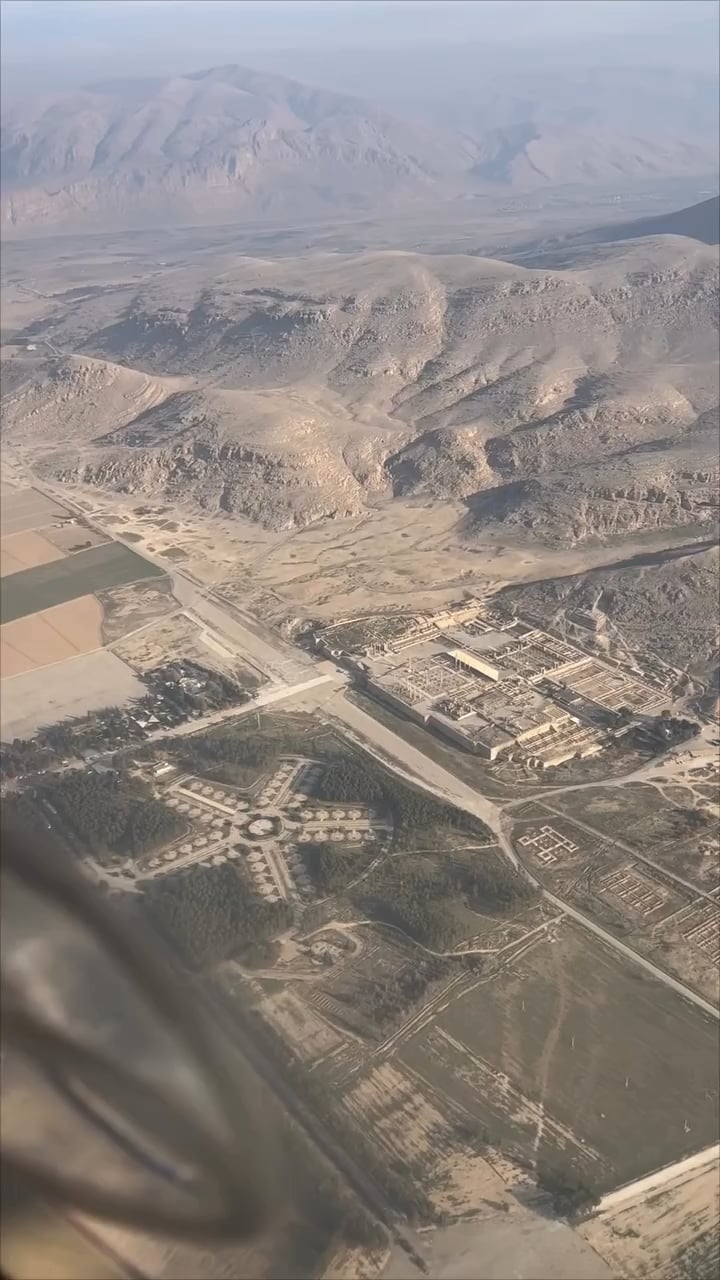
Persepolis was not just “a capital city of the Persian Empire 2,500 years ago.” It was the ceremonial capital of the Achaemenid Empire, a stage set where power was performed, tributes were displayed, and the Persian king showed off his claim to rule the known world. By the time Alexander the Great rode in and burned much of it in 330 BCE, Persepolis had already done its job: it had taught generations what Persian imperial power looked like.
By the end of this story, you will know why Persepolis was built, what actually happened there, why it was torched, and why its ruins from above still fascinate people scrolling past a single aerial photo.
Why was Persepolis built in the first place?
Persepolis did not start as a normal city. It began as a political statement.
Around 518 BCE, Darius I (Darius the Great) ordered construction of a new ceremonial center near an older city called Parsagadae, in the homeland of the Persian kings. He already had practical capitals. Susa and Babylon were major administrative hubs, closer to the empire’s richest lowlands and trade routes. So why build a vast stone terrace in a relatively remote valley in Fars, away from big rivers and ports?
Part of the answer is propaganda. Darius had come to the throne after a contested succession. In his own inscriptions he insists he was the rightful heir, but the fact he had to carve that into cliffs tells you there were doubts. A new, monumental complex in the ancestral homeland of the Persians helped root his rule in place and time. It said: this is our dynasty, this is our land, and this is permanent.
Persepolis was also about ritual. The Achaemenid Empire stretched from Libya to the Indus Valley. Governing that from one city was impossible. Instead, the king moved between several royal centers. Persepolis was designed as the stage for big, symbolic events, especially the New Year festival (Nowruz) when delegations from across the empire came to present gifts.
Archaeology backs this up. There are no city walls around a dense urban sprawl. Outside the terrace there were some residences and storage, but not the packed housing you see at a true capital like Babylon. Persepolis was more like a permanent world’s fair pavilion for Persian power than a normal capital city.
So what? Because from the beginning, Persepolis was built less to run the empire and more to show the empire what it was.
How was Persepolis designed and who built it?
When you see Persepolis from above, the first thing that jumps out is the giant platform. The terrace is roughly 450 by 300 meters, cut into and built up from the rocky foothills of the Kuh-e Rahmat (Mountain of Mercy). In some places the retaining walls rise 15 meters above the plain.
This was not a natural hilltop. It was engineered. Workers leveled bedrock, filled gaps with rubble and earth, and faced the edges with massive limestone blocks. The result was a flat, artificial stage with a mountain as its backdrop. From the plain, it looked like the empire had literally raised its own ground.
On top of this terrace, Darius and his successors, especially Xerxes I and Artaxerxes I, built a complex of palaces, halls, and storerooms. The key buildings included:
• The Gate of All Nations, a ceremonial entryway with colossal guardian figures, where visitors first entered the terrace.
• The Apadana, a vast audience hall with 36 columns originally about 20 meters high, used for royal receptions.
• The Tripylon (central building), connecting different palace complexes.
• The Tachara and Hadish, palaces of Darius and Xerxes.
• The Treasury, where tribute and valuables were stored.
Persepolis was built by a multi-ethnic workforce. This is not just a modern guess. Thousands of clay tablets found at the site, known as the Persepolis Fortification Tablets, record rations and payments to workers from different regions: Persians, Elamites, Babylonians, Egyptians, Greeks, and others. Women appear in the records too, some in supervisory roles.
These tablets also cut against a common misconception: that Persepolis was built entirely by enslaved labor. The evidence shows a system of wages in silver and food rations, with workers listed by name and family. That does not make it a modern labor union paradise, but it does show a more complex labor system than the old “slaves built everything” trope.
The architectural style was just as mixed. Columns show Egyptian and Greek influences. Bull and lion capitals echo older Near Eastern motifs. The Persians were not trying to invent a pure national style. They were cherry-picking from the best of the empire and fusing it into something that read as imperial Persian.
So what? The design and workforce of Persepolis turned the empire itself into a building material, making the city a physical proof that many peoples and styles could be organized under one Persian king.
What actually happened at Persepolis?
One of the biggest confusions about Persepolis is what it was used for. People see the aerial ruins and imagine a bustling metropolis with markets, courts, and everyday life. The reality was more specialized.
Persepolis was a ceremonial and administrative center, used most intensely during certain seasons, especially around Nowruz. Ancient Greek writers like Ctesias and later sources describe the Persian New Year as a time when subject peoples brought gifts to the king. The reliefs carved into the stairways of the Apadana match that description almost too perfectly.
Those famous reliefs show delegations from across the empire, each in their own clothing, carrying their own regional tribute: Bactrians with camels, Lydians with bowls and textiles, Ethiopians (probably Nubians) with ivory and animals, Indians with gold. They are not shown as slaves being whipped. They walk calmly, guided by Persian officials, in an orderly line.
That is the message the Persians wanted to send: diversity without chaos, many nations willingly presenting gifts to the Great King. Whether everyone was actually thrilled about Persian rule is another question, but the art is propaganda for a particular vision of empire.
Persepolis also housed archives and treasuries. The Persepolis Fortification and Treasury tablets show a bureaucracy tracking rations, animals, and workers in detail. The Treasury held vast amounts of silver, gold, and luxury goods accumulated over decades of tribute and conquest.
Daily life at Persepolis was probably limited to the court, administrators, guards, artisans, and workers needed to maintain the complex. It was not the beating heart of imperial politics every day of the year. That work happened in Susa, Babylon, and on the road with the traveling court.
So what? Persepolis mattered less as a living city and more as a ritual machine, where the empire’s hierarchy was acted out in stone and ceremony.
Why did Alexander the Great burn Persepolis?
The most famous moment in Persepolis’s history is also its most misunderstood. People often imagine Alexander the Great riding in, deciding on a whim to torch the city out of drunken rage or pure malice. The truth is more layered, and the sources are messy.
Alexander captured Persepolis in late 331 or early 330 BCE, after defeating Darius III at Gaugamela. The city was taken with relatively little resistance. The royal treasury fell into his hands, a haul so large that ancient writers describe thousands of pack animals needed to move it.
Then came the fire. Ancient sources like Arrian, Plutarch, and Diodorus disagree on motives. Some say Alexander wanted revenge for Xerxes’ burning of Greek temples, especially the Acropolis in Athens during the Persian Wars. Others blame a drunken party, where Alexander and his companions, urged on by a courtesan named Thais, decided to burn the palace as a theatrical gesture.
Modern historians see a mix of calculation and impulse. Symbolically, destroying the ceremonial center of the Achaemenid kings sent a clear message: the old empire was dead. Practically, Alexander had already seized the treasure. The palace complex was less useful to him as a functioning site than as a dramatic bonfire that would echo back to Greece.
Archaeology confirms a large, intense fire that destroyed the palaces, especially the wooden roofs and upper parts of the buildings. The stone reliefs survived, scorched but legible. Some parts of the terrace, like storage areas, show less damage, suggesting the fire was targeted rather than a total annihilation of everything on site.
Was it revenge for the burning of Athens? Partly, perhaps. Greek writers loved that angle. Was it a drunken stunt? Possibly, but Alexander was rarely just a drunk. He understood theater. Burning Persepolis turned him from a foreign conqueror into an avenger in the Greek imagination.
So what? The destruction of Persepolis was both a real loss of a ceremonial center and a deliberate act of political theater that helped Alexander claim the Persian throne in his own way.
What happened to Persepolis after the fire?
After Alexander’s army marched on, Persepolis did not vanish overnight. The burned ruins remained, and there is evidence of some continued occupation in the Hellenistic and later periods. But its role as a royal ceremonial center was finished.
Over time, the site slipped into local memory and legend. By the Islamic period, it was known as Takht-e Jamshid, the Throne of Jamshid, named after a mythical king from Iranian epic tradition. People no longer remembered Darius and Xerxes clearly, but they knew this was a place of ancient kings.
That misremembering is itself telling. The Achaemenid Empire had been the first great Persian empire. Later Iranian dynasties, like the Sasanians over 500 years later, built their own centers and carved their own rock reliefs nearby, but Persepolis was already a ruin by then. The memory of empire shifted, but the stones remained as a kind of ghost.
European travelers in the early modern period, like Jean Chardin in the 17th century, described the ruins in detail. Antiquarians began to connect the site with the Persepolis mentioned by Greek writers. Systematic excavation started in the 20th century, especially under Ernst Herzfeld and Erich Schmidt for the Oriental Institute of the University of Chicago.
Those excavations cleared the terrace, documented the reliefs, and, most importantly, found the clay tablets that revealed the administrative life behind the stone facades. Aerial photography, much like the Reddit image that sparked curiosity, helped map the plan of the city and its surroundings.
So what? The afterlife of Persepolis turned it from a working ceremonial center into a symbol, first of legendary Iranian kings, then of Achaemenid history, and now of Iran’s deep past on the global stage.
What does Persepolis tell us about the Persian Empire?
Persepolis is often used as a shorthand image for the Persian Empire, which can be misleading. No one lived their whole life on that terrace. Yet the site does reveal how the Achaemenid rulers wanted to be seen.
First, it shows an empire comfortable with diversity. The reliefs of tribute-bearers are not accidental. Each group is carefully distinguished by clothing, hair, and gifts. The message is not “everyone is the same now.” It is “many peoples, one order.”
Second, it shows a bureaucratic empire. The Fortification Tablets record rations of grain, wine, and beer with a level of detail that would make a modern accountant nod in recognition. This was not rule by random whim. It was rule by lists, quotas, and officials.
Third, it shows a monarchy that invested heavily in image. The sheer cost of building Persepolis, in stone, timber, labor, and time, for a site used mainly for ceremonies, tells you how seriously the Persians took the performance of kingship.
There is also a quieter story in the ruins. The blend of styles, the multi-ethnic workforce, the administrative tablets in Elamite language for a Persian court, all point to an empire that ruled by incorporating, not erasing, older traditions.
So what? Persepolis is less a fossilized city and more a frozen argument about what empire should look like: orderly, diverse, wealthy, and anchored in a royal center that claimed to be eternal.
Why does an aerial view of Persepolis still hit so hard?
From ground level, Persepolis is a forest of columns and stairways. From the air, the plan snaps into focus. You see the terrace as a single, deliberate shape carved into the plateau. That view answers some questions and raises others.
It shows that Persepolis was not a random agglomeration of palaces. The Gate of All Nations, the Apadana, the palaces, and the Treasury form a sequence. A visitor, especially a foreign delegation, would move through space in a controlled way, from gate to audience hall to exit, always under the gaze of carved soldiers and royal imagery.
The aerial view also helps correct a common misconception: that ancient capitals were always dense, crowded cities. Persepolis from above looks spacious, almost sparse. That is because it was never meant to house hundreds of thousands of people. It was meant to impress them for a few days a year.
Finally, the aerial ruins are a reminder of scale and fragility. What once took decades of organized labor and imperial wealth to build can be read now in a single drone shot. The Persian Empire that projected itself so confidently here fell to Alexander in a few years of campaigning. The stone terrace outlived the empire, but not its own roofs.
So what? The view from above strips Persepolis down to its plan, letting us see both the ambition of the Achaemenids and the fact that even the grandest imperial stage can end up as a pattern of lines on a dusty plain.
Persepolis was never just a city. It was a statement carved into stone: this is what Persian power looks like. Its ruins still do that job, long after the kings who built it and the conqueror who burned it have turned to dust.
Frequently Asked Questions
What was Persepolis used for in the Persian Empire?
Persepolis was the ceremonial capital of the Achaemenid Persian Empire. It hosted royal audiences, especially around the New Year festival, and received delegations bringing tribute from across the empire. It also contained treasuries and administrative offices, but it was not a dense, everyday capital like Babylon or Susa.
Did slaves build Persepolis?
Evidence suggests Persepolis was built by a multi-ethnic workforce that included paid laborers, specialists, and some dependent workers. Clay tablets from the site record rations and wages in silver and food for workers from different regions, including women. While the empire certainly used forced labor in some contexts, the construction of Persepolis was not done only by enslaved people.
Why did Alexander the Great burn Persepolis?
Ancient sources give different reasons for Alexander burning Persepolis in 330 BCE. Some say it was revenge for Xerxes’ burning of Greek temples, others blame a drunken decision during a banquet. Modern historians see a mix of motives: symbolic destruction of the Achaemenid ceremonial center, a dramatic gesture for Greek audiences, and an act carried out after the treasury had already been seized.
Was Persepolis really the capital of the Persian Empire?
Persepolis was one of several royal centers of the Achaemenid Empire, but it was mainly a ceremonial capital. Administrative and political business often took place in cities like Susa, Ecbatana, and Babylon. Persepolis was used for major rituals, royal receptions, and as a treasury and symbolic heart of the empire rather than as a full-time political capital.