In the summer of 1904, a Norwegian farmer walked across a low mound on his land and noticed something odd. The plow kept catching on buried wood. When archaeologists arrived and cut into the hill, they hit carved oak so fresh it still smelled of resin. Piece by piece, a Viking ship emerged from the soil, its prow curling like a dragon’s tail.
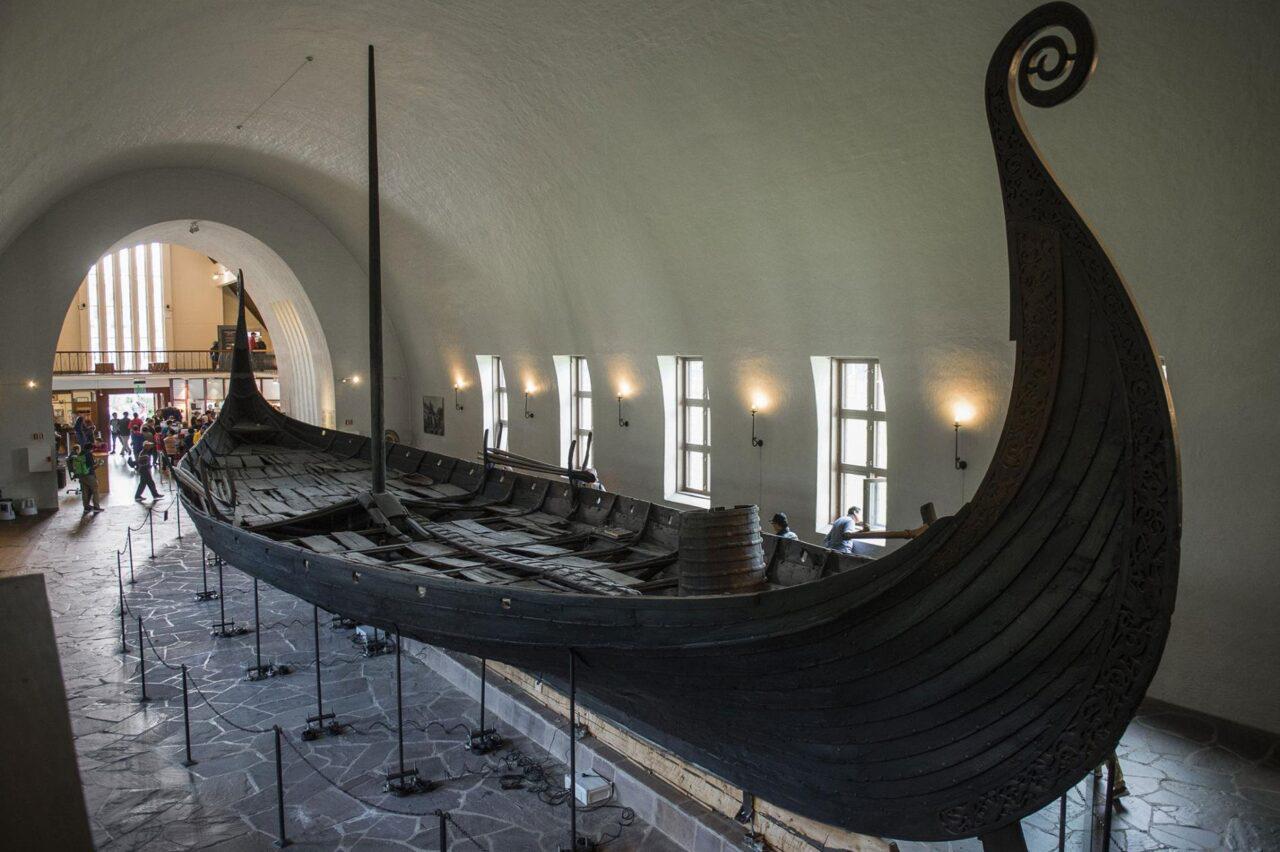
This was the Oseberg ship, a 9th century Viking vessel used as a burial chamber for two high‑status women. It was one of the best preserved Viking ships ever found, loaded with objects that looked like someone had just stepped away. The find rewrote what historians thought they knew about Viking society, religion, and even gender.
The Oseberg ship burial is one of the richest Viking graves ever discovered. It was a royal‑level send‑off that turned a ship into a tomb and a mound into a monument. By the end of this story, you will know who those women likely were, how the burial worked, what was in the grave, and why this one ship changed the way we talk about the Viking Age.
What was the Oseberg ship and when was it built?
The Oseberg ship is a 21.5 meter (about 70 feet) long wooden Viking ship, built mostly of oak, with 15 pairs of oar holes and a tall, curling prow carved with animal ornament. Radiocarbon dating and tree‑ring analysis place its construction around 820 CE. It is a real seagoing vessel, not a ceremonial fake.
Viking ships came in different types. Some were heavy cargo vessels. Some were warships. Oseberg is closer to a large, elegant pleasure or prestige ship. Its hull is relatively wide and shallow, good for coastal sailing and fjords, not for long ocean crossings like the later Gokstad ship. Think royal yacht more than Atlantic raider.
The hull planks are clinker‑built, overlapping like fish scales and fastened with iron rivets. The prow and stern rise high, each ending in a tight spiral of carved wood. The sides are decorated with carved animal ornament in the so‑called Oseberg style, all gripping beasts and writhing bodies. Even the functional parts are art.
Snippable definition: The Oseberg ship is a 9th century Viking ship used as a burial vessel for two elite women, discovered almost perfectly preserved in a burial mound in Norway in 1904.
The ship itself mattered because it was not just a prop in a grave. It was a working vessel, then repurposed as a coffin for someone powerful. That choice tells us how Vikings linked ships, status, and the journey to the afterlife.
How and why was the Oseberg ship buried?
The ship was buried in a mound at Oseberg, near Tønsberg in Vestfold, southern Norway. Dendrochronology shows that the burial took place in 834 CE. That is about a decade after the ship was built, which suggests it had a real life at sea before it became a grave.
Viking ship burials were rare and expensive. You needed a seaworthy vessel, a crew to move it inland, and a small army of workers to build the mound. At Oseberg, the ship was dragged up from the water and placed in a pit. A wooden burial chamber was built in the stern, like a little log cabin inside the ship. The two women were laid inside with textiles, furniture, and offerings. Then the ship and chamber were covered with stones and turf to form a mound about 40 meters across and several meters high.
Why bury a ship at all? In Norse belief, ships were more than transport. They were symbols of power, wealth, and connection. They carried warriors to raids, traders to markets, and, in poetry and myth, the dead to the next world. To give someone a ship in death was to give them status in eternity and to show the living that this person had commanded serious resources.
Snippable causal claim: Viking ship burials like Oseberg were political statements. They turned funerals into public displays of wealth and power that reinforced who ruled the region.
The Oseberg burial mattered because it shows a community willing to sacrifice a valuable ship and enormous labor to honor two women. That alone forces us to rethink who could hold power in Viking society.
Who were the two women in the Oseberg ship?
Inside the burial chamber, archaeologists found the remains of two women. Their bones were poorly preserved, but enough survived for basic analysis.
The older woman was probably in her 70s when she died, which is remarkable for the 9th century. Her spine showed signs of severe illness, possibly cancer or another degenerative disease. The younger woman was likely in her 50s. Both were buried with fine clothing and rich grave goods.
We do not know their names. Written sources from the time are scarce and do not mention this specific burial. But scholars have theories. One popular suggestion is that the older woman might have been Åsa, a semi‑legendary queen mentioned in later sagas as the mother or grandmother of Norwegian kings. That link is speculative. The sagas were written centuries later and mix history with legend.
Another line of thought is that at least one of the women was a religious figure, perhaps a völva, a seeress or ritual specialist. Viking graves of suspected völur sometimes contain staffs, special garments, and unusual objects. The Oseberg grave did include a staff‑like object and a number of items that look ritual, like a carved wagon and animal‑headed posts. Not all scholars agree on this interpretation, but the idea has stuck in the public imagination.
What is clear is that these were not ordinary people. The textiles alone, including fine imported silks and elaborate wool weaves, speak of elite status. The burial is on a scale usually reserved for kings. Yet here, the center of the ritual is two women.
This matters because it undercuts the stereotype of Vikings as exclusively male warriors. The Oseberg women show that women could be at the top of the social and religious hierarchy, powerful enough to command a ship burial that rivaled any male grave.
What was found inside the Oseberg burial mound?
The Oseberg mound was a treasure house. When archaeologist Gabriel Gustafson led the excavation in 1904–1905, his team found not just the ship and the women, but a whole world of objects packed inside.
There were at least 15 horses, 6 dogs, and 2 oxen, all sacrificed and buried with the women. There were four sledges, richly carved and painted. There was a four‑wheeled wooden wagon with elaborate animal carvings, probably used in processions. There were beds, chests, buckets with metal fittings, and kitchen gear.
Textiles were everywhere. Although many had decayed, enough survived to show a mix of local wool fabrics and imported silks from as far away as Central Asia or the Byzantine world. Some textiles had elaborate patterns and tablet‑woven borders. For a long time, Oseberg was the single richest source of Viking‑Age textiles ever found.
Then there were the famous animal‑headed posts, four carved wooden heads with gaping jaws and interlaced bodies. Their exact function is unknown. They may have been used in rituals or as part of a ceremonial wagon. They look almost modern in their abstract ferocity.
There were also everyday tools: farming gear, woodworking tools, even a loom. The grave was not just gold and glitter. It was the material kit of a household and a farm, as if the women were being sent off with everything needed to run an estate in the next world.
Snippable definition: The Oseberg grave goods are a unique collection of Viking‑Age ships, vehicles, animals, textiles, and ritual objects that reveal the wealth and culture of 9th century Norway.
The contents of the grave matter because they turn the Vikings from a stereotype into a society you can almost touch. You see their art, their technology, their trade networks, and their religious imagination in one place.
How was the Oseberg ship preserved and why did it decay later?
People often ask how a wooden ship from the 800s could survive into the 1900s. The short answer is: clay and luck.
The Oseberg mound was built over a layer of blue clay that kept air out and water relatively stable. For centuries, the ship sat in a cool, low‑oxygen environment. Wood‑eating organisms had a hard time getting started. When the mound was first opened, the oak was so well preserved that the ship could be lifted in large sections.
After excavation, the ship was treated with alum, a common conservation method at the time. Alum was meant to harden and stabilize the wood. For decades, it seemed to work. The ship was reassembled and put on display in the Viking Ship Museum in Oslo, where millions of visitors saw it.
Then the chemistry caught up. Alum treatment leaves acidic residues in the wood. Over time, that acid began to break down the cellulose. By the early 21st century, conservators realized that the Oseberg wood was becoming fragile and powdery from the inside. The very method that saved it was now threatening it.
This is why you sometimes hear that the Oseberg ship is both “almost perfectly preserved” and “in danger.” The original burial conditions preserved it. Modern conservation methods, based on the science of a century ago, created new problems.
The preservation story matters because it shows that archaeology is not just about digging things up. It is about long‑term care, changing science, and hard choices about how to keep a 1,200‑year‑old ship alive for future generations.
What did the Oseberg ship change about our view of Vikings?
Before Oseberg, the popular image of Vikings was simple: male warriors in horned helmets (which they did not wear), burning monasteries and drinking from skulls (they did not do that either). The Oseberg ship helped blow that cartoon apart.
First, it showed the Vikings as master craftsmen. The carvings on the ship, wagon, sledges, and animal‑headed posts are some of the finest woodwork from early medieval Europe. The textiles showed advanced weaving and access to global trade networks. These were not isolated barbarians. They were plugged into long‑distance commerce.
Second, it forced historians to take elite women seriously. A ship burial of this scale for two women is hard to ignore. It raised questions about female property rights, political power, and religious authority in Scandinavia. Later finds, like rich female graves in Birka in Sweden, have added to that picture.
Third, Oseberg gave scholars a reference point for Viking art. The “Oseberg style” of animal ornament, with its tight knotwork and gripping beasts, became a key category in art history. From this one grave, you can trace stylistic links across Scandinavia and into the British Isles.
Finally, the find fed into Norwegian nation‑building. In the early 1900s, Norway was newly independent from Sweden. The Oseberg ship arrived right on time as a symbol of a heroic, seafaring past. It was used in schoolbooks, art, and politics as proof that Norwegians had deep historical roots as a maritime people.
All of this matters because the Oseberg ship did not just fill in details. It shifted the center of gravity in Viking studies, from raiding to culture, from men with swords to societies with complex hierarchies and beliefs.
What is the legacy of the Oseberg ship today?
Today, the Oseberg ship is housed in the Viking Ship Museum (now part of the Museum of the Viking Age) in Oslo, though the building and exhibits are in the middle of a long‑term upgrade. Conservation teams are working to stabilize the alum‑treated wood with new methods, including consolidants and controlled environments. It is slow, delicate work.
Outside the museum, the ship has had a busy afterlife. Full‑scale replicas have been built and sailed, testing how the original might have handled at sea. These experiments suggest that while Oseberg was not ideal for ocean crossings, it was perfectly capable of coastal voyages and fjord travel. That matches the idea of a prestige vessel used in local power politics.
In popular culture, the Oseberg ship has quietly shaped how Viking ships are drawn in films, games, and illustrations. The curling prow, the low hull, the carved ornament: much of what people picture when they think “Viking ship” owes something to Oseberg, even if they do not know the name.
The ship also keeps fueling debates. Were the women queens, priestesses, or both? Was the burial a display of dynastic power, a religious act, or a mix of the two? As new methods like DNA analysis and isotope testing improve, researchers are still squeezing new data out of old bones and textiles.
The legacy of the Oseberg ship matters because it keeps reminding us that a single archaeological find can rearrange a whole historical era. A farmer’s stubborn plow turned up not just a ship, but a different story about who the Vikings were and what they valued.
Frequently Asked Questions
What was the Oseberg ship used for before it became a burial?
The Oseberg ship was a real seagoing vessel built around 820 CE, likely used as a prestige or ceremonial ship for coastal voyages in southern Norway. It was not built solely as a grave good. About a decade after construction, in 834 CE, it was hauled ashore and reused as the centerpiece of a lavish burial for two elite women.
Who was buried in the Oseberg ship?
Two women were buried in the Oseberg ship. One was probably in her 70s, the other in her 50s. Their rich grave goods, including fine textiles, vehicles, and sacrificed animals, show they were part of the highest elite. Some scholars suggest the older woman might have been a queen or a powerful religious figure, but their exact identities are unknown and the sources do not name them.
Why is the Oseberg ship so well preserved?
The Oseberg ship survived because it was buried in a mound over blue clay that created a cool, low‑oxygen environment. That slowed decay and protected the oak from many wood‑eating organisms. When excavated in 1904–1905, the wood was in exceptional condition. Later alum conservation treatments, however, have caused new problems, and conservators are now working to stabilize the fragile wood.
What was found in the Oseberg ship burial?
The Oseberg burial contained the ship itself, a wooden burial chamber, the remains of two women, and a huge range of grave goods: at least 15 horses, 6 dogs, and 2 oxen, four carved sledges, a ceremonial wagon, beds and chests, tools, kitchen equipment, and a remarkable collection of textiles including imported silks. It also included famous carved animal‑headed posts whose exact function is still debated.