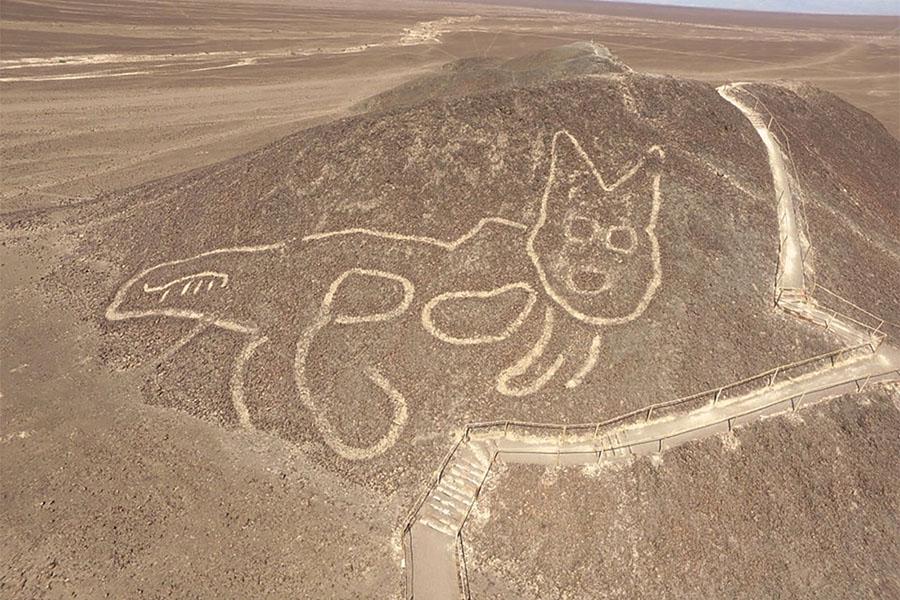
In late 2020, a drone survey team flew over a dusty hillside on the edge of Peru’s Nazca desert. On the screen, a faint outline came into focus: pointed ears, a long striped tail, two wide eyes staring back from the slope. It was a cat. A cat the size of a football field, drawn into the earth about 2,000 years ago, hiding in plain sight beside one of the most famous archaeological sites on the planet.
The Nazca Lines already had hummingbirds, monkeys, spiders and whales. The discovery of a giant cat geoglyph surprised even experts who thought they knew the desert’s every trick. The find raised a simple question that Reddit threads and news headlines echoed: how do you “miss” a 37‑meter cat for decades, and what does it tell us about the people who carved it?
By the end of this explainer, you’ll know what the Nazca cat actually is, who likely made it, how it was found so late, and why this odd desert feline matters for understanding ancient Peru.
What was the Nazca cat geoglyph, exactly?
The Nazca cat is a large geoglyph, a design made on the ground by rearranging the surface of the earth. It lies on the slope of a hill in the Nazca desert in southern Peru, near the famous Nazca Lines that stretch across the nearby plateau.
Peru’s Ministry of Culture announced the discovery in October 2020. The cat measures about 37 meters (roughly 120 feet) from head to tail. It is formed in the classic Nazca style: workers scraped away the dark, oxidized stones on the surface to reveal the lighter soil beneath, creating a pale outline that contrasts with the surrounding desert.
The figure is simple and cartoon-like. The cat is shown in profile, with its head turned toward the viewer, ears pricked, and a long tail that curls along most of its body. Archaeologists date it to the Late Paracas period, around 200–100 BCE, which makes it slightly older than many of the more famous Nazca figures on the flat pampa.
So when people say “a 2,000-year-old giant cat geoglyph was discovered in Peru,” they mean this: an enormous, stylized cat drawing etched into a desert hillside by pre-Columbian people, created by removing surface stones, and only properly recorded and restored in 2020.
That definition matters because it places the cat squarely within a known Andean tradition of earth drawings, rather than as some random or alien oddity.
What set it off: why did ancient people carve giant animals in the desert?
The cat is part of a much larger story. Between roughly 500 BCE and 500 CE, people in southern Peru created hundreds of geoglyphs: straight lines, trapezoids, and animal and plant figures spread across about 450 square kilometers of desert.
The Nazca Lines are not visible as coherent shapes from the ground at most angles. That has fueled decades of wild theories, from alien runways to astronomical observatories. Archaeologists, working with ceramics, burial sites and local traditions, have built a more grounded explanation.
The Nazca and earlier Paracas cultures lived in a harsh environment. The coastal desert is one of the driest places on earth, but rivers from the Andes create narrow fertile valleys. Water was everything. Many scholars think the lines and figures were tied to ritual activities meant to secure rainfall and agricultural fertility.
Some lines align with water sources or follow underground aquifers. Others form processional routes. People may have walked these lines in ceremonial circuits, turning the desert into a ritual stage. The animal figures, including the cat, likely carried symbolic meaning. Felines in Andean art often appear as powerful, sometimes supernatural creatures, linked to strength, protection, and the boundary between worlds.
So the “root cause” behind a giant cat on a hillside was not random doodling. It was a religious and social system that used the desert itself as a canvas to communicate with the gods, mark sacred spaces, and bind communities together around shared rituals.
Seeing the cat in that context shifts it from a quirky curiosity to one more piece of evidence for how ancient Andean societies thought about power, nature and the divine.
The turning point: how was the Nazca cat finally discovered?
The obvious question from Reddit and news readers was blunt: how do you lose a 37‑meter cat?
The answer is that no one so much “lost” it as never properly recorded it. The Nazca desert is full of geoglyphs, many faint or eroded. Archaeologists have known for years that there were more figures on the surrounding hillsides than had been mapped. The cat lay on a steep slope that is hard to see clearly from the ground and easy to miss from the air if you are not looking at the right angle.
By 2020, tourism infrastructure was expanding around the Nazca Lines, including observation points for visitors. During maintenance and improvement work on one of these lookouts on the Mirador Natural hill, staff noticed faint lines on the slope. Drone surveys and closer inspection revealed the cat figure.
At the time of discovery, the geoglyph was in poor condition. Natural erosion, rockfalls, and human foot traffic had blurred the lines. Archaeologists and conservators from Peru’s Ministry of Culture cleaned and restored the figure, carefully removing stones and stabilizing the outline. Only after this work did the cat become clearly visible in photographs.
So the “turning point” was a mix of modern technology and mundane construction work. Drones, high-resolution imaging, and the simple fact that people were finally looking closely at that particular hillside combined to bring the cat back into view.
This matters because it shows that the Nazca region is not a finished puzzle. Even in one of the most studied deserts on earth, new figures are still being found, which means our picture of ancient Andean ritual life is still incomplete and changing.
Who drove it: the Paracas and Nazca people behind the lines
No one signed the cat. There is no plaque on the hillside saying “Made by X in 150 BCE.” But style and dating give us a good idea of who was responsible.
The geoglyph’s form, especially the way the body is drawn with a long tail and the head turned toward the viewer, resembles figures seen in Paracas textiles and ceramics. The Paracas culture flourished on Peru’s south coast from about 700 to 200 BCE. They are known for elaborate woven cloths, often with feline and supernatural motifs, and for their early use of geoglyphs on hillsides.
Later, from around 100 BCE to 800 CE, the Nazca culture expanded the tradition onto the flat desert pampa, creating the huge lines and figures most tourists know. The cat appears to sit at the transition between these two traditions: a Paracas-style figure in the Nazca region, on a hillside rather than the plain.
Creating a geoglyph like this was not a casual act. It required planning, labor, and coordination. Workers had to mark out the design at scale, then remove the dark surface stones along the planned lines. The desert’s dryness helped preserve the result for centuries.
We do not know the names of the people who directed this work, but they were likely ritual specialists or local leaders with enough authority to mobilize labor for a project that did not produce food or buildings, only meaning.
Recognizing the human hands behind the cat matters because it ties the figure to real societies with politics, beliefs and conflicts, instead of treating it as an anonymous mystery divorced from the rest of Andean history.
What it changed: how the cat altered our view of the Nazca Lines
On one level, the Nazca cat did not rewrite history. Archaeologists already knew that there were many more geoglyphs than the famous dozen or so that appear in textbooks. They had already identified hillside figures and linked them to Paracas traditions.
Yet the cat did change a few things.
First, it expanded the catalog of known animal figures in the Nazca region. Each new figure helps refine stylistic chronologies. The cat’s style and location support the idea that hillside geoglyphs are generally older than the big pampa figures, helping to map how the practice evolved over centuries.
Second, it drew public attention back to the fact that many geoglyphs are in danger. The cat was partly eroded and affected by human activity. Its condition became a case study in how easily these lines can be damaged by vehicles, tourists, or simple neglect.
Third, the discovery encouraged more systematic surveys using drones and satellite imagery. In the years around 2018–2020, Japanese and Peruvian teams used AI and aerial data to identify dozens of previously unknown geoglyphs in the Nazca region. The cat fit into this wave of finds and helped justify continued funding and protection efforts.
So the cat’s real impact was to sharpen the timeline of geoglyph creation, raise alarms about preservation, and push archaeologists to search more carefully in places they thought they already knew.
Why it still matters: myth, science, and a desert full of lines
The Nazca cat went viral because it is visually charming and easy to grasp. A giant ancient hummingbird feels abstract. A giant cat with big eyes on a hillside looks like something out of a child’s drawing, scaled up to monumental size.
But the figure matters for more than memes.
First, it is a reminder of how incomplete our knowledge of the past remains. Even iconic sites still hold surprises. That pushes back against the idea that archaeology is a finished catalog and shows it as an active, changing field.
Second, the cat is a good entry point for correcting common misconceptions about the Nazca Lines. You do not need alien engineers or lost super-civilizations to explain them. You need organized communities, religious ideas about water and the cosmos, and a desert that preserves shallow earthworks for millennia.
Third, the discovery has practical consequences. International attention helps Peru secure resources for conservation. The more people understand that a faint line in the desert might be a 2,000‑year‑old ritual path or animal figure, the easier it is to argue for strict controls on roads, mining and unregulated tourism in the region.
Finally, the cat gives us a small but vivid glimpse into how ancient people saw the world. Someone, two millennia ago, decided that a cat was worth drawing at a scale only the gods or spirits might fully see. That choice tells us something about what they feared, respected, or loved.
That lingering stare from the hillside is not just a curiosity in a Reddit thread. It is a surviving trace of a conversation between humans and their environment that has been going on in the Nazca desert for thousands of years.
Frequently Asked Questions
What is the Nazca cat geoglyph in Peru?
The Nazca cat is a 37‑meter‑long geoglyph, a giant drawing made by scraping away dark surface stones to reveal lighter soil, on a hillside near the Nazca Lines in southern Peru. It dates to around 200–100 BCE and depicts a stylized cat with a long tail and large eyes.
How was the 2,000-year-old Nazca cat discovered?
The cat was identified in 2020 during maintenance work on a tourist lookout near the Nazca Lines. Staff noticed faint lines on a nearby slope, and drone surveys plus on-site cleaning by Peru’s Ministry of Culture revealed the full cat figure, which had been eroded and hard to see before restoration.
Why did the Nazca and Paracas cultures make giant geoglyphs?
Most archaeologists think the geoglyphs were tied to religious rituals related to water and agriculture. The lines may have been walked as ceremonial routes, and the animal figures, including the cat, likely had symbolic meanings connected to power, protection, and the spirit world in ancient Andean belief systems.
Can you see the Nazca cat geoglyph from the ground?
The Nazca cat is on a hillside, so parts of it can be seen from nearby vantage points, especially from designated lookouts. However, like many geoglyphs in the Nazca region, its full shape is easiest to recognize from the air or from drone and aerial photographs.