On a June day in 1948, a line of children at Mooseheart, Illinois, squinted into the sharp color of a Kodachrome lens. Their clothes are neat but plain. The grass is clipped. Behind them, low brick buildings and open space hint at something bigger than a simple orphanage. The Reddit caption calls it an “orphanage,” and in a sense that is right. But Mooseheart was also a social experiment: a self-contained “child city” built by a fraternal lodge to raise the children of its dead and destitute members.
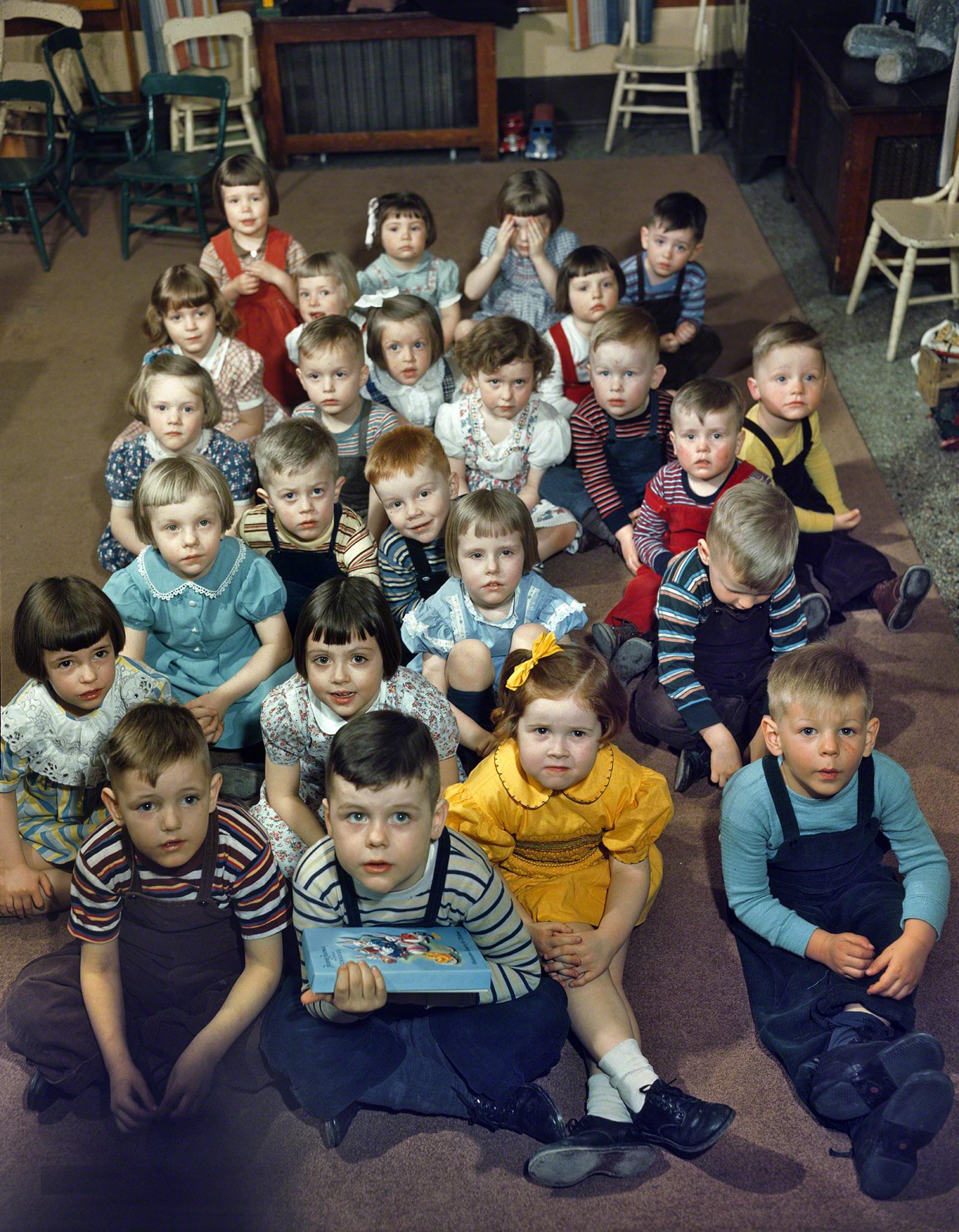
The Mooseheart orphanage photo from June 8, 1948, captures a moment when Americans were still building entire communities around ideas of charity, discipline, and order. To understand what we are seeing in that color image, you have to go back to the early 1900s, when fraternal orders were trying to solve a problem the welfare state had barely begun to touch: what happens to children when the breadwinner dies.
Mooseheart was not just an orphanage. It was a 1,000‑acre planned community for children, run by the Loyal Order of Moose, with its own farms, schools, chapel, and rules. It tried to replace family with institution, and for decades it did exactly that. The story of how it came to be, how it changed, and what it left behind is written on the faces of kids like those in the 1948 Kodachrome.
What was Mooseheart and why did it exist?
Mooseheart began with a blunt question that haunted industrial America: if a working man died, who would take care of his children?
The Loyal Order of Moose, founded in the 1880s and reorganized in 1906 under the energetic leadership of James J. Davis, was one of many fraternal orders that offered working men a mix of social life, mutual aid, and a sense of belonging. These lodges collected dues and, in return, promised some form of help in sickness and death. Davis, a Welsh immigrant and steelworker, pushed the order to do something more ambitious. He wanted a permanent home where the children of deceased or impoverished Moose members could live, study, and learn a trade.
In 1907, the Moose adopted the idea of a “Mooseheart” home. After fundraising and scouting, they bought about 1,000 acres of farmland near Batavia, Illinois, along the Fox River. Mooseheart officially opened on July 27, 1913, with the first children arriving that fall. The order called it the “Child City.” It had its own post office, power plant, dairy herd, and schools. At its peak, Mooseheart housed hundreds of children at a time.
Mooseheart was a planned institutional community created by a fraternal order to raise the children of its members, combining orphanage, boarding school, and small town in one place. That basic definition matters because it explains why the 1948 photo shows not a grim Dickensian asylum but a tidy, almost suburban scene.
The idea was simple and very early‑20th‑century: if you could not guarantee a stable home for each child, you could build a whole city for them instead. That decision shaped the daily lives of thousands of kids and created the world the 1948 children inhabited.
How did Mooseheart actually work for the children who lived there?
To get into Mooseheart, a child usually had to have a parent who was a Moose member and who had died, become disabled, or fallen into severe poverty. Exact rules shifted over time, but the core idea was that Moose dues funded the care of Moose children. This was mutual aid with a membership card.
Once accepted, children were transported to the Illinois campus and placed in age‑graded homes. In the early decades, Mooseheart used large dormitory buildings. Later it moved toward smaller “cottages” meant to resemble family homes, each run by houseparents. Boys and girls were separated by building and, often, by training track.
Daily life was regimented. There was school, of course, in Mooseheart’s own classrooms. There were chores, farm work, and vocational training. Boys might learn carpentry, agriculture, or mechanics. Girls were steered toward domestic science, sewing, and office work. Religion was part of the mix, though Mooseheart itself was not tied to a single denomination. The point was order, morality, and self‑sufficiency.
For many kids, Mooseheart meant food security, education, and medical care they would not have had at home. For others, it meant growing up inside an institution where affection was rationed and rules were not. Personal accounts from former residents, especially from the mid‑20th century, are mixed. Some remember Mooseheart as a lifeline. Others remember loneliness, strict discipline, and the feeling of being part of a system rather than a family.
Still, Mooseheart’s structure allowed the Loyal Order of Moose to claim something powerful: that no Moose member’s child would be left destitute. That promise helped the order recruit members and gave working‑class families a kind of informal insurance at a time when government support was thin.
The way Mooseheart functioned, with its blend of care, control, and vocational training, shaped the childhoods of thousands and created the institutional culture visible in that neat 1948 group portrait.
Why does the 1948 Kodachrome matter in Mooseheart’s timeline?
The date on the Reddit post, June 8, 1948, drops us into Mooseheart at a particular moment. World War II had ended three years earlier. The GI Bill was reshaping American education. The baby boom was underway. And the United States was just beginning to rethink how it treated children without stable homes.
By the late 1940s, Mooseheart had already been operating for more than three decades. It had weathered World War I, the 1918 flu pandemic, the Great Depression, and World War II. During those years, economic collapse and mass casualties created more children who qualified for institutional homes. Mooseheart’s population swelled in hard times and steadied in better years.
The 1948 scene shows Mooseheart at a kind of high plateau. The campus was built out. The routines were established. Color film, like Kodachrome, was becoming more common, so we see the place in vivid hues instead of the gray of earlier decades. The children are dressed in postwar American fashion, not the more formal outfits of the 1910s and 1920s. They look like kids from any small town, which was exactly the point.
At the same time, child welfare experts were starting to question large institutions. Social workers and psychologists argued that children did better in family settings, even if those families were foster homes or small group homes. Reports in the 1940s and 1950s criticized orphanages for being impersonal and rigid. Mooseheart, like other institutions, would soon feel that pressure.
So the 1948 Kodachrome captures Mooseheart in a moment of apparent stability just before the wider culture began to turn against the very model it represented.
Was Mooseheart a typical orphanage or something different?
People seeing the Reddit photo often assume Mooseheart was a standard orphanage for any child in need. It was not.
First, Mooseheart was tied to a membership organization. To get in, you usually needed a Moose connection. That made it less like a city orphan asylum and more like a private benefit for dues‑paying members. In that sense, Mooseheart was an early form of what we might now call a “benefit program” or “social insurance” for a specific group.
Second, Mooseheart was huge and self‑contained. Many orphanages were single buildings in cities, run by churches or charities, where children lived and then went to local schools or apprenticeships. Mooseheart had its own school system, farms, vocational shops, and sports teams. It was a closed world. Kids could spend their entire childhood there, from kindergarten through high school graduation, without ever living in a private home.
Third, Mooseheart’s funding and governance came from a national fraternal order. Moose lodges across the country sent money, supplies, and sometimes even members to work there. This gave Mooseheart a stable financial base compared to some small local orphanages that struggled year to year. It also meant Mooseheart reflected the values of the Moose: patriotism, work ethic, male breadwinner assumptions, and a strong belief in discipline.
Finally, not all Mooseheart children were technically orphans. Many had one living parent who simply could not support them. The term “orphanage” in mid‑20th‑century America often covered children of divorce, abandonment, or poverty, not only those who had lost both parents. Mooseheart was part of that broader pattern. The word “orphan” in the Reddit title is emotionally accurate but administratively fuzzy.
Understanding Mooseheart as a membership‑based, self‑contained “child city” rather than a generic orphanage changes how we read that 1948 image. Those children were not just wards of charity. They were, in a sense, beneficiaries of a private welfare system built by their parents’ lodge.
How did Mooseheart change as child welfare ideas shifted?
From the 1950s through the 1970s, American child welfare policy moved away from large institutions and toward foster care, adoption, and smaller group homes. Mooseheart had to adapt or become a relic.
Pressure came from several directions. Psychologists argued that children needed individual attention and stable attachments that big institutions struggled to provide. Social workers criticized the “warehousing” of children. State and federal agencies began to regulate child care more closely and to favor family‑based solutions when possible.
Mooseheart responded by shrinking and reconfiguring. Large dormitories gave way to smaller cottage‑style homes. Houseparents were meant to act more like surrogate parents than wardens. The number of children on campus declined. Mooseheart increasingly focused on kids with more complex needs or troubled family backgrounds, not just on the children of deceased Moose members.
By the late 20th century, Mooseheart described itself less as an orphanage and more as a residential childcare facility or community for children and teens in need. The Loyal Order of Moose still funded it, but the model had shifted. The campus remained, but the idea of raising large numbers of children from early childhood to adulthood inside an institution was fading.
This transition mirrored a national move away from classic orphanages. Many such institutions closed or reinvented themselves as treatment centers, boarding schools, or group homes. Mooseheart’s survival, in altered form, shows how some organizations managed to ride that policy wave instead of being swept under it.
The shift from mass institutional care to smaller, more family‑like settings changed what it meant to grow up at Mooseheart, and it marked the end of the world the 1948 children knew.
What is Mooseheart’s legacy and what happened to the “child city”?
Mooseheart did not vanish when orphanages went out of fashion. It is still there, on the same land along the Fox River, though with far fewer children and a different mission than in 1948.
Today, Mooseheart bills itself as a residential childcare community for children and teens whose families are in crisis. It uses a family‑style home model, with small houses and live‑in family teachers. The Loyal Order of Moose and its women’s auxiliary, now called Women of the Moose, still see Mooseheart as one of their core charitable projects.
For former residents, Mooseheart’s legacy is deeply personal. Many alumni groups exist. Their stories are complicated. Some recall Mooseheart as the place that gave them a future, a high school diploma, and a trade. Others remember harsh discipline, emotional distance, or the pain of being separated from siblings and parents. Both can be true at once.
On a broader scale, Mooseheart is a window into how Americans handled vulnerability before the rise of modern social programs. It shows how fraternal orders, not just churches and governments, built safety nets. It shows how ideas about childhood, family, and responsibility changed across the 20th century.
The 1948 Kodachrome matters because it freezes that story at one moment in time. The children in the photo are the product of a specific social contract: men paid dues to a lodge, the lodge built a city for their children, and the children were raised not by kin but by an institution. That arrangement is foreign to many people today, which is why Reddit users stare at the photo and ask what exactly they are looking at.
Mooseheart’s legacy is the reminder that the way we care for children without stable homes is not fixed. It is a choice, shaped by money, ideology, and the institutions we trust. The kids in that 1948 picture lived inside one such choice. Their faces, caught in early color, are the human proof.
How does the Mooseheart photo change how we see “the way we were”?
Old color photos have a particular power. They strip away the comforting distance of black and white. The children at Mooseheart in 1948 look like kids you might see at a summer camp today. That familiarity can trick us into assuming their lives were similar to ours.
They were not. Those children lived in a world where private lodges, not federal programs, might decide whether you had a bed and three meals a day. They grew up in an institution that tried to be an entire town and family at once. Their futures were steered toward specific roles in a mid‑century economy that assumed clear lines between men’s and women’s work.
At the same time, the photo cuts through some modern myths. Not every orphanage was a gothic horror. Mooseheart was clean, organized, and, by the standards of its time, proud of what it offered. Many children there were not literal orphans but kids whose families had been broken by death, illness, or poverty. The line between “orphan” and “poor child” was blurry.
When people on Reddit ask whether the colors are real, whether the kids were happy, or whether this sort of place still exists, they are really asking how different the past was from the present. The answer is that Mooseheart was both strange and familiar. It was a product of its era’s faith in institutions and discipline, and of a very human desire to keep children from falling through the cracks.
That tension is what gives the 1948 Mooseheart photo its pull. It is not just an image of children posing on a summer day. It is a snapshot of a whole system of care, now largely gone, that shaped the lives of thousands of kids and helped bridge the gap between private charity and public welfare in 20th‑century America.
So when you look at those faces, you are seeing more than nostalgia. You are looking at one answer to the question every society has to solve: who takes care of the children when everything else falls apart.
Frequently Asked Questions
What was Mooseheart orphanage in Illinois?
Mooseheart, founded in 1913 near Batavia, Illinois, was a 1,000‑acre “child city” run by the Loyal Order of Moose. It housed and educated the children of deceased or destitute Moose members, combining an orphanage, boarding school, and small town in one planned community.
Were the children at Mooseheart in 1948 all orphans?
Not all Mooseheart children were true orphans. Many had one living parent who could not support them because of death of a spouse, illness, poverty, or family breakdown. In mid‑20th‑century usage, “orphanage” often included children from broken or impoverished homes, not only those who had lost both parents.
Does Mooseheart orphanage still exist today?
Yes. Mooseheart still operates on its original site in Illinois, but it no longer functions as a classic orphanage. It now describes itself as a residential childcare community using family‑style homes and serves children and teens whose families are in crisis, funded by the Loyal Order of Moose and its auxiliary.
Why did institutions like Mooseheart decline in the US?
Large orphanages and institutional homes declined in the US after the 1950s as child welfare policy shifted toward foster care, adoption, and smaller group homes. Psychologists and social workers argued that children did better in family settings, and regulations and funding priorities moved away from mass institutional care.