Picture a trader in 11th century Cairo emptying a leather pouch onto a wooden table. Out spill thin gold dinars from Fatimid Egypt, chunky silver dirhams struck by the Abbasids, and dark copper fulus from some provincial governor. No portraits. No kings on horseback. Just lines of Arabic script, dates, and the names of rulers and caliphs.
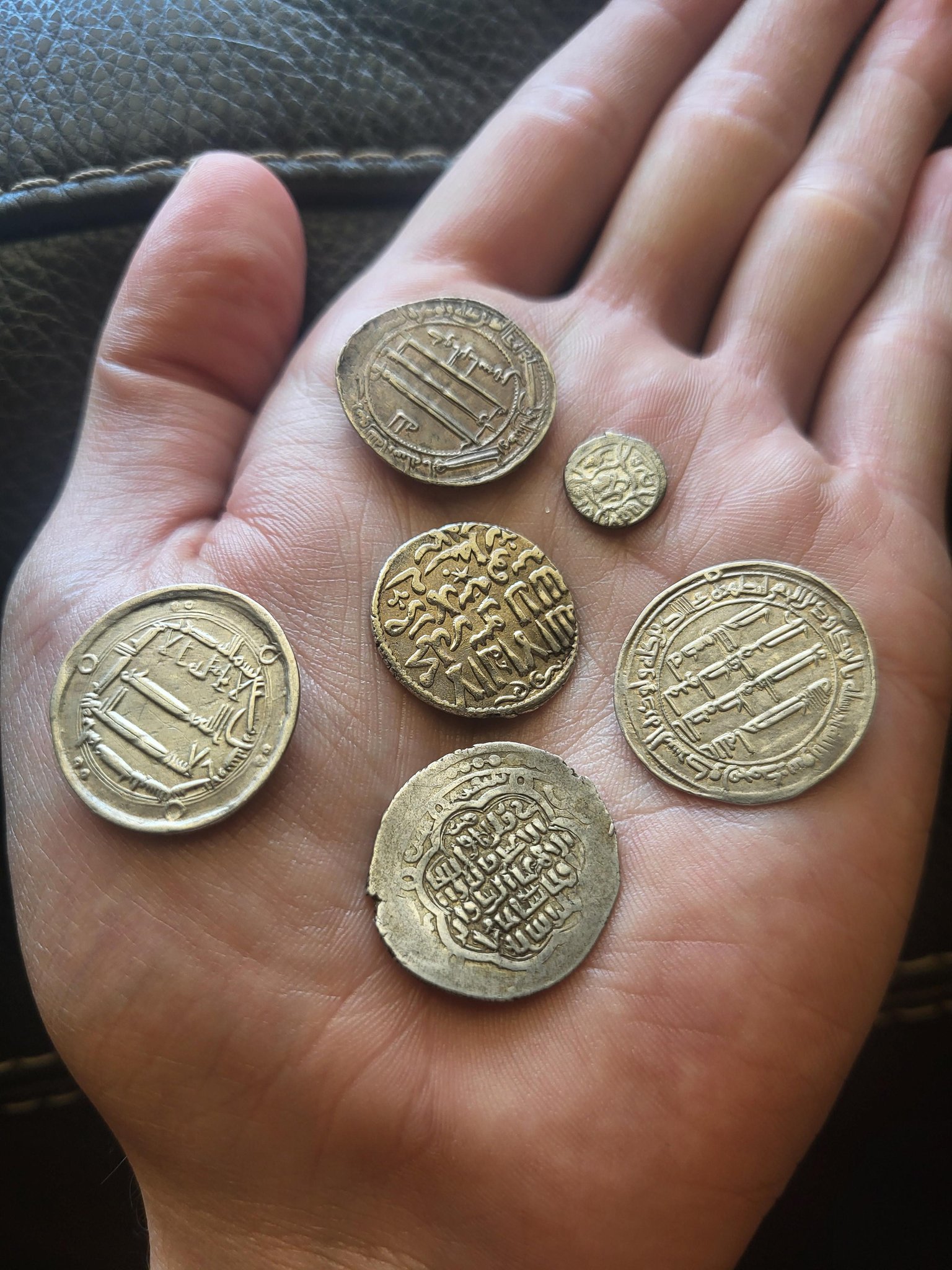
That handful of coins is not just money. It is a map of power, faith, and trade from Spain to Central Asia.
Medieval Islamic coinage looks strange to modern eyes used to faces and national symbols. Why all the text? Why no pictures? How could coins from different dynasties circulate together? And what did it mean when a ruler changed a single line of script?
Medieval Islamic coins were small metal documents. They announced who ruled, which faith they followed, and who they recognized as legitimate. When dynasties rose or fell, coins were among the first and clearest places where that change appeared.
Why did early Islamic coins look so different?
The first Muslim armies that burst out of Arabia in the 630s did not bring a new currency with them. They walked into regions already using long-established coins. In the former Sasanian Persian territories, people used silver drachms with fire altars and royal busts. In the eastern Roman (Byzantine) lands, they used gold solidi and copper folles with Christian symbols and imperial portraits.
For a while, the new rulers simply kept using those coins. They were familiar, trusted, and technically sound. Early Muslim governors even overstruck or added short Arabic inscriptions to existing coins rather than redesigning them from scratch.
The change came under the Umayyad caliph Abd al-Malik ibn Marwan, who ruled from 685 to 705. He faced rebellions, rival claimants, and a Christian empire to the west that still claimed to be the true Roman power. Money became a weapon in that struggle.
Around the 690s, Abd al-Malik began a deliberate coinage reform. In the east, he replaced the old Sasanian-style silver coins with dirhams that kept the circular layout but stripped away the royal bust and Zoroastrian fire altar. In their place came lines of Arabic text. In the west, he introduced a new gold coin, the dinar, that broke with Byzantine models and carried only inscriptions.
By about 697–698, the standard Islamic gold dinar had taken shape: about 4.25 grams of high-quality gold, with the Islamic profession of faith (the shahada) and Qur’anic phrases on one side, and the mint name and date in the Islamic calendar on the other. No faces. No crosses. No fire altars.
Islamic coinage is defined by its inscriptions. Most medieval Islamic coins replaced images with text, using Qur’anic verses and political formulas to express both religious belief and political legitimacy.
This mattered because it announced that the caliphate was not just a new regime using old Roman and Persian tools. It had its own visual language, rooted in Islam, and spread that identity into every market and tax office from Syria to Iran.
What did the inscriptions actually say?
To a modern collector, a medieval Islamic coin can look like a tiny metal page of Arabic calligraphy. To someone in the 8th or 10th century, it read like a political press release.
Most coins carried a few standard elements. First, a religious formula. The shahada, “There is no god but God, Muhammad is the messenger of God,” appears constantly. Many coins also quote short Qur’anic verses about God’s unity or justice.
Second, a political statement. Coins usually named the caliph or ruler, sometimes with titles like “Commander of the Faithful” (amir al-mu’minin). In early Abbasid times, coins might name the caliph al-Mansur or al-Ma’mun. Later, regional dynasties like the Ayyubids, Seljuks, or Ghaznavids put their own names forward, sometimes while still mentioning the caliph to show formal loyalty.
Third, time and place. Most coins give the mint city and the year, using the Hijri calendar that starts in 622 with Muhammad’s migration from Mecca to Medina. So a silver dirham might read something like “Struck in Wasit in the year 130.” That lets modern historians track where and when coins were produced with surprising precision.
Islamic coins often carried Qur’anic verses instead of images. The text on a coin could declare religious doctrine, political loyalty, and the ruler’s name all at once.
Those details had real stakes. When the Abbasids overthrew the Umayyads in 750, they did not just seize palaces. They changed the names on the coins. When a provincial governor rebelled, one of the boldest moves he could make was to strike coins in his own name and drop the caliph’s.
Every change in inscription, every dropped title, marked a shift in who claimed to rule. For people who never saw the caliph in person, the coin in their hand was often the only physical proof of who supposedly governed them.
Gold, silver, and copper: how did the system work?
Medieval Islamic economies used a three-metal system. At the top were gold dinars. These were high-value coins used for large transactions, long-distance trade, and state payments. They were especially common in the western and central parts of the Islamic world, where gold from West Africa and the Mediterranean flowed through markets.
Silver dirhams formed the backbone of everyday commerce in many regions, especially in Iraq, Iran, and Central Asia. They were lighter and lower in value than dinars, but still respectable money. A lot of tax payments and salaries were calculated in dirhams.
At the bottom were copper coins, usually called fulus (singular fals). These handled the smallest purchases: bread, vegetables, cheap pottery. They were often struck by local authorities and could vary wildly in weight and design.
In theory, there was a fixed ratio between gold and silver. In practice, that ratio shifted over time as mines opened or closed, trade routes changed, and states debased or reformed their coinage. When silver flooded in from Central Asia, for example, silver might lose value against gold.
Coins were not just symbols. They were pieces of metal whose value depended on weight and purity. Many people in the medieval Islamic world weighed coins on small scales, especially for large payments, to make sure they were not shortchanged.
Because of that, Islamic coins traveled far beyond the lands of Islam. Abbasid silver dirhams have been found in Viking hoards in Scandinavia and Russia. Traders carried them along the Volga and across the steppe. Some were even cut into pieces to make change.
Gold dinars from Fatimid Egypt or Almoravid North Africa moved across the Mediterranean into Christian Europe. Italian merchants, Spanish kingdoms, and West African traders all handled them. In some cases, Christian rulers imitated Islamic dinars because they were so widely trusted.
The gold dinar and silver dirham gave the Islamic world a shared monetary language. That made trade from Spain to India easier, which in turn helped bind a vast and diverse region into a single economic zone.
How did new dynasties use coins to claim power?
When you look at a handful of medieval Islamic coins from different dynasties, you are looking at a series of political gambles.
The Abbasid revolution of 750 is a clear example. The Abbasids claimed descent from the Prophet’s uncle and accused the Umayyads of impiety and injustice. Once they took power, they needed to show that the world had changed. They kept the basic Umayyad coin format, but they changed the names, sometimes the Qur’anic verses, and the style of script. The new coins circulated through markets and tax offices, quietly telling everyone that a new family ruled in Baghdad.
Regional dynasties played a more delicate game. Take the Buyids in 10th century Iran and Iraq. They were Shi’a military leaders who controlled the Abbasid caliphs in Baghdad. On their coins, they often kept the caliph’s name to show formal obedience, but they added their own titles and names. Anyone reading the coin could see who really held local power.
In Egypt, the Fatimids, who were Isma’ili Shi’a, challenged the Sunni Abbasids. Their coins named their own caliph in Cairo and used different religious formulas. That was not just a design choice. It was a direct claim that the Abbasids were illegitimate and that the true imam-caliph ruled from Egypt.
Later, Sunni rulers like Saladin, who overthrew the Fatimids and founded the Ayyubid dynasty, used coins to reverse that message. Ayyubid coins dropped the Fatimid caliphs, restored the name of the Abbasid caliph, and added Saladin’s own titles as a champion of Sunni Islam.
Even on the edges of the Islamic world, coins carried these arguments. In al-Andalus (Islamic Spain), the Umayyads who escaped the Abbasid massacre set up their own emirate and later caliphate in Córdoba. Their gold dinars announced a rival caliphate, with its own claims to universal leadership.
Changing a name or a phrase on a coin could be an act of rebellion or submission. Coins were the most regular and public way a ruler could assert their legitimacy to millions of people who would never see a royal palace.
Why are there no portraits on most Islamic coins?
One of the first things modern viewers notice is what is missing: faces. In contrast to Byzantine emperors or later European kings, most medieval Islamic rulers did not put their portraits on coins.
The reasons are partly religious and partly cultural. Many Muslim scholars were wary of figural images, especially in religious contexts. While attitudes varied by time and place, putting a human face on a coin that also carried Qur’anic verses felt uncomfortable or even offensive to some.
There were exceptions. Some very early Umayyad coins kept a stylized imperial bust before the full reform. In the eastern Islamic world, especially under Turkic and Mongol dynasties in the later Middle Ages, you do find coins with horsemen, animals, or even portraits influenced by pre-Islamic and Central Asian traditions.
But the dominant trend, especially from the late 7th to the 11th century, was text-based design. That pushed calligraphy to the center. Beautiful scripts like Kufic turned coins into tiny works of art. The aesthetic focus shifted from human figures to the written word.
Islamic coins usually avoided portraits, using calligraphy and Qur’anic text instead. That choice made religious identity and written authority more visible than the ruler’s physical image.
This had a side effect. Since there was no royal face to recognize, literacy in at least basic Arabic terms like “struck in” or “Commander of the Faithful” became more useful. People learned to read names and dates not from books, but from the money in their hands.
What happened when things went wrong: debasement and crisis
Coins were only as good as the trust people had in their metal. When rulers got desperate, they sometimes tampered with that trust.
Debasement meant reducing the amount of precious metal in a coin while keeping the same face value. A silver dirham might be issued with more copper mixed in, or a gold dinar might be slightly underweight. This let rulers stretch their resources, pay armies, or cover deficits.
People noticed. Merchants weighed coins and tested their quality. If a state pushed debasement too far, its coins were rejected in foreign markets or discounted at home. That could choke trade and damage a ruler’s reputation.
Some periods saw major reforms to fix such problems. In the 10th and 11th centuries, for example, the Fatimids in Egypt and the Buyids and later Seljuks in Iraq and Iran had to manage fluctuating supplies of silver and gold. They periodically reformed weights or issued new series of coins to restore confidence.
On the flip side, when a dynasty kept its coinage stable, that became part of its legacy. The early Abbasid dirhams and dinars were so reliable that they continued to be hoarded and used far from their original mints for generations.
Monetary crises and reforms shaped who could trade with whom, which cities thrived, and which dynasties kept their armies paid. Behind every neat row of coins in a collector’s tray lies a story of fiscal choices, good or bad.
How did medieval Islamic coins shape later money?
By the late Middle Ages, the Islamic world was no longer the only major monetary power. European kingdoms were striking their own gold coins. Mongol and Turkic empires controlled large parts of the old caliphate. Yet the habits and standards set by early Islamic coinage lingered.
Christian rulers in Sicily and Spain sometimes copied Islamic gold coins almost exactly, changing only the inscriptions. They did this because merchants trusted the weight and purity of dinars. In some cases, Arabic script was kept even when few locals could read it.
In the eastern Mediterranean, Italian city-states like Venice and Genoa traded heavily with Muslim ports. Their own gold coins, like the Venetian ducat, emerged in a world where the dinar had long been the reference point for international trade.
Within the Islamic world, later dynasties such as the Mamluks, Ottomans, and Safavids kept using the basic tri-metal system, though with local twists. The names changed, and portraits appeared more often in some regions, but the idea that coins carried both religious formulas and political claims remained strong.
For historians, these coins are now one of the best tools for reconstructing the past. Written chronicles can be biased, lost, or vague about dates. Coins are physical, datable, and often brutally honest about who held power in a given city in a given year.
Medieval Islamic coinage helped set standards of weight, purity, and design that influenced Mediterranean and Eurasian trade for centuries. Today, those same coins let us track the rise and fall of dynasties that left few other reliable records.
Why that handful of coins still matters
So imagine that Reddit post again: a handful of coins from various medieval Islamic dynasties. To a casual viewer, they are just old metal discs with fancy Arabic writing. To someone who knows what to look for, they are a compressed history of an empire that stretched across three continents.
One coin might bear the name of an Abbasid caliph in Baghdad, struck in a year when the empire still felt united. Another might carry the title of a Seljuk sultan who ruled in the caliph’s name but held the real military power. A third might show a Fatimid caliph in Cairo, quietly claiming to be the only legitimate leader of the Muslim community.
They tell us when gold was plentiful and when silver flooded in from Central Asia. They show how far Arabic as a written language spread. They reveal which cities were important enough to have their own mints and when those mints fell silent.
Medieval Islamic coins are not just collector’s items. They are the small, durable traces of how faith, power, and trade were negotiated in metal. That is why a simple photo of a few dinars, dirhams, and fulus can spark so much curiosity. Those tiny discs carried the weight of an empire in the palm of a hand.
Frequently Asked Questions
Why do medieval Islamic coins have no pictures?
Most medieval Islamic coins avoided portraits and images because many Muslim scholars were wary of figural art in religious contexts, especially alongside Qur’anic text. Instead, rulers used Arabic inscriptions and calligraphy to express religious belief and political authority. There are some exceptions, especially in later periods and in eastern regions, but text-based designs were the norm from the late 7th to about the 11th century.
What is the difference between a dinar, dirham, and fals?
In medieval Islamic coinage, a dinar was a gold coin used for large transactions and long-distance trade, especially around the Mediterranean. A dirham was a silver coin that formed the basis of many everyday payments and tax calculations, particularly in Iraq, Iran, and Central Asia. A fals (plural fulus) was a copper coin used for small purchases like food and cheap goods. Together, they formed a three-metal monetary system.
How did Islamic coins spread to Europe and the Viking world?
Abbasid silver dirhams traveled along trade routes from the Islamic world into Eastern Europe and Scandinavia, often via the Volga and Baltic routes. Vikings and Slavic traders used them as bullion and sometimes cut them into pieces for change. Gold dinars from North Africa and Egypt reached Christian Europe through Mediterranean trade, and some European rulers even copied Islamic dinars because they were widely trusted for their weight and purity.
How can historians date medieval Islamic coins?
Most medieval Islamic coins include the mint name and the year of issue written in Arabic, using the Hijri calendar that begins in 622 CE. By reading these inscriptions and converting the Hijri year to the Gregorian calendar, historians can date coins quite precisely. Changes in rulers’ names, titles, and Qur’anic phrases on coins also help track political events and dynastic shifts.