On a dusty set in Ghana in 1987, Klaus Kinski pressed a machete to Werner Herzog’s throat. Crew members froze. Cameras were rolling on Cobra Verde, their fifth film together, and everyone knew this was not a rehearsed stunt.
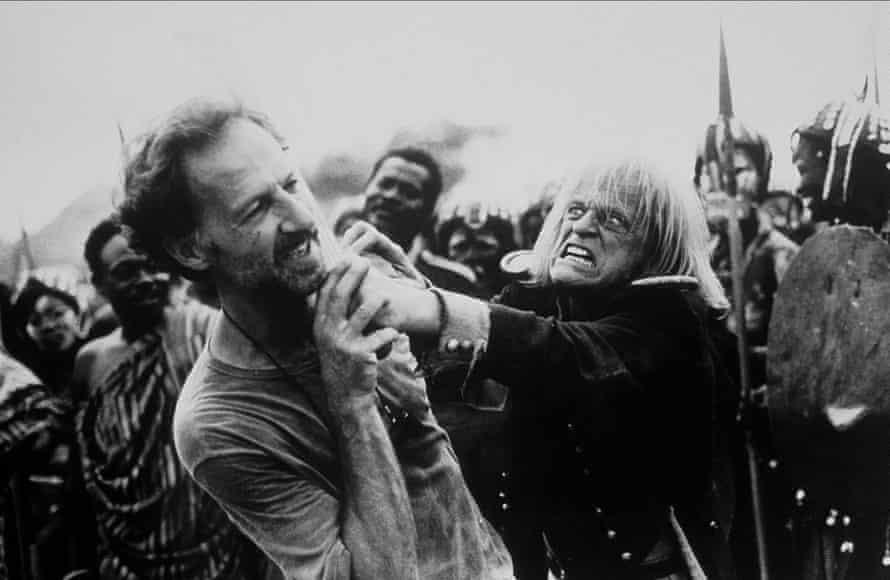
Herzog did not flinch. He stared back at his star, a man he once called his “best fiend,” and waited for Kinski to either cut or back down. He backed down.
The photo that circulates online, including on Reddit’s r/HistoryPorn, captures something real: not just a publicity shot, but the distilled madness of one of cinema’s most volatile partnerships. Klaus Kinski and Werner Herzog did not simply argue. They threatened to kill each other, sabotaged sets, terrified crews, and somehow produced some of the most haunting films of the late 20th century.
What happened between them was not a single outburst on Cobra Verde. It was the end point of a relationship that had been combustible from the start, and that reshaped both of their careers.
How did Herzog and Kinski first collide?
Werner Herzog first met Klaus Kinski in the late 1950s in a Munich boarding house. Herzog was a teenager. Kinski was a struggling actor with a reputation for volcanic rages. They barely spoke, but Herzog watched him.
In his memoir, Herzog recalls Kinski screaming for hours in the shared bathroom, smashing things, and terrorizing the building. For the young director-to-be, this was not just annoying. It was a glimpse of raw, uncontrolled energy that he filed away for later.
By the early 1970s, Herzog had become a key figure in the New German Cinema movement, with films like Signs of Life and Even Dwarfs Started Small. He was looking for someone to embody obsessive, doomed ambition in a film about a 16th‑century Spanish conquistador who loses his mind in the Amazon.
Klaus Kinski, meanwhile, had spent the 1960s and early 70s bouncing between European genre films, war movies, and spaghetti westerns. He was prolific, often broke, and already infamous for violent outbursts on stage and on set. Directors hired him for his intensity and then tried to survive the shoot.
Herzog decided that this barely controlled chaos was exactly what he needed. He cast Kinski as the title character in Aguirre, the Wrath of God (1972). It was their first real collaboration, and it set the pattern for everything that followed.
That first collision mattered because it joined a director obsessed with human extremity to an actor who lived at that edge every day.
What made their early films so powerful and so dangerous?
Aguirre, the Wrath of God was shot in the Peruvian jungle on a shoestring budget. The production was chaotic. The river was dangerous. The crew was small and often sick. Into this environment walked Klaus Kinski, already on a hair trigger.
Herzog and Kinski fought constantly. Kinski raged about his accommodations, his lines, the schedule. At one point, according to Herzog, Kinski threatened to walk off the film. Herzog claimed he told him he would shoot him and then himself if he tried. Kinski stayed.
Whether every detail of that story is literally true is debated, but the core dynamic is not. Herzog used confrontation as a directing tool. He provoked Kinski, needled him, and sometimes lied to him to get the performance he wanted. Kinski responded with real fury. The line between acting and breakdown blurred.
The result on screen was unforgettable. Kinski’s Aguirre, limping and wild-eyed, drifting downriver on a raft of monkeys, feels less like a performance than a possession. The film made Herzog internationally famous and turned Kinski into an icon of madness.
They followed it with Nosferatu the Vampyre (1979), where Kinski’s pale, rat‑like Dracula is both monstrous and pathetic, and then Woyzeck (1979), shot in just 18 days, where Kinski plays a soldier driven to murder by humiliation and poverty.
Herzog and Kinski’s early films worked because the director built stories about obsession, failure, and delusion, then cast an actor who seemed permanently on the edge of all three. The danger was not just narrative. It was baked into the way they worked.
These early collaborations mattered because they locked both men into a shared myth: Herzog as the mad visionary director, Kinski as his unhinged muse, and the jungle or the night as their arena.
Why was Fitzcarraldo the breaking point before the end?
If Aguirre was madness on a small budget, Fitzcarraldo (1982) was madness with money. Herzog wrote the story of a rubber baron in Peru who dreams of building an opera house in the jungle and decides to haul a 320‑ton steamship over a mountain to reach a new river.
Herzog insisted on doing it for real. No miniatures. No special effects. A real ship, real mud, real winches, real indigenous laborers pulling it up a real slope. The production was cursed from the start.
The original star, Jason Robards, fell ill and had to leave. Mick Jagger, cast as his sidekick, also left. Herzog turned again to Kinski, who stepped into the lead role. The set became a pressure cooker.
Local indigenous people, who were hired as extras and laborers, watched Kinski scream at crew members and throw fits. According to Herzog, some of them quietly offered to kill Kinski for him. Herzog says he declined, but the story captures how toxic the atmosphere had become.
Herzog filmed the chaos in Burden of Dreams, a documentary about the making of Fitzcarraldo. In it, he describes the jungle as “obscene” and “fornication and asphyxiation and choking and fighting for survival.” Kinski rants, storms off, and has to be coaxed back. The film itself, about a man dragging a ship over a mountain for art and ego, started to look like a mirror of Herzog’s own project.
By the time Fitzcarraldo wrapped, both men were exhausted. Kinski’s behavior had alienated much of the crew. Herzog had risked lives and money for a film that many thought was madness. The movie was released to acclaim, but the cost was high.
Fitzcarraldo mattered because it pushed their working method to its limit. It showed that their shared appetite for risk could produce great art, but also that the collateral damage, human and psychological, was mounting.
What actually happened on the set of Cobra Verde?
By the time they reached Cobra Verde in 1987, Herzog and Kinski were both older and more famous, but their dynamic had not softened. If anything, it had curdled.
Cobra Verde, based on Bruce Chatwin’s novel The Viceroy of Ouidah, tells the story of a Brazilian bandit who becomes a slave trader in West Africa. Herzog cast Kinski as Francisco Manoel da Silva, the title character. Filming took place in Ghana and Brazil, in heat and difficult conditions.
Kinski was in his 60s. His tantrums were worse. He screamed at extras, insulted locals, and fought with crew members. Herzog later said that Kinski’s behavior on Cobra Verde was the worst he had ever seen, and that the crew hated him.
The famous machete incident comes from this period. In one photo, Kinski holds a machete to Herzog’s throat, grinning. Some sources say it was partly staged for a photo. Others point out that, given their history, the threat never felt entirely like a joke.
Herzog himself has described similar moments where Kinski grabbed him, threatened him, or had to be physically restrained. The machete image captures a truth even if the exact circumstances are blurred. Their working relationship had become a kind of armed truce.
On set, Herzog tried to contain Kinski by isolating him, limiting his contact with others, and sometimes filming around his moods. The director later said that by this point he was no longer discovering new sides of Kinski as an actor. He was just managing damage.
Cobra Verde was completed and released, but it lacked the electricity of Aguirre or Fitzcarraldo. The film is visually striking, with haunting images of coastal forts and African regiments, yet the central performance feels more mannered, less dangerous on screen than the reality behind the camera.
The machete moment and the sour mood on Cobra Verde mattered because they marked the end. Both men knew, even if they did not say it immediately, that they could not work together again without someone getting seriously hurt.
Were they really trying to kill each other?
Stories about Herzog and Kinski often sound like legends. The gun threat on Aguirre. The indigenous extras offering to murder Kinski on Fitzcarraldo. The machete on Cobra Verde. So how much of this was real?
Some of it is clearly theatrical. Herzog is a gifted storyteller who enjoys mythologizing his own life. Kinski wrote an autobiography, All I Need Is Love, that is so extreme and self-aggrandizing that many details are impossible to verify.
Yet multiple witnesses confirm that Kinski’s rages were not exaggerated. He smashed objects, threatened people, and had to be calmed down or physically separated from others. His daughter, Pola Kinski, later accused him of horrific abuse in her own memoir, which fits a pattern of violence and control.
Herzog’s threats, by contrast, seem to have been part bluff, part desperate attempt to keep productions from collapsing. Pointing a gun at your star, even if unloaded, is not normal directing practice. Neither is tolerating an actor who regularly terrorizes the crew.
The machete photo is often misunderstood as a single shocking event. In reality, it is a snapshot of a long-running war of nerves. Kinski used rage and intimidation to dominate his surroundings. Herzog used stubbornness, manipulation, and sometimes his own threats to keep him from walking away.
Their mutual aggression mattered because it shaped how later generations think about “mad genius” in film. It fed the idea that great art requires dangerous behavior, a belief that has had real consequences for how abuse on sets is excused or romanticized.
How did their relationship end, and how did they remember it?
After Cobra Verde, Herzog and Kinski did not work together again. The break was not announced with a press release. It was more like an exhausted silence.
Kinski kept acting, mostly in low-budget European films, until his death in 1991 from a heart attack. He was 65. At his funeral in California, Herzog appeared quietly, stood at a distance, and left without speaking to the family. The gesture was ambiguous: respect, curiosity, or a final goodbye to a part of his own story.
In 1999, Herzog released My Best Fiend, a documentary about his relationship with Kinski. The title is a pun on “friend” and “fiend,” and the film is exactly that: affectionate, horrified, and self-serving in equal measure.
Herzog revisits locations from their films, shows outtakes of Kinski screaming, and tells stories of both tenderness and violence. He calls Kinski a great actor and a monster. He also quietly edits himself into the role of the long-suffering, almost saintly director who endured all this for art.
Other voices complicate that picture. Crew members describe the fear Kinski created, but also Herzog’s willingness to push people past safe limits. Kinski’s family, especially his daughters, paint a portrait of a man who was not just “difficult,” but abusive and predatory.
Herzog and Kinski’s mutual mythmaking mattered because it kept their story alive. It turned their five films into a saga about obsession, art, and violence that critics and fans still argue about.
What is the legacy of the Herzog–Kinski partnership?
Today, when people share the photo of Kinski holding a machete to Herzog’s throat, they are usually reacting to the sheer insanity of it. An actor threatening his director with a weapon on set is not normal. It is a safety meeting waiting to happen.
Yet the image also taps into a deeper fascination: the idea that great art comes from chaos. Herzog and Kinski’s films seem to confirm this. Aguirre, Nosferatu, Woyzeck, Fitzcarraldo, and Cobra Verde are not polite movies. They feel dangerous, feverish, obsessed.
Herzog has often said that he could not have made those films with anyone else. Kinski, for all his horrors, gave him a face and a body that matched his themes. When Herzog wanted to show a man consumed by his own delusions, Kinski did not have to reach far.
At the same time, the cost of that collaboration looks different now. In an era more alert to abuse, the stories that once sounded like wild legends now read as red flags. A director threatening an actor with a gun. An actor terrorizing crews and, off set, allegedly abusing his own children. Those are not quirks of temperament. They are harms.
The Herzog–Kinski partnership matters today for two reasons. First, the films they made together remain some of the most striking portraits of obsession and failure ever put on screen. Second, their story forces uncomfortable questions about how much damage we are willing to accept in the name of art, and who pays that price.
The machete at Herzog’s throat on the set of Cobra Verde was not just a shocking moment. It was the visual end point of a relationship that had always balanced on the edge of violence. The fact that we still pass that image around, half in awe and half in horror, says a lot about how that balance still haunts cinema.
Frequently Asked Questions
Did Klaus Kinski really threaten Werner Herzog with a machete?
Yes, there is a widely circulated photo from the 1987 film Cobra Verde showing Klaus Kinski holding a machete to Werner Herzog’s throat. Accounts differ on whether that exact moment was partly staged for the camera, but it reflects a very real pattern of threats, rages, and physical intimidation in their working relationship.
Why did Werner Herzog keep working with Klaus Kinski?
Herzog believed Kinski was uniquely capable of embodying the obsessed, doomed characters at the center of his films. Despite Kinski’s violent outbursts and abusive behavior, Herzog felt that the intensity Kinski brought to roles like Aguirre and Fitzcarraldo could not be replicated by other actors. He tolerated and managed Kinski’s behavior because he thought the resulting films justified the risk, at least at the time.
How many films did Herzog and Kinski make together?
Werner Herzog and Klaus Kinski made five feature films together: Aguirre, the Wrath of God (1972), Nosferatu the Vampyre (1979), Woyzeck (1979), Fitzcarraldo (1982), and Cobra Verde (1987). Herzog later made a documentary about their relationship titled My Best Fiend (1999).
Were Werner Herzog and Klaus Kinski friends in real life?
Their relationship was a mix of collaboration, dependence, and hostility. Herzog called Kinski his “best fiend,” suggesting both closeness and enmity. They shared intense creative experiences and sometimes moments of warmth, but they also fought constantly, threatened each other, and left behind very different memories of what their partnership meant.