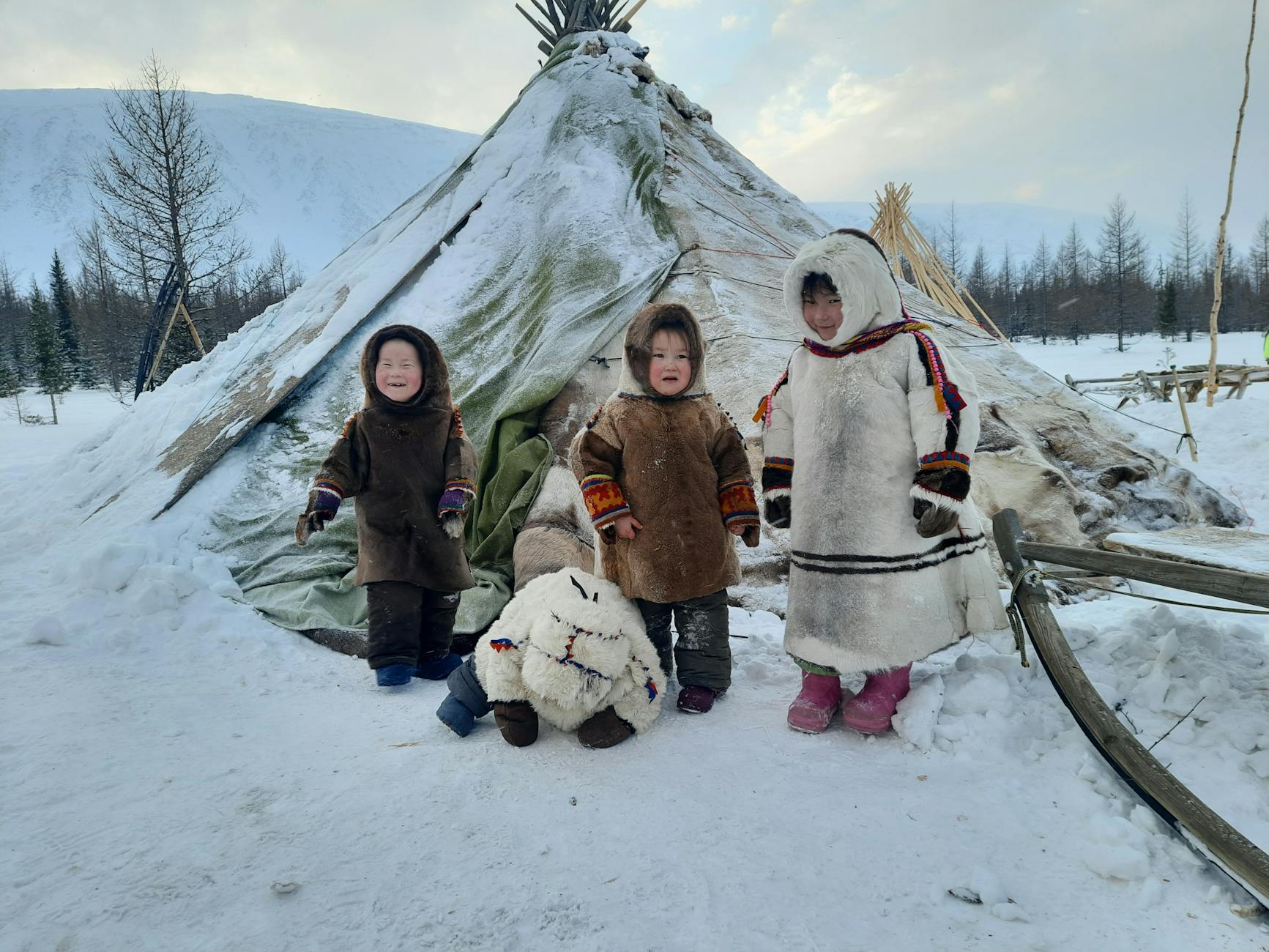
Picture a winter night on the Arctic sea ice. A low dome of snow blocks the wind. Inside, a single room glows with seal-oil light. A family of six or eight people eats, talks, repairs tools, and sleeps on the same raised snow platform. No bedrooms. No walls. Just one shared space.
So how did anyone in this world ever have sex without an audience?
The short answer: Inuit people did not “just do it in front of family.” They had their own systems of privacy, modesty, and sexual etiquette that made sense in a one-room house. Privacy did not mean what it means in a modern suburban home, but it existed. It was enforced by behavior, sound, timing, and social rules rather than drywall and doors.
This is an explainer about how sex, space, and privacy worked among Inuit in the pre-colonial and early contact periods, based on accounts from anthropologists, missionaries, and Inuit oral history. By the end, you will see why the question itself reveals more about modern Western assumptions than about Inuit life.
What was Inuit domestic life actually like?
First, the igloo. The classic winter snow house of Inuit in parts of the Central and Eastern Arctic was usually a single-room dome of snow blocks, sometimes with a small entrance tunnel and, in larger camps, a connected smaller annex. Inside, people built a raised sleeping and living platform of packed snow covered with skins. Along the walls, gear, clothing, and food hung or were stacked.
In many areas, a typical winter household might include a married couple, their children, and sometimes an elderly parent or a relative without their own family. In crowded times or bad weather, several related families might share a large snow house, or build several igloos linked by tunnels. In summer, snow houses gave way to skin tents, which were also usually single-room structures.
So yes, by modern standards, there was almost no architectural privacy. No separate bedrooms. No soundproofing. Everyone slept in close proximity, often literally shoulder to shoulder, for warmth and safety.
But that does not mean people had no concept of privacy. Inuit societies had clear ideas about what should and should not be seen, said, or done in front of others. Privacy was created through social rules, not walls. People looked away, pretended not to hear, and followed patterns of movement that gave others space when they needed it.
Understanding that the igloo was a one-room home with strong rules about behavior, not a chaotic free-for-all, is the first step to seeing how sex fit into everyday life.
What set off the question: Why do we assume “no walls = no privacy”?
The Reddit question taps into a modern Western assumption: that privacy is physical. We imagine privacy as a separate room with a door that closes. No door, no privacy. That model is historically and culturally specific. It is not universal.
For most of human history, people lived in one-room dwellings. Medieval European peasants often slept in the same room as their children and livestock. Early modern urban families packed into single rooms. In many parts of Asia, Africa, and the Americas, multi-generational households shared a single space. Yet these societies did not abandon modesty or sexual norms. They used other tools.
Anthropologists who worked with Inuit in the 19th and 20th centuries, such as Knud Rasmussen, Franz Boas, and later Jean Briggs, describe a world where social privacy mattered more than physical separation. People managed embarrassment, shame, and respect through gaze, timing, and ritual behavior.
Children were expected to pretend not to notice adult sexual behavior. Adults avoided explicit sexual talk in mixed company. People turned their backs, pulled up hoods, or busied themselves with tasks when a couple wanted time together. In many cases, the entire camp understood that a couple needed privacy and quietly cooperated.
The root cause of the “did they just do it in front of family” question is not a lack of information about Inuit, but a narrow definition of privacy. Once you drop the equation of privacy with four walls, the question looks different, and the answers get more interesting.
What was the turning point: How did couples actually get privacy?
So, practically speaking, how did a couple in a one-room igloo have sex?
First, timing. Nighttime, when lamps were dimmed and people were wrapped in bedding, was an obvious opportunity. People slept close together, but not everyone was awake at the same time. Parents might wait until children were asleep. In some accounts, older children understood enough to feign sleep or turn away.
Second, behavioral screens. Bedding and clothing were not just for warmth. Thick caribou-skin covers could be pulled up to create a kind of visual barrier. People might turn to face the wall or the opposite direction. In some regions, couples slept at one end of the platform, with children and others at the other end. That distance, plus darkness and heavy bedding, created a kind of “micro-zone” of privacy.
Third, spatial workarounds. Larger snow houses sometimes had small side chambers or annexes used for storage, guests, or special purposes. In some cases, a couple could withdraw there. In multi-igloo camps, a couple might step out to a separate, smaller snow shelter or tent when weather allowed. There are ethnographic references to young couples or lovers meeting in secondary shelters or out on the land when conditions were safe.
Fourth, social choreography. People gave each other space. If it was understood that a married couple wanted time alone, others might go outside to tend to dogs, fetch ice, or visit another igloo. The expectation was not that sex was a public spectacle, but that it was a normal part of life that did not need theatrical secrecy.
None of this means that sex was perfectly hidden. In a one-room house, everyone knows what is going on. Privacy here meant not that no one knew, but that no one openly acknowledged it. The line was about not forcing others to witness or discuss it directly.
This matters because it shows that Inuit sexual life was organized, not chaotic. People used timing, bedding, side spaces, and cooperative behavior to create as much privacy as the environment allowed, which tells us a lot about how they balanced intimacy with communal living.
Who drove it: Gender, elders, and sexual norms in Inuit society
There is no single “architect” of Inuit sexual privacy, but several social actors shaped the rules: elders, married women and men, and, indirectly, children and youth.
Elders, especially older women, were often the keepers of social norms. They advised younger women on marriage, childbirth, and acceptable behavior. They could scold or shame people who behaved in ways that disrupted household harmony, including sexual behavior that was too noisy, too public, or involved the wrong partners.
Married couples themselves negotiated a lot of the practical details. Ethnographers from the early 20th century describe Inuit marriages as often arranged but not necessarily loveless, and divorce or separation was possible. Sexual relations were expected within marriage, and a lack of sexual cooperation could be grounds for tension or separation. Couples had a shared interest in finding workable ways to be intimate without causing social friction.
Children and youth shaped the norms by their presence. Adults did not want to constantly confront children with explicit sexual acts, even if they knew that some awareness was inevitable. In many accounts, children were not given detailed sexual instruction, but they picked up knowledge gradually. Adults managed this by avoiding explicit displays and by using euphemism, stories, and joking rather than direct explanation.
There were also practices that can look startling to modern readers, such as partner exchange between married couples in some regions, or visiting arrangements during long hunting trips. These did not mean that sex was public. They were governed by rules, consent (within the power structures of the time), and expectations about discretion.
Missionaries and colonial officials later tried to reshape these norms. From the late 19th century onward, Christian missionaries in Greenland, Canada, and Alaska condemned what they saw as sexual laxity, pushed for nuclear-family ideals, and introduced new ideas about shame and sin. They brought houses with separate rooms, schools, and new forms of authority that changed how people thought about sex and privacy.
Looking at who enforced and negotiated sexual norms shows that Inuit privacy was a social project, not an accident. Elders, couples, and, later, missionaries all pulled on the system, which shaped how sex fit into everyday life inside the igloo.
What it changed: From igloos to wooden houses and new ideas of privacy
When permanent settlements and government housing spread in the 20th century, Inuit domestic life changed dramatically. Snow houses and skin tents gave way to wooden or prefabricated houses, often modeled on southern Canadian or American designs, with separate bedrooms and interior doors.
At first, these houses were often overcrowded. A three-bedroom house might hold a large extended family, so the physical privacy promised by walls was not always real. But the idea that each nuclear family, or even each couple, should have its own room took root. Children and parents sleeping in separate rooms became more common, especially in towns.
Missionary influence and schooling also reshaped sexual norms. Christian teachings framed sex outside marriage as sinful and emphasized modesty in new ways. Some traditional practices, like partner exchange or more flexible marriage arrangements, declined or were abandoned. Public discussion of sex became more restricted in some communities, even as Western media and later the internet brought in new sexual imagery.
Yet older patterns did not disappear entirely. In many Arctic communities, housing shortages mean that multiple generations still share small houses. People still rely on social privacy: looking away, pretending not to hear, and negotiating space. The tension between Western architectural privacy and Arctic realities continues.
These changes matter because they show that privacy is not just cultural, it is political. Government housing policies, missionary campaigns, and settlement patterns all reshaped how Inuit could and did manage sex and intimacy, shifting from one-room igloos with strong social rules to multi-room houses with different, sometimes conflicting, expectations.
Why it still matters: Rethinking privacy, sex, and cultural assumptions
Asking “Did Inuit just have sex in front of family?” sounds simple. Underneath it sits a bigger issue: how easily we treat our own norms as universal.
Inuit societies had clear ideas about modesty, shame, and respect. They did not match Victorian or 21st-century middle-class standards. They did not build bedrooms, but they built privacy out of behavior. Sex was normal, expected, and woven into daily life in a one-room home, but it was not a spectator sport.
Understanding this matters for a few reasons. It reminds us that human beings are endlessly adaptable. People can maintain dignity and intimacy in conditions that would baffle a modern architect. It also warns historians and readers against assuming that “no walls” equals “no boundaries.” Boundaries can be social, not physical.
Finally, the question of Inuit sex and privacy connects to ongoing debates in the Arctic about housing, overcrowding, and health. When governments design houses or policies without understanding how people actually live and think about space, they risk repeating old mistakes. The igloo, far from being a joke about “no privacy,” is a case study in how a community solved the problem of intimacy in a harsh environment with the tools they had.
So no, ancient Inuit did not casually have intercourse in front of the whole family as entertainment. They lived in tight quarters, managed embarrassment with social rules instead of drywall, and found ways to be intimate in a world where everyone could hear the wind and, if they chose, hear everything else too.
Frequently Asked Questions
Did Inuit people really have sex in front of their children in igloos?
Not in the sense of deliberate public display. Traditional Inuit snow houses were one-room structures, so complete physical separation was rare, but couples used timing, darkness, bedding, and social etiquette to create as much privacy as possible. Children were expected to look away or pretend to sleep, and adults avoided making sex an explicit spectacle.
How did privacy work in a one-room Inuit igloo or tent?
Privacy was mostly social, not architectural. People managed it through behavior: turning away, dimming lamps, pulling up bedding, stepping outside, or visiting another dwelling to give a couple space. Everyone might know what was happening, but social rules said you did not watch, comment, or force others into direct participation.
Did traditional Inuit have different sexual norms than Europeans?
Yes. While they valued modesty and had strong rules about respect and kinship, some regions accepted practices like partner exchange or more flexible marriage arrangements that shocked European missionaries. These practices were still governed by rules and expectations of discretion, and sex was not treated as something to be performed publicly.
How did colonialism change Inuit ideas about sex and privacy?
Missionaries and colonial governments introduced Christian sexual morality and Western-style housing with separate rooms. They condemned some traditional practices and promoted nuclear-family ideals. Over time, this reshaped Inuit norms about marriage, modesty, and where and how sex should happen, although overcrowding and local customs mean social privacy remains important.