On a cold January day in 1938, a train rolled into Nuremberg under heavy guard. Inside were no troops, no weapons, just a chest and cases padded with velvet. Adolf Hitler had ordered the Imperial Regalia of the Holy Roman Empire brought “home” to the city of his party rallies. Crowds cheered as if an army had arrived.
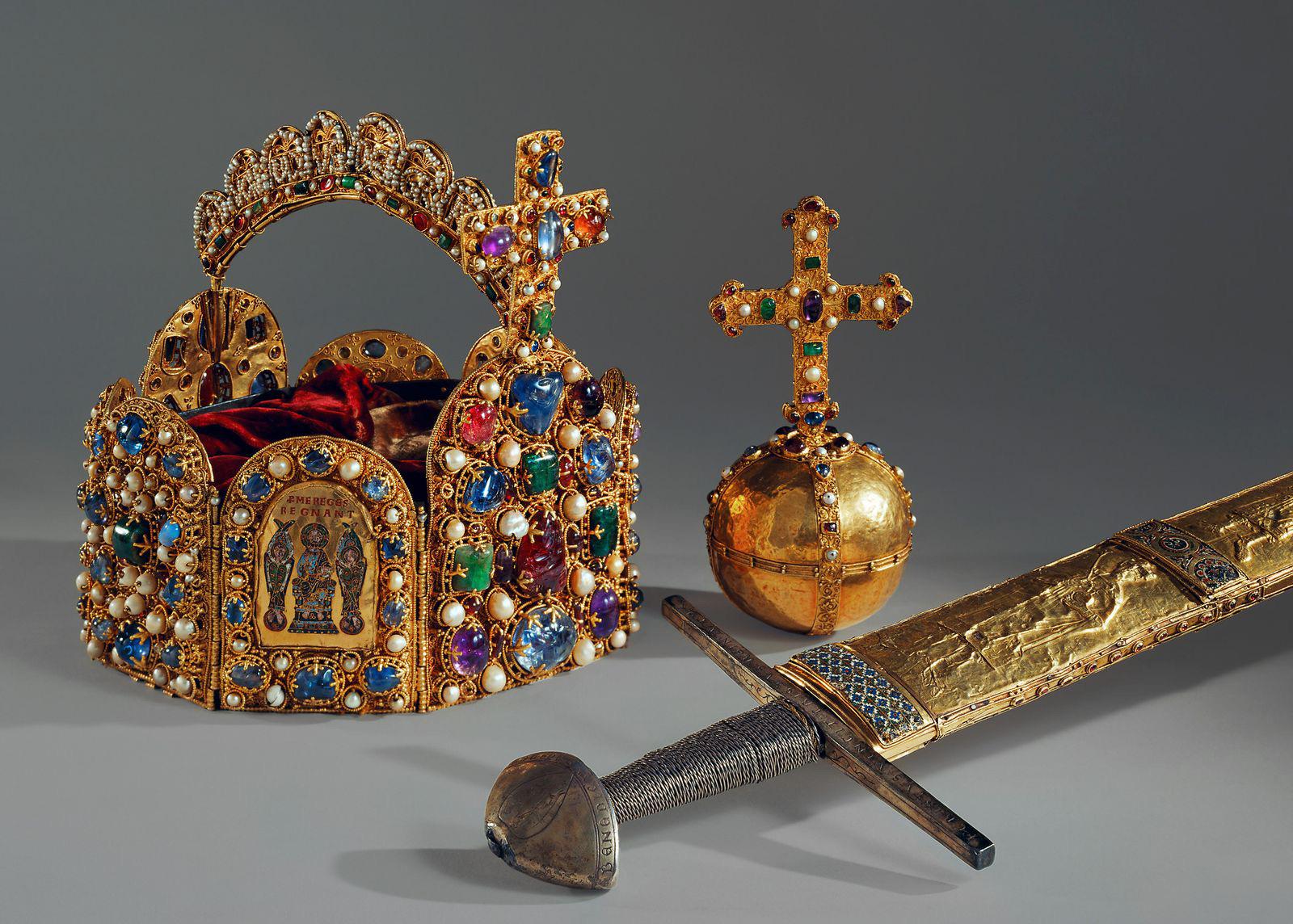
They were cheering for objects: a crown, a sword, a spear, a cloak, some worn stones. Yet for a thousand years, these things had helped decide who ruled central Europe. Kings risked excommunication, war, and humiliation to get their hands on them. Cities were besieged because they held them. In the Second World War, American soldiers were sent underground to find them before the SS could destroy them.
The Imperial Regalia were the ceremonial objects used in the coronation of the kings and emperors of the Holy Roman Empire. They were not just fancy props. They were treated as physical proof that a man was not just a ruler, but God’s chosen ruler of Christendom’s German core. By the end of this story, you will see why a medieval crown ended up in a Nazi bunker, and why tourists still file past it in Vienna today.
What were the Imperial Regalia, exactly?
When people say “Imperial Regalia” they often picture a single golden crown. In reality, the regalia were a changing collection of sacred and ceremonial objects kept together and used to crown German kings and Holy Roman Emperors.
The core pieces that survive today in Vienna are:
• The Imperial Crown (Reichskrone), probably made in the late 10th or early 11th century. It is an octagonal gold crown with hinged plates, decorated with enamel images of Christ, kings, and prophets. It is not a round band like later crowns, but a kind of golden helmet of authority.
• The Imperial Cross, a processional cross that doubled as a reliquary, with compartments for sacred objects.
• The Imperial Sword, a long coronation sword with a plain but powerful look, used in the rite to show the ruler’s duty to defend the Church and do justice.
• The Imperial Orb, a golden globe with a cross on top, symbolizing Christ’s rule over the world and the emperor’s role beneath him.
• The Holy Lance (or Spear of Destiny in later legend), a lance head that medieval tradition linked to the spear that pierced Christ’s side. It was actually a composite object, probably with a Carolingian core, wrapped in later metalwork.
• The Coronation Gospels and other liturgical books, used in the oath and mass.
• The Coronation Mantle, a rich silk cloak embroidered in gold, made in Sicily in 1133/34 for the Norman kings and later absorbed into the imperial collection.
Not every item was always present at every coronation, and the collection grew and changed over centuries. But by the High Middle Ages, these objects together were understood as the “Reichskleinodien,” the little treasures of the Empire.
The Imperial Regalia were the physical toolkit of imperial legitimacy. If you wanted to be more than just a powerful warlord, you needed these things placed on you, in the right place, by the right churchmen. That gave them political weight far beyond their gold content.
Did Charlemagne really wear this crown? Early origins and myths
Every powerful dynasty loves an origin story. For the Holy Roman Empire, that story began with Charlemagne, crowned “Emperor of the Romans” by Pope Leo III in Rome on Christmas Day 800.
Later generations claimed that the Imperial Crown was Charlemagne’s own. Nineteenth-century romantic nationalism loved to repeat this. The problem is that art historians and conservators, looking at the enamel style and construction, date the crown to around the late 10th or early 11th century, probably in the time of Otto III or Henry II. Charlemagne never saw it.
What Charlemagne did have were regalia of his own: a crown, a sword, a scepter, a throne. Some of these survive, like his famous throne in Aachen. But the specific set we call the Imperial Regalia coalesced later, under the Ottonian and Salian dynasties, as German kings took over the imperial title and tried to present themselves as heirs of both Charlemagne and the Roman emperors.
The Holy Lance is a good example of how myth and politics fused. By the 10th century, a lance kept in the royal treasury was said to be the spear of Longinus, the Roman soldier who pierced Christ’s side. Whether any part of it is from Roman Palestine is doubtful, but the belief mattered more than the metallurgy. When King Henry I and his son Otto I carried it into battle, chroniclers wrote as if they had God’s own weapon in their hands.
By the time Otto I was crowned emperor in 962, the idea was set: the German king who held these relics and regalia was not just a regional monarch. He was the emperor, God’s anointed protector of the Church. Later emperors leaned hard on that symbolism when arguing with popes and rival kings.
So what? The myths about Charlemagne and sacred weapons gave the regalia a backstory that stretched from the Bible to Rome to Aachen, turning a German kingship into something that claimed universal Christian authority.
Why did the regalia matter so much in medieval politics?
In a world without photo IDs or central bureaucracies, power had to be seen and touched. Coronation rituals did that job. The regalia were the props that turned a strongman into a sacral king.
The coronation of a German king usually happened in Aachen, then later in Frankfurt, and the imperial coronation by the pope in Rome. The ritual was thick with symbolism. The candidate swore to defend the Church and do justice on the Coronation Gospels. The sword was placed in his hand. The crown was put on his head with prayers linking him to Old Testament kings like David and Solomon.
Contemporaries believed that the right ritual, with the right objects, conferred God’s grace in a special way. That did not mean a man without the regalia could not rule, but it did mean his rivals had an easy line of attack: he was not properly crowned, not truly emperor.
During the Investiture Controversy in the late 11th and early 12th centuries, this symbolism turned into a weapon. When Pope Gregory VII clashed with Emperor Henry IV over who could appoint bishops, the deeper fight was about who had the higher authority in Christendom. The emperor’s supporters pointed to the regalia and the ancient coronation rites. The pope’s camp said that without papal blessing, the crown was just metal.
In 1122, the Concordat of Worms settled part of that conflict, but the argument over who “made” an emperor never fully died. The regalia stayed at the center of that tug-of-war. When an emperor was excommunicated, his enemies sometimes claimed that he had effectively lost the right to wear them.
So what? Because legitimacy in the Holy Roman Empire was bound up with ritual and relics, whoever controlled the regalia had a powerful say in who could claim to be God’s chosen ruler, which raised the stakes of every succession crisis.
Why were the regalia moved so often? From Aachen to Nuremberg
People often imagine the Imperial Regalia sitting in a single vault for a thousand years. The reality was messier. For a long time, they traveled with the king or emperor, locked in chests and guarded by trusted officials. Medieval rulers did not have fixed capitals. Their court moved constantly, and so did their treasures.
By the 13th century, as the Empire’s politics grew more fragmented, it became risky to have the regalia on the road. They were gradually entrusted to specific cities and churches. Aachen, the old coronation city, held some items. Cologne and other cathedrals held relics linked to the imperial cult.
The real turning point came in the early 15th century. In 1423, Emperor Sigismund granted the city of Nuremberg the right to keep the main regalia permanently. Nuremberg was a wealthy imperial city, loyal and centrally located. The regalia were kept in the Heilig-Geist-Spital (Hospital of the Holy Spirit) and brought out for display on certain feast days.
From then on, Nuremberg’s identity was tied to the Empire’s sacred treasure. The city had to swear elaborate oaths about their safekeeping. When a new king was elected, the regalia had to be fetched for his coronation, then returned. During the Reformation and the religious wars of the 16th and 17th centuries, the question of who controlled these Catholic-flavored symbols in a now-mixed Protestant Empire became delicate.
In 1796, as French Revolutionary armies advanced, the Nuremberg council panicked. They secretly sent the regalia east to Vienna for safekeeping, into the hands of the Habsburgs, who by then had long been the Empire’s dominant dynasty. The move was supposed to be temporary. It never was reversed.
So what? The shift from a traveling treasury to a fixed home in Nuremberg, and then to Vienna, turned the regalia from a working political tool into a kind of sacred heritage, while also tying them to specific cities that would later fight over their symbolic ownership.
How did Napoleon and the end of the Empire change the regalia?
Napoleon never wore the Imperial Crown. He did something more devastating. He destroyed the political structure that gave it meaning.
In 1806, under pressure from Napoleon and after the formation of the Confederation of the Rhine, Emperor Francis II dissolved the Holy Roman Empire. He had already started calling himself Francis I, Emperor of Austria, to keep an imperial title in the family. With a single act, a thousand-year-old institution vanished.
What, then, were the Imperial Regalia? They were no longer the working tools of a living empire. They became dynastic trophies. The Habsburgs kept them in Vienna as part of their own imperial display, alongside the Austrian crown jewels. Public access was limited. They were used to tell a story: that the Habsburgs had been the natural heirs of the medieval emperors.
German nationalists were not thrilled. As the 19th century progressed and various German states argued about unification, some saw the regalia as “German” rather than “Austrian” property. Romantic writers and painters revived the Charlemagne myth and the idea of a medieval Reich that should inspire a modern one.
When the German Empire was finally proclaimed in 1871 in Versailles, its new emperor, Wilhelm I of Prussia, did not use the old Imperial Crown. A new Prussian-style crown was designed. The Habsburgs were not about to hand over their prize, and the new empire did not want to look like a mere copy of the old. The medieval regalia were left to gather dust and meaning in Vienna.
So what? Napoleon’s destruction of the Holy Roman Empire froze the regalia in time as relics of a dead order, which later nationalists on both the Austrian and German sides tried to appropriate for their own stories of continuity and greatness.
Why did Hitler care about the Imperial Regalia?
When Adolf Hitler demanded the return of the Imperial Regalia to Nuremberg in 1938, he was not thinking about careful medieval scholarship. He was thinking about myth, spectacle, and legitimacy.
Hitler and other Nazi ideologues were obsessed with symbols. They wanted to present the Third Reich as the rebirth of a greater German empire. The medieval Holy Roman Empire, with its long history and religious aura, was a tempting source material. Nuremberg, already the site of the Nazi Party rallies, had been the medieval keeper of the regalia. The propaganda writes itself.
After the Anschluss, when Nazi Germany annexed Austria in March 1938, Hitler had the leverage to get what earlier German governments had only dreamed of. Under pressure, the Austrian authorities agreed to send the regalia to Nuremberg. They were displayed in the Katharinenkirche and later in a specially prepared room in the Nuremberg Castle.
Nazi propaganda presented this as a homecoming. Films and posters linked the medieval crown and lance to the swastika and the modern Wehrmacht. The religious meaning was quietly stripped out or twisted into vague talk of “German destiny.” The Holy Lance, in particular, attracted occult and nationalist fantasies, some of them wildly exaggerated in later popular books.
As the war turned against Germany, the regalia became a liability. In 1945, they were hidden in a vault under Nuremberg, in a section of the city’s medieval rock-cut cellars. American forces, aware of their importance, searched for them. In August 1945, a U.S. Army officer, Lt. Walter Horn, who happened to be an art historian, located the cache. The regalia were taken into American custody, then returned to Vienna in 1946.
So what? Hitler’s appropriation of the regalia showed how easily medieval symbols could be ripped from their original context and used to dress up a modern dictatorship, which in turn forced postwar Europe to think harder about how it displays and interprets such objects.
Where are the Imperial Regalia now, and what do they mean today?
Today, the core Imperial Regalia are in the Imperial Treasury (Schatzkammer) in Vienna, part of the Hofburg complex. They are displayed in glass cases, carefully lit, with explanatory labels. Visitors shuffle past, some thinking of Charlemagne, some of Hitler, some just of shiny gold.
Other related items are in different places. The coronation throne of Charlemagne is still in Aachen Cathedral. Some regalia used for later German kings and emperors are in Munich and Berlin. Nuremberg has copies and a long memory of the years when it was the guardian of the originals.
Modern historians treat the regalia as sources. The enamel work on the crown tells us about Ottonian art. The Coronation Gospels show how rulers wanted to be seen in relation to scripture. The very wear and repair on the Holy Lance reveals how often it was handled and revered.
At the same time, the regalia have become part of debates about identity. Are they “German” or “Austrian” heritage? They were made for rulers who did not think in those terms. The Holy Roman Empire was a patchwork of duchies, bishoprics, and cities that covered much of central Europe. Its emperors ruled over Czechs, Italians, Dutch, and others, not just “Germans” in the modern sense.
For many visitors, the most striking thing is the gap between the objects and their lost world. The crown that once settled succession disputes and justified wars now sits behind glass, protected by alarm systems, its power reduced to drawing tourist revenue and sparking arguments in academic journals and on Reddit.
So what? The modern fate of the regalia, as museum pieces contested by national narratives, reminds us how physical objects outlive the political orders that created them and keep getting drafted into new stories about who “we” are.
Common myths and confusions about the Imperial Regalia
Because the regalia are dramatic objects with a long life, they attract myths. A few of the most common:
“Charlemagne’s crown is in Vienna.” The crown in Vienna is often called “Charlemagne’s,” but experts date it to around 960–1020. It symbolizes continuity with Charlemagne, but it is not his personal crown.
“The Holy Lance guarantees victory or destiny.” Medieval rulers carried the lance into battle believing it brought divine favor. Modern occult stories about invincibility or world domination are later inventions. The lance mattered because people believed in it, not because it had magic powers.
“The Holy Roman Emperor always used the same regalia.” The core set stabilized over time, but pieces were added, lost, or replaced. Coronations in Rome, Aachen, Frankfurt, and later Regensburg or elsewhere could use slightly different combinations, depending on what was available and politically acceptable.
“The regalia were purely religious objects.” They were sacred, but they were also tools of hard politics. Who held them, where they were stored, and who could access them were questions that sparked real conflicts between cities, princes, and dynasties.
So what? Sorting myth from fact about the regalia does not make them less impressive, it makes their real historical role clearer: not as magic relics, but as very human tools for building and contesting power over a millennium.
The Imperial Regalia began as working instruments of medieval kingship, became trophies of dynasties, props for nationalist fantasies, and finally museum pieces. Their journey from battlefield and altar to bunker and display case tracks the long, uneven death of the medieval idea that God’s will could be worn on your head in gold and enamel.
Frequently Asked Questions
What were the Imperial Regalia of the Holy Roman Empire?
The Imperial Regalia were the ceremonial and sacred objects used to crown and legitimize the kings and emperors of the Holy Roman Empire. They included the Imperial Crown, the Holy Lance, the Imperial Sword, the orb, the Imperial Cross, coronation books, and the coronation mantle. Together they formed a physical set of symbols that marked a ruler as God’s chosen emperor, not just a regional king.
Did Charlemagne really wear the Imperial Crown in Vienna?
No. The crown in Vienna is often linked to Charlemagne in legend, but art historians date it to the late 10th or early 11th century, long after his death in 814. It was probably made for an Ottonian or early Salian ruler, such as Otto III or Henry II. Later generations used the Charlemagne story to give the crown and the Empire a deeper sense of antiquity and legitimacy.
Where are the Imperial Regalia kept today?
The main Imperial Regalia are housed in the Imperial Treasury (Schatzkammer) in the Hofburg in Vienna, Austria. They were moved there from Nuremberg in 1796 to protect them from French Revolutionary armies, briefly taken to Nuremberg again by the Nazis in 1938, hidden in a bunker during World War II, and returned to Vienna in 1946. Related items, like Charlemagne’s throne, are in Aachen, and some later regalia are in Munich and Berlin.
Why did Hitler want the Imperial Regalia in Nuremberg?
Hitler wanted the Imperial Regalia in Nuremberg to connect his Third Reich to the medieval Holy Roman Empire in the public imagination. Nuremberg had been the historical custodian of the regalia and was already the site of major Nazi Party rallies. By displaying the crown, lance, and other items there, Nazi propaganda suggested a line of continuity from medieval emperors to the modern dictatorship, using old symbols to legitimize a new regime.