In June 1954, a 41‑year‑old mathematical genius who helped defeat Nazi Germany died alone in his house in Wilmslow, England. A half‑eaten apple lay by his bed. The coroner called it suicide by cyanide. The British state had chemically castrated him two years earlier for being gay.
That man was Alan Turing. He cracked German codes at Bletchley Park, sketched the foundations of modern computing in 1936, and proposed what we now call the Turing Test. Then the same government he helped save destroyed his career and his body.
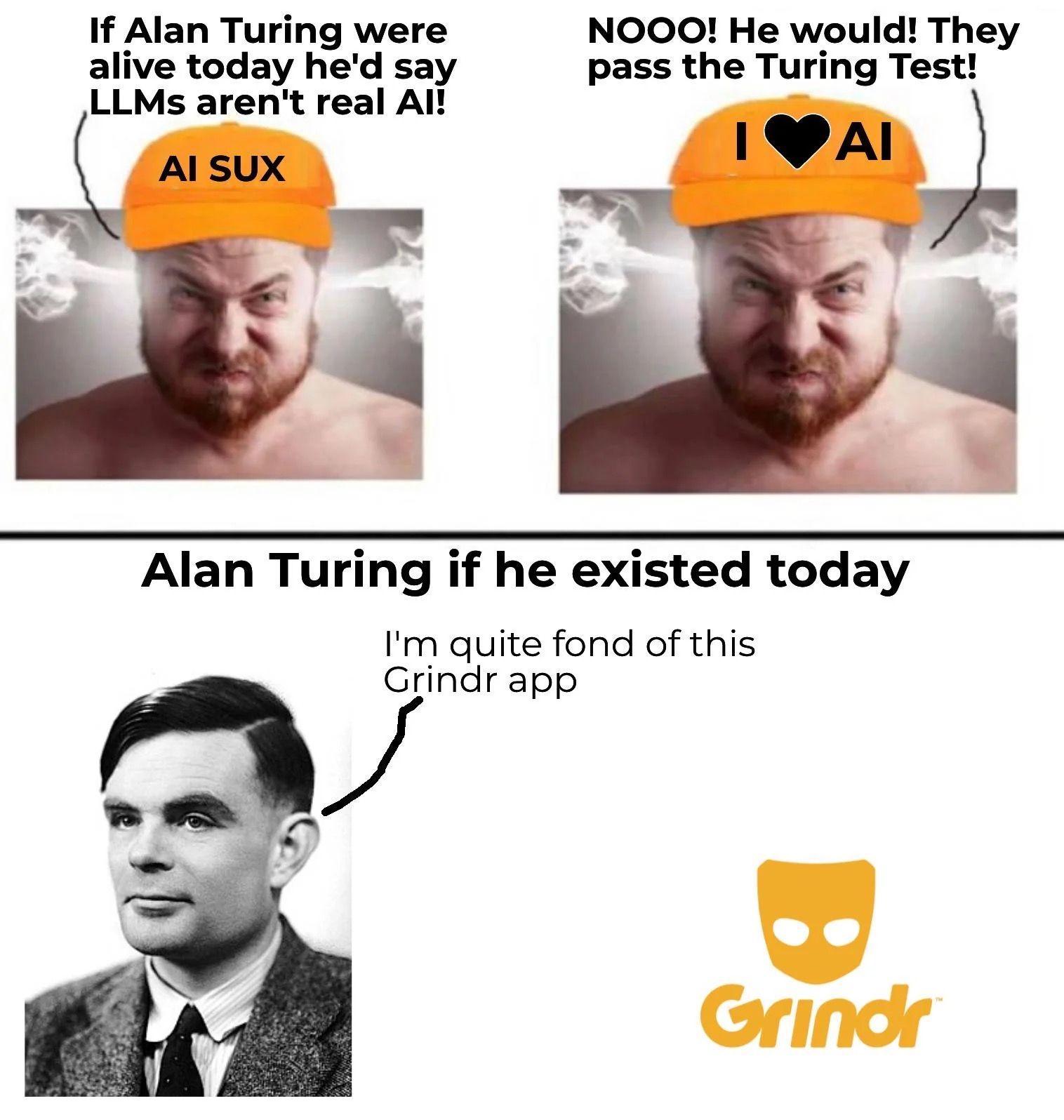
So when people online joke about “Alan Turing if he existed today,” they are really poking at a serious counterfactual: what changes if you drop that mind into the 21st century? By the end of this, you will see five concrete ways Turing’s life, work, and impact would likely look very different in our world of Big Tech, Pride parades, and ChatGPT.
1. From criminal to keynote speaker: Turing and LGBTQ rights
What it is: In Turing’s Britain, sex between men was a crime. In many Western countries today, it is legal, protected, and in some places celebrated. That legal and social shift alone would rewrite his life story.
In 1952, Turing was prosecuted under Section 11 of the Criminal Law Amendment Act for “gross indecency” with another man. He avoided prison by accepting hormone treatment, a form of chemical castration. His security clearance was revoked. His career in cryptography was effectively over.
Now picture that same man born in, say, 1982 instead of 1912. By the time he is an adult, the UK has decriminalized homosexuality (1967 in England and Wales), equalized the age of consent (2001), and passed the Equality Act (2010) outlawing discrimination based on sexual orientation.
Instead of a police interrogation, he is more likely to encounter an LGBTQ student society at King’s College, Cambridge. Instead of secret relationships, he might be an openly gay professor or a tech founder who gives talks at Pride events. Think of Tim Cook, the openly gay CEO of Apple, or mathematician and computer scientist Sophie Wilson, a trans woman who helped design the ARM architecture. People like that exist in public, not in court records.
The state that once chemically castrated Turing later apologized. In 2009, British Prime Minister Gordon Brown issued a formal apology for his treatment. In 2013, Queen Elizabeth II granted him a royal pardon. In 2017, the UK passed what journalists called the “Alan Turing law,” posthumously pardoning thousands of men convicted under old anti-gay laws.
So what? If Turing lived today, the thing that destroyed him in the 1950s would be legally protected and often socially accepted, which means the world would likely get decades more of his work instead of a life cut short at 41.
2. From secret war rooms to Silicon Valley: Turing in Big Tech
What it is: Turing’s real career was split between pure math, wartime codebreaking, and early computing research in government labs. Today, that same skill set would be hunted by tech giants, startups, and venture capital.
During World War II, Turing worked at Bletchley Park, Britain’s codebreaking center. He helped design electro‑mechanical machines like the Bombe to attack the German Enigma cipher. After the war, he worked at the National Physical Laboratory and then the University of Manchester, wrestling with the design of stored‑program computers.
Now imagine him in a world where Google, DeepMind, OpenAI, Microsoft, and a hundred startups are throwing salaries and stock options at anyone who can push the boundaries of algorithms and machine learning.
A Turing born in 1982 might do a PhD in theoretical computer science at Cambridge or MIT, publish a mind‑bending paper on computability or complexity, then get recruited by DeepMind in London or OpenAI in San Francisco. He would not be hand‑wiring relays in a drafty lab. He would be running experiments on vast GPU clusters.
Think of Demis Hassabis at DeepMind, leading teams that created AlphaGo and AlphaFold, or Geoffrey Hinton at Google, whose work on neural networks helped spark the current AI boom. Turing would be in that tier of people whose names show up on arXiv preprints and keynote slides at NeurIPS and ICML.
There is another twist. In the 1940s, Turing’s work was classified. The public barely knew what he had done until decades later. In the 21st century, Big Tech loves publicity. A Turing at DeepMind or OpenAI would be on stage at conferences, in long‑form interviews, and in the crosshairs of regulators and journalists.
Snippet‑ready: Alan Turing’s theoretical work on computation would map directly onto modern computer science and AI research. In a world of tech giants, he would almost certainly be recruited into high‑impact industry labs.
So what? Instead of a quiet government scientist whose greatest work stayed secret for years, Turing today would likely be a visible architect of commercial AI, shaping products used by billions rather than just weapons used in one war.
3. From thought experiment to product spec: the Turing Test in the age of ChatGPT
What it is: In 1950, Turing proposed a thought experiment he called the “imitation game.” We now call it the Turing Test. It asked: could a machine’s conversation ever be indistinguishable from a human’s? In 2024, that question is no longer hypothetical.
Turing’s 1950 paper, “Computing Machinery and Intelligence,” did two big things. It replaced the vague question “Can machines think?” with a concrete test of conversational behavior. And it anticipated many of the objections people still raise about AI, from “machines can only do what we tell them” to “machines lack consciousness.”
In 2022, OpenAI released ChatGPT. Other companies followed with their own large language models. Suddenly, millions of people were having long, reasonably coherent conversations with software. The Turing Test went from philosophy seminar to something like a product requirement.
If Turing lived today, he would see chatbots that can pass casual versions of his test for many users, at least for short conversations. He would also see where they fail: hallucinations, lack of real understanding, brittle reasoning.
He might refine his test. Perhaps he would propose a multi‑day interaction, or a test that includes grounding in the physical world, or the ability to learn new concepts during the conversation. He might join current debates about whether passing a Turing‑like test says anything about consciousness, or whether it just measures statistical mimicry.
Think of people like Stuart Russell, co‑author of the standard AI textbook, who now spends much of his time talking about AI safety and alignment. Or Margaret Mitchell, formerly of Google’s Ethical AI team, who works on bias and harm in language models. A modern Turing could easily be pulled into that world of technical work mixed with public argument.
Snippet‑ready: The Turing Test was originally a philosophical thought experiment about machine intelligence. In the era of large language models, it has become a practical benchmark and a lightning rod in AI ethics debates.
So what? Instead of writing a lonely paper in 1950 that few outside philosophy and computer science read, Turing today would be watching his thought experiment collide with real products, real money, and real fears about what smart machines might do.
4. From persecuted security risk to protected national asset
What it is: In the 1950s, British authorities treated Turing’s sexuality as a security threat. Today, most Western intelligence agencies care more about clearances, vetting, and retention of rare talent than about who someone dates.
After his 1952 conviction, Turing lost his security clearance. The man who had helped shorten World War II by years was now seen as a liability, vulnerable to blackmail. He was barred from continuing some of his cryptographic work.
Modern security services have their own problems, but the official stance on LGBTQ employees has shifted. The US lifted its ban on gay and lesbian people serving openly in the military in 2011. Security clearance guidelines in the US and UK now explicitly say that sexual orientation, by itself, is not a bar to clearance. The logic is simple: if being gay is not a crime and not a shameful secret, it is hard to use as blackmail.
Think of someone like mathematician and cryptographer Whitfield Diffie, co‑inventor of public key cryptography, who worked in and around classified and commercial security worlds. Or the many anonymous queer analysts, engineers, and mathematicians inside the NSA, GCHQ, and similar agencies today. They exist, and their employers want to keep them.
A modern Turing might still work in secret. He might be buried inside GCHQ or the NSA, designing quantum‑resistant cryptography or offensive cyber tools. But if he were outed as gay, the likely response would be HR paperwork, not hormone injections.
There is another angle. Governments today are acutely aware of “brain drain.” China, the US, and Europe compete for AI talent. Immigration policies, research grants, and security rules are often adjusted to attract or retain star scientists. A 21st‑century British government would be far more likely to see Turing as a national asset to be protected, not a problem to be punished.
So what? The same state that once destroyed Turing’s career would now be more likely to fast‑track his clearance, fund his lab, and quietly worry about losing him to a rival power, which means his most advanced ideas might stay classified but would not be cut short by persecution.
5. From forgotten pioneer to living public icon of science
What it is: Turing’s fame is largely posthumous. For decades after his death, most people had no idea what he had done. Today, science celebrities are made in real time, and Turing would almost certainly be one of them.
In 1954, when Turing died, his wartime work was still secret. His 1936 paper on computable numbers was read by a small circle of mathematicians. There were no documentaries, no biopics, no banknotes with his face on them.
That changed slowly. In 1970, his wartime work began to be declassified. In 1983, a biography by Andrew Hodges brought his story to a wider audience. In 2014, the film “The Imitation Game” put a heavily dramatized version of Turing, played by Benedict Cumberbatch, in front of millions. In 2021, the Bank of England put Turing on the £50 note.
Now imagine that same level of achievement happening in a media environment that loves genius narratives. Think of Stephen Hawking, whose work on black holes and cosmology made him a global icon, or of figures like Neil deGrasse Tyson and Brian Cox, who turned astrophysics into TV content.
A living Turing who helped invent a new branch of AI, or who cracked a major cryptographic problem, would be a natural subject for Netflix documentaries, TED talks, and long podcasts. He might hate it. By most accounts, the historical Turing was shy, socially awkward, and uninterested in self‑promotion. But in the 21st century, even reclusive geniuses get dragged into the spotlight.
There is also the symbolic side. Turing has become a shorthand for two things: the birth of computer science and the injustice of anti‑gay persecution. A living Turing today would be asked to comment on both. He would be pulled into debates about STEM education, diversity in tech, and the ethics of surveillance.
So what? Instead of being a secret weapon in a war and a tragic footnote for decades, Turing today would likely be a living symbol of both AI’s promise and the history of LGBTQ oppression, shaping public stories about science and justice while he was still alive.
Alan Turing’s core ideas do not need a modern setting to matter. His 1936 work on computability, his wartime codebreaking, and his 1950 thought experiment on machine intelligence already helped build the world we live in.
What changes if he “exists today” is everything around those ideas: the laws that govern his body, the companies that fight over his mind, the machines he has to work with, and the public that would know his name while he was still breathing.
The counterfactual is not just a meme. It is a reminder that genius is not enough. Turing’s life was shaped as much by British law, Cold War security fears, and social prejudice as by his own brilliance. In a different legal and cultural frame, he might have lived into old age, arguing about AI ethics on stage instead of dying with a poisoned apple by his bed.
We cannot rerun history with better conditions for Turing. We can, however, notice how many potential Turings still live under regimes that criminalize their identity, restrict their research, or treat them as expendable. The question “Alan Turing if he existed today” is really a question about who gets to think freely, for how long, and for whose benefit.
Frequently Asked Questions
Who was Alan Turing and why is he important?
Alan Turing (1912–1954) was a British mathematician and codebreaker. He helped crack German Enigma codes during World War II and wrote a 1936 paper that laid the foundations of modern computer science. His 1950 idea of the “imitation game” became known as the Turing Test for machine intelligence.
What was done to Alan Turing because he was gay?
In 1952, Turing was prosecuted in Britain for “gross indecency” because he had a sexual relationship with another man. To avoid prison, he accepted hormone treatment that amounted to chemical castration. He lost his security clearance and much of his research work. He died in 1954, and the coroner ruled it a suicide, though some details are still debated.
What is the Turing Test in simple terms?
The Turing Test is a thought experiment proposed by Alan Turing in 1950. It says that if a computer can hold a text conversation so convincingly that a human judge cannot reliably tell whether they are talking to a machine or a person, then the machine can be said to “think” in a meaningful sense.
Would Alan Turing be rich if he lived in the age of Big Tech?
We cannot know for sure, but his skills in mathematics, algorithms, and early computing map closely to what top AI researchers and cryptographers do today. People with similar profiles in modern companies like Google, DeepMind, or OpenAI often receive high salaries, stock options, and research funding, so it is likely he would be far better rewarded than he was in the 1940s and 1950s.