Picture a muddy Bohemian hillside around 1420. A line of wooden wagons, chained together, bristles with gun barrels, crossbows, and pikes. Armored knights from across Europe lower their lances and charge, expecting the usual peasant rout. Instead, they hit a wall of iron, wood, and gunpowder. Horses rear at the noise of handguns. Knights crash into chains they never saw. Then the wagons open and the peasants charge downhill.
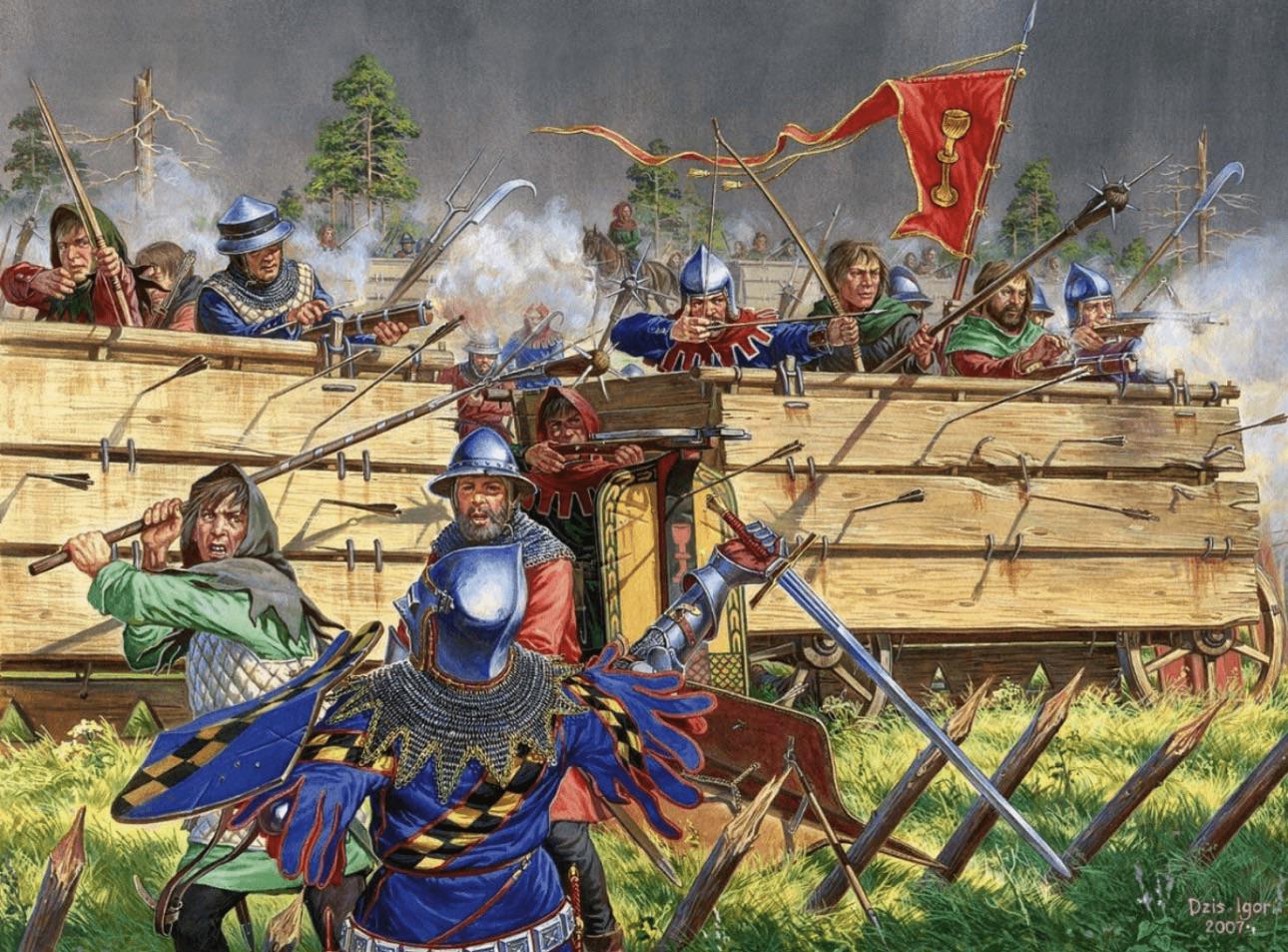
This is the Hussite Wars in miniature. Between 1419 and 1434, a religious movement in Bohemia used wagon forts, early firearms, and a one-eyed (then blind) commander to humiliate some of the richest armies in Europe. The Hussite Wars were a series of religious and political conflicts in Bohemia in which followers of Jan Hus fought off multiple crusades called by the pope and the Holy Roman Emperor. They showed that disciplined infantry with gunpowder and field fortifications could defeat traditional knightly armies.
By the end of this story, the Catholic powers had spent fortunes, burned towns, and buried thousands of knights. The Hussites, though divided, had rewritten both Czech identity and European military thinking.
What were the Hussite Wars, in plain terms?
The Hussite Wars were a set of religious and civil wars fought mainly in Bohemia (roughly today’s Czech Republic) from 1419 to 1434. On one side were the Hussites, followers of the Czech reformer Jan Hus. On the other were Catholic loyalists backed by the Holy Roman Emperor, the papacy, and foreign crusading armies from places like Germany, Austria, Hungary, and Italy.
At their core, the Hussite Wars were about who controlled Bohemia’s church, its wealth, and its politics. The Hussites demanded religious reform, communion in both kinds (bread and wine) for laypeople, and limits on church property. Their enemies wanted to crush what they saw as heresy and keep Bohemia firmly inside the Catholic and imperial system.
Militarily, the wars are famous because the Hussites, many of them peasants and townspeople, repeatedly defeated heavily armored knights and professional soldiers. They did this with disciplined infantry, fortified wagon formations called Wagenburgs, and early gunpowder weapons.
So what? The Hussite Wars were one of the first large conflicts where gunpowder infantry and mobile field fortifications consistently beat traditional medieval cavalry, which signaled a shift in how wars in Europe would be fought.
What set off the Hussite movement and the wars?
The fuse was lit in a lecture hall and a pulpit, not on a battlefield.
Jan Hus, a Czech priest and university master in Prague, had been preaching reform since the late 14th century. Influenced by the English thinker John Wycliffe, Hus attacked church corruption, the sale of indulgences, and the luxury of the clergy. He also preached in Czech, not just Latin, which made him popular with ordinary people and the Czech-speaking elite.
Bohemia was already tense. There was resentment against German-speaking clergy and officials, anger at church wealth, and a strong sense of Czech identity forming. Hus’s message plugged straight into that. When he was summoned to the Council of Constance and burned at the stake for heresy in 1415, many in Bohemia saw it as a national insult as much as a religious crime.
Hus’s death did not end the movement. It radicalized it. His followers, soon called Hussites, organized around reform demands later summarized in the “Four Articles of Prague”: free preaching of the word of God, communion in both kinds for laity, poverty of the clergy and seizure of excessive church property, and punishment of mortal sins regardless of social rank.
Then politics poured gasoline on the fire. King Wenceslaus IV of Bohemia died in 1419. His brother, Sigismund, king of Hungary and later Holy Roman Emperor, claimed the Bohemian crown. Many Hussites despised Sigismund, blaming him for Hus’s death at Constance. They refused to accept him as king.
The street-level trigger came that same year in Prague. In July 1419, a Hussite crowd led by priest Jan Želivský stormed the New Town Hall and threw several city councilors out of the windows. This “First Defenestration of Prague” killed royal officials and made compromise much harder. Violence spread, and Hussite-controlled towns and rural communities began to arm.
So what? Hus’s execution and the disputed royal succession turned a religious reform movement into an armed revolt, making war between Hussites and Catholic loyalists almost unavoidable.
The turning point: wagons, gunpowder, and humiliating crusades
From the Catholic side, the plan seemed simple. Declare a crusade, march in with professional knights and mercenaries, crush the heretics, and restore order. The first crusading armies entered Bohemia in 1420 expecting an easy win.
They met Jan Žižka.
Žižka was a veteran mercenary, probably born into the lower nobility. He had fought in earlier wars in Poland and Lithuania. By 1419 he had joined the radical Hussites and quickly emerged as their most effective commander. He was already missing one eye. He would lose the other during the wars and still keep command.
Žižka understood two things very clearly. First, his men could not win a straight cavalry battle against heavily armored knights. Second, Bohemia’s hilly terrain and growing access to gunpowder could be turned into advantages.
His answer was the Wagenburg, the wagon fortress. The idea of using wagons defensively was not new, but the Hussites turned it into an art. They used sturdy farm wagons reinforced with planks and iron. In battle, they chained them together in a ring or square on good ground, often on a hill. Behind and between the wagons stood:
• Crossbowmen and later handgunners, firing through gaps.
• Pikemen and men with flails or polearms to repel anyone who got close.
• Small field guns and bombards placed to sweep the approaches.
Horses hated the smoke and noise of early firearms. Knights who reached the wagons found themselves jammed against chains, shot at from above, and poked with pikes. Once the enemy attack lost momentum, Žižka would counterattack. The wagons would open, and disciplined infantry would rush out to finish the job.
In 1420, at the Battle of Vítkov Hill near Prague, Žižka’s smaller force used fortified positions and wagons to repel a much larger crusading army. The failure shook Sigismund’s authority and helped keep Prague in Hussite hands.
Over the next decade, multiple crusades into Bohemia ended the same way: expensive, embarrassing defeats. Hussite forces even went on the offensive in so-called “beautiful rides” (spanilé jízdy), raiding into neighboring German and Austrian lands. What had begun as a defensive war of survival turned into a war that bled the surrounding states.
So what? The success of wagon forts and gunpowder infantry against elite cavalry shattered the assumption that armored knights were unbeatable, nudging European warfare toward the gunpowder age.
Who drove the Hussite Wars? Hus, Žižka, and their heirs
Two names anchor the story: Jan Hus and Jan Žižka. One lit the fire, the other kept it burning on the battlefield.
Jan Hus (c. 1370–1415) never saw a Hussite army. His role was ideological. He preached reform, attacked corruption, and gave religious and moral language to Czech grievances. His trial and execution at Constance turned him into a martyr. Hussite soldiers marched into battle singing hymns about the “truth” Hus had preached.
Jan Žižka (c. 1360–1424) turned that moral passion into military survival. He led radical Hussites based in towns like Tábor, a fortified community that tried to live out a more egalitarian Christian order. Žižka’s genius was not just technical. He imposed discipline on what could have been a mob. He drilled peasants to fight in formation, to hold their fire, to move wagons quickly, and to trust the system.
Even as he lost his sight, sources describe Žižka being carried around the field, issuing orders. His reputation grew so large that later legends claimed he asked for his skin to be made into a war drum after his death. That story is almost certainly not true, but it tells you how people remembered him.
After Žižka’s death in 1424, leadership passed to other commanders, notably Prokop the Great (Prokop Holý). Prokop was a priest and a capable general who continued the aggressive raids into neighboring lands and held together the more radical wing of the movement for several years.
On the other side, Sigismund of Luxembourg, king of Hungary and later Holy Roman Emperor, was the main political opponent. He needed Bohemia’s crown and resources but never managed to subdue the Hussites by force. Popes Martin V and Eugenius IV called crusades and tried to coordinate Catholic princes, but the results were usually disjointed campaigns and mutual suspicion among the crusaders.
Inside the Hussite camp, there were also key factions. The more moderate Utraquists, based in Prague, wanted reform but were willing to compromise with the church and monarchy. The radicals, especially the Taborites, pushed for deeper social and religious change and were less inclined to negotiate.
So what? The combination of Hus’s ideas and Žižka’s tactics gave the movement both a cause and a way to survive, while the later split between moderates and radicals shaped how the wars ended.
What did the Hussite Wars change in Bohemia and Europe?
By the early 1430s, everyone was exhausted. The Catholic powers had failed to crush the Hussites militarily. The Hussites were divided and war-weary. That is when the Council of Basel tried a different approach: negotiation.
Talks between moderate Hussites and church representatives produced the Compacts of Basel, agreed in 1433 and ratified in Bohemia in 1436. These allowed communion in both kinds for laypeople in Bohemia and accepted some Hussite demands, while affirming basic Catholic doctrine and papal authority.
Not everyone accepted this. The radical Taborites and their allies rejected the compromise. The real turning point came not from a crusade, but from a civil war inside the movement. In 1434, at the Battle of Lipany, moderate Utraquist forces allied with Catholic nobles defeated the Taborites. Cleverly, the moderates used some of the same wagon tactics the radicals had perfected, luring them into a trap.
After Lipany, organized radical resistance collapsed. Sigismund was finally recognized as king of Bohemia, though his authority remained limited and contested. Bohemia emerged as a mostly Catholic kingdom with a legally tolerated Hussite (Utraquist) church alongside it, something like a negotiated religious pluralism a century before Luther.
The wars had other effects:
• They devastated parts of Bohemia and neighboring regions through raids, sieges, and scorched earth tactics.
• They weakened the prestige of the Holy Roman Emperor and the papacy, which had failed repeatedly to enforce religious uniformity by force.
• They accelerated the use of gunpowder weapons and field fortifications in central Europe, as other states watched and learned.
So what? The Hussite Wars forced the Catholic church and empire to accept a limited form of religious difference in Bohemia and pushed European warfare further toward gunpowder and infantry-centered tactics.
Why the Hussites still matter today
The Hussites are not just a quirky footnote about wagons and blind generals. They left marks that lasted centuries.
For Czechs, the Hussite era became a core part of national memory. Jan Hus turned into a symbol of Czech language, identity, and resistance to foreign domination. In the 19th century, during the Czech national revival, writers and politicians reached back to Hus and Žižka as proof that Czechs had their own proud, rebellious history. Statues of Hus in Prague and Žižka on horseback above the city are products of that later memory as much as the 15th century itself.
In church history, the Hussites are often seen as precursors to the Protestant Reformation. They challenged church wealth, demanded vernacular preaching, and insisted on communion in both kinds long before Martin Luther. Some of Luther’s followers later saw themselves as finishing what Hus had started. That said, Hussite beliefs were not identical to later Protestant doctrines, and the movement was internally diverse.
In military history, the Hussites are a case study in how a supposedly inferior force can beat richer, better equipped enemies through organization and tactics. The wagon fort was not magic. It worked because Žižka and his successors drilled their troops, coordinated firepower, and used terrain intelligently. Their success helped convince other rulers to invest more seriously in infantry, artillery, and gunpowder.
There is also a quieter legacy. The Compacts of Basel and the coexistence of Utraquists and Catholics in Bohemia showed that negotiated religious compromise was possible, even in an age that preferred burning heretics. It did not create tolerance in the modern sense, but it carved out space for a minority confession to exist legally inside a Catholic kingdom.
So what? The Hussites matter because they connect religious reform, national identity, and military innovation in one story, and because their wagons and hymns foreshadowed both the Reformation and the gunpowder battlefields that reshaped Europe.
Frequently Asked Questions
Who were the Hussites in simple terms?
The Hussites were followers of the Czech reformer Jan Hus in early 15th century Bohemia. They wanted church reform, communion in both kinds for laypeople, and limits on church wealth. When Hus was burned as a heretic and the Bohemian throne was disputed, many Hussites took up arms and fought off several Catholic crusades.
How did the Hussites defeat medieval knights?
The Hussites used wagon forts (Wagenburgs), early firearms, and disciplined infantry tactics. They chained wagons into defensive lines, filled them with crossbowmen, handgunners, and pikemen, and used small cannon. Knights charging these positions were slowed by chains and terrain, frightened horses, and concentrated fire, then counterattacked by infantry.
Was Jan Žižka really blind when he commanded?
Yes. Jan Žižka lost one eye before the Hussite Wars and the other during the conflict, probably in the early 1420s. Sources describe him as completely blind in his later campaigns, yet still commanding successfully. He relied on experienced subordinates and his deep understanding of terrain and tactics to direct battles.
Did the Hussites cause the Protestant Reformation?
The Hussites did not cause the Protestant Reformation directly, but they were important precursors. Jan Hus’s criticism of church corruption and his emphasis on scripture and vernacular preaching anticipated some of Martin Luther’s ideas. A century later, reformers saw Hus as an early martyr for similar causes, and Bohemia’s Hussite tradition shaped how the Reformation unfolded there.