She is kneeling in the dirt, clutching a clear plastic bag. Inside are bones. Her husband’s bones. A year earlier, during the Tet Offensive of 1968, he disappeared in the chaos around the Vietnamese city of Huế. In April 1969, his remains were pulled from a mass grave of civilians. Photographer Larry Burrows caught the moment her grief hit like a physical blow.
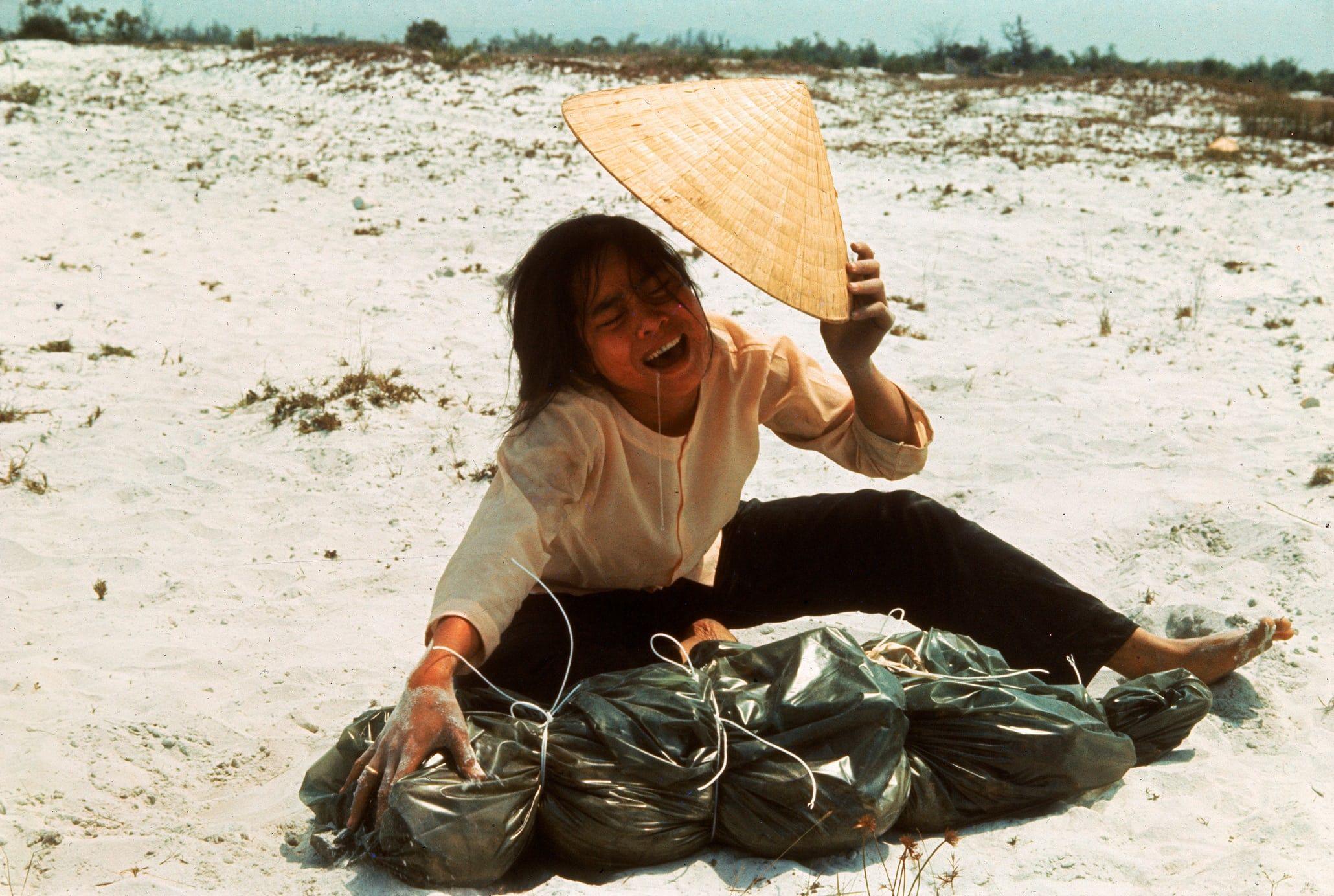
The photo, often shared online without context, is a window into one of the darkest episodes of the Vietnam War: the Huế Massacre. During and after the Tet Offensive, Viet Cong and North Vietnamese forces rounded up thousands of South Vietnamese civilians in and around Huế. Many never came back. Their bodies were found later in mass graves.
The Huế Massacre was a large-scale political purge and killing of civilians carried out by communist forces during the Tet Offensive in early 1968. Between about 2,800 and 6,000 people were executed or died in captivity. Understanding what happened in Huế explains why Tet was not just a military turning point, but a moral one.
What was the Huế Massacre during the Tet Offensive?
In late January 1968, during the Tet Offensive, Viet Cong (VC) and North Vietnamese Army (NVA, or PAVN) troops seized most of Huế, the old imperial capital of Vietnam. They held large parts of the city for nearly a month. During that time, communist security and political units arrested thousands of people on prepared lists: civil servants, teachers, religious leaders, policemen, local officials, suspected informers, and sometimes just people in the wrong place.
Many of those detained were taken to temporary prisons, pagodas, schools, or marched out to the countryside. Some were subjected to summary “people’s courts” or political reeducation sessions. Hundreds were executed on the spot. Others were marched away and killed as the communists retreated under pressure from US and South Vietnamese counterattacks.
After Huế was retaken by US Marines and South Vietnamese troops in late February 1968, the city’s missing were counted in the thousands. Over the next months and years, searchers uncovered mass graves in and around Huế. Bodies were often bound, blindfolded, and shot, or bludgeoned, or buried alive. Estimates of the dead usually fall between 2,800 and 6,000 civilians.
The Huế Massacre was the systematic killing of South Vietnamese civilians and officials by communist forces during and after their occupation of Huế in the Tet Offensive. It was not a single event on one day, but a campaign of arrests, executions, and forced marches that unfolded over several weeks. That scale and method made Huế one of the most notorious atrocities of the Vietnam War, and it turned a battlefield victory for North Vietnam into a propaganda disaster.
So what? Because Tet is often remembered in the West as a dramatic TV war story, the Huế Massacre forces us to see the offensive as something else too: a political purge that shattered the lives of thousands of noncombatants.
What set it off? Tet Offensive plans and local scores to settle
The Tet Offensive was a coordinated series of attacks launched by the Viet Cong and North Vietnamese forces across South Vietnam starting on January 30–31, 1968, timed with the Lunar New Year. The goal was not just military shock. Hanoi hoped to spark a general uprising against the South Vietnamese government, collapse its authority, and force the Americans to negotiate from a position of weakness.
Huế was a special target. It was the old royal capital, a cultural and religious center, and home to many educated elites and government officials. Symbolically, taking Huế meant humiliating Saigon. Practically, it meant seizing a city full of administrators, policemen, and community leaders who kept the South Vietnamese state functioning in the central region.
Communist planners did not arrive in Huế empty-handed. Captured documents and later testimonies show that they carried lists of “reactionaries” and “enemies of the revolution.” These lists had been compiled over years by local Viet Cong cadres and informants. They named district chiefs, village heads, political party members, teachers, religious figures, and anyone suspected of working too closely with the Saigon government or the Americans.
Once Huế fell, security units and political officers began arresting people on these lists. Some were long-standing targets. Others were denounced in the moment by neighbors or rivals, sometimes out of ideology, sometimes out of personal grudges. In a city under occupation, with power suddenly reversed, old resentments could be settled under the cover of revolutionary justice.
The chaos of urban combat made things worse. Artillery and airstrikes destroyed neighborhoods. Families fled or were separated. Records were lost. People who might have vouched for someone were dead or gone. In that fog, it was easy for a name on a list to become a death sentence without much scrutiny.
So what? Because the Huế Massacre grew out of long-prepared political targeting combined with local grievances and wartime chaos, it shows how ideological war and personal vendetta can fuse into mass killing once state power flips, even temporarily.
The turning point: from occupation to retreat and mass graves
The Tet Offensive caught US and South Vietnamese forces off guard, but Huế turned into a grinding urban battle. Communist troops seized the Citadel and much of the city on January 31, 1968. US Marines and South Vietnamese units fought block by block to take it back. The fighting lasted nearly a month, until late February.
During the early days of occupation, many detainees were kept in makeshift prisons. Some were executed after quick political trials. Others were used for labor, propaganda events, or as hostages. The communist side still hoped the offensive might trigger a broader uprising, so they needed at least the appearance of a functioning revolutionary administration in Huế.
The turning point came when it became clear that the uprising was not happening and that US and ARVN forces were slowly but steadily retaking the city. As the communist grip weakened, the calculus changed. Prisoners became a liability. They could identify cadres, expose networks, and serve as witnesses to what had happened.
So as PAVN and VC units began to withdraw from Huế and surrounding areas, many prisoners were marched out with them. Some were executed along the way. Others were killed at preselected sites and buried in hastily dug pits. In some cases, bodies were layered in trenches, tied together with wire or rope. There are accounts of people being buried alive when time or ammunition ran short.
After the city was retaken, families searched desperately for missing relatives. Over the next year, mass graves were discovered in places like Da Mai Creek, Khe Trai, and the Gia Hoi school. Each discovery brought scenes like the one Larry Burrows photographed: women and men wailing over plastic bags of bones, trying to identify loved ones by scraps of clothing, dental work, or a watch.
The graves did more than confirm rumors. They provided physical evidence that large numbers of civilians had been executed or left to die in captivity, not just killed by stray shells or crossfire.
So what? Because the shift from occupation to retreat turned detainees into disposable liabilities, the final phase of the Tet fighting around Huế turned a harsh political crackdown into a mass killing that would haunt both Vietnamese sides for decades.
Who drove it? Cadres, commanders, and contested responsibility
Responsibility for the Huế Massacre sits on several levels, from local cadres up to Hanoi’s military and political leadership. The exact chain of orders is still debated, partly because communist archives remain limited and wartime documents can be ambiguous.
On the ground, the killings were carried out by a mix of Viet Cong security units, local party cadres, and some regular North Vietnamese soldiers. Security and political officers were the ones with the lists, the authority to run “people’s courts,” and the power to decide who lived or died. Some of these men and women had long personal knowledge of Huế’s residents.
Higher up, the offensive in Huế was directed by regional communist commands, such as the Tri-Thien-Huế front. They had broad guidance to destroy the Saigon government’s apparatus in the city. That meant eliminating key officials and “reactionaries.” In revolutionary jargon, that could easily slide from arrest and intimidation into execution, especially under battlefield pressure.
Did Hanoi’s top leadership explicitly order mass executions of civilians? The record is murkier. There is evidence of preplanned targeting of “class enemies” and “traitors,” and of instructions to carry out revolutionary justice. There is less clear-cut proof of a central directive that said, in effect, “kill thousands.” Some historians argue that local zeal, misinterpretation of orders, and the chaos of retreat amplified what might have been intended as a narrower purge.
North Vietnamese and later unified Vietnamese official narratives long denied that a massacre took place, or blamed most civilian deaths on American and South Vietnamese bombing and shelling. Over time, some Vietnamese scholars and former cadres have acknowledged that executions and wrongful killings happened, though usually with lower numbers than Western or South Vietnamese sources claim.
On the other side, the South Vietnamese government and the United States publicized the Huế Massacre as proof of communist brutality. Saigon held public exhumations and ceremonies. US officials cited Huế in speeches to argue that a communist victory would bring mass terror. Some critics later accused them of inflating numbers or exploiting genuine suffering for propaganda.
So what? Because responsibility for Huế ran from local cadres to regional commanders, and because both sides later weaponized the story, the massacre became not just an atrocity but a contested memory that still shapes how the war is remembered.
What did it change? Military victory, moral defeat, and public opinion
Militarily, the Tet Offensive was a disaster for the Viet Cong. They suffered heavy casualties and failed to spark the general uprising they had hoped for. US and South Vietnamese forces retook almost all the ground lost, including Huế. By mid-1968, the communist guerrilla infrastructure in many areas was badly damaged.
Politically and psychologically, Tet was something else. The scale and surprise of the attacks shattered the American public’s belief that victory was near. Television images of fighting in Saigon and Huế, and of US troops battling house to house, made official optimism look hollow. Tet is often described as the moment when many Americans concluded that the war was unwinnable, or at least not worth the cost.
The Huế Massacre fed into that shift, but in a more complicated way. For supporters of the war, the mass graves were proof that the enemy was ruthless and that abandoning South Vietnam would mean abandoning its people to terror. For critics, Huế was one more horror in a war that already featured My Lai, napalm burns, and villages flattened by B-52s. Atrocities on one side did not excuse those on the other.
Inside South Vietnam, the massacre had a chilling effect. In areas where communist influence was already strong, some people concluded that resistance was too dangerous. In other places, the killings hardened anti-communist sentiment. Families who lost relatives in Huế carried that anger for generations.
For North Vietnam and the communist movement, Huế was a propaganda problem. The Tet Offensive was a strategic success in that it broke American political will, but the massacre undercut claims that the revolution was fighting for the people. Even if Hanoi denied the scale of the killings, the story of Huế circulated among Vietnamese and foreign observers as a warning about what communist victory might bring.
So what? Because Tet shifted the political ground of the war while Huế exposed the human cost of revolutionary violence, the massacre helped turn a military offensive into a long-term moral and strategic dilemma for all sides.
Why it still matters: memory, denial, and the woman with the plastic bag
The woman in Larry Burrows’ photograph is not a statistic. She is one of thousands of South Vietnamese who spent months or years searching for missing relatives, only to find them in shallow graves. Her grief is a reminder that the Vietnam War was not just about American soldiers and Washington politics. It was also about Vietnamese civilians caught between two armed states and two competing visions of the future.
Today, the Huế Massacre sits in an uneasy place in Vietnamese memory. The unified Socialist Republic of Vietnam has tended to downplay or reinterpret the event, focusing instead on American bombing and the victory over foreign intervention. Public discussion of communist atrocities remains sensitive. Families who lost relatives in Huế often remember quietly, through private rituals and oral stories.
Outside Vietnam, the massacre is sometimes used as a political talking point. In American debates, it appears as Exhibit A in arguments that “we were fighting real evil” or, on the other side, as something weighed against US atrocities like My Lai. That framing can flatten the story into a scorecard of horrors, where the dead of Huế are used to win an argument rather than to understand what happened to them.
Historically, Huế matters because it shows how revolutionary wars often eat civilians first. The same structures that allow guerrilla movements to survive underground, with informants, secret lists, and political cells, can be turned quickly into instruments of terror once they gain open control. It also matters because it complicates simple narratives of good and bad in the Vietnam War. The side fighting against American intervention was capable of mass killing. The side fighting with American support was capable of its own brutalities.
For anyone scrolling past that Reddit post of the crying woman and the plastic bag, context changes the image. She is not reacting to a random wartime death. She is mourning a man taken away during a planned political purge, found a year later in a mass grave created as an army retreated.
So what? Because the Huế Massacre forces us to confront how ideology, fear, and war can turn neighbors into targets, it remains a key case for understanding not just the Vietnam War, but how modern conflicts can turn cities into killing fields and civilians into evidence bags.
Frequently Asked Questions
What was the Huế Massacre during the Tet Offensive?
The Huế Massacre was the large-scale killing of South Vietnamese civilians and officials by Viet Cong and North Vietnamese forces during and after their occupation of Huế in the Tet Offensive of early 1968. Between about 2,800 and 6,000 people were executed or died in captivity, many later found in mass graves around the city.
How many people were killed in the Huế Massacre?
Estimates vary, but most historians place the number of victims between 2,800 and 6,000. South Vietnamese sources tended toward the higher end, while communist and some later Vietnamese official accounts gave lower figures or blamed many deaths on US and South Vietnamese bombing. Mass graves discovered in 1968–1969 confirmed that thousands of civilians were executed or died while detained.
Why did Viet Cong and North Vietnamese forces kill civilians in Huế?
Communist forces entered Huế with prepared lists of “reactionaries” and “enemies of the revolution,” including officials, policemen, teachers, religious leaders, and suspected informers. During the occupation, security cadres arrested people on these lists, held political trials, and carried out executions. As they retreated under pressure, many detainees were killed and buried in mass graves to prevent them from identifying cadres or exposing networks.
Did North Vietnam ever admit the Huế Massacre happened?
For years, North Vietnamese and later unified Vietnamese official narratives denied that a massacre took place, or claimed that most civilian deaths in Huế were caused by American and South Vietnamese shelling. Over time, some Vietnamese scholars and former cadres have acknowledged that executions and wrongful killings occurred, though often with lower victim counts than Western or South Vietnamese sources. The event remains politically sensitive in Vietnam.