Louis XIV of France spent hours getting dressed. Courtiers watched as he put on red-heeled shoes, a powdered wig that could weigh several pounds, and a coat stiff with gold thread. His clothes were not a personal choice. They were a political weapon.
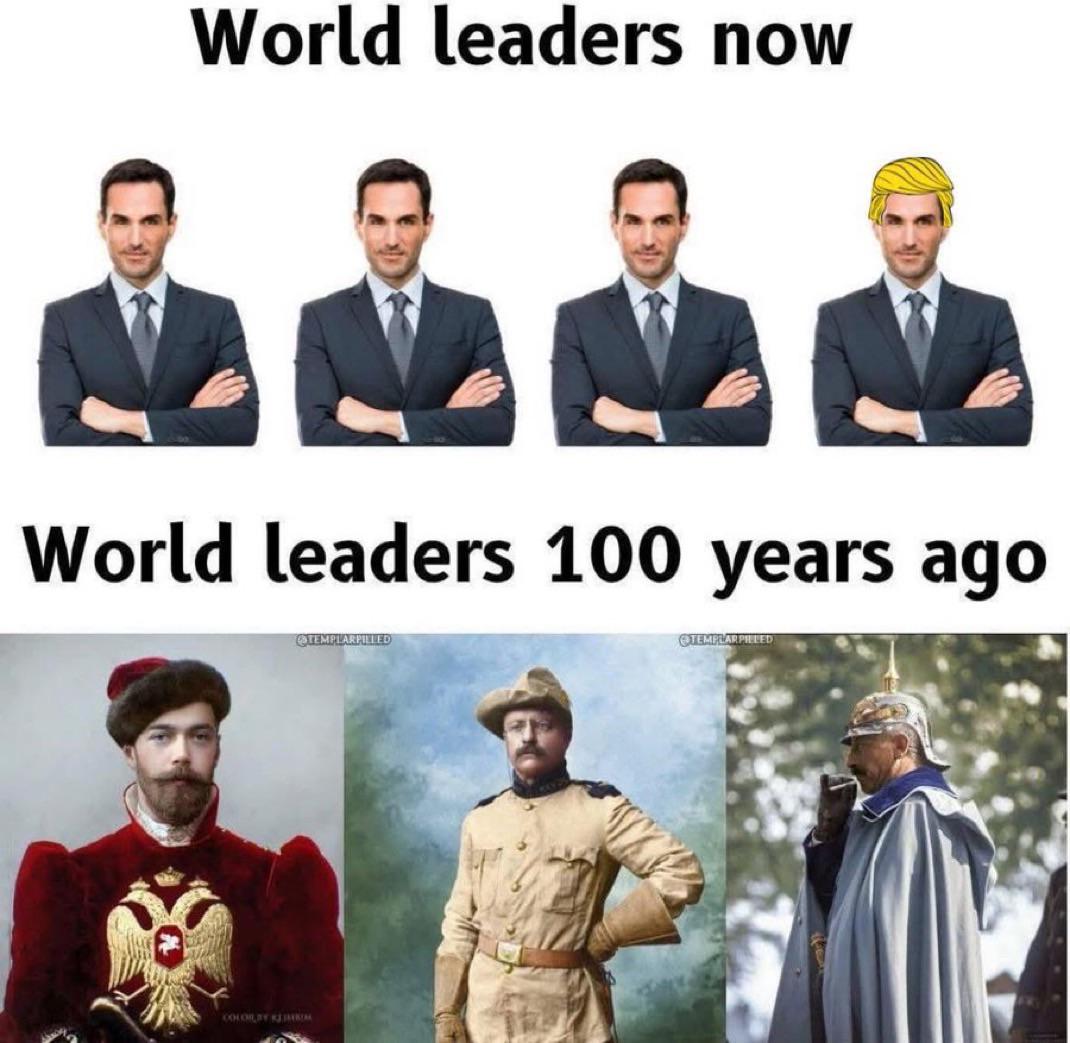
Fast forward three centuries. Volodymyr Zelensky appears on global TV in an olive drab T-shirt. Angela Merkel repeats the same blazer in ten colors. Barack Obama rolls up his sleeves on the campaign trail. The meme practically writes itself: from jeweled crowns to business casual.
The aesthetics of world leadership changed because the idea of what a leader is changed. Monarchs needed to look untouchable. Modern politicians need to look like they might show up at your barbecue. By the end of this story, the shift from armor and ermine to suits and hoodies will make a lot more sense.
Why early rulers dressed like walking gods
For most of recorded history, rulers did not try to look relatable. They tried to look terrifying, sacred, or both.
Ancient Egyptian pharaohs wore the double crown of Upper and Lower Egypt and the false beard. These were not fashion accessories. They signaled that the pharaoh was a bridge between gods and humans. Mesopotamian kings, Persian emperors, and Chinese rulers used similar visual tricks: towering headgear, rare colors like Tyrian purple, and fabrics commoners were legally forbidden to wear.
Medieval European kings followed the same script. The crown, orb, and scepter were visual theology. Coronation robes were heavy with fur and gold embroidery to say, without words, that this person was not like you and never would be.
Armor was part of the look too. A king in full plate armor on a warhorse was a walking billboard for power. Even when monarchs stopped actually fighting in the front lines, they kept commissioning portraits in armor. Think of Henry VIII: by the time of his most famous portraits he was overweight and sick, but the armor in the painting tells you he is still a warrior king.
In many societies, sumptuary laws backed this up. Ordinary people could not copy elite clothing. In Ming China, only certain ranks could wear dragon robes. In early modern Europe, laws restricted furs, silks, and specific colors to nobles. The visual gap between ruler and ruled was enforced by law.
The early aesthetics of leadership were about distance. The more a ruler looked like a god or a warrior from another world, the easier it was to justify why they had so much power. That distance is what later revolutions would attack.
How portraits and uniforms turned power into a brand
Once painting and printmaking took off, leaders did not just dress up for court. They dressed up for reproduction.
In the 16th and 17th centuries, European monarchs started using official portraits as mass media. These images traveled to foreign courts, hung in town halls, and later appeared in cheap prints. The look had to be consistent. Habsburg emperors had their distinctive jaw. Louis XIV had his long wig and high heels. Russian tsars like Peter the Great posed in Western-style armor and uniforms to send a message about modernization.
Louis XIV is the classic case. His coronation portrait by Hyacinthe Rigaud shows him in coronation robes, sword, and high red heels. He is not in battle. He is not doing paperwork. He is simply existing as the center of the universe. The clothes say that is enough.
Military uniforms then added a new layer. As standing armies grew in the 18th century, rulers started appearing in uniform to signal that they were not just hereditary figures but commanders. Frederick the Great of Prussia wore his blue uniform constantly. Napoleon Bonaparte perfected the look: simple gray greatcoat, bicorne hat, hand in waistcoat. It was a uniform that became a logo.
By the 19th century, even constitutional monarchs leaned hard into uniforms and medals. Kaiser Wilhelm II of Germany collected uniforms from every branch of his forces. Tsar Nicholas II of Russia appeared in dress uniforms dripping with orders and decorations. These outfits were meant to project discipline, hierarchy, and masculine authority in an age of mass conscription.
Portraits and uniforms turned leadership into a recognizable brand. A ruler could be identified at a glance on a coin, a poster, or a cigarette card. That visual branding made power feel permanent, which is exactly what the next wave of political movements wanted to break.
Revolutions and the birth of the “plain” leader
Revolutionary movements attacked crowns and ermine long before they toppled thrones. Clothing became a battlefield.
During the French Revolution, Jacobins mocked the silk stockings and powdered wigs of the aristocracy. The radical “sans-culottes” literally called themselves “without knee-breeches,” a reference to the trousers of common workers versus the breeches of nobles. Long trousers, simple jackets, and the Phrygian cap became symbols of the people.
Leaders adjusted. Maximilien Robespierre did not dress like a king, but he still wore a carefully chosen, slightly fussy bourgeois suit. The message: not a noble, but not a street brawler either. A moral, middle-class revolutionary.
Across the Atlantic, George Washington set an early pattern for republican leadership aesthetics. He wore military uniform during the American Revolution, but as president he preferred relatively plain civilian clothes. He refused monarchical trappings like a crown or elaborate throne. This was not modesty alone. It was a deliberate visual break with European kings.
The 19th century saw more of this. Abraham Lincoln’s tall stovepipe hat and simple black suit were not aristocratic. They were lawyerly. Giuseppe Garibaldi, the Italian nationalist, wore a red shirt and poncho that signaled a romantic, populist fighter rather than a court general.
In these cases, “plain” did not mean uncalculated. It meant a new kind of calculation. Leaders needed to look like citizens, not demigods. The visual gap between ruler and ruled narrowed, which made modern ideas of representation and democracy feel more believable.
Mass politics, mass media, and the age of the suit
By the early 20th century, one outfit had conquered the world of male leadership: the dark business suit.
The modern suit evolved in the 19th century as industrialization and urban life created a new middle class. It was practical, relatively modest, and easy to standardize. Bankers, lawyers, and bureaucrats wore it. So did many early politicians. When photography and film arrived, the suit had a huge advantage. It looked clean and modern on camera.
Woodrow Wilson, David Lloyd George, and other World War I leaders mostly appear in suits in civilian settings and uniforms only at military events. The message is clear. They are managers of a national bureaucracy, not medieval warlords.
After World War II, the suit became almost mandatory for male leaders in democracies and dictatorships alike. Winston Churchill had his three-piece suits and bow ties. Charles de Gaulle had his severe, almost priestly suits. American presidents from Harry Truman to George H. W. Bush followed the same pattern: dark suit, white shirt, conservative tie.
Television locked this in. Suits read well on the small screen. They framed the face, hid the body, and projected seriousness. When John F. Kennedy debated Richard Nixon in 1960, both wore suits, but Kennedy’s better tailoring and ease on camera helped him. The aesthetic battle was inside the narrow boundaries of the suit.
Women entering top office had to navigate this male-coded uniform. Golda Meir in Israel and Indira Gandhi in India kept to national dress, but often in subdued colors. Margaret Thatcher adopted a version of the suit: tailored jackets, skirts, pearls. Angela Merkel’s famous uniform of blazer and trousers is a direct descendant of this logic. The goal was to look professional and authoritative without copying a tuxedo.
By mid-century, the suit had become the visual language of bureaucracy, expertise, and rational governance. Leaders who wore it signaled that they were part of a rules-based system, not above it. That association would later be both an asset and a liability.
Dictators, cults of personality, and the strongman look
Not every 20th century leader wanted to look like a middle manager. Authoritarian rulers often tweaked the uniform to signal that they were more than bureaucrats.
Fascist leaders were obsessed with uniforms. Benito Mussolini loved military-style jackets, breeches, and boots. Adolf Hitler wore a relatively plain brown party uniform, but it was still a uniform, complete with armband and decorations. The idea was to fuse party, state, and leader into one visual package.
Joseph Stalin moved from priest-like tunics to a plain military-style jacket with high collar and few medals, then later to more decorated uniforms. Mao Zedong adopted the Zhongshan suit, known in the West as the “Mao suit,” a simplified, collar-buttoned tunic. It was supposed to signal equality with the masses and a break from both Western suits and old Chinese court dress.
These outfits were not just personal taste. They were part of a cult of personality. Posters, statues, and parades repeated the same look until the leader’s silhouette was instantly recognizable. Kim Il Sung’s jacket, Fidel Castro’s fatigues, Muammar Gaddafi’s flamboyant uniforms with sunglasses and sashes, all worked the same way.
Authoritarian aesthetics often blended military cues with a hint of informality. The leader is always ready for war, yet also a man of the people. Saddam Hussein in a beret and mustache, Bashar al-Assad in an open-necked shirt and blazer, Vladimir Putin shirtless on a horse or in a bomber jacket, all play with this dual message.
Strongman aesthetics mattered because they made power feel personal and physical again. In an age of faceless bureaucracies, the uniformed leader promised direct action. That image could attract supporters and intimidate opponents long before a single speech was heard.
Why today’s leaders dress “normal” (and why it is not really normal)
Scroll through modern memes comparing old and new leaders and you will see the joke: kings in armor and fur versus presidents in polo shirts. The shift looks like a fall from grandeur to blandness. That reading misses what is going on.
Modern leaders still use clothing as a political tool. They just operate in a media environment where authenticity is the currency. The goal is not to look divine. It is to look like a believable human who shares your life.
Barack Obama’s rolled-up sleeves at rallies were not an accident. They said: I am working hard, I am approachable, I am not an aloof aristocrat. Justin Trudeau’s rolled sleeves and no-tie look send a similar message. Emmanuel Macron sometimes ditches the tie and loosens the collar for the cameras when he wants to signal urgency or informality.
Volodymyr Zelensky’s wartime T-shirts and hoodies are a sharp example. Before the 2022 Russian invasion, he wore suits like any other president. After the war began, he switched to olive drab and simple gear. It connected him visually to soldiers and civilians under fire, and contrasted him with Vladimir Putin’s distant, long-table suits in the Kremlin.
Women leaders also play this game. Jacinda Ardern’s simple jackets and sometimes flat shoes in New Zealand, Sanna Marin’s minimalist style in Finland, or Alexandria Ocasio-Cortez’s red lipstick and hoop earrings in the US Congress, all carry signals about class, generation, and attitude.
Even the “dad” aesthetics of leaders like Joe Biden or Olaf Scholz are curated. The aviator sunglasses, the Amtrak stories, the slightly rumpled suit, all aim to make a powerful person look familiar rather than imperial.
The meme-worthy contrast between crowns and hoodies tells a story about democracy, media, and trust. As people gained more formal political power, they expected leaders to look less like gods and more like neighbors. That expectation shapes campaign photos, summit wardrobes, and even crisis outfits.
How global styles and social media scramble the old rules
One more twist: the world no longer has a single template for what a leader should look like.
Globalization spread the Western suit almost everywhere, but local traditions push back. Indian prime ministers from Jawaharlal Nehru to Narendra Modi have used the Nehru jacket or kurta to signal national identity. African leaders like Nelson Mandela made bold patterned shirts a symbol of post-apartheid confidence. Gulf monarchs wear traditional robes and headscarves that connect them to religious and tribal authority.
At international summits, this creates a striking visual mix. G20 “family photos” often show a row of suits interrupted by a sari, a thawb, or a traditional shirt. Hosts sometimes put everyone in local dress for one photo, which is both cultural diplomacy and soft pressure to recognize the host’s status.
Social media speeds everything up. Every outfit is instantly photographed, memed, and dissected. A leader in a luxury watch can be attacked for being out of touch. A leader in cheap, wrinkled clothes can be mocked as unprofessional. The safe zone is narrow, so many default to a bland, repeatable uniform.
At the same time, younger politicians experiment more. Hoodies, sneakers, and streetwear appear on campaign trails. Some of this is genuine generational change. Some is pure marketing. Either way, the old gap between “leader costume” and “normal clothes” is thinner than ever.
The global mix and the social media microscope matter because they make leadership aesthetics a constant negotiation. Every outfit is a small referendum on what kind of authority people will accept in the 21st century.
Leadership aesthetics are not a side story. They are a visible record of changing ideas about power. From pharaohs in gold to presidents in polo shirts, what leaders wear tells you who they think they are, who they want you to think they are, and what kind of world they are trying to rule.
Frequently Asked Questions
Why did kings and emperors wear such extravagant clothes?
Monarchs used extravagant clothes to signal that they were different from ordinary people and closer to the divine. Rare colors, jewels, and elaborate robes were political tools that justified their power and created a visible gap between ruler and ruled.
When did world leaders start wearing suits instead of royal robes?
Leaders began shifting toward suits in the 19th century as industrialization and middle-class culture grew. By the early 20th century, the dark business suit had become the standard outfit for male political leaders in many countries, reinforced by photography and television.
Why do modern politicians dress casually or roll up their sleeves?
Modern politicians dress more casually to appear relatable and hardworking in a media environment that values authenticity. Rolled-up sleeves, open collars, and simple outfits send a message that they are ordinary citizens doing a tough job, not distant aristocrats.
Why do some dictators still wear military uniforms?
Authoritarian leaders often wear military uniforms to project strength, control, and a personal connection to the armed forces. Uniforms help build a cult of personality by making the leader’s image instantly recognizable and associating them with discipline and power.