They look similar because our brains are lazy.
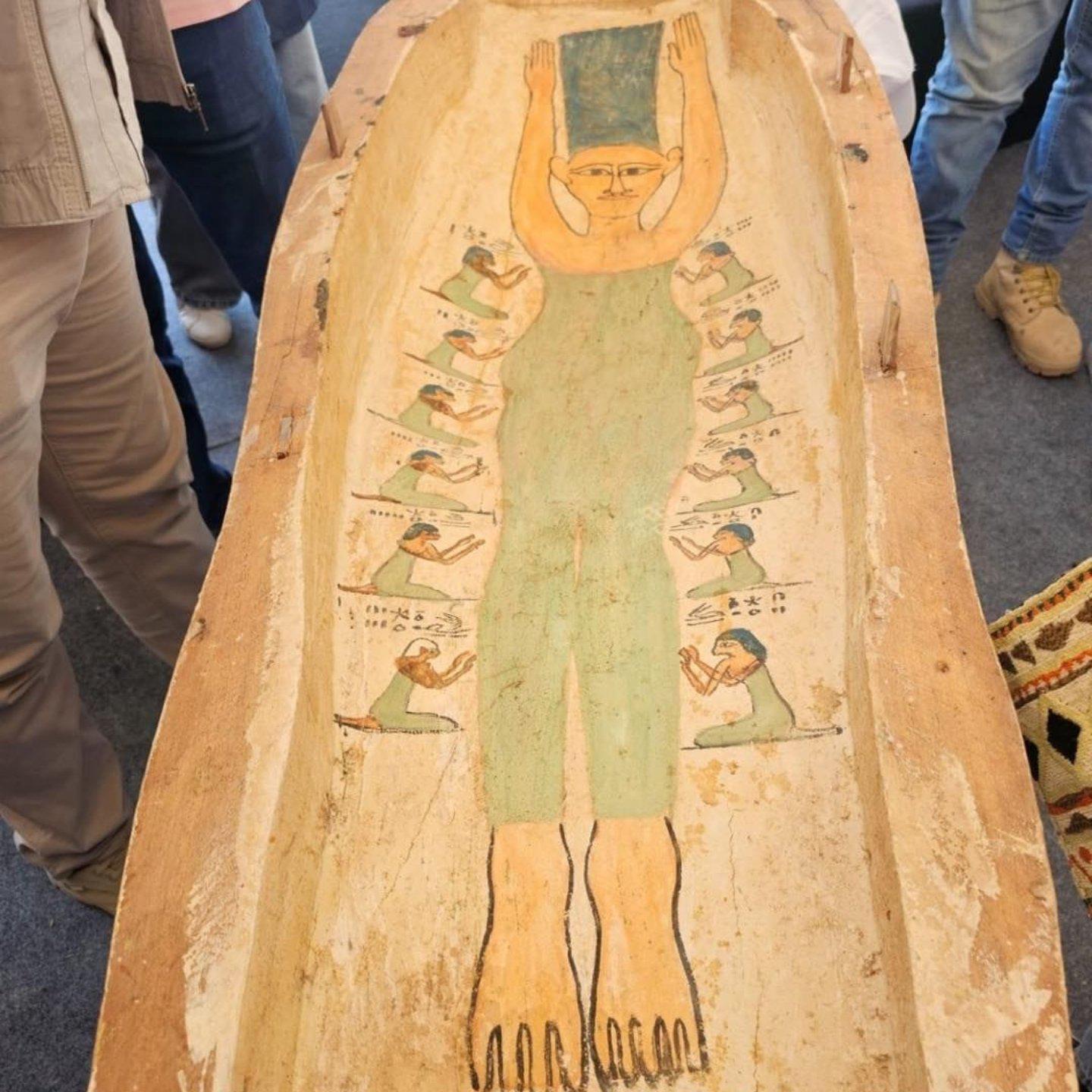
A 3,500-year-old Egyptian sarcophagus turns up with a carved figure: tall, narrow body, big round eyes, a long tube of hair rising straight up from the head. Someone posts it online. Within hours, the verdict appears in the comments: “That’s Marge Simpson.”
What actually happened is simple. An Egyptian artist around 1500 BCE carved a goddess or coffin guardian using the visual rules of their time. In 1987, a team of American animators drew a blue-haired sitcom mom using the visual rules of theirs. The resemblance is an accident, but the comparison is a gift. It lets us put ancient Egyptian religious art and modern TV animation side by side and see what both were trying to do.
By the end, the Marge meme and the sarcophagus carving stop being just a joke. They turn into a neat case study in how humans keep solving the same problems of identity, memory, and storytelling with very different tools.
Why an Egyptian coffin figure and Marge Simpson look alike
The viral photo that sparked the “Marge Simpson sarcophagus” jokes almost certainly shows a coffin from Egypt’s New Kingdom, probably between about 1550 and 1100 BCE. These coffins often had painted or carved figures of goddesses like Isis or Nephthys, or protective spirits, on the lid. They were drawn in the Egyptian “frontal” style: shoulders facing forward, head in profile, eyes huge, wigs tall and rigid.
That wig is doing most of the work in the meme. Elite Egyptians wore heavy, structured wigs. In art, these became simplified into tall, rectangular or slightly flared blocks of hair, often painted black or blue. On a narrow coffin lid, that hair can look like a vertical tube. To a 21st-century viewer raised on cartoons, a vertical tube of hair is not a wig. It is Marge Simpson.
Marge Simpson is a fictional character created by cartoonist Matt Groening. She first appeared in animated shorts on “The Tracey Ullman Show” in 1987 and then in “The Simpsons” series from 1989. Her defining feature is that towering blue beehive hairdo. Groening has said he exaggerated classic 1960s hairstyles to make her instantly recognizable in silhouette.
So you have two artists, 3,500 years apart, both stretching hair into a vertical column to solve the same problem: how to make a female figure stand out at a glance. The sarcophagus carving and Marge Simpson look similar because both are using exaggerated hair as a visual shortcut for identity.
The joke works because our brains are wired for pattern recognition. But that same pattern recognition lets us compare ancient religious art and modern animation in a serious way, so the meme becomes a doorway into how both cultures used pictures to fix people in memory.
Origins: Egyptian funerary art vs a late-20th-century cartoon mom
Start with the coffin.
By the New Kingdom, Egyptian burials for the wealthy were wrapped in layers of meaning. The body went into a decorated wooden or stone coffin. The lid often showed the deceased as a stylized figure, sometimes flanked or covered by protective deities. These images were not portraits in our sense. They were symbolic bodies designed to work in the afterlife.
The Egyptians believed the person was made of multiple parts: the physical body, the ka (life force), the ba (personality), and others. The image on the coffin gave the ba and ka something to recognize and inhabit. The point was religious continuity, not realism. A goddess carved on the lid was there to guard, guide, and absorb damage meant for the dead.
The visual rules had centuries of momentum. Egyptian artists followed a canon: specific proportions, fixed poses, and consistent wigs and headdresses that marked status and divinity. The tall hair-like mass on many coffin figures is probably a stylized wig or crown, not a personal hairstyle. The origin of that shape is ritual and convention.
Marge’s origin story could not be more different.
Matt Groening sketched the Simpson family in the lobby of a TV studio in the mid-1980s. He wanted a family that was immediately readable and a little grotesque. Big eyes, overbites, weird skin colors. For Marge, he grabbed a 1960s beehive hairdo, then stretched it to absurd height and colored it bright blue. The hair made her tall and visually separate from the chaos of Homer and the kids.
Her role was domestic, not divine. She was the moral center of a satirical show about American suburban life. Where the coffin figure is a guardian between worlds, Marge is a buffer between her family and their worst impulses.
So the Egyptian figure’s origin is a religious system that wanted images to work as magical technology for the dead. Marge’s origin is a commercial entertainment system that wanted characters to be instantly recognizable on a flickering TV screen. That difference in origin matters because it explains why one image was meant to function forever, while the other was meant to hold attention for 22 minutes at a time.
Methods: chisels and pigments vs storyboards and cel animation
Now look at how each figure was actually made.
An Egyptian coffin carver in the New Kingdom worked with wood or stone, a set of chisels, and a visual template learned in a workshop. Archaeologists have found grid lines on walls and coffins where artists laid out proportions in advance. The body was divided into standard units. The wig had a standard outline. The eyes were drawn larger than life, then carved or painted.
Color came from mineral pigments. Black hair might be made from carbon black, blue from ground azurite or a manufactured pigment called Egyptian blue. The figure on the sarcophagus was not just carved. It was painted, varnished, and sometimes inlaid. Every element had meaning: the color of the skin, the jewelry, the inscriptions nearby.
The method was slow and collaborative. Multiple artisans might work on a single coffin: one to shape, one to carve, one to paint. They were not trying to innovate. They were trying to get the ritual formula right so the dead person’s afterlife would not be at risk.
Marge Simpson was born in pencil lines on paper, then turned into animation cels. Early episodes of “The Simpsons” were drawn by hand, with key frames sketched by animators in the United States and much of the in-between work done in studios in South Korea. Her hair had to be simple enough to animate dozens of times per second, but distinctive enough to read even when she was a tiny figure in the background.
Color choices were driven by television technology. The Simpsons’ yellow skin and Marge’s blue hair popped on 1980s and 1990s CRT screens. The palette helped them stand out when viewers were channel surfing. Her design was refined over time, but always within the constraints of weekly production schedules and network budgets.
So the sarcophagus figure was carved and painted as a one-off sacred object, meant to endure in a tomb. Marge was drawn and redrawn thousands of times as a reproducible asset in a serialized story machine. That contrast in methods matters because it shows why the Egyptian figure is rigid and formulaic, while Marge is flexible enough to move, emote, and age without ever really changing.
Outcomes: protecting a soul vs anchoring a sitcom
What did each image actually do in its own world?
For the coffin figure, the outcome was spiritual security. In Egyptian thought, the dead person faced dangers: demons, hostile gods, the weighing of the heart against the feather of Ma’at. Coffin texts and Book of the Dead spells were written on the wood to give the deceased passwords and protection. The carved figure of a goddess or guardian was a kind of spiritual armor.
When mourners saw that figure, they were reassured. The dead relative was not alone. A powerful being was literally built into the coffin lid, watching over the body. The image helped families feel they had done their duty. It also sent a social message: coffins this elaborate were expensive. They told the living that this person had status and connections.
We do not know the name of the person in the viral sarcophagus. We do not know which deity the carving was meant to represent without seeing the inscriptions. But we can say that for the original audience, the figure’s job was to keep one specific individual safe forever.
Marge’s outcome is emotional and cultural, not spiritual.
On screen, she is the glue of the Simpson family. She forgives Homer, worries about Bart, encourages Lisa, and tries to hold some line of decency. Without her, the show would tip into pure chaos. She is the straight character that makes the satire work. Her hair is part of that. You can spot her silhouette and know that the scene will probably pivot on her reaction.
Off screen, Marge became a familiar figure for millions of viewers. She is not a goddess, but she is a kind of cultural archetype: the overburdened mother, the voice of reason, the person who absorbs the family’s dysfunction. People project their own mothers, or themselves, onto her.
So the sarcophagus figure’s outcome was to guard one person’s afterlife and signal their status. Marge’s outcome was to stabilize a fictional family and anchor a long-running satire of American life. That matters because it shows how similar visual tricks, like exaggerated hair, can be used to solve very different problems: cosmic danger in one case, domestic comedy in the other.
Legacy: a forgotten coffin vs a global pop icon
Legacy is where the comparison gets lopsided.
The Egyptian coffin was made for a private tomb, probably sealed soon after burial. For centuries, no one saw that carved figure except maybe tomb robbers. Its religious function was directed at the dead and the gods, not at a public audience. Many coffins were looted or damaged. Some were burned for fuel. Others were stripped of gold and left behind.
When European and Egyptian archaeologists began excavating tombs in the 19th and 20th centuries, these coffins entered a new life. They became museum pieces, research objects, and sometimes exotic decor. Their religious meaning faded. Their artistic and historical value rose. The figure that once guarded a soul now guards a glass case.
The viral Marge comparison is part of that modern afterlife. A carving that once spoke a clear visual language to ancient Egyptians now speaks through memes to people who have never read a hieroglyph. Its legacy has shifted from sacred technology to internet joke, and then, for some, to a spark of curiosity about ancient art.
Marge’s legacy is loud and global.
Since 1989, “The Simpsons” has aired hundreds of episodes in dozens of countries. Marge has been on lunchboxes, T-shirts, Halloween costumes, and advertising campaigns. She has been referenced in academic papers, political cartoons, and other TV shows. Her hair alone is enough to trigger recognition in people who have never watched a full episode.
Her image has also been reinterpreted. Artists have painted her as classical sculpture, street art, and religious icon. Cosplayers have turned themselves into live-action Marges with towering blue wigs. She has become raw material for other people’s creativity, not unlike how Egyptian goddess imagery was borrowed and reworked across centuries of Egyptian history.
So the sarcophagus carving’s legacy has moved from sacred object to archaeological artifact to meme. Marge’s legacy has moved from TV character to shared cultural reference point to flexible symbol. That matters because it shows how visual forms can outlive their original meanings and keep working in new contexts, long after their creators are gone.
Why our brains keep seeing Marge in ancient Egypt
There is a temptation to turn the resemblance into something mystical. People sometimes joke that The Simpsons “predicted” everything. So when a 3,500-year-old coffin carving looks like Marge, some leap to the idea of hidden connections, time travel, or lost knowledge.
The reality is more mundane and more interesting.
Human faces and bodies have limited shapes. Human hair, when exaggerated for effect, tends to go up, out, or both. When artists simplify, they converge on the same solutions. Big eyes read as expressive. Tall hair reads as distinctive. Narrow bodies fit better on narrow surfaces, whether that surface is a coffin lid or a TV frame.
Psychologists talk about pareidolia, the tendency to see faces or familiar patterns in random shapes. We see animals in clouds, a man on the moon, and Marge Simpson in a sarcophagus. Our brains are pattern-matching engines that would rather see something familiar than admit they do not know what they are looking at.
That same pattern matching is what made Egyptian religious art work. The moment an ancient Egyptian saw a certain wig, a certain pose, a certain set of symbols, they knew: that is Isis, or that is a protective spirit. The image triggered a whole story and set of expectations. Marge works the same way. Her silhouette triggers decades of episodes and jokes.
So when people online laugh at the “Marge Simpson sarcophagus,” they are accidentally doing what humans have always done. They are using familiar images to make sense of unfamiliar ones. That matters because it reminds us that the gap between ancient and modern is not as wide as it looks. We are still using exaggerated hair and stylized bodies to say, “This person matters. Remember her.”
What the Marge meme actually tells us about ancient Egypt
The meme is funny. It is also a small warning label.
When we project Marge onto an Egyptian coffin, we risk flattening the original meaning. That carved figure was not a cartoon. It was part of a serious religious system, tied to grief, hope, and fear about death. For the family that paid for that coffin, the image was an investment in eternity, not a visual gag.
At the same time, the meme can be a doorway. People who would never search for “New Kingdom coffin iconography” will click on a post about a Marge-like sarcophagus. Some of them will keep reading. They will learn that Egyptian art was not “bad at realism” but following its own rules. They will see that wigs, colors, and poses all carried meaning.
They might notice that our own culture does something similar. We give superheroes capes and logos. We give cartoon moms impossible hair. We repeat designs until they become shorthand for whole personalities. We are not so different from the artisans who gave goddesses tall wigs and rigid profiles.
So the Marge Simpson sarcophagus meme matters because it catches us in the act of recognizing ourselves in the ancient world. It shows that when we laugh at a 3,500-year-old carving, we are also, quietly, admitting that we still use the same visual tricks to say who we are and what we care about.
Frequently Asked Questions
Did ancient Egyptians really draw a figure that looks like Marge Simpson?
No Egyptian artist knew Marge Simpson. The resemblance comes from similar visual solutions: a tall, stylized wig on a coffin carving looks like Marge’s exaggerated beehive hair to modern viewers. It is coincidence plus our tendency to see familiar patterns.
Why do some Egyptian sarcophagi show figures with tall hair?
The tall “hair” on Egyptian coffins usually represents a formal wig or headdress, not a natural hairstyle. In New Kingdom art, wigs were drawn as rigid, elongated shapes that signaled status or divinity. On narrow coffin lids, these shapes can resemble a vertical tube of hair.
Who created Marge Simpson and why does she have such tall blue hair?
Marge Simpson was created by cartoonist Matt Groening in the 1980s. Her towering blue hair exaggerates 1960s beehive styles. It makes her instantly recognizable in silhouette and helps her stand out on screen among other characters.
What was the purpose of figures carved on Egyptian sarcophagi?
Figures carved or painted on Egyptian sarcophagi had religious and protective roles. They could represent the deceased, goddesses like Isis or Nephthys, or other protective beings. Their images were meant to guard the dead and provide a recognizable form for the soul in the afterlife.