On a cold January day in 1883, a crew of men with shovels and picks cut into a grassy hill above the Kanawha River in South Charleston, West Virginia. Locals had long known it as a “Indian mound,” one of many earthen hills that dotted the Ohio Valley. That day they opened it like a layer cake. Near the top they found two burials. At the base, they uncovered something stranger: a large skeleton in the center, surrounded by ten others laid out like the spokes of a wheel, feet pointing toward the middle.
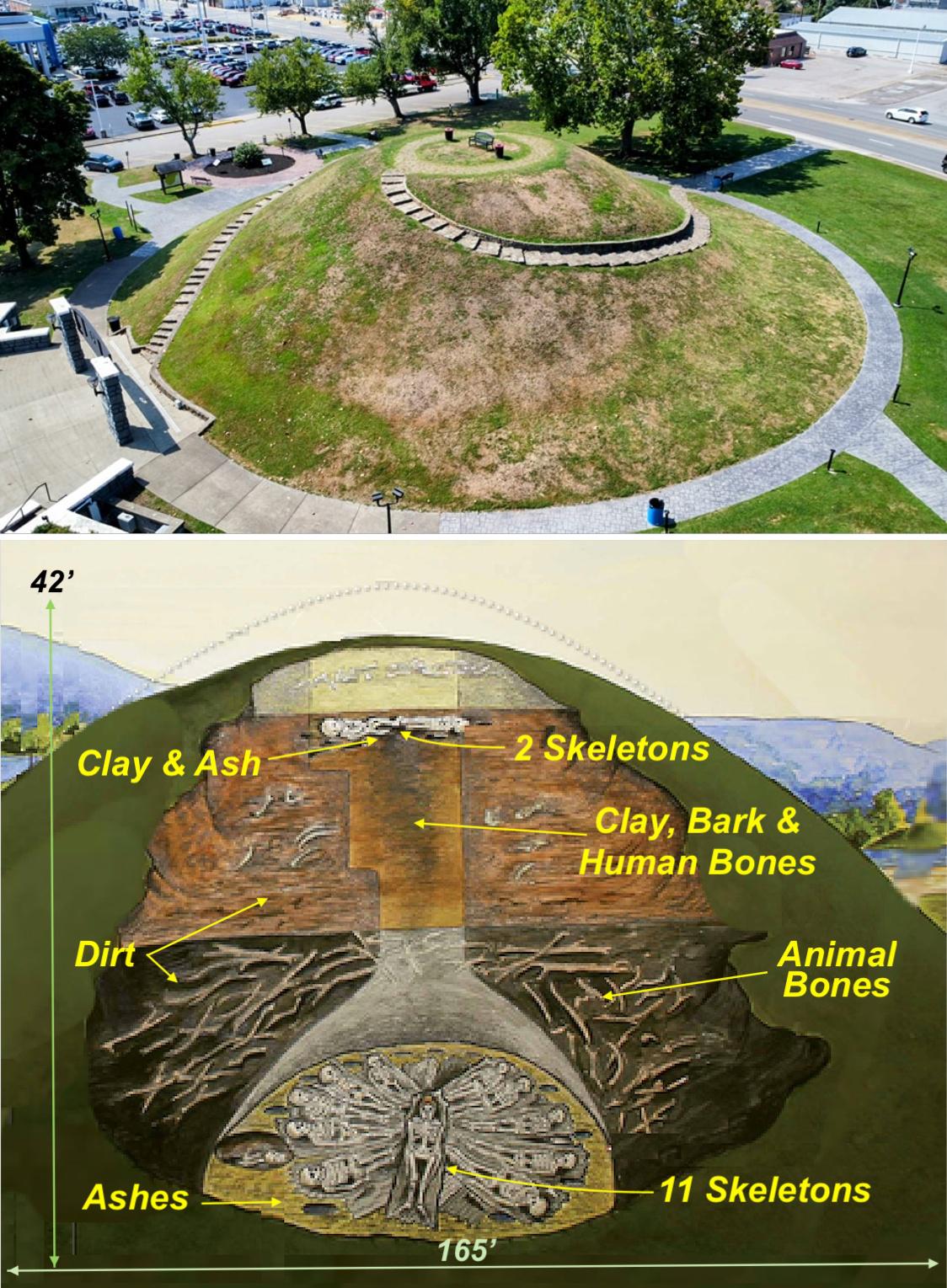
This is the Criel Mound, one of the largest surviving burial mounds in West Virginia, built around 250–150 BC by people archaeologists group under the name “Adena.” It is not a pyramid, not a fort, and not the work of a lost civilization. It is a carefully built cemetery and monument from a Native society that flourished long before Europeans ever saw the Ohio Valley.
By the end of this story, you will know who built the Criel Mound, what that strange spoke-like burial pattern probably meant, what happened to the skeletons, and why this 2,000-year-old earthwork still matters in a region better known for coal and chemical plants.
Who built the Criel Mound and when?
The Criel Mound rises about 35 feet high and roughly 175 feet across at its base, a smooth cone of earth in what is now South Charleston, West Virginia. When it was first measured in the 19th century it was slightly taller, closer to 38–40 feet, but time and erosion have shaved it down.
Archaeologists date the mound to roughly 250–150 BC. That puts it in what is called the Early Woodland period in eastern North America. The builders are associated with the Adena culture, a label archaeologists use for a set of burial customs, artifacts, and earthworks that appear across the Ohio Valley from about 1000 to 200 BC.
“Adena” is not the name these people used for themselves. It comes from an early 1800s Ohio estate named Adena, near Chillicothe, where one of the first big mounds was studied. The term stuck. When archaeologists see certain patterns — conical burial mounds, log tombs, tubular pipes, certain styles of pottery and stone tools — they call it Adena.
The Adena people were not city-builders. They lived in small villages or hamlets, hunted deer and other game, gathered wild plants, and grew early crops like squash and sunflower. They were not isolated either. The Ohio Valley was a busy corridor of trade and ritual. Exotic materials like copper from the Great Lakes and marine shells from the Gulf Coast show up in Adena burials.
So the Criel Mound was not a random pile of dirt. It was part of a regional tradition of building monumental earthworks for the dead, a tradition that linked scattered communities into a shared religious world. That connection to a larger ceremonial culture is what turns this one mound from a local curiosity into a piece of a continental story.
How was the Criel Mound built?
To modern eyes, the mound looks like a single, solid cone. The 1883 excavation showed that it was anything but simple. It was built in stages over time, probably over generations.
Workers in 1883, directed by local physician and amateur antiquarian Dr. P. D. C. Ballard, cut a trench from the side toward the center and then down to the base. They reported distinct layers of earth. At the very bottom they found a prepared surface, likely a kind of floor or platform where the earliest burials were placed.
Building a mound like this meant moving thousands of basket-loads of soil. Estimates for similar Adena mounds suggest tens of thousands of cubic feet of earth. There were no draft animals or metal tools in the Ohio Valley at this time. People dug with stone and bone tools and carried dirt in woven baskets or skin bags.
Archaeologists think the process went something like this: a burial or group of burials was laid out on a prepared surface, sometimes in a log-lined tomb. A low mound was raised over them. Later, more burials were added on top or beside the earlier ones, and the mound was expanded upward and outward. Over time, this layered building created the big conical form we see today.
The labor involved was significant for small communities. Organizing that work meant someone had enough authority or spiritual weight to call people together, perhaps from multiple villages, for ceremonies that mixed grief, obligation, and communal identity. The mound was a project that bound the living to the dead and to each other. That social investment is why the Criel Mound became a lasting landmark rather than a forgotten grave.
What exactly was found inside the Criel Mound?
The short version that circulates online is accurate as far as it goes: two skeletons near the top, and eleven at the base, with a large central skeleton surrounded by ten others arranged in a spoke-like pattern. The longer version is messier, because the excavation was done in 1883, before modern archaeological standards.
Near the top of the mound, excavators reported two intrusive burials. “Intrusive” means they were dug into the mound after its original construction. These upper burials were likely later Native graves, placed there because the mound was already a sacred spot. The details of these two skeletons are thin in the surviving reports.
At the base, things were more dramatic. The excavators described a central burial of a relatively large individual, lying on his back. Around this central skeleton, ten other skeletons were arranged in a circle, with their feet pointing toward the center, like spokes on a wheel. Some accounts say they were laid on their backs, others that they were on their sides. The record is not perfectly consistent, but the spoke-like pattern is repeated across sources.
Early writers claimed the central skeleton was “giant,” with estimates of over 7 feet tall. This is where modern myth-making kicks in. Later physical anthropologists who examined long bones from Adena burials in the region found that some individuals were tall by ancient standards, often 6 feet or a bit more, but not the 8- or 9-foot giants of internet lore. The 1880s habit of rounding up and sensational reporting did the rest.
Artifacts were reported with the burials: stone tools, pipes, and ornaments. Some were said to be made of copper. Precise provenience — which object was with which skeleton — was rarely recorded. Many of these items are now lost or scattered in collections. The human remains themselves were removed and eventually reburied in the 20th century, in keeping with changing attitudes and later with Native American Graves Protection and Repatriation Act (NAGPRA) standards.
So what we know is this: the Criel Mound contained multiple burials from different times, with an early and visually striking arrangement at the base centered on a tall individual. What we do not have is a full modern excavation report with careful measurements, photos, and lab analysis. That gap between dramatic 19th-century accounts and modern scientific standards is exactly where confusion and legend have grown.
Was the spoke-like pattern a human sacrifice scene?
The image of a central figure surrounded by ten others, feet toward the middle, practically begs for a dramatic explanation. People on Reddit and elsewhere often jump straight to “human sacrifice” or “mass execution.” The truth is more cautious.
Archaeologists who study Adena mounds have seen group burials before. Some mounds contain bundles of bones gathered after bodies decomposed elsewhere. Others have multiple individuals laid out together. The spoke pattern at Criel is unusual but not completely unique. It suggests a planned arrangement, not a hasty dumping of bodies.
Were they killed at the same time? The 1883 excavators did not have the tools to answer that. There is no reliable record of trauma on the bones, no radiocarbon dates, no DNA analysis. Without that, we cannot say whether this was a single event or a gathering of individuals who died at different times but were laid out in a pattern to express some social or spiritual idea.
One reasonable interpretation is that the central person was a high-status individual — a leader, religious specialist, or someone whose role mattered to many communities. The ten around him could have been relatives, allies, or followers whose remains were brought in from elsewhere to rest around him. In this reading, the spoke pattern is about relationship and orientation, not slaughter.
Another, more dramatic possibility is that some or all of the surrounding individuals were sacrificed or died in connection with the central figure’s death. Human sacrifice is documented in some later Mississippian cultures of the Southeast, such as at Cahokia, though those societies are many centuries later and culturally distinct. There is no clear proof of such practices in Adena contexts, but absence of evidence is not the same as proof that it never happened.
Modern archaeologists tend to be conservative. Without clear trauma or other signs, they avoid declaring a scene “sacrifice.” The safest statement is that the spoke-like burial pattern at the base of the Criel Mound was a carefully arranged group burial focused on a central individual, expressing a social or religious structure we can only partly guess at.
That uncertainty matters because it pushes us away from easy, sensational answers and back toward a harder question: how did these communities think about status, kinship, and the afterlife, and how did they use the dead to express the living order of their world?
What happened to the mound and the remains after 1883?
When the Criel Mound was opened in 1883, it was part of a broader 19th-century rush to dig into mounds across the Midwest and Ohio Valley. Farmers, local doctors, and amateur “antiquarians” treated them as treasure chests of curiosities, not as cemeteries.
Dr. Ballard’s excavation was more systematic than some, but by modern standards it was still destructive. Once a mound is cut open and the contents removed without detailed recording, that context is gone forever. Many artifacts and bones from such digs ended up in personal collections, local museums, or simply disappeared.
The Criel Mound survived where many others did not. In the early 20th century, as South Charleston grew, there were real discussions about leveling the mound for development. Instead, local citizens and officials pressed to preserve it. The city acquired the site, and the mound became a public park feature. A concrete stairway was added so visitors could climb to the top. A flagpole went up. For decades, the mound was used as a scenic overlook and patriotic backdrop, with little sense that it was an ancient cemetery.
Attitudes toward Native burials shifted in the later 20th century. Archaeologists began to treat mounds as sacred sites, not playgrounds. Native communities pressed for the return and reburial of remains. Under NAGPRA, museums and agencies holding human remains and funerary objects from Native sites must inventory them and work with tribes on repatriation.
West Virginia has no federally recognized tribes today, but that does not mean the people who built the Criel Mound vanished. Their descendants are woven into Shawnee, Delaware (Lenape), and other Native nations that were pushed west or south. In the late 20th century, human remains from Criel and other mounds in the Kanawha Valley were quietly reburied.
That shift from curiosity cabinet to protected cemetery changed how the Criel Mound is treated and talked about. It is no longer just an object to be cut open and measured. It is a place where the dead still lie, and where living communities negotiate how to remember a past that was nearly erased.
How does the Criel Mound fit into the wider story of the Mound Builders?
The Criel Mound often gets pulled into a bigger, and often confused, story: the “Mound Builders.” In the 19th century, many Euro-American writers claimed that the impressive earthworks of the Ohio and Mississippi valleys could not have been built by the ancestors of the Native peoples they knew. They invented a lost race of “Mound Builders” who had supposedly been wiped out by “savage” tribes.
That idea was racist and wrong. By the late 1800s, careful work by the Smithsonian’s Bureau of American Ethnology and others showed that the mounds were the work of Native societies whose descendants were still very much alive. The Adena, Hopewell, and Mississippian cultures are all part of that long story of earthwork building.
The Adena built conical burial mounds like Criel. The Hopewell, who came a bit later, built vast geometric earthworks and elaborate ceremonial centers in Ohio and beyond. Centuries after that, Mississippian societies like Cahokia near modern St. Louis built huge platform mounds as the bases for temples and elite residences.
The Criel Mound is one node in that long chain. It shows that people in what is now West Virginia were part of the same broad ceremonial world as communities in Ohio and Kentucky. Artifacts from Adena sites in the Kanawha Valley match those from classic Adena centers in Ohio. The same ideas about honoring the dead with earth monuments and exotic goods had spread along river routes.
When people today ask, “Who were the Mound Builders?” the honest answer is: many different Native societies over thousands of years. The Criel Mound helps anchor that answer in a specific place and time, with a specific burial pattern that we can point to and say, “Here is one way those societies expressed power, memory, and belief.”
Why does the Criel Mound still matter today?
On most days, the Criel Mound is quiet. Cars pass on nearby streets. A few visitors climb the steps. Kids might race up and down without thinking much about the 2,000 years of history under their feet.
Yet the mound still carries weight. For archaeologists, it is a rare surviving example of a large Adena mound that has not been completely destroyed. Even with the damage from 1883, its size, form, and setting give context to smaller, plowed-down mounds in the region.
For Native communities, it is part of a sacred geography that stretches along the Ohio and Kanawha rivers. Even if direct tribal connections are hard to trace through centuries of displacement, the mounds mark a deep time presence that contradicts any story of an “empty” or “unused” land before European arrival.
For locals in South Charleston, the Criel Mound is a reminder that their town did not begin with a railroad, a factory, or a subdivision. People here were organizing labor, building monuments, and conducting complex rituals when Rome was still a republic. That time depth changes how a place feels.
And for anyone who stumbles across a photo of the mound on Reddit and wonders about the spoke-like burials inside, the site is a doorway into a less familiar North American past. It is a past where earth, bone, and basket-loads of soil were used to build memory into the ground, and where a circle of the dead around a central figure still raises questions we cannot fully answer.
The Criel Mound matters because it forces us to see the Ohio Valley not as a blank stage waiting for Europeans, but as a region with its own ancient monuments, its own sacred hills, and its own long, complicated human story.
Frequently Asked Questions
What is the Criel Mound in West Virginia?
The Criel Mound is a large conical burial mound in South Charleston, West Virginia, built around 250–150 BC by people associated with the Adena culture. It is about 35 feet high and 175 feet across and was used as a ceremonial cemetery, not as a fort or dwelling.
Who built the Criel Mound and why?
The mound was built by Native communities archaeologists group under the Adena culture, active in the Ohio Valley during the Early Woodland period. They built it in stages as a burial and ceremonial monument, using basket-loads of earth to honor important individuals and to express social and religious ties among their communities.
Were giants or human sacrifices found in the Criel Mound?
Nineteenth-century reports described a tall central skeleton surrounded by ten others in a spoke-like pattern, but claims of giant skeletons are exaggerated. Later study of Adena remains shows some individuals were tall, often over 6 feet, but not the 8–9 foot giants of legend. There is no clear scientific evidence that the Criel burials were human sacrifices, although the group arrangement suggests a planned ceremonial pattern focused on a central figure.
Can you visit the Criel Mound today?
Yes. The Criel Mound is preserved as a public site in South Charleston, West Virginia. A stairway allows visitors to climb to the top. It is treated as an ancient cemetery and archaeological site, so visitors are expected to respect it as a burial place rather than a playground or digging spot.