Picture this: a flickering animal-fat lamp, a cramped limestone wall, and a person 32,000 years ago calmly drawing a cave bear with just fourteen lines.
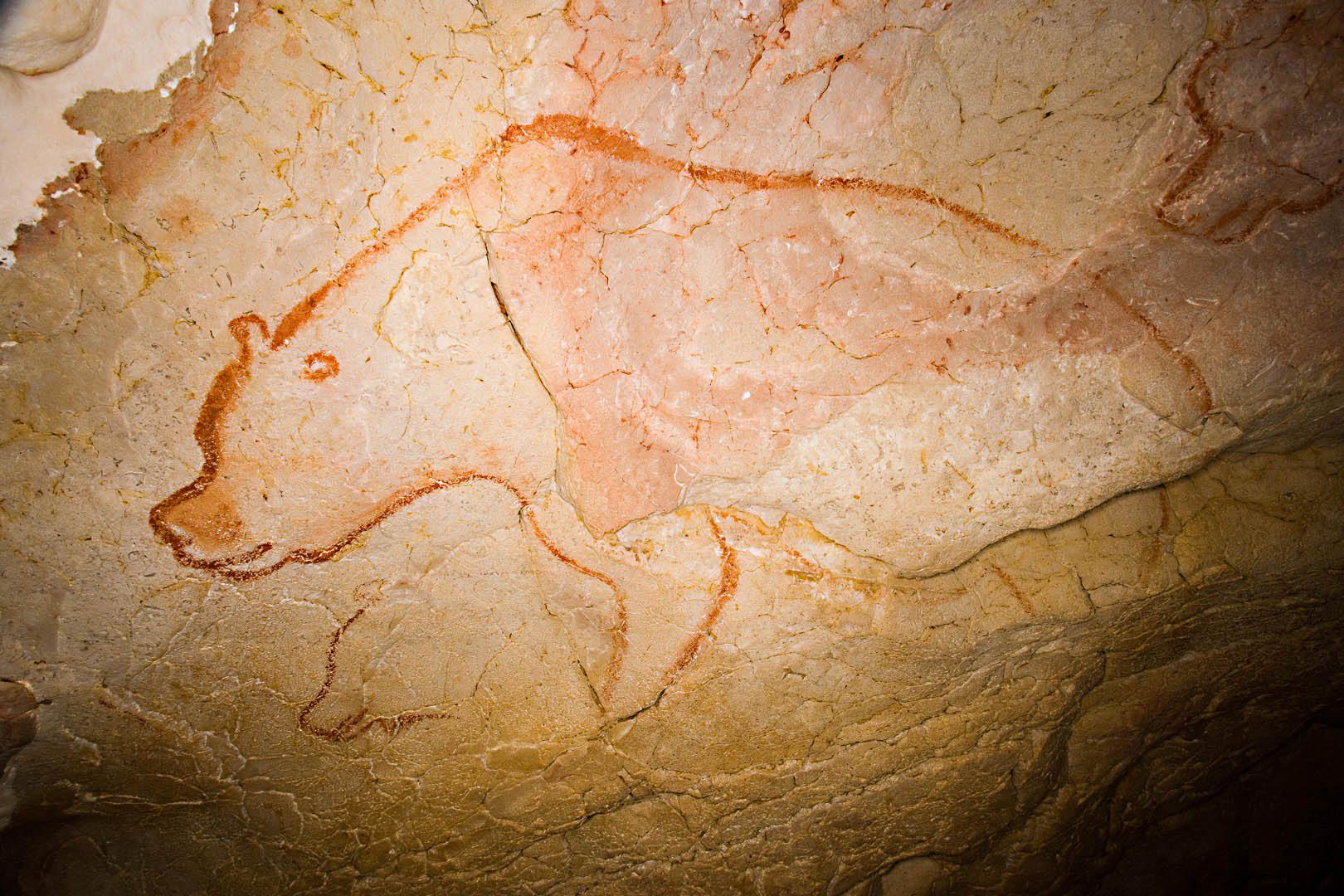
That bear, in France’s Chauvet Cave, is one of the oldest known figurative paintings on Earth. It was drawn with charcoal and smudged with fingers or hide in a method archaeologists call “stump-drawing.” No color explosion, no elaborate background. Just a few confident strokes that somehow capture muscle, weight, and attitude.
The Chauvet cave bear painting is a 32,000-year-old charcoal drawing that uses only about fourteen lines to suggest a powerful animal. It shows that Ice Age artists already used advanced shading and contour techniques. By looking closely at this one bear, we can see how skilled, organized, and thoughtful these people really were.
Here are five things that single animal on a cave wall tells us about the people who painted it and the world they lived in.
1. Ice Age “minimalism”: 14 lines, real bear
What it is: The Chauvet cave bear head is a charcoal drawing that uses around fourteen main lines to outline the skull, muzzle, neck, and shoulders. The artist then smudged the charcoal to suggest volume and fur, a method called stump-drawing.
Stump-drawing means using fingers, a piece of hide, or another soft tool to blur and spread pigment. In Chauvet, the artist traced the main contours of the bear’s head and forequarters, then rubbed the charcoal to soften some edges and deepen others. The result is a bear that feels heavy and three-dimensional, even though the lines are spare and economical.
This is not stick-figure art. The muzzle has depth. The forehead slopes correctly. The neck and shoulders are suggested with just a few curves, but you can feel the mass of the animal. Whoever drew it had spent a lot of time watching real bears, probably cave bears (Ursus spelaeus), which used the same cave system long before humans sealed it off.
Concrete example: In the same chamber, there are lions, rhinos, and horses drawn with similar confidence. Some lions are shown in profile with overlapping legs, as if they are moving. The bear fits into this visual language: clean outlines, selective shading, and almost no background clutter.
Why it mattered: That economy of line tells us these were not people tentatively scratching at a wall for the first time. They had a visual tradition and training. The fact that a 32,000-year-old artist could suggest a bear’s bulk with a few strokes shifts how we think about “primitive” art. It suggests that by the time of Chauvet, humans already had a mature way of seeing and representing the world, which changes the story from “art slowly stumbled into realism” to “as soon as we find it, it is already sophisticated.”
2. Stump-drawing: Ice Age shading with fingers and hide
What it is: Stump-drawing is a technique where the artist draws with charcoal or pigment, then uses fingers, a wad of hide, or a soft tool to smear and blend the lines. It creates gradations of light and shadow, a kind of proto-shading long before pencils and sketchbooks.
In Chauvet, the bear’s muzzle and head outlines are not just hard, sharp lines. Archaeologists studying the wall up close see rubbed areas where the pigment has been pushed into the rock’s texture. The artist likely drew the main lines, then used their fingers or a small pad of skin or fur to soften the muzzle and emphasize the head and forequarters.
Concrete example: The lions in Chauvet’s so-called “End Chamber” show the same trick. Their heads and shoulders are modeled with smudged charcoal, giving an illusion of depth. In some cases, the artist used the natural bulges of the rock, then shaded around them to make a lion’s chest or a bear’s shoulder stand out.
Why it mattered: Stump-drawing shows that Ice Age artists were not just copying outlines. They were manipulating light, texture, and the rock surface to create volume. That means they were thinking like later draftsmen and painters, experimenting with tools and effects. It pushes the history of “technique” far back. When you see that smudged bear muzzle, you are looking at one of the earliest known uses of shading to create a three-dimensional illusion, which links those anonymous artists directly to every later portraitist and sketch artist who ever rubbed a line to make a shadow.
3. Chauvet’s artists were organized specialists, not dabblers
What it is: The quality and consistency of the Chauvet paintings, including the cave bear, suggest that not everyone in the group was drawing on the walls. Certain people had the skill, access, and time to do this work, which points to a form of artistic specialization.
The cave itself is deep and hard to reach. To get to some of the painted panels, including bear and lion scenes, you have to move through narrow passages and uneven floors. That means torches or lamps, planning, and probably helpers. You do not bring a whole band, including kids and elders, into those spaces casually.
Concrete example: Jean Clottes, one of the main researchers at Chauvet, and his team identified different “hands” in the cave. They noticed recurring styles and gestures, like how one artist shaped horse heads or bear muzzles. One individual, sometimes called the “Panel of the Horses artist,” appears to have worked on multiple panels over time. The bear painting fits into this pattern of identifiable, practiced hands.
Why it mattered: If some people were recognized as the ones who painted, that hints at social roles. Even in small hunter-gatherer groups, certain individuals may have been the go-to image makers, ritual specialists, or both. The bear painting is not just art, it is evidence of social organization. It suggests that Ice Age groups could afford to let some members spend time on skilled, non-subsistence work, which means their societies were more complex and flexible than the stereotype of constant survival struggle.
4. Cave bears were more than background animals
What it is: The animal in the painting is almost certainly a cave bear, a species that roamed Europe during the Ice Age and used caves for hibernation. For the people at Chauvet, cave bears were powerful, dangerous neighbors, not abstract symbols.
Cave bears were huge. Adult males could weigh several hundred kilograms. Their bones and claw marks are found throughout Chauvet. Some skulls seem to have been placed deliberately on rocks, though archaeologists debate whether that was human action or chance. Either way, humans and bears were sharing the same underground spaces, even if not at the same time.
Concrete example: In Chauvet, there is a chamber with a bear skull sitting on a natural stone block, framed by other bones on the floor. Some researchers have argued this arrangement looks intentional, as if someone placed the skull for effect. Right or wrong, that debate exists because cave bears so dominate the site that their presence feels almost staged.
Why it mattered: Painting a cave bear on the wall was not a neutral choice. It meant engaging with an animal that could kill you, that left deep claw marks on the same surfaces, and that may have been part of stories, fears, and rituals. The bear painting hints that Ice Age people had complex mental worlds where animals had meanings beyond meat. That matters because it pushes us to see them not just as hunters, but as people who built mythologies and symbolic systems around the creatures they lived alongside.
5. The bear painting rewrites the timeline of “advanced” art
What it is: Chauvet Cave was discovered in 1994 and dated to around 32,000 to 30,000 years ago for its oldest paintings. That made the cave bear and its neighbors far older than famous sites like Lascaux, which dates to roughly 17,000 years ago. Yet the Chauvet art looks, to many eyes, more sophisticated.
Before Chauvet, many archaeologists thought cave art evolved from simple, clumsy figures to more refined, naturalistic images over thousands of years. Chauvet complicated that story. Here were lions, rhinos, horses, and bears drawn with overlapping bodies, perspective tricks, and shading, all at the very beginning of the known European cave art sequence.
Concrete example: Compare the Chauvet bear to some later, more schematic figures in other caves. In certain sites, animals are reduced to outlines or abstract signs. At Chauvet, by contrast, the bear’s head and shoulders show a confident grasp of anatomy and volume. The artist uses the rock relief to give the impression of a rounded body, something you might expect from a much later period.
Why it mattered: The bear painting is one of the clearest pieces of evidence that artistic skill did not simply climb in a straight line from crude to refined. It forces historians to abandon the idea that early Homo sapiens in Europe were just warming up. Instead, it suggests that as soon as we see their art, they are already experimenting with perspective, motion, and shading. That changes how we think about human cognitive evolution, because it means that the mental capacity for complex, naturalistic art was present very early in our species’ story.
The Chauvet cave bear is not just a pretty Ice Age picture. It is a compressed data set about technique, social life, and thought.
In a few smudged lines, we see that 32,000 years ago people were already using advanced drawing methods, organizing access to deep ritual spaces, and thinking hard about the animals that shared their world. The bear on the wall is a reminder that when we talk about “prehistoric” people, we are talking about minds that could do what that anonymous artist did in the dark: imagine, plan, and execute an image that still feels alive to us today.
Frequently Asked Questions
How old is the Chauvet cave bear painting?
The Chauvet cave bear painting is part of the oldest phase of art in Chauvet Cave, dated by radiocarbon methods to roughly 32,000 to 30,000 years ago. That makes it significantly older than famous caves like Lascaux in France, which dates to about 17,000 years ago.
What is stump-drawing in cave art?
Stump-drawing is a technique where an artist draws with charcoal or pigment, then uses fingers, a piece of hide, or another soft tool to smear and blend the lines. In Chauvet Cave, this method was used on the bear’s muzzle and head to create shading and volume, making the animal look more three-dimensional.
Why did Ice Age artists paint cave bears?
Cave bears were large, powerful animals that used the same caves as humans for hibernation. Their bones and claw marks are found throughout Chauvet. Painting cave bears likely reflected both direct experience with a dangerous animal and deeper symbolic or ritual meanings that archaeologists can only partly guess at today.
Who discovered Chauvet Cave and its paintings?
Chauvet Cave was discovered in December 1994 by three speleologists: Jean-Marie Chauvet, Éliette Brunel-Deschamps, and Christian Hillaire. The cave is named after Jean-Marie Chauvet. Soon after, archaeologist Jean Clottes led the first scientific studies of the paintings, including the cave bear images.