The photo catches him in midair, somewhere between New York and Washington. Smoke is still rising from the ruins of the World Trade Center. George W. Bush is on Air Force One, jacket off, tie loosened, a phone pressed to his ear. Outside the window, the country he leads is in shock.
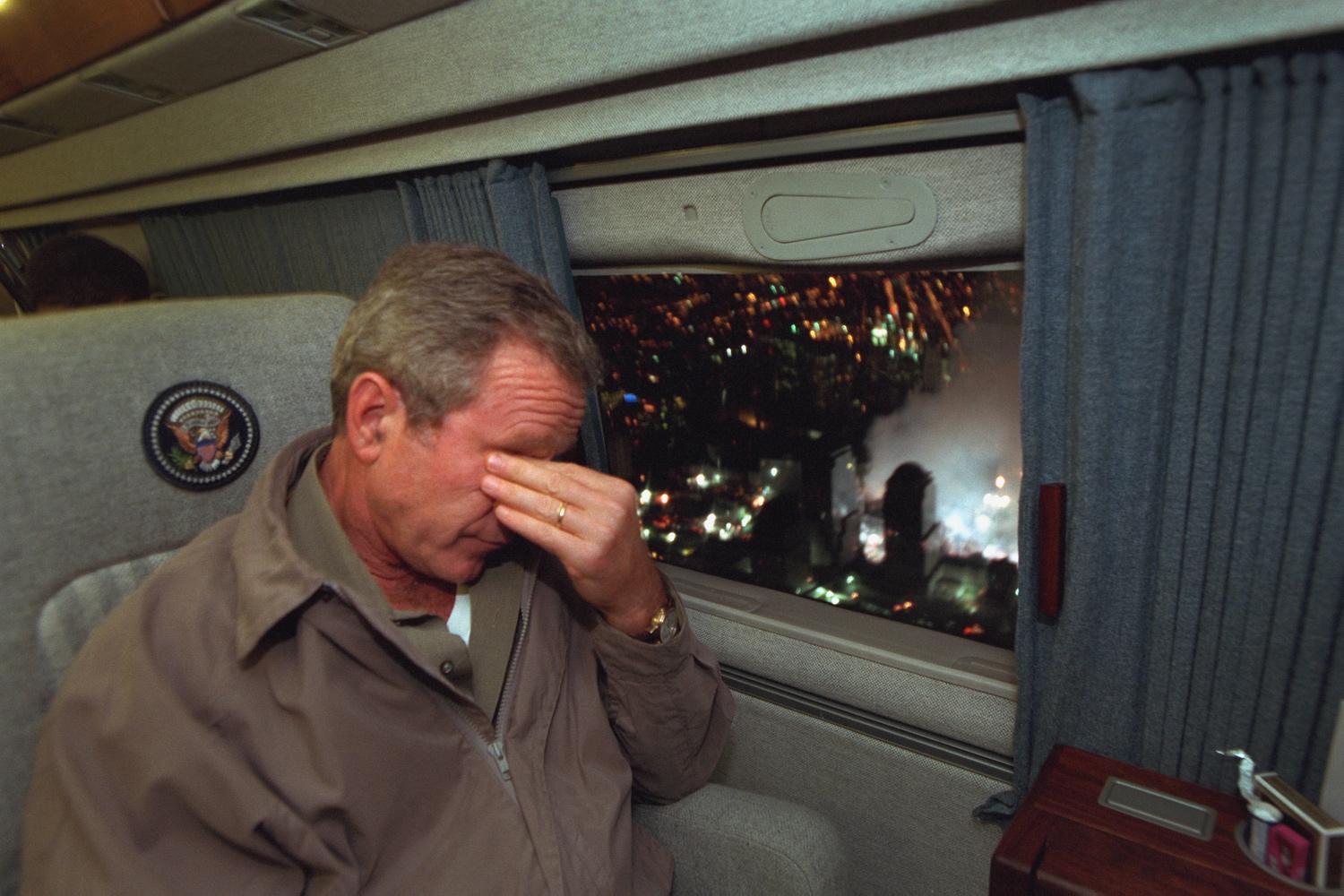
That image, often shared with captions like “Bush flying back to DC after 9/11,” looks simple. The president, the plane, the disaster. But the story behind Bush’s movements on September 11 and the days that followed is messier, more frightened, and more improvised than most people realize.
By the end of that day, nearly 3,000 people were dead, New York and Washington were wounded, and the United States was already shifting toward war. What Bush did, where he went, and what he said in those first hours helped shape everything that came next, from the invasion of Afghanistan to the expansion of presidential power at home.
Here are five things people often get wrong about Bush’s 9/11 day, and why they mattered.
1. Bush did not fly straight back to Washington after the attacks
What it is: A common belief is that once Bush left the Florida classroom where he heard about the attacks, he headed straight back to Washington. He did not. Air Force One zigzagged across the country, first to Barksdale Air Force Base in Louisiana, then to Offutt Air Force Base in Nebraska, before finally returning to Washington that evening.
Concrete example: After leaving Sarasota, Florida, around 9:35 a.m., Air Force One climbed fast. The Secret Service feared that Washington was under attack and that the president himself might be a target. At 11:45 a.m. Bush landed at Barksdale AFB near Shreveport. There he recorded a short statement in a windowless conference room and spoke with Vice President Dick Cheney and national security advisers by secure phone. A few hours later he flew to Offutt AFB near Omaha, home to U.S. Strategic Command and one of the most hardened command posts in the country, before finally departing for Washington around 4:30 p.m. Eastern.
Why it mattered: That zigzag flight pattern was not about indecision. It was about survival and continuity of government. The Secret Service, backed by Cheney and some Pentagon officials, pushed hard to keep Bush away from Washington until they could be sure there were no more hijacked planes headed for the capital. The image of a president “on the run” bothered Bush politically, but the choice reflected a long-standing Cold War doctrine: in a crisis, get the commander in chief to a secure location where he can still give orders. The fact that Bush did not go straight back to Washington shows how real the fear was that 9/11 might be only the first wave of a larger attack.
2. Bush was not “missing” or out of contact while in the air
What it is: Another myth says Bush was essentially out of the loop while Air Force One roamed the skies, cut off from his advisers and watching events unfold on TV like everyone else. The reality is that Air Force One functioned as a flying command post, though the communications that day were far from perfect.
Concrete example: On the flight from Florida to Louisiana, Bush spoke repeatedly with Vice President Cheney, National Security Adviser Condoleezza Rice, and Defense Secretary Donald Rumsfeld. He authorized the shootdown of hijacked aircraft if necessary, a grim order relayed through the chain of command. At Barksdale and Offutt, he joined secure video teleconferences with national security officials. The plane had secure phones and communications gear, but on 9/11 some systems were overloaded or glitchy. At times, aides had to scramble to patch calls through or rely on less secure lines.
Why it mattered: The idea of a “missing” president on 9/11 feeds a broader narrative of chaos and leaderless panic. In reality, while coordination was uneven and some messages were garbled, the constitutional chain of command never broke. Bush was reachable, giving orders, and being briefed. That matters for understanding how the United States responded so quickly with measures like grounding all civilian flights, raising alert levels worldwide, and preparing military options. It also shows the limits of even the most sophisticated command systems when hit by surprise, something that would drive later investments in secure communications and continuity planning.
3. Cheney, not Bush, made many of the day’s most immediate calls
What it is: The president is the face of 9/11, but in the first hours, while Bush was in Florida and then in the air, Vice President Dick Cheney was in the White House bunker making some of the most urgent decisions. That included directing air defenses and dealing with the possibility of more hijacked planes.
Concrete example: After the second plane hit the South Tower at 9:03 a.m., Cheney was quickly moved to the Presidential Emergency Operations Center under the White House. There, in contact with the Pentagon and the FAA, he confronted the nightmare scenario: hijacked civilian airliners still in the sky, possibly heading for Washington. Cheney later said that Bush authorized him to give a shootdown order if needed. The exact timing and wording of that authorization has been debated, but what is clear is that Cheney, not Bush, was the one physically present in the bunker, talking to military commanders as NORAD fighters scrambled over the East Coast.
Why it mattered: Cheney’s role on 9/11 was not just a footnote. It foreshadowed the influence he would wield in the months and years that followed, from the push for the invasion of Iraq to the defense of secret prisons and “enhanced interrogation” programs. The fact that Cheney was the one in the bunker, while Bush was on a plane, helped cement a dynamic in which the vice president became the administration’s most aggressive voice on national security. It also fed later arguments that emergency power had shifted too far away from the traditional checks on the presidency, since Cheney operated with fewer political constraints and less public visibility.
4. The famous Ground Zero bullhorn moment was not scripted heroism
What it is: Many people remember Bush standing on a pile of rubble at Ground Zero on September 14, 2001, arm around retired firefighter Bob Beckwith, shouting through a bullhorn that “the people who knocked these buildings down will hear all of us soon.” It looks like a perfectly staged political moment. It was not planned that way.
Concrete example: When Bush arrived in New York that Friday, local officials and the Secret Service wanted him to speak at a more controlled location. Bush insisted on going to the actual site. Once there, he tried to address the crowd of rescue workers, but they could not hear him. Someone handed him a bullhorn. He climbed onto a crushed fire truck next to Beckwith, who had been helping with recovery efforts. When a worker shouted that they could not hear him, Bush improvised the line that would loop endlessly on television.
Why it mattered: That unscripted moment did more than any formal speech to repair the image of a president who had spent much of 9/11 out of sight. It gave Bush a connection to the anger and grief of ordinary Americans and helped build broad support for military action in Afghanistan. The bullhorn scene became a symbol of resolve, used later to justify a wide range of policies, from the Patriot Act to the invasion of Iraq. Understanding that it was improvised, not stage-managed, shows how raw emotion and chance can shape political narratives for years.
5. Bush’s 9/11 actions helped expand presidential power at home and abroad
What it is: The choices Bush made in the hours and days after 9/11 did not just respond to a crisis. They helped open the door to a long-term expansion of executive power, surveillance, and military action that still shapes American life.
Concrete example: On the night of September 11, Bush addressed the nation from the Oval Office. He framed the attacks as an act of war, not just a crime. Within days, his administration was drafting what became the Authorization for Use of Military Force (AUMF), passed by Congress on September 14 and signed on September 18. That short resolution gave the president broad authority to use force against those responsible for 9/11 and those who harbored them. It did not name a specific country. The same climate of emergency helped push through the USA Patriot Act in October 2001, which expanded surveillance powers and law enforcement tools in the name of counterterrorism.
Why it mattered: The AUMF and the Patriot Act were direct outgrowths of the fear and unity of September 2001, and of the way Bush and his team defined the attacks. Those tools were used not only in Afghanistan but later to justify operations in places like Yemen, Somalia, and Pakistan, and to support domestic programs like warrantless wiretapping. Presidents from both parties have leaned on the 2001 AUMF for more than two decades. The photo of Bush flying with smoke still rising from New York captures a moment when the country was willing to grant extraordinary leeway to the executive branch. The decisions made under that leeway changed the balance between security and liberty in ways that are still being argued in courts and Congress.
The image of Bush on Air Force One, looking out at a wounded country, invites simple stories: a leader fleeing, or a leader calmly in command. The reality is closer to a president and his team improvising under pressure, trying to keep the government functioning while the scale of the attack kept growing.
Where he flew, who made which call, and how he spoke to the country were not just details of a bad day. They set patterns for a 20-year “war on terror,” for the power of the vice presidency, for the reach of surveillance, and for how Americans expect their leaders to act when the unthinkable happens again.
Frequently Asked Questions
Where was President Bush when he first learned about the 9/11 attacks?
George W. Bush was at Emma E. Booker Elementary School in Sarasota, Florida, on the morning of September 11, 2001. He had just begun reading with a second-grade class when Chief of Staff Andrew Card whispered to him that a second plane had hit the World Trade Center and that “America is under attack.”
Why didn’t President Bush return to Washington immediately on 9/11?
Bush did not return to Washington immediately because the Secret Service and senior advisers believed there might be more hijacked planes targeting the capital or the president himself. Air Force One first flew to Barksdale Air Force Base in Louisiana, then to Offutt Air Force Base in Nebraska, both considered more secure locations, before Bush returned to Washington that evening once the immediate threat seemed lower.
Who gave the order to shoot down hijacked planes on September 11, 2001?
Vice President Dick Cheney, in the White House bunker, relayed the shootdown order to the military, but he later said that President Bush had authorized him to do so during phone calls while Bush was aboard Air Force One. The exact timing and wording of that authorization have been debated, but both men agreed that Bush, as commander in chief, approved the authority to shoot down hijacked aircraft if necessary.
What did President Bush say during his Ground Zero bullhorn speech?
On September 14, 2001, at Ground Zero in New York, Bush stood on a pile of rubble with retired firefighter Bob Beckwith and spoke through a bullhorn to rescue workers. When someone shouted that they could not hear him, Bush replied, “I can hear you, the rest of the world hears you, and the people who knocked these buildings down will hear all of us soon.” The line was improvised and became one of the most quoted moments of his presidency.