She is mid-laugh. He is mid-lecture.
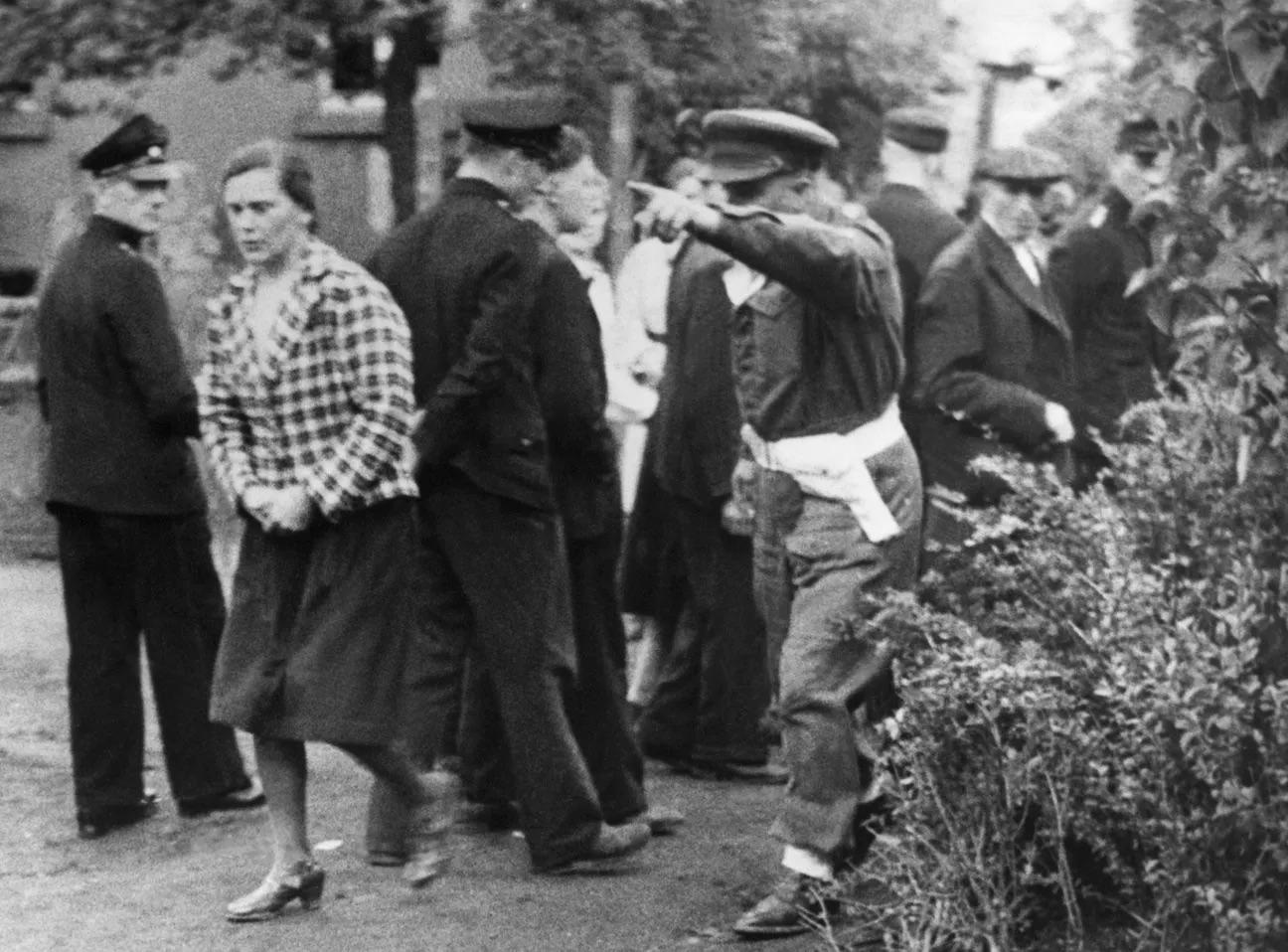
In the famous May 1945 photograph, a British soldier leans toward a German woman in a darkened cinema, finger raised. On the screen in front of them, unseen in the frame, are the bodies and survivors of Nazi concentration camps. She has just laughed. He is not amused.
The caption says she was ordered to watch the film again. That single moment, frozen in grainy black and white, raises a lot of questions. Why were Germans being shown these films? Were they really ignorant of the camps? Why did some laugh? And what did the Allies think this would achieve?
Here are five things that photo leaves out, and why they mattered for how Germany, and the world, came to terms with the Holocaust.
1. The Allies ran a systematic “forced viewing” campaign
What it is: From April 1945, Allied armies organized compulsory screenings of concentration camp footage for German civilians, party members, and POWs. This was not a one-off stunt. It was policy.
When American troops liberated camps like Buchenwald (April 11, 1945) and Dachau (April 29), they brought in camera crews. The U.S. Army Signal Corps and British units filmed piles of corpses, gas chambers, crematoria, and interviews with survivors. The raw material became short films like Nazi Concentration Camps, compiled under the supervision of directors such as George Stevens and later shaped by editors in London and Washington.
Commanders then ordered local populations to see what had been done in their name. In Weimar, General Dwight D. Eisenhower ordered 1,000 civilians to tour nearby Buchenwald. In towns across occupied Germany, mayors were told to send residents to the cinema. Tickets were not optional. In some places, Allied soldiers literally rounded people up in the street.
The British zone did the same. The woman in the Reddit photo was almost certainly in one of these British-run screenings in May 1945, when newsreel compilations like the British film German Concentration Camps Factual Survey were shown to stunned, and sometimes hostile, audiences.
These were not just newsreels. They were part of a deliberate effort to confront Germans with the physical evidence of mass murder and to undercut any future claims that “we did not know.”
So what? The forced viewings turned atrocity footage into an early tool of political re-education, shaping how postwar Germans, and later the world, would see the Holocaust.
2. Many Germans claimed ignorance, but the record is messy
What it is: After the war, millions of Germans insisted they had no idea what was happening in the camps. The truth is more complicated than total ignorance or total complicity.
The camps were not exactly hidden. Dachau opened in 1933. Buchenwald in 1937. They sat near major towns. Locals saw columns of prisoners marched through streets. They heard shots. They smelled the smoke. Railway workers shunted cattle cars packed with people to places like Auschwitz, Treblinka, and Sobibor.
At the same time, the full industrial scale and specific methods of extermination were not broadcast on the radio. The SS used euphemisms. Many Germans knew there were camps and that people suffered and died there. Far fewer grasped, or wanted to grasp, the organized mass murder of European Jewry.
When confronted in 1945, the standard line was: “We did not know.” In Weimar, some townspeople told U.S. reporters they thought Buchenwald was a labor camp. In British-occupied areas, civilians emerging from screenings often said the films were Allied propaganda or exaggerated. Some insisted the dead were victims of Allied bombing, not Nazi policy.
The woman laughing in the photo fits into that murky space. Was she laughing from disbelief, nervousness, contempt, or genuine ignorance? The image does not tell us. But her reaction, and the soldier’s anger, capture the clash between Allied certainty about Nazi crimes and German claims of not knowing.
Historians now talk less about “what Germans knew” and more about what they could have known, what they suspected, and what they chose not to ask about. Silence and willful blindness were part of the story.
So what? The gap between what Germans claimed and what the evidence shows shaped postwar debates about guilt, responsibility, and how to rebuild a society that had lived alongside mass murder.
3. Reactions in the cinemas ranged from tears to defiance
What it is: Not everyone in those darkened theaters reacted like the woman in the photo. Some wept. Some walked out. Some refused to believe what they were seeing. The emotional range was wide, and it mattered.
American officers reported that in some towns, older women sobbed openly during screenings. In others, people sat in stony silence. A U.S. psychological report from 1945 noted that many viewers expressed “shock and dismay,” but also “resentment at being forced to watch.”
In the British zone, observers saw similar patterns. Some Germans reportedly shouted that the films were faked. Others muttered that the Allies were hypocrites, pointing to the firebombing of Hamburg or Dresden. There were cases of nervous laughter, like the woman in the photo, which Allied soldiers often interpreted as callousness or denial.
One concrete example: in the town of Hildesheim, British authorities screened camp footage for local Nazi Party members. According to reports, several tried to leave and were forced back into their seats. Afterward, some claimed the victims on screen were criminals who “deserved it.” Others were visibly shaken and later admitted they had been misled.
The Allies paid close attention to these reactions. The U.S. Army’s Information Control Division and British intelligence officers wrote up detailed notes. They were trying to gauge whether Germans felt guilt, shame, anger, or nothing at all, and to adjust their re-education strategies accordingly.
The photo of the soldier scolding the laughing woman is striking because it captures this tension in a single frame. He wants contrition. She is not giving it, at least not yet. The fact that she was ordered to watch the film again shows how determined the Allies were to break through that resistance.
So what? The mixed reactions in those cinemas showed that confronting people with atrocity images did not automatically produce remorse, which forced the Allies to rethink how to change minds in defeated Germany.
4. The British and Americans disagreed on how hard to push guilt
What it is: The Allied powers were not united on how much to shame ordinary Germans. The British, Americans, Soviets, and French all used atrocity evidence, but with different goals and tones.
The U.S. military government initially leaned into a “collective guilt” approach. General Lucius Clay, deputy military governor, approved programs that hammered home German responsibility. American-produced newsreels like Death Mills (directed by Billy Wilder in 1945) were blunt. They told German audiences that the world saw them as complicit in murder.
The British approach in their zone, where the Reddit photo was taken, was similar at first but shifted faster. London worried that too much humiliation would make Germans resentful and more susceptible to communism. By 1946, British policy papers started to move from guilt to “democratic education,” focusing more on rebuilding institutions than on repeated shock tactics.
The Soviets, for their part, used Nazi crimes as proof of fascist evil and justification for harsh reparations and political purges, but they were less interested in nuanced moral reflection. French authorities were somewhere in between, using atrocity material to justify territorial and economic demands.
This mattered on the ground. A German watching camp films in Hamburg under British control might get a slightly different narrative than someone in Munich under U.S. control. The British soldier in the photo, scolding the woman and making her rewatch the film, reflects the early, harder edge of British policy before it softened.
By the late 1940s, both Britain and the U.S. had largely abandoned the idea that you could rebuild Germany by keeping its people in a permanent state of shame. The Cold War and the need for West Germany as an ally pushed them toward reconciliation.
So what? The shifting Allied strategies around guilt and re-education shaped how quickly West Germany was brought back into the Western camp and how the Holocaust was framed in early postwar memory.
5. Those 1945 films helped define how the Holocaust is remembered
What it is: The footage shot in 1945 for German audiences did not stay in Germany. It became the visual foundation of how the world imagines Nazi camps and, later, the Holocaust itself.
The U.S. film Nazi Concentration Camps was shown at the Nuremberg Trials in November 1945 as evidence. Judges, lawyers, and defendants watched the same images that German civilians had seen in their local cinemas. The film entered the trial record and has been reused in documentaries ever since.
The British project German Concentration Camps Factual Survey, overseen by Sidney Bernstein with input from Alfred Hitchcock, was meant to be the definitive record. It used careful editing, maps, and narration to argue that the camps were part of a system, not random brutality. The project was shelved in 1945 for political reasons, then reconstructed and released decades later as Night Will Fall.
These films fixed certain images in public memory: bulldozers pushing bodies into mass graves at Bergen-Belsen, skeletal survivors behind barbed wire, heaps of shoes and hair. When people today picture “concentration camps,” they are often seeing, in their mind’s eye, frames first captured for those 1945 screenings.
The Reddit photo is part of that same story. It is not a camp image. It is an image of someone being forced to look at camp images. It shows the second layer of memory: not just what happened, but how people were made to confront what happened.
Over time, German society moved from resentment and denial to a more sustained reckoning. By the 1960s and 1970s, West German courts were trying former camp guards, and television series like Holocaust (aired in West Germany in 1979) sparked new waves of discussion. The early Allied films, and the memory of being made to watch them, were part of that long arc.
So what? The 1945 camp films, and the forced screenings captured in photos like this one, helped create the visual and moral framework through which later generations understand the Holocaust.
The British soldier and the laughing woman shared a dark room and a screen full of horrors. He came as a victor, armed with images meant to indict a nation. She came as a subject of a defeated regime, caught between whatever she had known, what she was seeing, and what she was willing to admit.
The photo freezes them in that moment of confrontation. Behind it lies a larger story about how you make people face a crime so large it defies belief, and what happens when you try to use film to change a country’s conscience.
Frequently Asked Questions
Did ordinary Germans know about the concentration camps during WWII?
Many Germans knew that concentration camps existed and that people suffered and died there, especially at places like Dachau and Buchenwald near major towns. Fewer understood the full scale and systematic nature of the mass murder of Jews and other groups. Historians argue that while detailed knowledge varied, there was widespread awareness that severe abuses were taking place.
Why did the Allies force Germans to watch concentration camp films in 1945?
Allied authorities wanted to confront Germans with direct evidence of Nazi crimes and prevent future claims of ignorance. Compulsory screenings of films like “Nazi Concentration Camps” were part of broader re-education policies aimed at breaking Nazi ideology, establishing the truth about the camps, and laying a moral foundation for postwar reconstruction.
What film was shown at the Nuremberg Trials about Nazi camps?
The film “Nazi Concentration Camps,” compiled from footage shot by U.S. Army Signal Corps cameramen at liberated camps, was shown at the Nuremberg Trials in November 1945. It documented conditions at camps such as Buchenwald, Dachau, and Mauthausen and was entered into evidence to demonstrate the scale of Nazi atrocities.
Is the famous photo of a British soldier scolding a German woman real?
Yes. The photograph, taken in May 1945 in the British occupation zone, shows a British soldier reprimanding a German civilian who reportedly laughed during a screening of concentration camp footage. She was ordered to watch the film again. The image is widely reproduced as an example of Allied efforts to confront Germans with evidence of Nazi crimes.