In 1943, a 15-year-old girl from the United States could fold herself in half, spring across a mat in a blur of cartwheels and handsprings, then smile like it was nothing. Her name was Bonnie Nebelong. She became a national tumbling champion, a contortionist, and a minor media star, turning up in Life Magazine and Ripley’s Believe It or Not.
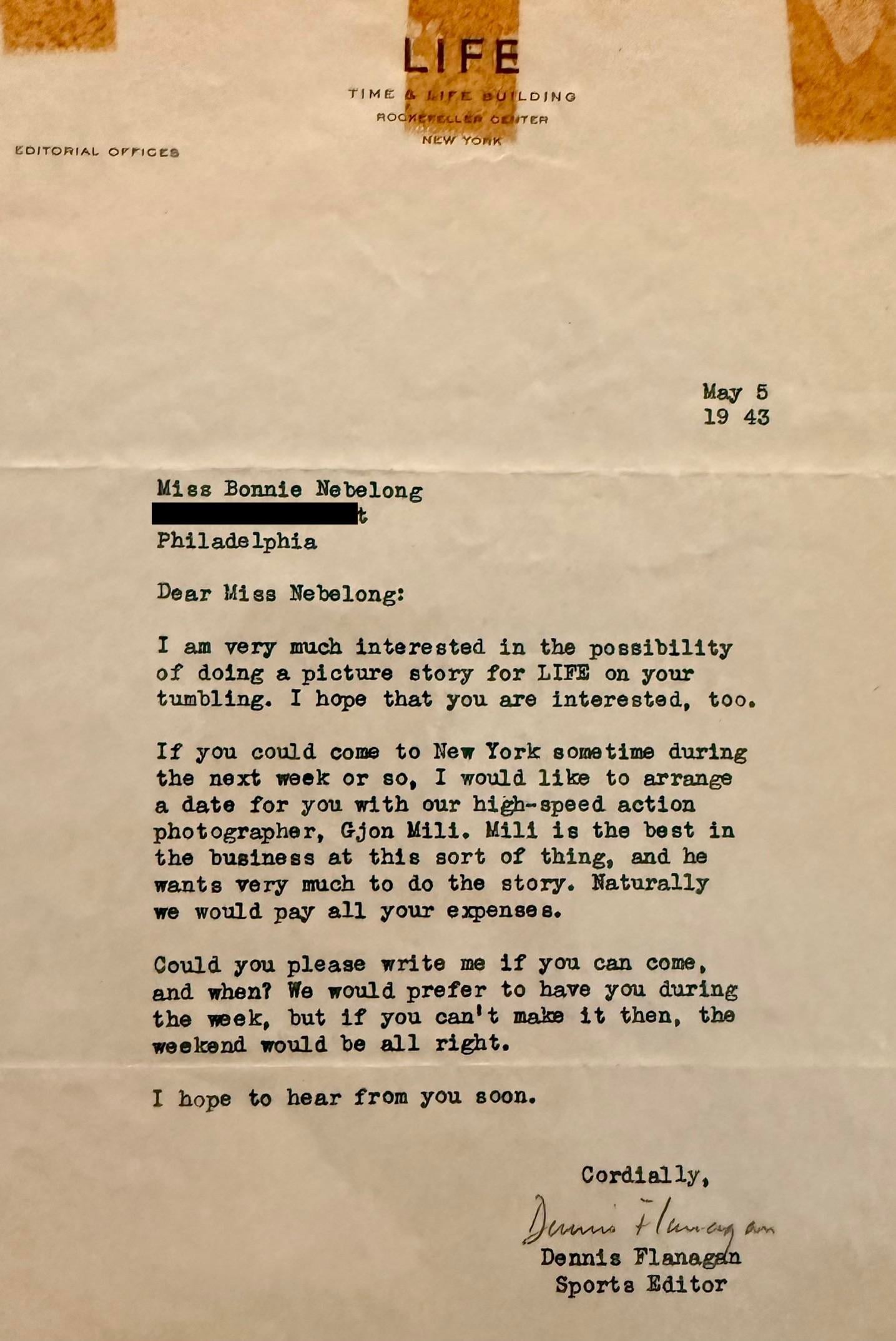
She also belonged to a lost Olympic generation. Had World War II not wiped out the 1940 and 1944 Olympic Games, her family says she would have gone to the Olympics. Instead, her peak years lined up perfectly with the years the world shut sports down.
This is a counterfactual story, but not a fantasy. The question is simple: if World War II had not canceled the Olympics, what might Bonnie Nebelong’s athletic life, and women’s acrobatics in general, have looked like? By the end, we will have three grounded scenarios and a hard look at which one history makes most likely.
Who was Bonnie Nebelong, and what did she actually achieve?
Start with what we know. According to her granddaughter’s account, Bonnie Nebelong won a national championship in tumbling in 1943 at age 15. She did contortion work, performed for audiences, and drew enough attention to land in Life Magazine and Ripley’s Believe It or Not, two of the biggest mass-media spotlights of mid-century America.
That combination tells us a lot. National tumbling champion means she was competing in a structured, judged event, not just a local fair. Life Magazine and Ripley’s usually found people who were both visually striking and technically unusual. A teenage girl who could out-tumble most adults and twist her body into improbable shapes fit the bill perfectly.
In the 1930s and 1940s, “tumbling” in the United States often sat halfway between sport and show business. It was part of physical education programs, AAU competitions, circus acts, and vaudeville-style variety shows. There was overlap with artistic gymnastics, but the events were not identical. Tumbling emphasized passes of flips and handsprings in a straight line on the floor, with less focus on apparatus like bars and beam.
So when her family says she “would’ve gone to the Olympics,” they are probably referring to her being at or near the top of a national talent pool in a discipline adjacent to women’s gymnastics. Given her age, 15 in 1943, she would have been 12 for the canceled 1940 Games and 16 for the canceled 1944 Games. In women’s gymnastics, those are prime developmental years.
The so what: understanding who Bonnie actually was and what sport she did keeps our what-if grounded in the real athletic structures of the 1940s, not in a modern idea of gymnastics.
Scenario 1: A 1944 Olympics gives Bonnie a shot at the podium
First scenario: World War II never happens, or at least never reaches the scale that cancels the 1940 and 1944 Olympics. The Games go ahead as planned, and Bonnie Nebelong, national tumbling champion, finds herself in the middle of a young but growing women’s gymnastics program.
In our world, the 1940 Olympics were supposed to be in Tokyo, then Helsinki. The 1944 Games were awarded to London. Without war, those plans hold. The United States, already a rising sports power, sends teams in track, swimming, and gymnastics. Women’s artistic gymnastics had been on the Olympic program since 1928, but it was still evolving. The format was mostly team-based, with group exercises and apparatus work. Floor exercise as we know it today was still forming.
Could a U.S. tumbling champion cross over into Olympic gymnastics? Yes, with caveats. Tumbling skill translates well to floor exercise and vault. The strength, air awareness, and showmanship are the same. What Bonnie would need is training on uneven bars and balance beam, plus familiarity with the group routines that were common for women at the time.
By 1943, she was already a national champion in a related discipline, which suggests she had access to coaching, facilities, and competition circuits. If the U.S. women’s gymnastics program had been actively recruiting the best acrobatic talent, someone like Bonnie would have been on their radar. The fact that she attracted national media attention supports that idea. Selectors read Life Magazine too.
Now the hard part: medals. In the pre-war and early post-war era, European teams, especially from Czechoslovakia, Hungary, and later the Soviet Union, dominated women’s gymnastics. The United States was not yet a powerhouse. Even with a prodigy, the odds of an American woman winning all-around gold in 1944 are slim.
But medals in specific apparatus or strong performances in team events are more plausible. A 16-year-old Bonnie, with elite tumbling, could have been one of the best floor workers in the world. Judges in that era valued grace and synchronization, but acrobatic difficulty was already impressive. A routine that blended contortion flexibility with tumbling passes would have stood out.
So picture it: London 1944. The women’s team event includes a floor segment. The American team is not favored, but one of their youngest members draws attention. She whips through passes that look more like circus than school gymnastics, then folds into contortion poses that make photographers reach for their cameras. The U.S. might finish off the podium as a team, but Bonnie’s routine becomes a talking point and a photo spread.
In this scenario, she probably does not rewrite the medal table. What she does is become an early symbol of American acrobatics on the Olympic stage, a kind of pre-Nadia figure whose style hints at where the sport will go.
The so what: if the 1944 Olympics had happened, Bonnie’s most likely impact would be to put American women’s acrobatics on the international map a decade or two earlier than it actually happened.
Scenario 2: A pro show-business path, even with an Olympic run
Second scenario: The Olympics happen, Bonnie goes, maybe even medals, but her main career still runs through show business, not sport. This one leans heavily on economics and gender norms of the 1940s.
In that era, there was no real professional path in women’s gymnastics. No endorsement deals, no NCAA scholarships as we know them, no pro leagues. Even the concept of an “amateur ideal” made it hard for Olympic athletes to earn money from their skills without risking their eligibility.
By contrast, there was money, or at least steady work, in performance. Circus troupes. Traveling shows. Nightclub revues. Vaudeville-style acts that survived into the 1940s. Hollywood musicals sometimes hired acrobats and contortionists for specialty numbers. A young woman who had already been in Life Magazine and Ripley’s Believe It or Not had a calling card for that world.
Even without war, the United States in the 1940s was still conservative about women’s long-term athletic careers. Many female athletes retired young to marry, work, or both. A girl like Bonnie, from an ordinary family, would have to weigh the chance to earn money performing against the unpaid prestige of staying in amateur sport.
So in this scenario, the Olympics become a springboard, not a destination. She competes in 1944, maybe 1948, gains a bit of fame, then signs with a circus or a touring acrobatic troupe. Her Olympic label becomes part of the billing: “Olympic gymnast and contortionist.”
This path fits neatly with what we know she actually did. In our real timeline, without Olympic opportunities, she still ended up in the media as a contortionist and tumbling star. That suggests she and her family were willing to embrace the performance side of her talent.
Historically, plenty of athletes straddled this line. American swimmers and divers did water shows. Skaters joined ice revues. Gymnasts and acrobats went to circuses. The Olympics were not yet the all-consuming, lifetime identity they would become in the late twentieth century.
So what changes if the Games are not canceled? Her resume gets a line or two longer. She might have had a bigger name in the 1940s entertainment circuit. She might have toured Europe with a “former Olympian” tag, which played well in posters and newspaper ads.
The so what: even with an Olympic shot restored, the economics of women’s sport in the 1940s make it likely that Bonnie’s main career would still run through stages and arenas, not through extended Olympic dominance.
Scenario 3: A different women’s sport system reshapes her life
Third scenario: No World War II, and the absence of total war spending changes how the United States builds its sports system. This is the widest-angle what-if, because wars do not just cancel events. They reshape institutions.
World War II poured money into the U.S. military, which in turn poured energy into mass physical training. Men’s sports, especially football and boxing, benefited from this. After the war, the GI Bill and booming colleges helped build the modern American sports-industrial complex. Women’s sports, by contrast, lagged, hemmed in by social norms and lack of investment until the 1970s.
If there is no global war, or a much smaller one, the U.S. might not build the same military-centered physical culture. Instead, more of that energy could have gone into school-based and community-based sports earlier. That could cut both ways for someone like Bonnie.
On one hand, a stronger pre-war school sports system for girls might have given her better coaching, safer facilities, and a clearer path from local talent to national team. She might have had a defined ladder: local meets, state championships, national trials, Olympic team. That structure did exist in bits and pieces, but war disrupted travel, funding, and attention.
On the other hand, without the shared trauma and rebuilding narrative of the post-war Olympics, the Games might not have become such a powerful symbol. The 1948 London Olympics in our world were called the “Austerity Games” and were soaked in stories of resilience. That helped cement the Olympics as a global stage worth sacrificing for.
In a world where the 1940 and 1944 Games go ahead quietly, the Olympics might feel more like just another big meet. Less myth, more routine. That could make them matter less in a young athlete’s life choices. A girl might see more long-term value in a teaching degree or a steady job than in chasing a second or third Olympic cycle.
There is also a gender twist. War work pulled many women into factories and public life. That experience, plus their role in keeping sports and schools running, fed into later arguments for women’s rights, including Title IX. Without that, the timeline for serious investment in women’s athletics might shift.
So in this scenario, Bonnie grows up in a slightly more organized but less emotionally charged sports system. She still becomes a national tumbling champion. She might still reach an Olympic team. But the cultural weight of that achievement is lighter, and the long-term institutional support for women’s sport might arrive later, not sooner.
The so what: changing the war changes the entire ecosystem of sport, and in a quieter Olympic world, Bonnie’s path might be more stable but less historically visible.
Which scenario fits the real Bonnie Nebelong best?
So which of these futures lines up most closely with the scraps of real history we have? The strongest clues are her age, her 1943 title, and her media profile.
Age first. At 15 in 1943, she was in peak developmental years for women’s gymnastics. In a world with a 1944 Olympics, she would have been an obvious candidate for trials, especially if U.S. selectors were hungry for acrobatic talent. That makes Scenario 1, at least the part where she reaches the Olympic stage, quite plausible.
Next, the 1943 national tumbling championship. That year was deep in wartime. Travel restrictions, rationing, and the draft all squeezed sports schedules. The fact that a national tumbling championship happened at all, and that she could win it, suggests she was competing in a serious, organized circuit under difficult conditions. In a non-war world, that circuit would have been easier to run and probably better funded. That strengthens the idea that she could have been tracked into an Olympic program.
Then there is her media presence. Life Magazine and Ripley’s Believe It or Not did not usually chase anonymous school champions. They wanted spectacle, novelty, and a good photo. A teen girl who could contort and tumble like a circus pro fit that bill. That leans us toward Scenario 2: whatever her sporting opportunities, she was already positioned as a performer.
Historically, when you combine high-level acrobatic skill, a photogenic act, and a lack of long-term professional sport options, the show-business path wins. Even in countries with stronger state sports systems, like the Soviet Union later on, retired gymnasts often ended up in circuses and shows. In 1940s America, with no state support and few coaching jobs for women, the pull toward performance would be even stronger.
Scenario 3, the big structural shift, is the least certain because it depends on how a non-war United States would have chosen to spend its money and shape its schools. That is hard to model. What we can say is that the war’s cancellation of the Olympics clearly robbed athletes like Bonnie of a specific stage. Whether it also sped up or slowed down broader investment in women’s sport is more debatable.
So the most grounded composite answer looks like this: in a world without World War II canceling the Games, Bonnie Nebelong probably makes a U.S. Olympic team in 1944 as a young, acrobatically gifted gymnast. She turns heads with her tumbling, maybe helps the U.S. to a respectable finish, and gets a few more magazine spreads. Then, like many women of her era, she channels that fame into a career in performance, not in a long-term sporting system that barely exists for her.
The so what: the Bonnie Nebelong story, real and imagined, shows how war, gender norms, and the thin infrastructure of women’s sport could take a world-class talent and steer her away from the kind of Olympic legacy we now take for granted, even when the ability was clearly there.
Why this lost Olympic story still matters
Bonnie Nebelong is not a household name. She is a set of black-and-white photos on Reddit, a family memory, and a reminder that history is full of athletes whose best years collided with events far beyond their control.
When people say she “would’ve gone to the Olympics,” they are not just bragging. They are pointing to a real gap in the record. The canceled 1940 and 1944 Games erased an entire cohort of athletes from the Olympic story. Many, like Bonnie, found other outlets. Some never got another chance.
Her case also pushes back against a modern myth: that talent always finds its stage. In the 1940s, a girl could be the best tumbler in the country and still have no clear path to long-term support, coaching careers, or sustained competition. The Olympics, when they happened, were brief flashes, not lifelong platforms.
Today, when teenage gymnasts become global celebrities overnight, it is easy to forget how new that system is. The what-if around Bonnie Nebelong is not just about one missed Games. It is about how fragile athletic opportunity used to be, and how much of it still depends on timing, politics, and luck.
That is why those old photos hit a nerve online. People are not just looking at a flexible teenager from the 1940s. They are looking at a fork in history, and at all the medals, routines, and careers that might have been if the world had not gone to war right when she was ready to fly.
Frequently Asked Questions
Who was Bonnie Nebelong, the 1940s tumbling champion?
Bonnie Nebelong was an American tumbling champion and contortionist who, according to her family, won a national tumbling title in 1943 at age 15. She appeared in Life Magazine and Ripley’s Believe It or Not, and was considered good enough that she likely would have been in contention for an Olympic spot if the 1940 and 1944 Games had not been canceled by World War II.
Was tumbling an Olympic sport in the 1940s?
Tumbling as a separate event was not on the women’s Olympic program in the 1940s. However, tumbling skills were central to women’s floor exercise and vault in artistic gymnastics. A national-level tumbler like Bonnie Nebelong would have had a realistic path into Olympic gymnastics with additional training on apparatus such as the balance beam and uneven bars.
How did World War II affect the Olympics and athletes like Bonnie Nebelong?
World War II led to the cancellation of the 1940 and 1944 Olympic Games, erasing a key opportunity for athletes whose peak years fell in that window. For someone like Bonnie Nebelong, who was 12 in 1940 and 16 in 1944, the war likely removed her best chance to compete on an Olympic stage, forcing her to focus on national competitions and performance work instead.
Could Bonnie Nebelong realistically have been an Olympic medalist?
Given the strength of European women’s gymnastics in the 1940s, it is unlikely that an American like Bonnie Nebelong would have dominated the all-around. However, her elite tumbling and contortion skills could have made her one of the more eye-catching floor performers, and possibly a contender for strong apparatus scores, especially if the U.S. program had integrated tumblers into its gymnastics team.