On the evening of 9 November 1938, Berlin burned.
Synagogues were smashed, Jewish shops wrecked, men dragged into the streets. The next night, in a Catholic church near the city center, a priest walked to the pulpit and did something almost no public figure in Nazi Germany dared to do.
He asked his congregation to pray for the Jews.
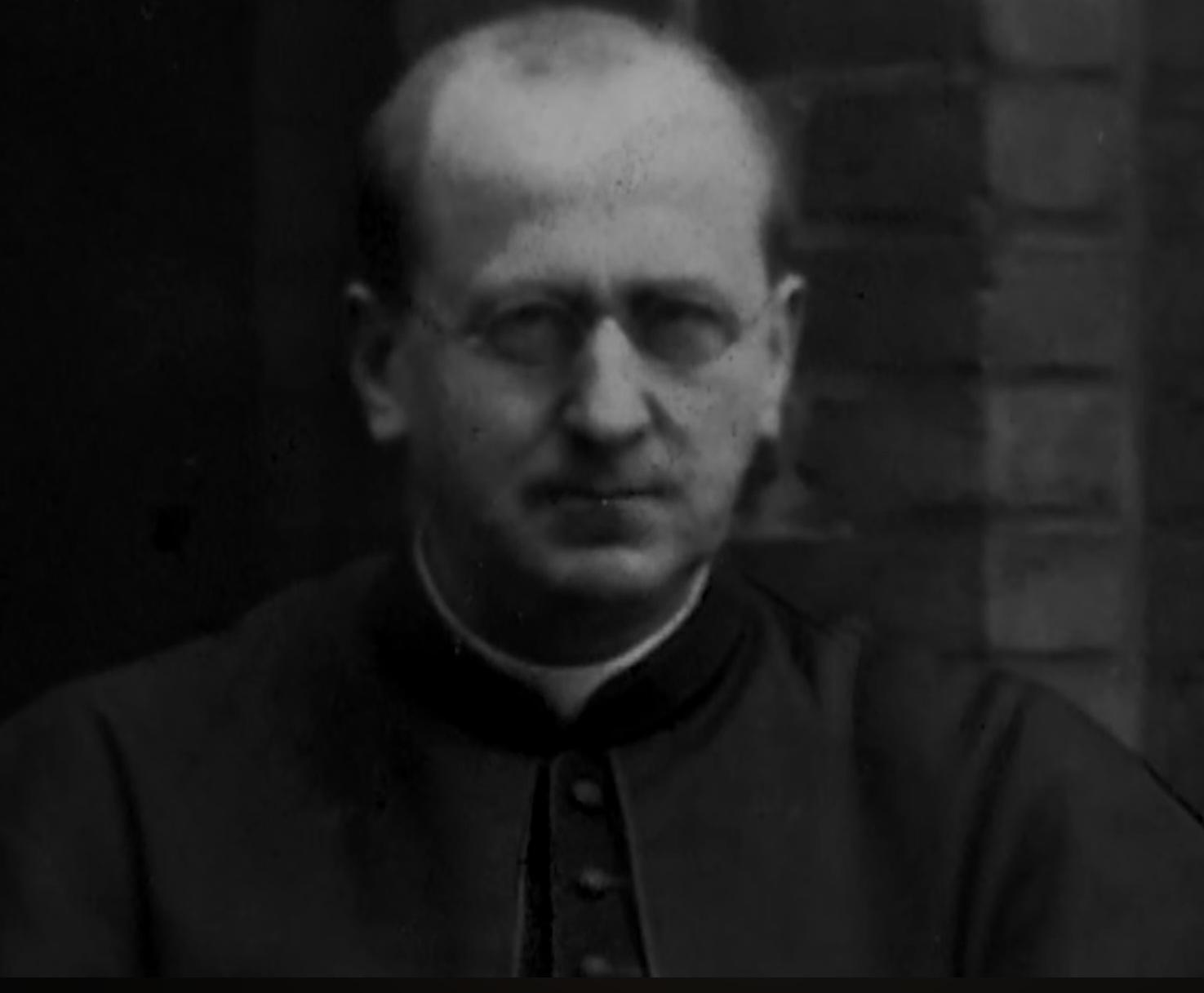
His name was Bernhard Lichtenberg, a Catholic priest and cathedral provost in Berlin. For years he used the most public place he had, the pulpit of St Hedwig’s Cathedral, to condemn Nazi racism and to intercede for those the regime wanted erased. Some of his own parishioners informed on him to the Gestapo. He died in 1943 on the way to the Dachau concentration camp.
Bernhard Lichtenberg was not the only German who helped Jews. But he was one of the very few public religious figures who did so openly, by name, week after week, in the capital of the Third Reich. His story shows how rare open resistance was, why most churches stayed quiet, and what it cost to break that silence.
Who was Bernhard Lichtenberg before Hitler?
Bernhard Lichtenberg was born on 3 December 1875 in Ohlau, in Silesia (then part of the German Empire, today Oława in Poland). He grew up in a Catholic family in a largely Protestant country. That minority status mattered. German Catholics had long experience of being treated with suspicion by the state.
He studied theology and was ordained a priest in 1899. By the early 20th century he was serving in Berlin, a fast-growing, rough-edged metropolis. He gained a reputation as a pastor who cared about the poor, the sick, and prisoners. He visited hospitals and jails, organized charity, and tried to keep politics out of the pulpit.
Like many Germans, he lived through the trauma of World War I, the collapse of the Kaiser’s empire, and the chaos of the Weimar Republic. Street violence, inflation, and political extremism were part of his daily environment. He saw how quickly a modern society could unravel.
By the time Hitler came to power in 1933, Lichtenberg was an experienced priest in his late fifties, not a young radical. He was shaped by Catholic social teaching, loyalty to Rome, and a sense that the Church should defend the weak but avoid party politics.
That background matters because it explains why, when Nazism turned from rhetoric to persecution, he interpreted it not just as a political problem but as a direct assault on Christian ethics. His earlier work with the marginalized prepared him to see Jews, the disabled, and prisoners as people he was bound to defend, not as outsiders he could ignore. So from the start of Nazi rule, he was primed to react.
Why did Lichtenberg confront Nazism when most clergy stayed quiet?
When Hitler took power in January 1933, many German Christians welcomed him. They hoped he would restore order and fight communism. The Catholic hierarchy, wary but pragmatic, negotiated the Reichskonkordat with the Nazi state in July 1933, a treaty meant to protect Church rights in exchange for political non-interference.
On paper, that looked like a deal. In practice, it gave the regime breathing room while it dismantled democracy. Many bishops decided that open confrontation would only make things worse. Their priority became protecting Church institutions, schools, and charities.
Lichtenberg thought differently. In 1932 he had already joined a Catholic group opposed to Nazism. After 1933 he watched as Jewish neighbors were boycotted, political opponents arrested, and propaganda filled the streets. He saw that Nazi ideology was not just another party program. It was a racial creed that rejected the basic Christian idea that all humans share equal dignity.
He began to speak out in small ways. In 1934 he protested Nazi attacks on Catholic youth groups. He wrote letters to authorities about abuses. By 1935 he was appointed provost of St Hedwig’s Cathedral, the main Catholic church in central Berlin. That gave him a larger platform, and he used it.
He started to criticize Nazi policies from the pulpit, especially the cult of race and the suppression of religious freedom. He read out pastoral letters from the bishops that condemned aspects of Nazism. When the Vatican issued the 1937 encyclical “Mit brennender Sorge,” which denounced Nazi racism and breaches of the concordat, he had it read publicly.
Most clergy tried to walk a line: condemn specific abuses, avoid direct confrontation, and keep their institutions alive. Lichtenberg moved steadily toward open moral opposition. For him, silence meant complicity. That choice set him on a collision course with the regime and with more cautious colleagues.
His early decision to treat Nazism as a moral heresy, not just a political problem, pushed him from quiet disapproval into public resistance, which made him one of the few churchmen the Gestapo watched closely.
What happened on Kristallnacht and why did he pray for the Jews?
The turning point came with Kristallnacht, the nationwide pogrom of 9–10 November 1938. Synagogues were burned, Jewish businesses smashed, around 30,000 Jewish men arrested. In Berlin, flames and broken glass were impossible to miss.
The next evening, 10 November, Lichtenberg went to the pulpit of St Hedwig’s. According to later testimony, he said to his congregation something close to this: “What took place yesterday, we know. What will happen tomorrow, we do not know. But what is happening today, we have experienced. Outside, the synagogue is burning. That too is a house of God.”
He then led the congregation in prayer “for the poor non-Aryan Catholics and the Jews.”
In Nazi Germany, this was not a small gesture. Publicly naming Jews as people worthy of Christian prayer was a direct challenge to the regime’s racial ideology. It also cut against the grain of widespread antisemitism, which existed in German society long before Hitler.
From that day on, Lichtenberg prayed for Jews, prisoners, and other victims in the general intercessions at evening services. He did this in Berlin, under the eyes of the Gestapo, in a cathedral where party members and informers could easily sit in the pews.
He did not limit his concern to baptized “non-Aryan” Catholics, which would have been safer. He explicitly included Jews as Jews. That mattered. Many Christian leaders were willing to defend converts or Church rights. Far fewer were willing to say that the persecution of Jews as such was a moral crime.
By turning the liturgy itself into a weekly act of protest, Lichtenberg turned ordinary worship into a public indictment of Nazi policy, which made his church a rare space where the regime’s racial project was named as evil.
Did his own congregation really inform on him to the Gestapo?
The Reddit claim that “they informed on him to the Gestapo” captures a painful truth, but it needs nuance.
We know from Gestapo records that Lichtenberg was denounced several times. Some reports came from people who heard his prayers or sermons. In Nazi Germany, the secret police relied heavily on ordinary citizens to report “defeatist” or “subversive” remarks. Churches were not exempt.
Were these informers regular parishioners? Some likely were. Berlin Catholics were not a heroic minority immune to Nazi ideas. Some supported the regime. Some were antisemitic. Some were simply afraid and thought reporting a priest might protect themselves.
We also know that others in his flock admired him. Parishioners later recalled his courage. Some tried to shield him. The Catholic hierarchy in Berlin did not remove him, even though his actions created tension with the state. So the picture is mixed: a congregation divided, with some quietly supportive, some silent, some hostile.
What is clear is that the Gestapo opened a file on him, attended his services, and collected denunciations. By 1941 he was on their radar as a repeat offender. His own pulpit had become a monitored space.
The fact that a priest could be betrayed from within his own church shows how deeply Nazi norms had penetrated everyday life, turning even worship spaces into arenas of surveillance and fear.
Why was Lichtenberg arrested and how did he die?
Lichtenberg’s arrest came not directly from the Kristallnacht prayers but from his continued defiance as the war and the Holocaust escalated.
In 1941 the regime launched the mass killing of the disabled and mentally ill, known as the “euthanasia” program (Aktion T4). Rumors of gas chambers in asylums reached church circles. The Protestant bishop Clemens August von Galen famously preached against it in Münster. Lichtenberg reacted in his own way.
He wrote a letter to the head of the Reich Chancellery, Hans Heinrich Lammers, protesting the killings. He called the program murder and a violation of God’s law. He also continued to pray publicly for Jews and other persecuted groups.
On 23 October 1941, the Gestapo arrested him. The charges included “abuse of the pulpit” and “subversive activity.” In May 1942 a court sentenced him to two years in prison. He was held in Berlin’s Tegel prison, where he continued to pray and minister to fellow inmates.
When his sentence ended in October 1943, the Gestapo did not release him. Instead they ordered him transferred to Dachau concentration camp, where many clergy were held. By then he was 67 and in poor health. The transport conditions were brutal. He fell gravely ill on the way and died on 5 November 1943 in Hof, Bavaria, before reaching the camp.
His body was returned to Berlin and buried in the crypt of St Hedwig’s Cathedral. After the war, he was remembered as a martyr. The Catholic Church beatified him in 1996.
His death on the way to Dachau shows how the Nazi state treated even elderly clergy who refused to bend: prison, camp, and neglect, with death as an acceptable outcome.
Was he really the only public figure in Nazi Germany to help Jews?
The Reddit title overstates the case. Bernhard Lichtenberg was not the only public figure in Nazi Germany who helped Jews or spoke on their behalf. But he was among a very small number who did so openly, repeatedly, and from a prominent pulpit in Berlin.
Other examples exist. The Protestant pastor Dietrich Bonhoeffer joined resistance circles and was involved in efforts to aid Jews, though much of his work was clandestine. The Catholic bishop Konrad von Preysing of Berlin supported Jewish converts and criticized Nazi policies, mostly in private or coded ways. Individual officials and diplomats, such as Georg Ferdinand Duckwitz or Oskar Schindler, helped Jews through bureaucratic maneuvers rather than public speeches.
What made Lichtenberg unusual was the combination of three factors:
First, he acted in public. His prayers were spoken aloud in a central cathedral, not just in private letters or secret meetings.
Second, he named Jews explicitly, not only “non-Aryan Christians.” Many church leaders limited their concern to baptized Jews. Lichtenberg did not draw that line.
Third, he did this consistently over years, in the capital, under Gestapo observation, and accepted imprisonment rather than stop.
So the fairer claim is this: Bernhard Lichtenberg was one of the very few public religious figures in Nazi Germany who openly and regularly prayed for Jews as Jews and condemned Nazi racial policy, and he paid for it with his life.
Recognizing both his uniqueness and the existence of other resisters helps avoid turning the story into a simple tale of one hero in a nation of villains, and instead shows how rare, risky, and costly open opposition really was.
How is Lichtenberg remembered and why does his story still matter?
After 1945, Germany struggled with the question of church complicity in Nazism. Many Catholics and Protestants had gone along, some had resisted, most had tried to keep their heads down. Figures like Lichtenberg became points of reference in that debate.
In 1965, Yad Vashem in Jerusalem recognized Bernhard Lichtenberg as Righteous Among the Nations, an honor given to non-Jews who risked their lives to save Jews. The Catholic Church beatified him as a martyr in 1996, acknowledging that he died because he opposed Nazi crimes rooted in hatred of Jews and the disabled.
In Berlin, streets and schools bear his name. His grave in St Hedwig’s Cathedral is a site of remembrance. For German Catholics, his story is often held up as an example of what the Church could have done more broadly but mostly did not.
His case also complicates easy narratives. He was not a political revolutionary. He did not organize armed resistance or rescue networks on the scale of some others. His main weapon was public prayer and moral speech. That sounds modest, but in a dictatorship built on total control of public language, it was dangerous.
His story matters for a few reasons.
It shows that even in a tightly controlled regime, there was some space for public dissent, but using that space carried real risk. The fact that so few did so tells us something about fear, conformity, and the temptation to protect institutions over people.
It reminds us that persecution rarely happens without the cooperation of ordinary bystanders. The fact that some parishioners informed on him is not an odd detail. It is part of how terror systems work: they rely on neighbors, colleagues, and fellow worshippers to police one another.
And it offers a specific example of what moral resistance looked like in practice: not grand speeches in safety decades later, but a man in his sixties, in a city under dictatorship, standing in front of his congregation and saying that the burning synagogue outside was also a house of God.
Bernhard Lichtenberg did not stop the Holocaust. He did not save thousands. What he did do was refuse to let Nazi ideology define who counted as a human being worth praying for. In a regime built on dehumanization, that refusal was enough to get him killed, and enough to make his name worth remembering.
Frequently Asked Questions
Who was Father Bernhard Lichtenberg?
Father Bernhard Lichtenberg was a German Catholic priest and provost of St Hedwig’s Cathedral in Berlin who openly opposed Nazi racial policies. From 1938 onward he regularly prayed in public for Jews and other persecuted groups, was arrested in 1941, and died in 1943 on the way to Dachau concentration camp.
Did Bernhard Lichtenberg really pray for Jews in Nazi Germany?
Yes. After Kristallnacht in November 1938, Bernhard Lichtenberg began including Jews in the public prayers of St Hedwig’s Cathedral in Berlin. He referred to the burning synagogue as a house of God and continued to pray for Jews and other victims in his evening services, which brought him under Gestapo surveillance.
Why was Father Lichtenberg arrested by the Gestapo?
Lichtenberg was arrested by the Gestapo in October 1941 for “abuse of the pulpit” and “subversive activity.” He had publicly prayed for Jews, criticized Nazi racial ideology, and written a protest letter against the killing of the disabled in the regime’s “euthanasia” program. He was sentenced to two years in prison and then ordered sent to Dachau.
Was Bernhard Lichtenberg the only public figure in Nazi Germany who helped Jews?
No. He was not the only public figure who helped Jews, but he was one of very few religious leaders who did so openly and consistently from a prominent pulpit. Others, like Dietrich Bonhoeffer or certain bishops and officials, also opposed aspects of Nazi policy or aided Jews, but much of their work was clandestine or focused on baptized Jews rather than Jews as such.