They look similar because they are trying to solve the same problem, a century apart. A narrow platform, two wheels in line, a vertical stem to hold onto, and a motor that saves your legs. In a colorized photo from around 1918, an American couple rides an Autoped scooter through an Edwardian street. Swap their clothes for hoodies and backpacks and you would swear you were looking at a modern electric scooter ad.
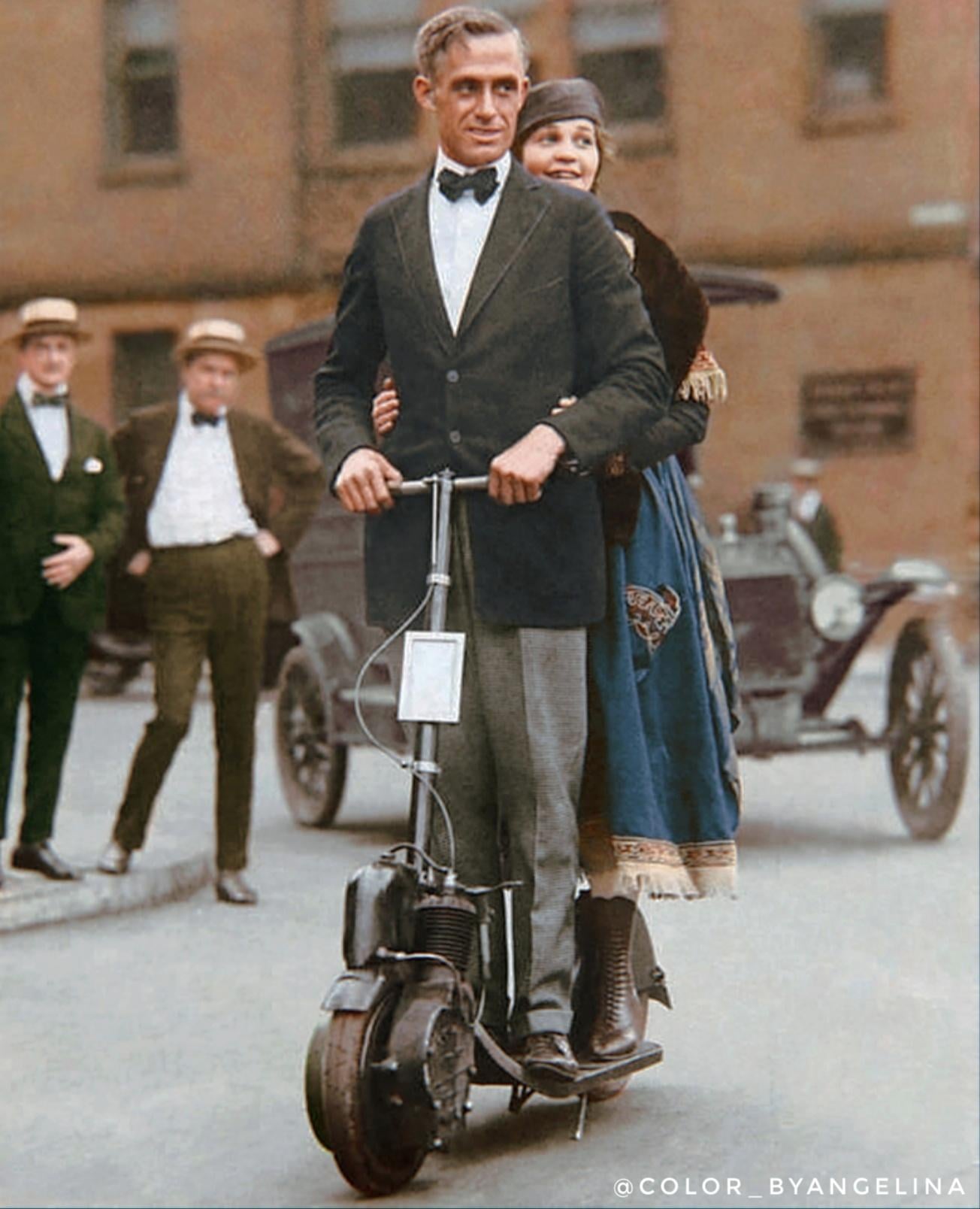
The Autoped was an early 20th‑century motorized scooter, sold from about 1915 to the early 1920s. Most were gasoline powered, though an electric version existed. Modern electric scooters, the kind filling bike lanes and rental racks since the 2010s, are its direct spiritual descendants. Both tried to make short urban trips faster, cheaper, and a bit more fun. Only one survived.
By the end of this story, the family resemblance between the Autoped and the e‑scooter will be obvious: same idea, different world. The comparison runs through their origins, how they worked, what they actually did in daily life, and what they left behind.
Where did the Autoped and modern e‑scooter come from?
The Autoped was born in New York in the middle of World War I. The Autoped Company of America filed patents in 1913 and began production around 1915, building a compact, stand‑up motor scooter with a 4‑stroke gasoline engine mounted over the front wheel. The company marketed it as a personal commuter machine for the modern city dweller.
Ads showed businessmen in suits, women in long skirts, even postal workers gliding through traffic. The message was clear: this was not a toy. It was a serious, if slightly daring, way to get to work without a horse, car, or streetcar. In a world where cars were still expensive and streets were clogged with carriages and trolleys, the Autoped promised autonomy.
There was also an electric Autoped. It replaced the petrol engine with an electric motor and battery pack, targeting quieter operation and less maintenance. Surviving examples and period references confirm it existed, but it never sold in large numbers. Early 20th‑century batteries were heavy, low‑capacity, and slow to charge. The technology was there in theory, not quite in practice.
Modern electric scooters emerged from a very different environment. By the late 1990s, battery tech had improved enough for kids’ electric kick scooters, but the real shift came with lithium‑ion batteries and cheap brushless motors in the 2000s and 2010s. Chinese manufacturers began mass‑producing sturdy adult‑sized e‑scooters. Startups like Bird and Lime then dropped thousands of them into cities around 2017–2018.
Those companies did something the Autoped never could. They combined a cheap, rechargeable scooter with smartphones, GPS, and mobile payments. Suddenly, you did not have to buy a scooter. You could rent one for a few minutes, unlock it with an app, and leave it almost anywhere. The scooter was no longer a product, it was a service.
So what? The Autoped came from an era of early motorization and tried to be a small personal vehicle, while modern e‑scooters came from the smartphone era and became part of a shared mobility system. That difference in origin shaped who used them and how long they lasted.
How did the Autoped actually work compared to an e‑scooter?
On the surface, the Autoped and a modern e‑scooter look nearly identical: a narrow deck, two small wheels, a folding steering column. The mechanics under your feet are very different.
The standard Autoped used a small air‑cooled gasoline engine, around 1.5 horsepower, mounted directly over the front wheel. The front wheel was the drive wheel. The rider stood on the platform and controlled speed by pushing the steering column forward or pulling it back. Pushing it forward engaged the clutch and throttle. Pulling it back disengaged the drive and applied the brake. It was a clever mechanical linkage, but it demanded some balance and practice.
The electric Autoped swapped the engine for an electric motor and a battery box, but the basic layout remained. The battery was likely lead‑acid, the same chemistry used in car starter batteries. That meant weight, limited range, and slow charging. It was quiet and cleaner at the point of use, but early 20th‑century electricity infrastructure and battery tech made it a niche choice.
A modern electric scooter uses a hub motor in one of the wheels, usually the front or rear, powered by a lithium‑ion battery hidden in the deck or stem. There is no clutch, no fuel, no choke. You press a thumb throttle or twist a grip, a controller feeds power to the motor, and off you go. Regenerative braking on some models feeds a trickle of energy back into the battery.
Top speeds are surprisingly similar. Period sources suggest Autopeds could reach around 20 miles per hour on flat ground. Many consumer e‑scooters today are limited to about 15 to 20 miles per hour for safety and legal reasons. Where they differ is in usability. Modern scooters start instantly, need little maintenance, and can be charged from a wall socket overnight. The Autoped needed fuel, oil, mechanical upkeep, and a tolerance for noise and fumes.
So what? The Autoped and modern e‑scooter share a basic form because that form works, but modern electronics and batteries turned a finicky mechanical gadget into a simple, everyday tool that almost anyone can ride.
Who used them, and for what?
Marketing images of the Autoped show a cross‑section of early 20th‑century urban life. Men in hats heading to the office. Women in long coats riding alone, which was a small act of independence in itself. Postal workers and delivery boys using them for work. Even police officers in some cities tested them for patrols.
Newspapers at the time treated the Autoped as both novelty and symbol. Suffragettes in Britain were photographed on Autopeds, and some commentators grumbled that women on motor scooters were another sign of social change. The machine became a prop in the ongoing argument about who had the right to move freely through the city.
Yet the Autoped was still relatively expensive. It cost less than a car but more than a bicycle. That put it in the hands of middle‑class buyers and institutions, not the masses. It was also competing with an expanding network of streetcars and, soon, cheaper mass‑produced cars like the Ford Model T.
Modern e‑scooters began as toys and hobby gear, then jumped classes when rental fleets appeared. Suddenly, anyone with a smartphone and a few dollars could ride one. Office workers used them to shave time off commutes. Tourists used them to hop between attractions. Food delivery riders in some cities adopted them as low‑cost work vehicles. Students used them to cross sprawling campuses.
There is a social echo here. Just as the Autoped raised eyebrows when women rode alone through city streets, modern e‑scooters have sparked arguments about who belongs in bike lanes, on sidewalks, and in traffic. Complaints about reckless riders, cluttered sidewalks, and class tensions around who rides and who regulates them feel familiar if you read early 20th‑century gripes about motorbikes and scooters.
So what? The Autoped hinted at a more flexible, personal way to move around cities, but price and timing kept it limited. Modern e‑scooters, cheap and rentable, finally pushed that idea into everyday life for a much wider range of people.
Why did the Autoped disappear while e‑scooters spread?
The Autoped had a short commercial life. Production in the United States seems to have run from about 1915 to 1921. A German company, Krupp, built licensed versions for a few more years. Then the product faded. By the mid‑1920s, the Autoped was already a curiosity.
Several forces worked against it. Cars got cheaper and more reliable. The Model T and its competitors put four wheels within reach of more families. Motorcycles and small motorbikes offered higher speeds and better performance for similar money. Public transit networks were still expanding. In that mix, a stand‑up scooter with small wheels and limited comfort was a hard sell.
Regulation and road conditions did not help. Early motor traffic laws were written around cars and motorcycles. Where did a motor scooter fit? On rutted, cobbled, or unpaved streets, small wheels were a liability. The Autoped was at its best on smooth urban roads, and there simply were not enough of those yet.
Electric Autopeds faced an even steeper climb. Lead‑acid batteries limited range and performance. Electricity access was not universal. For most buyers, the petrol version made more sense, and even that struggled.
Modern e‑scooters arrived in cities that had already built bike lanes, paved streets, and charging infrastructure. They slipped into a world where short car trips were choking traffic and where city governments were under pressure to cut emissions. E‑scooters offered a way to replace some car trips with something smaller and cleaner.
They also benefited from a different business model. Companies could flood a city with scooters without asking individuals to commit to buying one. Even if personal ownership stayed niche, shared fleets could still have a big presence. That gave e‑scooters visibility and normalized their use.
So what? The Autoped was technically sound but arrived too early and in the wrong regulatory and economic environment, while modern e‑scooters landed in cities that were ready, or at least pressured, to accept small electric vehicles as part of the transport mix.
What did each leave behind?
The Autoped did not reshape transport, but it left traces. It was one of the first commercially produced stand‑up motor scooters. It showed that people were willing to ride such a thing in traffic and that there was a market, however small, for a compact, personal motor vehicle between a bicycle and a motorcycle.
Designers did not forget the idea. Through the 1920s and 1930s, other motor scooters appeared, often with seats and bodywork, leading eventually to the classic Italian Vespa after World War II. The Autoped is part of that lineage, an early experiment in making motorized travel smaller and more personal.
It also left a visual legacy. Those photos of women and men in 1910s clothing standing upright on a motorized platform look startlingly modern. They remind us that many of the “new” mobility debates are actually quite old. Who gets to move quickly? Who controls the streets? How much noise, speed, and risk are acceptable?
Modern e‑scooters are still writing their legacy. They have already changed how cities think about “micromobility,” a catch‑all term for small, usually electric vehicles like scooters, e‑bikes, and one‑wheels. They have forced new rules about where you can ride, how fast, and where you can park. They have also raised questions about labor, since many gig workers use them, and about environmental impact, since early shared fleets had short lifespans and created a lot of electronic waste.
Yet they have done something the Autoped never managed: they have become a normal sight. In many cities, a stand‑up scooter zipping by is as unremarkable as a bicycle. That cultural shift matters as much as the technology.
So what? The Autoped’s legacy is mostly historical, a prototype for later scooters and a snapshot of early motorization, while modern e‑scooters are actively reshaping urban transport norms and forcing cities to rethink how short trips should work.
Why the Autoped photo feels so familiar today
Look again at that 1918 American couple on their Autoped. They are sharing a small platform, balancing on tiny wheels, trusting a compact motor to carry them through the city. A century later, couples, friends, and commuters do the same thing on electric scooters, often in the same streets, just with smoother pavement and better brakes.
The Autoped and the modern e‑scooter are separated by a hundred years of technology, but they answer the same question: how do you move one person a short distance in a crowded city without a car? The Autoped answered with petrol and levers. The e‑scooter answers with lithium‑ion cells and an app.
They look similar because the basic problem has not changed, and neither has the human desire to stand up, lean forward, and feel like you are gliding past the traffic. The difference is that our era finally has the batteries, roads, and digital systems to make that feeling more than a brief fad.
So what? The Autoped photo is not just a charming historical oddity. It is an early frame in a long story about shrinking the vehicle to fit the city, a story that modern electric scooters are now pushing into their own, louder chapter.
Frequently Asked Questions
What was an Autoped scooter and how did it work?
The Autoped was a motorized stand-up scooter sold from about 1915 to the early 1920s. Most had a small gasoline engine mounted over the front wheel. The rider stood on a narrow platform and controlled speed and braking by pushing or pulling the steering column, which engaged the clutch, throttle, and brake through mechanical linkages.
Were early Autoped scooters electric or gasoline powered?
Most Autoped scooters were gasoline powered, using a small 4-stroke engine over the front wheel. The company also produced an electric version with a battery and motor, but it was a minority product. Early 20th-century batteries were heavy and low-capacity, so the petrol Autoped was more practical for most buyers.
How are modern electric scooters different from the Autoped?
Modern electric scooters use hub motors and lithium-ion batteries, controlled by simple thumb throttles and electronic brakes. They are quieter, cleaner at the point of use, and much easier to operate and maintain than the mechanically complex, gasoline-powered Autoped. They also benefit from smooth roads, charging infrastructure, and app-based rental systems that did not exist a century ago.
Why did the Autoped disappear while e-scooters are popular today?
The Autoped vanished in the 1920s because it faced competition from cheaper cars, motorcycles, and expanding public transit, and it struggled on rough early roads. Battery technology was too weak to make the electric version widely useful. Modern e-scooters arrived in cities with good pavement, bike lanes, electricity, and smartphones, and they fit current demands to cut car use and offer flexible, short-distance transport.