Imagine walking into a small palace pavilion and finding the floor dominated by a single object: a vast, oval basin of polished red stone, big enough to drown a carriage. That is the granite bathtub of Alexander I of Russia at Babolovsky Palace near St. Petersburg, carved from a single block that once weighed over 160 tons.
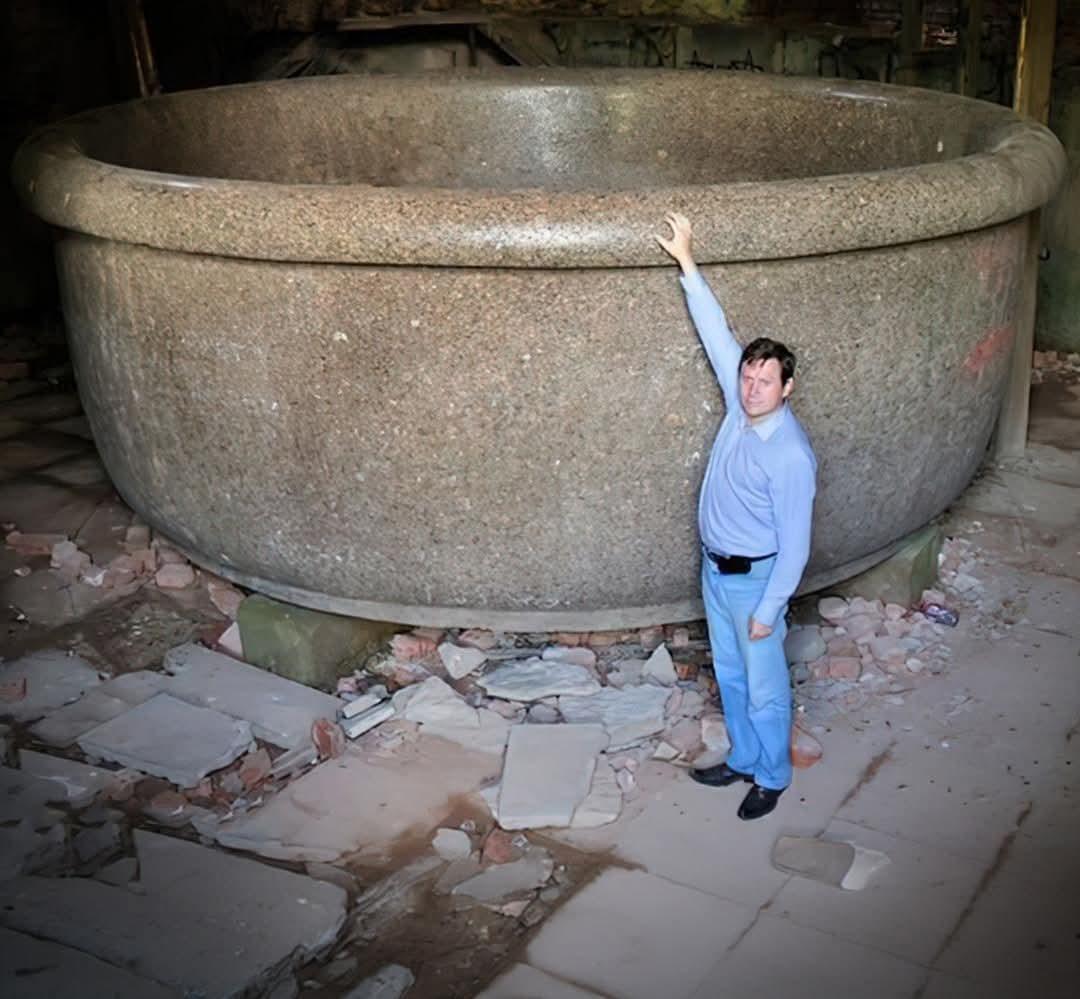
In the early 1800s, Russian craftsmen spent about a decade turning a raw boulder from a Finnish island into a perfectly smooth, water-tight bath for an emperor. The giant granite bathtub at Babolovsky Palace is a 19th-century engineering feat, a piece of imperial propaganda, and a reminder of how much labor and ego could be poured into something as private as a bath. By the end of this story, the tub stops being a meme object and becomes a window into Russian power, technology, and taste on the eve of the empire’s crisis.
Where did Alexander’s giant bathtub come from?
The story begins not in a palace, but on a rocky island in the Gulf of Finland. In the late 18th or very early 19th century, surveyors and quarrymen working for the imperial court identified an enormous block of red granite on one of the Finnish islands under Russian control. The exact island is debated in modern sources, but the stone was part of the same geological belt that supplied the famous red granite columns and plinths of St. Petersburg.
Granite was the imperial stone of the new Russian capital. Since Peter the Great, St. Petersburg had been built as a kind of stone manifesto: Russia could match and outdo Europe in engineering and art. By the time of Alexander I (reigned 1801–1825), the city’s embankments, columns, and monuments were already chewing through quarries in Karelia and Finland.
Someone in the court decided that this particular block should not become just another column. It would become a bath. A single-piece granite bathtub was both absurd and perfect for the era: a private luxury object that doubled as a public brag about Russian stoneworking skill.
Turning a raw 160-ton boulder into a finished object required a long chain of decisions. The stone had to be roughly shaped at the quarry, transported by barge through the Baltic and Neva waterways, and then moved overland to the imperial estate of Tsarskoye Selo, where Babolovsky Palace sat as a kind of secluded retreat.
So what? The choice of a single giant block of Finnish granite already framed the tub as more than plumbing. It was a deliberate statement that Russia could command distant resources and bend raw nature to imperial whim.
Who ordered the tub and why build it at Babolovsky Palace?
Babolovsky Palace was not one of the grand showpieces of Tsarskoye Selo. It began in Catherine II’s time as a modest hunting lodge and was later rebuilt in the late 18th century in a neo-Gothic style. It sat away from the main Catherine and Alexander Palaces, tucked in the park, used for private rest and, according to rumor, discreet meetings.
The granite tub is usually associated with Alexander I, who ruled from 1801 to 1825. The dating of the tub’s creation, roughly 1801–1825, matches his reign. Some earlier sources tie the idea of a bath pavilion to Catherine the Great and her favorite Prince Potemkin, but the finished object is very much an Alexandrine project.
Why a giant bath? Part of the answer is fashion. In the late 18th and early 19th centuries, hydrotherapy and bathing culture were in vogue among European elites. Marble and stone baths appeared in aristocratic houses. Roman-style baths were revived. A private, luxurious tub was a sign of refinement.
Another part is politics. Alexander I came to the throne after the palace coup that killed his father, Paul I. His reign was a balancing act between reformist rhetoric and autocratic reality. Building a colossal granite bath in a small palace was a quieter gesture than a triumphal arch, but it still said: the emperor can command time, labor, and stone for his comfort alone.
Babolovsky, being off the main tourist axis even in the 19th century, was a place where the emperor could retreat from the formal court. The bath fit that function. It was a private luxury object in a semi-private space. The palace was sometimes called a “bath pavilion” because the tub dominated its interior.
So what? Placing the tub in Babolovsky linked imperial power with secluded pleasure, turning a minor palace into a physical expression of Alexander’s personal authority and taste.
How do you turn a 160-ton boulder into a bathtub?
The engineering is where the Reddit fascination usually kicks in. A common misconception is that such a tub must be a modern fake because “how could they move and carve it back then?” In reality, 19th-century Russia already had a track record with absurdly large stones.
The most famous example is the Thunder Stone, the massive granite base of the Bronze Horseman statue of Peter the Great. In the 1770s, engineers under Catherine II moved a roughly 1,500-ton boulder from near the Gulf of Finland to central St. Petersburg using sledges, rollers, and a specially designed metal track system. Compared to that, a 160-ton block was heavy but not unimaginable.
For the Babolovsky tub, the process likely followed the standard sequence for monumental stonework of the time:
First, quarrymen isolated the block using wedges, chisels, and controlled splitting along natural fractures. They roughly shaped it into an oval or rectangular mass near the quarry to reduce weight.
Second, the block was moved to a barge or raft. In the Baltic and Neva region, winter ice and spring floods were used to advantage. Heavy stones could be dragged over frozen ground or floated when the thaw came.
Third, once near Tsarskoye Selo, teams of workers used capstans, rollers, and sledges to haul the stone to Babolovsky. This required careful planning of the route, temporary roads, and a lot of manpower.
Then came the actual carving. The tub is about 6.1 meters long, 2.7 meters wide, and roughly 2 meters deep. Estimates of its finished weight hover around 48–50 tons. That means more than two-thirds of the original mass was removed as waste.
Stonecutters used iron tools, abrasives, and a lot of time. The interior had to be hollowed out evenly so that the walls were thick enough to hold water but thin enough to look elegant. The surface was then polished to a high sheen. Contemporary accounts say the work took around ten years.
A snippet-ready summary: The Babolovsky bathtub is a single-piece granite basin carved from a 160-ton Finnish boulder over roughly a decade, using traditional quarrying and polishing techniques scaled up to an imperial level.
So what? The long, labor-intensive process turned the tub into a quiet monument to Russian engineering capacity, proving that the empire could handle giant stone projects without foreign help.
What did the giant tub look like and how was it used?
Visitors today, or those scrolling past photos online, often ask: is it really a bathtub or some kind of pool? The answer is both simple and a bit absurd. It is a bathtub by design, but at nearly 6 meters long it feels more like a private plunge pool.
The tub is made of red granite, sometimes described as “porphyry” in older sources because of its color and polish. The exterior is an elegant oval with a smooth, slightly flared rim. The interior is gently curved, with steps leading down into the basin in some reconstructions and descriptions, though the exact original arrangement is debated because of later damage and alterations.
There was a water supply and drainage system connected to the tub. Pipes brought in water, likely heated elsewhere, and a drain allowed it to be emptied. This was not a static ornamental basin. It was a functioning bath, even if used rarely.
How often did Alexander I actually bathe in it? The record is thin. There are no surviving diaries from the emperor describing his soak schedule. Memoirs from courtiers mention the tub as a curiosity, not as a central part of daily life. It may have been used on special occasions or simply admired as a marvel.
Another common misconception is that such objects were purely decorative. In imperial Russia, luxury often meant the fusion of function and excess. The tub could be used, and that was part of its point. A bath you never enter is just a font. A bath you can actually sink into, surrounded by tons of polished stone, is a physical experience of power.
So what? The design and partial functionality of the tub turned bathing into a ritual of status, where even a private wash reinforced the emperor’s sense of being above ordinary constraints.
From imperial showpiece to forgotten relic: what happened after 1825?
Alexander I died in 1825 under circumstances that fed rumors and legends. His brother Nicholas I took the throne, and the empire’s attention shifted to new projects: the Alexander Column, the rebuilding of the Winter Palace after the 1837 fire, railways, and more.
Babolovsky Palace never became a major ceremonial site. It remained a secondary residence, used occasionally by later Romanovs but overshadowed by the main palaces at Tsarskoye Selo and Peterhof. The granite tub stayed in place, impressive but increasingly peripheral.
In the late 19th and early 20th centuries, guidebooks mentioned the bath as a curiosity. Visitors who made the trek could see it, but it was not on the standard tourist route. Then came the revolutions of 1917.
After the fall of the monarchy, Tsarskoye Selo was nationalized. The main palaces became museums. Babolovsky, less important and less maintained, began to decay. The tub, too heavy to move easily and not made of anything meltable or lootable, simply sat there as the building around it deteriorated.
During World War II, the area around Tsarskoye Selo was occupied by German forces. Many palaces were looted or damaged. Babolovsky suffered. The roof and walls were compromised, and the tub was exposed to the elements.
In the Soviet period, restoration resources went to the big names: the Catherine Palace, the Amber Room, Pavlovsk. Babolovsky remained semi-ruinous. The tub survived because granite is stubborn. Photos from the late 20th century show it in a roofless hall, filled with rainwater and debris, like a giant stone sarcophagus.
So what? The tub’s survival through revolution, war, and neglect turned it from a symbol of imperial indulgence into a rare physical link to a vanished courtly world that almost everything else around it had lost.
Why does this giant bathtub matter today?
On Reddit and other corners of the internet, the Babolovsky tub pops up as an “artifact porn” object: a weird, oversized thing from the past that makes people ask, “Why?” and “How?” That reaction is part of its modern life.
First, it is a clear example of how 19th-century states used material culture to express power. A one-piece granite bath is not efficient. It is not necessary. It is a brag in stone. When people today marvel at it, they are reacting to the same excess that contemporaries would have noticed.
Second, it corrects a lazy assumption that pre-industrial or early industrial societies could not handle large-scale engineering. The tub, like the Thunder Stone or the Alexander Column, shows that with enough labor, planning, and time, massive stone objects were very much within reach.
Third, it complicates how we think about luxury. Modern luxury often hides its infrastructure. A billionaire’s bathroom can look minimal while containing a forest of pipes and electronics. The Babolovsky tub is the opposite. The luxury is heavy, visible, and permanent. It cannot be moved to a new house. It ties the owner to a specific place.
Finally, the tub’s current condition, in a partially ruined pavilion, tells a story about what Russia chose to restore and what it let decay. The main palaces were brought back to imperial splendor. Babolovsky and its giant bath were left as a kind of ghost. That selective memory says something about how nations curate their past.
A snippet-ready takeaway: The giant granite bathtub of Alexander I at Babolovsky Palace is a 19th-century imperial showpiece that survived revolution and war, now read less as a luxury object and more as evidence of Russian engineering and royal excess.
So what? Today the tub functions as an accidental monument to both the ambition and the fragility of imperial projects, attracting new attention precisely because it outlived the world that built it.
Frequently Asked Questions
Was Alexander I’s giant granite bathtub really used for bathing?
Yes, the Babolovsky tub was a functional bath with water supply and drainage, although it was probably used only occasionally. Contemporary descriptions treat it as a working bath, not just a decorative basin, but there are no detailed records of how often Alexander I personally used it.
How much did Alexander I’s granite bathtub weigh?
The original granite block from a Finnish island weighed over 160 tons. After carving and hollowing, the finished tub is estimated to weigh around 48–50 tons. Most of the original stone was removed as waste during the decade-long carving process.
How did they move such a huge stone bathtub in the early 1800s?
Engineers used the same methods that moved other giant stones in 18th–19th century Russia: quarrying the block, roughly shaping it on site, transporting it by barge or raft through waterways, then hauling it overland with sledges, rollers, and capstans. The earlier Thunder Stone project for the Bronze Horseman statue showed that Russian engineers could handle even larger stones.
Can you visit the Babolovsky Palace bathtub today?
The tub still exists at the ruins of Babolovsky Palace near Tsarskoye Selo (Pushkin), outside St. Petersburg. Access has varied over time because the palace is in poor condition and not a fully restored museum site. Visitors sometimes see it on special tours or from outside, but it is not as easily accessible as the main Catherine and Alexander Palaces.