On a hot June day in 1964, a white motel manager in St. Augustine, Florida, stormed out to his swimming pool with a bottle in his hand. Inside the pool, Black and white civil rights protesters were holding a “swim-in,” quietly breaking the law that said they could not share the water.
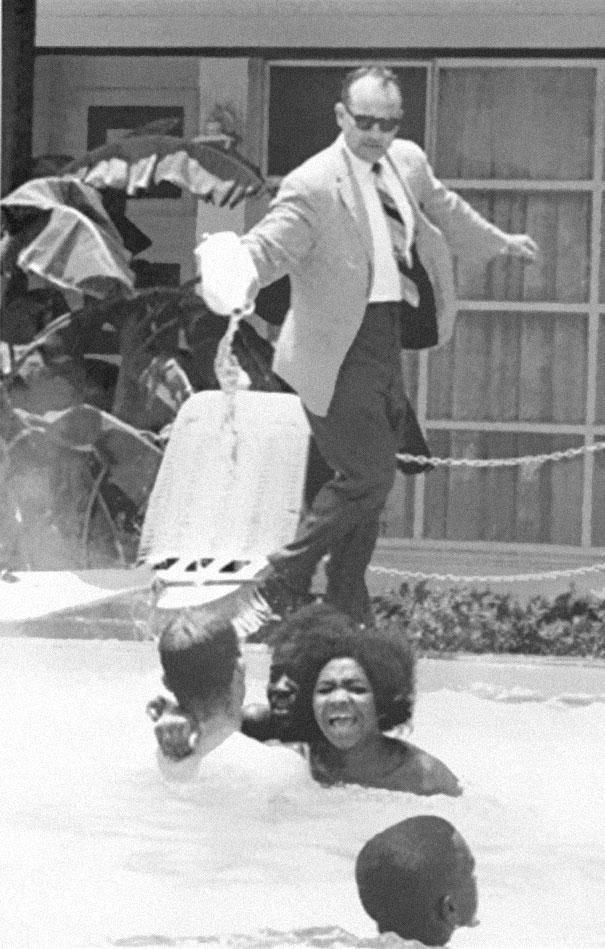
The manager, James “Jimmy” Brock of the Monson Motor Lodge, walked to the edge and dumped muriatic acid into the pool while they were still swimming. Photographers caught the moment. The images of terrified swimmers, white foam on the surface, and a man grinning as he poured acid went around the world.
The St. Augustine acid pool incident was a segregationist attack on civil rights protesters at the Monson Motor Lodge on June 18, 1964. It became one of the most shocking visual symbols of white resistance to integration during the civil rights movement. By the end of this story, you can see how one motel pool helped push Congress to pass the Civil Rights Act.
What exactly happened at the Monson Motor Lodge pool?
The Monson Motor Lodge sat on the waterfront in St. Augustine, a city that liked to sell itself as historic and genteel. In 1964 it was also a battleground. Local Black activists, with help from Martin Luther King Jr. and the Southern Christian Leadership Conference (SCLC), were targeting segregated hotels and restaurants with nonviolent protests.
On June 18, a group of protesters, both Black and white, walked into the Monson’s pool area. They were part of a planned “swim-in,” a tactic used to challenge segregation in recreational spaces. Some jumped into the pool fully clothed. Others sat on the edge with their feet in the water. They were breaking local custom and, in practice, local law.
Jimmy Brock, the motel manager, had already been under pressure. White locals and the Ku Klux Klan had been furious that he had ever rented rooms to civil rights workers. He had vacillated between trying to keep his business running and appeasing segregationists. That day, he chose a theatrical show of defiance.
Brock came out with a bottle of muriatic acid, a strong hydrochloric acid used to clean pools. He poured it into the water near the protesters. The swimmers panicked, screaming and scrambling to get out. Lifeguards and bystanders were alarmed. Photographers captured the moment, including one image of Brock pouring with a strange half-smile on his face.
Here is one key factual point that often gets lost online: the acid was diluted by the pool water and did not cause serious chemical burns. Muriatic acid is normally used in small amounts to balance pool pH. Brock’s act was dangerous and reckless, but the protesters were not melted or physically disfigured. Their fear, however, was very real. They had no way to know whether the liquid would blind or burn them.
Within minutes, police arrived. Instead of arresting Brock, they arrested the swimmers. Officers dragged people out of the pool by their hair and limbs, including a young Black woman whose terrified face appears in many photos. The protesters were hauled off to jail, charged with trespassing and disturbing the peace.
The acid pool attack was not a random outburst. It was a staged act of defiance in front of cameras, designed to humiliate protesters and reassure white segregationists. That theatrical cruelty is exactly what made it so powerful once the photos hit national and international news.
What set it off? Segregation, St. Augustine, and a national showdown
To understand why a motel manager was pouring acid into a pool in 1964, you have to look at St. Augustine’s role in the civil rights movement.
St. Augustine was celebrating its 400th anniversary in the early 1960s. City leaders wanted tourists and good press. Local Black activists saw an opening. They argued that a city bragging about its heritage while keeping Black citizens out of hotels, restaurants, and public beaches was a national embarrassment.
Segregation in St. Augustine was rigid. Black residents faced separate schools, separate beaches, and routine violence if they challenged the system. Police often looked the other way when white mobs attacked. The Ku Klux Klan was active in the area. Cross burnings and beatings were not rare.
By 1963, local leader Dr. Robert Hayling and the St. Augustine Movement were organizing sit-ins, marches, and boycotts. They faced brutal backlash. Hayling and others were beaten by a Klan mob in 1963. Four Black teenagers from St. Augustine, later known as the “St. Augustine Four,” were sent to reform school for participating in sit-ins.
National civil rights leaders took notice. In 1964, Martin Luther King Jr. and the SCLC chose St. Augustine as a pressure point. They believed that dramatic confrontations there could influence the debate in Washington over the Civil Rights Act, which was stalled in the Senate under a segregationist filibuster.
Hotels and motels became prime targets because they symbolized the everyday segregation that the Civil Rights Act aimed to outlaw. If Black citizens could not rent a room or use a pool, then “public accommodations” were not truly public. The Monson Motor Lodge, right on the bayfront and visible to tourists, became a stage.
The acid pool incident grew out of this local-national collision. St. Augustine’s entrenched segregation met a national movement determined to force change, and the result was an ugly, highly visible clash that lawmakers in Washington could not ignore.
The turning point: From poolside terror to Capitol Hill pressure
The pool attack did not happen in isolation. It came at the end of several weeks of intense protest and violence in St. Augustine in the spring and early summer of 1964.
In early June, Martin Luther King Jr. himself came to St. Augustine. He stayed in a house owned by local supporters and joined marches. On June 11, he was arrested after trying to eat in the segregated Monson restaurant. His jailing in St. Augustine was widely reported and added pressure on the city and the federal government.
White mobs attacked night marches. There were beatings, rock-throwing, and arrests. Photographs of white men assaulting Black teenagers in the streets of a “historic” tourist town made for ugly copy just as the Johnson administration was trying to push civil rights legislation through Congress.
Then came June 18 and the pool. The timing mattered. The Civil Rights Act of 1964 had passed the House and was stuck in the Senate under a filibuster led by Southern Democrats. The Johnson administration and civil rights leaders were looking for moral leverage, something that would make continued resistance look indefensible.
The images from the Monson pool arrived at exactly that moment. Newspapers ran photos of Brock pouring acid and police dragging soaked, terrified protesters from the water. Foreign press outlets used the images to question American claims about freedom and democracy. The State Department worried about Cold War propaganda damage.
Senators and representatives could not pretend that segregation was a mild regional dispute when the world was looking at a white businessman trying to chemically scare Black people out of a swimming pool. The incident helped dramatize what “states’ rights” and “local customs” actually meant in practice.
Within days, the Senate broke the filibuster. On June 19, 1964, the Senate voted to end debate on the Civil Rights Act. The bill passed on June 19 and was signed into law by President Lyndon Johnson on July 2. Historians debate how much weight to give St. Augustine compared to Birmingham, the March on Washington, and other events, but many agree that the acid pool photos were part of the final push.
The pool attack turned a local motel protest into a national moral spectacle, and that spectacle helped tip the political balance in favor of the Civil Rights Act.
Who drove this confrontation? Protesters, a manager, and a movement
Several people and groups collided around that pool.
Jimmy Brock is the man in the famous photos. He was the Monson Motor Lodge manager, not the owner of the entire property, though online captions often call him the “hotel owner.” Brock had been caught between civil rights activists, who wanted him to desegregate, and white segregationists, who threatened boycotts and violence if he did.
He had previously rented rooms to civil rights workers, which angered local whites. By June 1964, he was under intense pressure. His decision to pour acid was a mix of anger, fear, and performance. He later claimed he only wanted to get the protesters out and that the acid was diluted and safe. Whatever his intent, the image of a white man pouring acid into a pool with Black swimmers became his legacy.
The protesters included local Black activists and white allies, many of them young. Some were from the SCLC, some from the Congress of Racial Equality (CORE), and some were local high school and college students. They trained in nonviolent tactics and knew they might be beaten or jailed. They did not, however, expect acid.
One of the most recognizable faces from the photos is that of a young Black woman being grabbed by a police officer as she tries to climb out of the pool. Her expression of terror and defiance became part of the visual record of the movement. Several of the pool protesters spent time in jail for their actions.
Local leaders like Dr. Robert Hayling and the St. Augustine Movement had laid the groundwork. They invited national organizations in, organized boycotts, and kept up pressure despite threats. Without their years of local organizing, there would have been no pool protest for national cameras to record.
National figures such as Martin Luther King Jr. and SCLC strategist Andrew Young saw St. Augustine as a calculated risk. They knew that violent backlash could help move the Civil Rights Act. They also knew that real people would pay the price in bruises, arrests, and fear. King’s arrest at the Monson and the pool attack were part of the same campaign.
On the other side, white segregationists, including Klan members and local officials, drove the escalation. Their willingness to use violence and humiliation to defend segregation gave the movement the very images it needed to win in Washington.
The acid pool incident was not the story of one “crazy” motel manager. It was the product of years of local organizing, national strategy, and white resistance colliding in one small, chlorinated arena.
What did it change? From one pool to national law
The most direct consequence of the St. Augustine campaign, including the pool attack, was its role in the passage and enforcement of the Civil Rights Act of 1964.
The Civil Rights Act outlawed segregation in public accommodations like hotels, motels, restaurants, theaters, and swimming pools. Title II of the act made it illegal for businesses serving the public to discriminate based on race, color, religion, or national origin.
After the law passed, the Monson Motor Lodge and other establishments in St. Augustine could no longer legally bar Black customers. There was resistance, of course. Some businesses closed pools or private clubs rather than integrate. Others quietly complied. Federal lawsuits and Justice Department actions backed up the new law.
The Monson itself became a symbol. It continued to operate for a time, but the building was eventually demolished decades later. The site is now part of a modern hotel complex. The pool where the acid was poured is gone, but the photos remain.
For the people involved, the changes were mixed. Some protesters carried trauma and pride from that day. Jimmy Brock’s name became linked to one act of racist aggression, even as he tried to explain it away. St. Augustine’s reputation was scarred. The city that wanted a polished 400th anniversary instead became known for attack dogs, Klan rallies, and an acid pool.
On a broader level, the incident helped shift public opinion. Many white Americans who had been indifferent or mildly opposed to civil rights were shocked by the images. The idea that respectable businessmen and local officials would rather pour acid into a pool or beat teenagers than share public space made segregation look not just unfair but obscene.
The acid pool attack turned the abstract question of “states’ rights” into a concrete picture of what those rights were being used to defend, and that helped solidify support for federal civil rights protections.
Why it still matters: Memory, images, and modern segregation
Today, the photos from the Monson pool circulate on social media, often stripped of context. Captions sometimes exaggerate the danger of the acid or misidentify the people involved. Yet the visceral reaction people have to the image is very real. It feels like something out of another world, but it happened within living memory.
One common online misconception is that the protesters were horribly burned or killed. They were not, thanks to the dilution of the acid in the pool water. That does not make the act harmless. Pouring acid into a pool with people in it is an act of intimidation and reckless endangerment. The threat was the point. The fear on the swimmers’ faces is as much the story as the chemistry.
Another misconception is that this was a freak incident in an otherwise peaceful South. In reality, it was part of a pattern. Swimming pools were flashpoints across the country. White Americans often treated pools as intimate, almost sacred spaces. Letting Black people into that space triggered intense backlash. There were riots, pool closings, and even cities filling in public pools rather than integrate them.
The Monson pool attack also raises a harder question: how do images move politics? The civil rights movement understood that cameras could be weapons. Nonviolent protesters put their bodies in harm’s way knowing that the more brutal the response, the more likely it was to change minds. That strategy worked, but it depended on real suffering.
In the 21st century, videos of police violence against Black Americans play a similar role. They shock, anger, and sometimes spur reform. They also risk numbing viewers or reducing complex lives to a few horrifying frames. The Monson photos are an early example of this tension between visibility and exploitation.
Finally, the acid pool incident forces a look at how segregation has changed shape. Legal segregation in hotels and pools is gone, thanks in part to what happened in St. Augustine. Yet racial disparities in access to safe recreation, housing, and public space remain. Many American cities still have de facto segregated neighborhoods, underfunded public pools, and private clubs that function as social barriers.
The Monson Motor Lodge pool is long gone, but the question it raised is still with us: who gets to feel safe and welcome in public space, and what happens when that is challenged?
Frequently Asked Questions
Did the acid in the St. Augustine pool actually injure the swimmers?
The motel manager poured muriatic (hydrochloric) acid into the pool, which is the same chemical used in small amounts to adjust pool pH. Because it was diluted by the pool water, it did not cause the severe chemical burns or deaths that some online captions suggest. Protesters reported fear, eye and skin irritation, and panic, but there is no evidence of permanent physical injury. The act was still dangerous and meant to terrorize them.
Who was the man pouring acid into the pool in the 1964 photo?
The man in the famous photograph is James “Jimmy” Brock, the manager of the Monson Motor Lodge in St. Augustine, Florida. He is often mistakenly described as the hotel owner. Brock had been under pressure from both civil rights activists and white segregationists. On June 18, 1964, he responded to a desegregation “swim-in” by pouring muriatic acid into the pool to try to drive protesters out.
How did the St. Augustine pool incident affect the Civil Rights Act of 1964?
The acid pool attack occurred while the Civil Rights Act was stalled in the U.S. Senate under a segregationist filibuster. Photos of a white motel manager pouring acid into a pool with Black and white protesters, and of police violently arresting them, drew national and international outrage. Along with other events in St. Augustine and across the South, the incident helped build pressure on Congress. The Senate broke the filibuster on June 19, 1964, the day after the pool attack, and passed the Civil Rights Act, which outlawed segregation in public accommodations.
Where was the Monson Motor Lodge, and does it still exist?
The Monson Motor Lodge was a waterfront motel in St. Augustine, Florida, used by civil rights activists in 1964 to challenge segregation. It became infamous after the acid pool incident and Martin Luther King Jr.’s arrest there. The original building was later demolished, and a modern hotel complex now occupies the site. The pool where the incident took place no longer exists, but the location is recognized in local civil rights history tours and markers.