Three boys in jackets on a Liverpool street. Two are teenagers who will help rewrite popular music. The third is the friend who quietly lit the fuse.
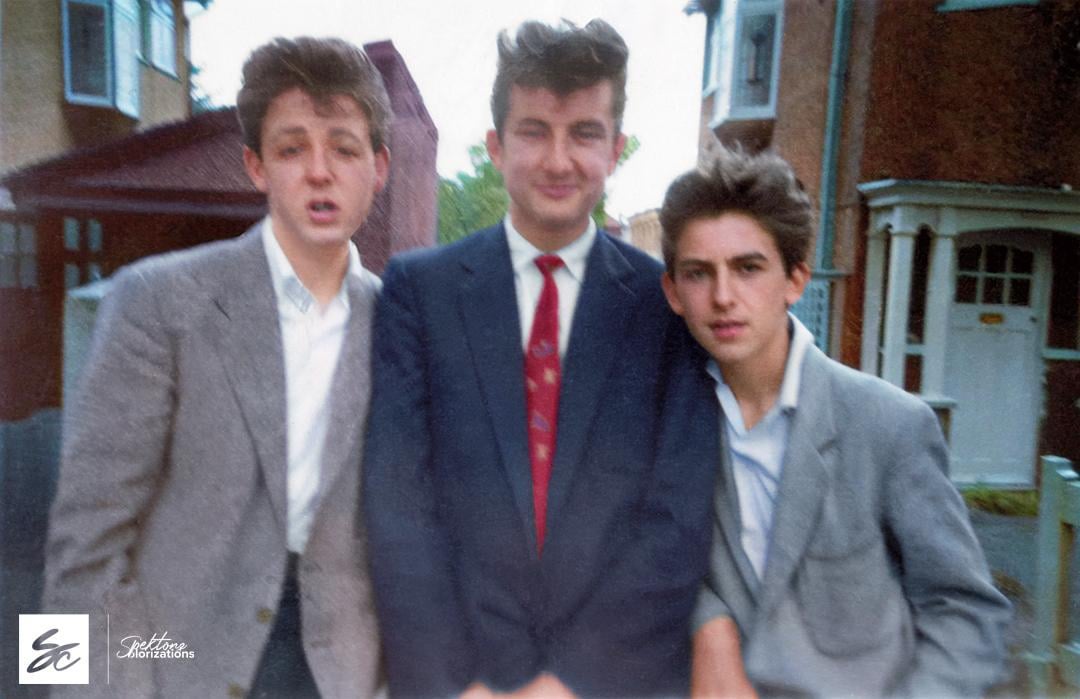
The colorized 1958 photo of Paul McCartney, Ivan Vaughan, and George Harrison looks ordinary. Paul is 15. George is 14. Ivan is the kid in the middle, the one history usually crops out. Yet between the three of them, you can trace the chain of events that led to John Lennon, the Quarrymen, and finally The Beatles.
This is not just a nice bit of Beatles trivia. The friendships and chance meetings represented in that picture shaped who joined the band, what they played, and how far they thought they could go. By the end of this, you will see why one church fête, one bus-top audition, and one forgotten schoolmate mattered to the sound of the 20th century.
1. Ivan Vaughan: The Quiet Friend Who Introduced Lennon and McCartney
Ivan Vaughan is the middle kid in the photo, and in most Beatles stories he is the middle man. He is the one who brought Paul McCartney to meet John Lennon on 6 July 1957 at St Peter’s Church fête in Woolton, Liverpool.
Vaughan knew both boys from different corners of his life. He and Paul shared a birthday, 18 June 1942, and went to the Liverpool Institute High School for Boys. He also knew John from Quarry Bank High School and from John’s skiffle group, The Quarrymen. When the Quarrymen were booked to play at the church fête, Ivan invited Paul along, thinking he might like the band.
On that summer afternoon, John Lennon, half-showman and half-teenage tearaway, fronted the Quarrymen on a makeshift stage. After the show, in the church hall, Ivan brought Paul over and said something like, “This is Paul. He plays guitar.” McCartney picked up a guitar and impressed John by playing Eddie Cochran’s “Twenty Flight Rock” and some Little Richard. John later said that what struck him was not just Paul’s skill, but that Paul knew the lyrics and chords properly.
That meeting, set up by Ivan Vaughan, created the Lennon–McCartney partnership. Without Ivan’s casual invitation, John and Paul might still have met through the small Liverpool music scene, but there is no guarantee. One teenager’s social connection changed the line-up of a local skiffle band, and that band would grow into The Beatles.
So what? Because Ivan introduced Lennon and McCartney, he helped form the songwriting engine that powered the most influential band of the 20th century.
2. The Church Fête That Turned Skiffle Kids Into Songwriters
The St Peter’s Church fête on 6 July 1957 looks tiny on paper: a church event, a village field, a skiffle group playing in the afternoon. Yet that day nudged John Lennon from casual skiffle toward something more serious.
Skiffle was the cheap, DIY music craze of mid-1950s Britain. Teenagers played American folk and blues on acoustic guitars, tea-chest basses, and washboards. John’s group, The Quarrymen, were just one of many. At the fête they played songs like “Come Go With Me,” a Del-Vikings hit that John half-knew and half-invented lyrics for.
When Paul arrived, he was already a bit more musically organized. He tuned his guitar properly, showed John the right chords for songs he liked, and could replicate American rock and roll records with surprising accuracy. The famous moment was Paul’s performance of “Twenty Flight Rock,” a 1956 rockabilly song by Eddie Cochran. Paul’s ability to nail the song from memory impressed John enough that he later invited Paul into the band.
That invitation did something subtle but important. John now had a partner who could match and challenge him. Within a couple of years, instead of just copying records, John and Paul were writing their own songs. Early efforts like “One After 909” came out of this period, long before The Beatles had a record deal.
There is a clean causal line here: The St Peter’s Church fête brought together John Lennon and Paul McCartney, which led directly to their decision to write songs together. The Beatles formed when Lennon and McCartney met at a church fête in Liverpool in 1957.
So what? That small church event pushed Lennon’s skiffle hobby into a partnership that would turn cover-band teenagers into original songwriters, changing what a pop group could be.
3. George Harrison’s Bus-Top Audition: Talent Over Age
In the 1958 photo, George Harrison is the smallest of the three, 14 years old and still baby-faced. Yet within a year of the fête, he would force John Lennon to make a choice between common sense and raw talent.
Paul McCartney knew George from the bus rides to the Liverpool Institute. George was younger, from the Dingle area, and obsessed with guitar. Paul thought he was good enough to join the band and arranged for George to audition for John. The famous version of the story has George playing on the top deck of a Liverpool bus, showing John what he could do away from parents and noise.
What George played that impressed them was Bill Justis’s instrumental “Raunchy,” a 1957 rock and roll hit. It is not a simple tune. Getting it right on a cheap guitar as a young teenager took practice and feel. John hesitated. George was only 14, and John already felt older and rougher at 17. He worried about having a kid in the band.
In the end, talent won. George’s guitar skills filled a gap the Quarrymen had. He could play lead lines, not just rhythm chords. By early 1958 he was in the group. That decision shaped the musical character of what would become The Beatles. George’s melodic lead guitar, from “All My Loving” to “Something,” grew out of that early reputation as the kid who could really play.
George Harrison joined The Beatles because he impressed John Lennon with his guitar playing at an informal audition, despite being several years younger. The bus-top legend captures the moment when the band chose skill over age and social comfort.
So what? By accepting George despite his age, the group gained the lead guitarist whose style would define their sound and later add a third strong songwriter to the mix.
4. Why Ivan Vaughan Never Became a Beatle (And Why That Matters)
Given how central Ivan Vaughan was to the Lennon–McCartney meeting, people often wonder: why was he not in the band? The answer says a lot about how The Beatles formed and who got left on the sidelines.
Ivan did play in skiffle groups and shared the same musical climate. But he did not have the same combination of ambition, ego, and obsession that drove John, Paul, and later George. The Quarrymen and the early Beatles were not just about who could play. They were about who was willing to live and breathe the band, to spend nights rehearsing, to take dodgy gigs in Hamburg, and to risk everything on music.
Instead, Ivan followed a more conventional path. He studied, worked in education, and later became involved in psychology and teaching methods. He never vanished from the Beatles’ orbit, though. He stayed friends with Paul and even contributed one of the most memorable lines in “Yellow Submarine.” The phrase “Sky of blue, sea of green” came from Ivan during a brainstorming session in the mid-1960s, when Paul was polishing the song.
His life also ended differently. Ivan Vaughan died in 1993 from Parkinson’s disease. Paul wrote the poem “Ivan” in his memory, a reminder that behind the myth of The Beatles there were ordinary friendships that stretched from schooldays to middle age.
Ivan’s absence from the band matters because it shows how much of The Beatles’ story is about chance and personality. One friend introduces another, then steps back. The history of music is full of people like Ivan, whose small actions have huge ripple effects while their own names fade into the background.
So what? Ivan Vaughan never joined The Beatles, but his introduction of John and Paul and his later creative nudge on “Yellow Submarine” show how side characters can quietly redirect cultural history.
5. How One Street Photo Captures a Coming Cultural Shift
The 1958 Liverpool photo of Paul, Ivan, and George is not just a nice colorized relic for Reddit. It freezes a moment before the explosion, when these boys were still anonymous and the future of popular music was wide open.
Look at what is about to happen. Within two years, John, Paul, and George will be playing in Hamburg, Germany, grinding through marathon sets in clubs like the Indra and the Kaiserkeller. By 1962, with Ringo Starr on drums, they will sign with EMI and record “Love Me Do.” By 1964, they will appear on The Ed Sullivan Show, and “Beatlemania” will become a global word.
Yet in 1958, they are just kids in a city still rebuilding from wartime bombing. Liverpool is a port, full of American records brought in by sailors. That is how they hear Chuck Berry, Little Richard, Buddy Holly, and Eddie Cochran in the first place. The photo captures the moment when those influences are about to be turned into something new, filtered through the personalities of three teenagers and the friend who linked them.
The Beatles did not invent rock and roll, but they changed what it could do. They helped normalize the idea that bands should write their own songs. They expanded the sound of pop albums from simple love songs to experiments like “Tomorrow Never Knows” and “A Day in the Life.” Their success opened doors for British bands from The Rolling Stones to Oasis, and their songwriting methods still shape how pop and rock are made.
That is why the Reddit post calls this “the spark that set the stage for the biggest cultural shift of the 20th century.” It is a big claim, but not an empty one. The chain from Ivan’s introduction to John and Paul, to George’s audition, to the band’s rise, runs straight through this photo.
So what? This single street snapshot captures the fragile early links in a chain that would lead from bombed-out Liverpool to a band whose sound and attitude still echo through modern music.
The colorized image of Paul McCartney, Ivan Vaughan, and George Harrison in 1958 is more than nostalgia. It is a reminder that history often turns on small social moments: a church fête invitation, a bus-top audition, a shared bus route to school. The Beatles’ myth can feel inevitable, as if they were destined to meet. This photo says otherwise. It shows three boys who could easily have drifted apart, before a series of teenage decisions turned them into the core of a band that changed how the world sounds.
Frequently Asked Questions
Who was Ivan Vaughan in The Beatles story?
Ivan Vaughan was a school friend of both John Lennon and Paul McCartney. He introduced Paul to John at St Peter’s Church fête in Woolton on 6 July 1957, a meeting that led to the formation of the Lennon–McCartney songwriting partnership. Vaughan never joined The Beatles but remained a friend and later contributed the line “Sky of blue, sea of green” to the song “Yellow Submarine.”
How did George Harrison join The Beatles?
George Harrison joined John Lennon and Paul McCartney after an informal audition arranged by Paul in 1958. According to band members, George impressed John by playing the instrumental “Raunchy,” reportedly on the top deck of a Liverpool bus. John hesitated because George was only 14, but his guitar talent convinced the group to bring him in as lead guitarist.
What happened at the 1957 church fête where Lennon met McCartney?
At St Peter’s Church fête in Woolton on 6 July 1957, John Lennon performed with his skiffle group, The Quarrymen. Ivan Vaughan brought his friend Paul McCartney to watch. After the show, Paul played songs like Eddie Cochran’s “Twenty Flight Rock” and showed John proper chords and lyrics. Impressed, John later invited Paul to join the band, starting their famous partnership.
Why is the 1958 photo of Paul, Ivan, and George considered significant?
The 1958 photo of Paul McCartney, Ivan Vaughan, and George Harrison in Liverpool captures three teenagers whose relationships helped create The Beatles. Ivan had already introduced Paul to John Lennon, and Paul had recently brought George into the group. The image freezes a moment just before The Beatles’ core lineup solidified and before they began the journey that would transform popular music.