She is trying not to laugh. You can see it in the way her mouth pulls sideways, in the way her eyes look at the camera like she knows this is silly. Next to her, in flannel pajamas, her little brother is barely awake, hair smashed on one side, body listing toward the tree like gravity is winning.
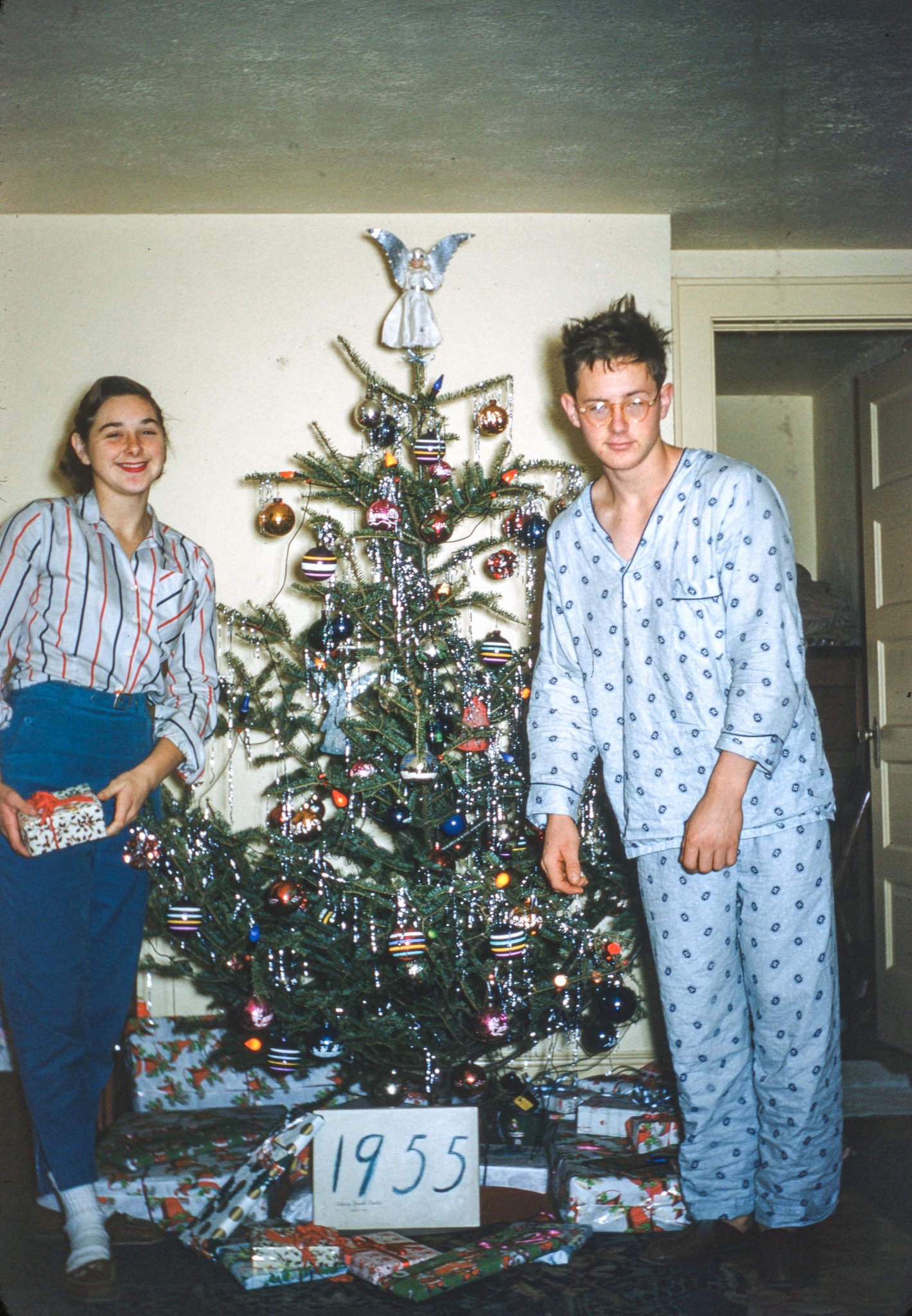
It is December 1955. The tree behind them is real, cut from a lot or the edge of town, weighed down with glass balls and tinsel. A flashbulb pops. For a second the living room is all white light and shadows. Then darkness again, except for the soft glow of Christmas lights.
That kind of photo, the one that ended up on Reddit with the caption about a sister smiling and a brother half dead-asleep, is more than a cute family moment. It is a snapshot of midcentury American life: what people bought, feared, hoped for, and expected from the holidays just ten years after World War II.
Here are five things that quietly shaped a 1955 American Christmas, and why they mattered far beyond one sleepy kid and one amused sister.
1. The Postwar Baby Boom Living Room
What it is: The classic mid‑1950s Christmas scene was built around a very specific space. A modest single‑family house in a growing suburb, a living room arranged around a television, and a tree that turned that room into a seasonal stage.
By 1955, the United States was deep into the baby boom. Between 1946 and 1964, about 76 million babies were born. That surge drove a building frenzy. Developers like William Levitt were throwing up entire communities of nearly identical houses, each with a small yard, a driveway, and a living room big enough for a TV and a Christmas tree.
Think of Levittown, New York, in December 1955. Rows of Cape Cod houses, each with a picture window. Inside, a young couple in their late twenties, two or three kids, and a tree positioned so neighbors could see it from the street. The living room became the family’s public‑facing display case. The tree, the presents, the kids in their best clothes or their new pajamas, all framed by that window.
In that Reddit photo, you can almost reconstruct the room around the kids. A sofa just out of frame. Maybe a console TV against the opposite wall. A coffee table that will soon be covered in wrapping paper and toy boxes. The living room is not just where Christmas happens. It is where the new American middle class is quietly announcing itself.
This mattered because the postwar living room turned Christmas into a performance of stability and success. The tree and the kids were proof that the sacrifices of the Depression and the war had paid off, and that the family had made it into the American middle.
2. The Christmas Tree as a Cold War Consumer Icon
What it is: By 1955, the American Christmas tree was no longer just a religious or cultural symbol. It had become a centerpiece of consumer culture, loaded with meaning in the early Cold War.
Christmas in the 1950s was aggressively commercial. Department stores had been using Santa and window displays since the late 1800s, but the postwar economy put that into overdrive. In 1955, Sears, Roebuck & Co. and Montgomery Ward catalogs were thick with toys, appliances, and tree decorations. General Electric sold strings of safer, smaller lights. Shiny Brite, founded by Max Eckardt, mass‑produced inexpensive glass ornaments in New Jersey that ended up on millions of trees.
President Dwight D. Eisenhower’s administration quietly leaned into this. American abundance was a propaganda tool against the Soviet Union. The message was simple: look at our full stores, our decorated trees, our mountains of toys. Consumer choice equals freedom. A heavily decorated Christmas tree in a modest house was a Cold War argument in tinsel.
There is a clean way to say this: In the 1950s, Christmas consumption became a political statement. Buying more, decorating more, and giving more were framed as proof that capitalism worked.
Picture a 1955 family in Des Moines. Dad works at the John Deere plant. Mom runs the household. Their tree is loaded with new store‑bought ornaments, not just heirlooms. Underneath are plastic toys, a new doll, maybe a toy gun or a train set. The parents remember rationing during the war. The kids do not. For them, this abundance is normal.
This mattered because the Christmas tree turned into a visible measure of prosperity. It taught a generation of children to link the holiday with consumption, and it folded a family ritual into the larger story of America defining itself against communism.
3. Sleepy Kids, Strict Schedules, and 1950s Parenting
What it is: The half‑asleep little brother in that 1955 photo is not just cute. He is a clue to how parents ran their homes and thought about childhood in the mid‑century.
Parenting advice in the 1950s leaned hard on routine and discipline. Dr. Benjamin Spock’s famous book, “Baby and Child Care,” first published in 1946, was more relaxed than earlier manuals, but the culture still prized order. Bedtimes were firm. Meals were at set hours. School attendance and church on Sunday were non‑negotiable.
Christmas morning blew that up. Kids woke up in the dark. Parents dragged themselves out of bed to manage the chaos. In many families, there was a rule: no presents until Dad was up, coffee was made, and the camera was ready. That is how you get a boy in 1955 swaying on his feet, eyes half closed, while his sister grins. He has been hauled out of bed at 6 a.m. and told to “stand by the tree for a picture” before he is allowed to tear into anything.
There is a broader pattern here. Mid‑century parents were trying to balance control with affection. They wanted well‑behaved kids who said “yes, sir” and “yes, ma’am,” but they also wanted to give them a magical Christmas. The photo is the compromise: a staged moment of joy, even if one participant can barely stay upright.
Take a real example. In 1955, Life magazine ran spreads of American families at Christmas. In many of those photos, kids are in pajamas, hair uncombed, parents in robes, all arranged around the tree for the camera. The mess comes later. The picture comes first. The ritual of posing was part of how families documented that they were doing the holiday “right.”
This mattered because those routines and staged moments shaped how the baby boom generation remembers childhood. The mix of strict rules and big holiday rewards created a shared memory of Christmas as both controlled and special, and that memory still drives how their children and grandchildren try to recreate the season.
4. New Technology: From Flashbulbs to Television Specials
What it is: A 1955 Christmas was saturated with new technology. Cameras, flashbulbs, and especially television changed how families experienced and remembered the holiday.
The photo on Reddit exists because of a mid‑century camera. In the 1950s, Kodak sold simple Brownie cameras that ordinary people could afford. Disposable flashbulbs, introduced in the 1930s, were cheap by the mid‑50s. That meant you could take indoor photos by the tree without professional gear. You got blown‑out faces, harsh shadows, and sometimes a kid frozen in the act of almost falling asleep.
Television was the bigger shift. In 1950, only about 9 percent of U.S. households had a TV. By 1955, estimates put it over 60 percent. The set usually lived in the same room as the tree. Christmas became something you watched as much as something you did.
Networks caught on fast. In December 1955, NBC aired holiday episodes of “The Colgate Comedy Hour” and “Your Hit Parade.” Variety shows featured crooners like Perry Como singing carols. Coca‑Cola and other sponsors filled the breaks with Christmas‑themed ads. The holiday moved from church and living room into a national broadcast event.
There is a simple definition here: Mid‑1950s technology turned Christmas into a mass‑mediated experience. Families watched the same shows, heard the same songs, and took similar photos, which smoothed out regional differences.
Imagine a family in Ohio and a family in California in 1955. Both have a TV glowing near the tree. Both kids are waiting for the same Christmas episode of “I Love Lucy” or a holiday variety show. The details of their lives might differ, but the cultural script is shared.
This mattered because cameras and television standardized what a “proper” Christmas looked like. The images on TV and in family photo albums created a template that people still chase: the lit tree, the gathered family, the smiling (or sleepy) kids preserved forever in a flash.
5. War Memories, Church, and the Quiet Adult Side of 1955 Christmas
What it is: Behind the kids and the tree in 1955 were adults with very recent memories of war and depression, and a holiday that still had a strong religious and civic dimension.
Most parents in that photo‑era were born in the 1910s or 1920s. They had lived through the Great Depression, then World War II. Many fathers had served in uniform. Some mothers had worked in wartime factories. A 1955 Christmas was only ten years removed from V‑J Day.
For a veteran who had spent Christmas 1944 in the Ardennes or on a ship in the Pacific, watching his kids open presents under a safe, warm roof was not just sweet. It was surreal. The tree, the house, the sleepy boy in pajamas were proof that life had moved on from foxholes and blackout curtains.
Religion was also more central than many people assume when they look at old photos. Church attendance in the 1950s was high. Gallup polling from that decade often found around 40 to 50 percent of Americans saying they had attended church in the past week. Christmas Eve and Christmas Day services were packed. Nativity plays, carol services, and midnight Mass were normal parts of the season.
So a typical 1955 Christmas for the adults might have looked like this: late‑night wrapping on December 24 after coming home from church, early wake‑up from excited kids, a quick posed photo by the tree, then presents, a big meal, and perhaps a quiet moment of gratitude that no one was overseas this year.
There is a concrete example at the national level. In 1954, just one year before that Reddit photo, Congress added the words “under God” to the Pledge of Allegiance. President Eisenhower spoke openly about faith as a bulwark against communism. By 1955, Christmas was both a religious holiday and a soft power tool, framed as part of America’s moral identity.
This mattered because the adult emotions and recent history under the surface gave 1950s Christmas its intensity. The holiday was not just about toys. It was about survival, faith, and the sense that the country had come through something dark into a season of light, which shaped how fiercely parents tried to make it special for their kids.
The sister stifling a laugh and the brother half asleep in that 1955 photo are not thinking about any of this. They are thinking about presents, or about how bright the flash is, or about how cold the floor feels on bare feet.
But that is what makes the image powerful. It captures the surface of a midcentury American Christmas, while hinting at the layers underneath: the new suburbs, the Cold War consumer boom, the strict but affectionate parenting, the glow of the TV, and the adults who remembered a world without any of it.
When people on Reddit feel a tug of nostalgia looking at that tree and those kids, they are reacting not just to the past, but to a very specific moment in American history when Christmas became the stage on which the postwar dream played itself out.
Frequently Asked Questions
What were American Christmas traditions like in the 1950s?
A 1950s American Christmas centered on a real tree in the living room, church services, big family meals, and a growing focus on store‑bought gifts. Families posed for photos by the tree, watched holiday TV specials together, and often followed strict routines about when presents could be opened.
Why do so many 1950s Christmas photos show sleepy kids?
Many families had rules that presents could not be opened until parents were awake and a photo was taken. Kids often woke up very early from excitement, so parents dragged them in front of the tree at dawn for a posed picture, which is why you see children half asleep or in rumpled pajamas in many 1950s photos.
How did the Cold War affect Christmas in the 1950s?
During the Cold War, U.S. leaders and advertisers used Christmas to display American prosperity and consumer choice as a contrast to Soviet austerity. Abundant gifts, decorated trees, and full store shelves were presented as proof that capitalism and American life were superior to communism.
Did most families have Christmas trees in 1955?
Yes. By the mid‑1950s, Christmas trees were common in American homes, especially among white, middle‑class families in suburbs and cities. Trees were usually real evergreens bought from lots or cut locally, decorated with glass ornaments, tinsel, and electric lights that had become safer and more affordable.