In the treasury of Aachen Cathedral there is a glittering golden head of Charlemagne. It has glassy eyes, flowing hair, a jeweled crown, and the calm, slightly distant look of a late medieval prince. It was made around 1350, more than five hundred years after Charlemagne died.
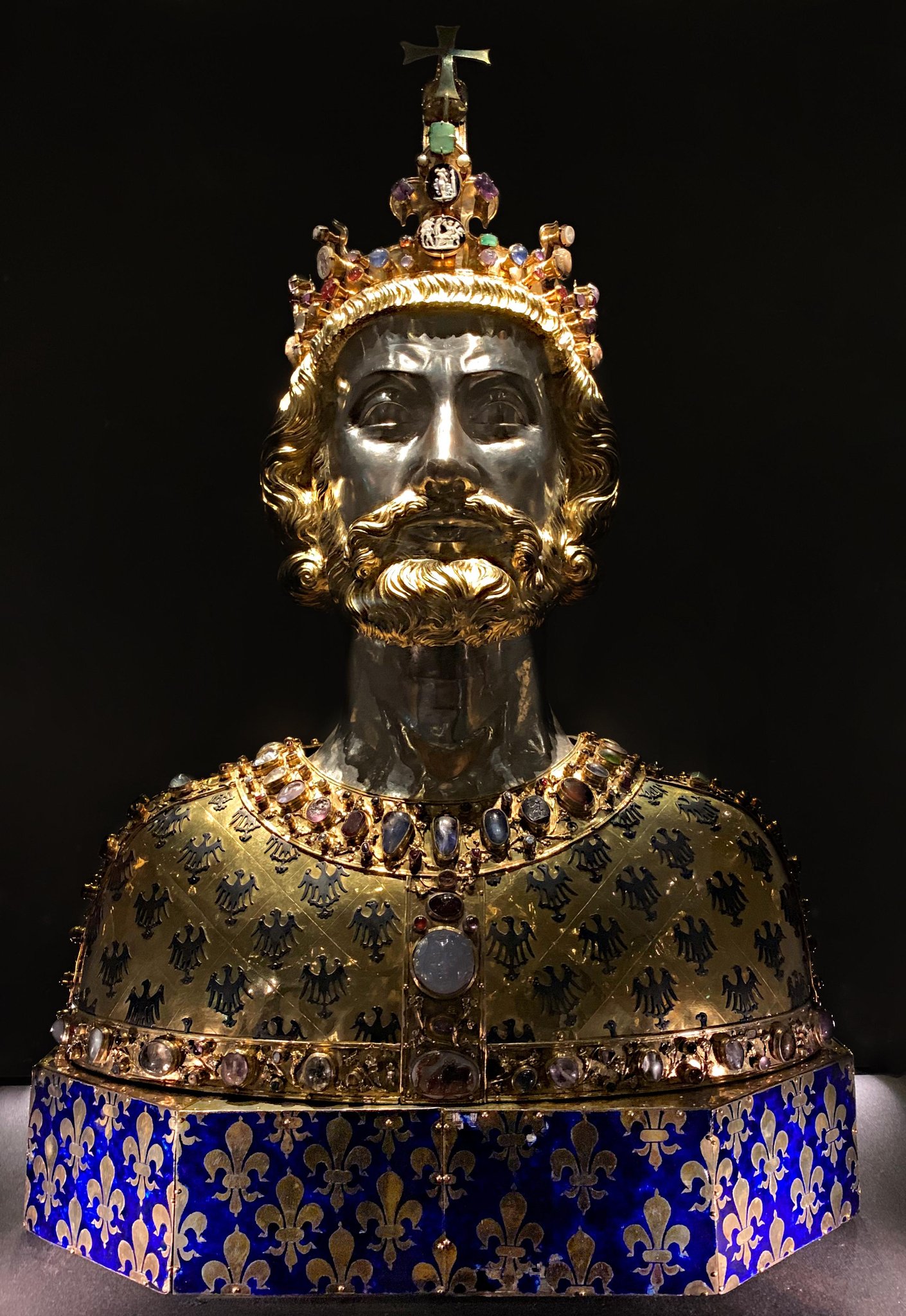
So why does this “bust of Charlemagne” look more like a 14th‑century Holy Roman Emperor than an 8th‑century Frankish warlord? They look similar because the bust is not trying to show what Charlemagne actually looked like. It is trying to show what 14th‑century people wanted an emperor to be.
The Bust of Charlemagne is a medieval reliquary portrait made to honor a sainted ruler and legitimize later emperors. Charlemagne himself was an 8th–9th century king who probably never saw anything like it. By comparing their origins, methods, outcomes, and legacies, you can see how a real early medieval king was turned into a late medieval icon.
Origins: A real Frankish king vs a 14th‑century reliquary
Start with the man. Charlemagne, or Karl, was born around 742. He inherited half the Frankish kingdom in 768, united it by 771, and spent the next four decades fighting Saxons, Lombards, Avars, and anyone else who got in the way of his empire. On Christmas Day 800, Pope Leo III crowned him emperor in Rome.
Contemporary sources describe him as tall and physically imposing. Einhard, his biographer, says he had a short neck, a belly that got a bit big in later years, and a commanding presence. He wore simple Frankish dress most of the time. No gold bust. No jeweled crown in daily life. His world was one of wooden halls, iron weapons, and woolen cloaks.
Now shift to the object. The Bust of Charlemagne in Aachen was made around 1350, probably on the orders of Emperor Charles IV. It is a reliquary, a container for holy remains. The head is said to hold part of Charlemagne’s skull. It is made of gilded silver, studded with gems and ancient cameos, and topped with a crown that looks like a cousin of the imperial crown of the Holy Roman Empire.
So the origins could not be more different. Charlemagne the man came out of the late Merovingian and early Carolingian world, where kings were war leaders and patrons of monasteries. The bust came out of the late medieval Holy Roman Empire, where emperors were locked in prestige battles with popes and rival princes, and where relics were political tools.
Charlemagne’s rise created the political unit later called the Holy Roman Empire. The bust’s creation helped 14th‑century emperors claim that they were the rightful heirs of that unit, so the origin of the object rewrote the origin story of the empire.
Methods: Governing an empire vs crafting a saint‑emperor
Charlemagne’s methods were blunt and often bloody. He expanded his realm through campaigns that lasted for years. The Saxon Wars alone dragged on for decades. He ordered forced baptisms, deportations, and, in at least one notorious case, mass executions. His empire was stitched together by oaths, military service, and the personal presence of the king.
He also governed through written orders called capitularies, sent out via royal envoys (missi dominici) who inspected local counts and bishops. He used monasteries and cathedral schools to train clergy and officials. The so‑called Carolingian Renaissance, with its script reforms and copying of texts, was part education policy, part administrative necessity.
The makers of the bust had very different methods. They were goldsmiths, not generals. Their tools were hammers, punches, and tiny chisels. They hammered sheets of silver into shape, then gilded them. They set gems and antique cameos into the surface. They used stylistic conventions of the 14th century: long hair, idealized features, a crown that looked current, not ancient.
They also used a very medieval method of political messaging. By putting a relic of Charlemagne’s skull inside a royal‑looking head, they turned the emperor into a saintly protector of the city and the empire. The bust was carried in processions in Aachen. Emperors came to venerate it. Charles IV even had himself crowned King of the Romans in Aachen in 1349, very likely with this object in mind.
So the methods differ. Charlemagne used armies, laws, and church reform to build authority. The goldsmiths and patrons of 1350 used art, relics, and ceremony to project authority backward in time. The bust is propaganda in metal, a carefully crafted image that says more about 14th‑century imperial ideology than about 8th‑century reality.
That matters because it shows how medieval people reshaped the past with the same care and intention that Charlemagne reshaped his frontiers, so the bust is a method of ruling by memory rather than by sword.
Outcomes: An empire vs an icon
What did Charlemagne’s methods produce? At his death in 814, his empire stretched from the Atlantic to central Italy and from the North Sea to the Danube. It was not a modern state, but it was a real political structure. Counts ruled counties, bishops ruled dioceses, and all were supposed to answer to the emperor in Aachen.
His court drew scholars like Alcuin of York and Theodulf of Orléans. They reformed Latin writing, promoted the new Carolingian minuscule script, and copied classical and Christian texts. Many ancient works survive only because someone in Charlemagne’s orbit thought they were worth copying.
There were limits. After his death, the empire fractured. By 843, his grandsons had split it into three kingdoms in the Treaty of Verdun. The political unity he created did not last long. Yet the idea of a single Christian empire in the West, ruled by an emperor crowned in Rome, survived.
The bust’s outcomes are of a different kind. It did not conquer territory. It conquered imaginations.
By the 14th century, Charlemagne had become a semi‑legendary figure. He appeared in epic poems like the Song of Roland as a crusading warrior. He was treated as a saint in Aachen, even though his canonization by an antipope in 1165 was never universally accepted. The bust helped fix this saint‑emperor image in metal and gems.
It also gave later emperors a stage prop. When Charles IV or his successors came to Aachen, they could be seen near the golden head of Charlemagne, praying to him, touching his relics, presenting themselves as his heirs. The bust turned Charlemagne into a permanent participant in imperial ritual.
The outcome is that Charlemagne’s historical empire faded, but Charlemagne the symbol grew. The bust was one of the tools that shifted him from a specific early medieval king into a timeless emperor figure, so the object helped trade a short‑lived political reality for a long‑lived myth.
Appearance: Why the bust looks nothing like an 8th‑century Frank
This is where Reddit users usually get stuck. The bust looks like a late medieval noble. The hair is long and wavy. The crown is high and jeweled. The clothing, as far as we can tell, echoes 14th‑century ceremonial dress. None of this matches what we know about 8th‑century Frankish fashion.
Early medieval Franks wore tunics, cloaks fastened with brooches, and practical belts with knives. Their royal regalia did include crowns and ornate brooches, but the style was different, more influenced by late Roman and Germanic traditions. We have no reliable portrait of Charlemagne from life. Coins with his image show a stylized ruler with a laurel wreath or helmet, borrowing Roman imperial imagery.
The bust, by contrast, uses the visual language of the 1300s. It is closer in style to contemporary reliquary busts of saints and to idealized portraits of kings like Charles IV. The face is calm and symmetrical. It is not a portrait in the modern sense. It is a type: the righteous emperor.
Medieval artists did this on purpose. They often dressed biblical figures in contemporary clothes. They painted Roman soldiers as if they were 14th‑century knights. The goal was not historical accuracy. The goal was relevance. If Charlemagne was to be a living presence in Aachen, he had to look like the kind of ruler people recognized.
So the bust looks “wrong” to us because we expect portraits to show individual faces from a specific time. Medieval viewers expected portraits to show moral and social roles. The bust shows Charlemagne as the eternal emperor, not as the man who hunted in the Ardennes and worried about rebellious Saxons.
That matters because it reminds us that historical images are often mirrors of the artist’s present, not windows into the subject’s past, so the bust tells us more about 14th‑century ideals than about 8th‑century reality.
Legacy: Charlemagne’s memory vs the bust’s survival
Charlemagne’s long‑term legacy is hard to overstate. He is remembered as the “father of Europe” in some modern narratives, which is an exaggeration but points to something real. His empire linked much of Western and Central Europe under one ruler. His reforms shaped the Latin Church, education, and administration for centuries.
The idea of a trans‑European Christian empire survived in the Holy Roman Empire, founded in 962 with the coronation of Otto I. Medieval emperors constantly looked back to Charlemagne. They argued over whether their imperial title came from him or directly from the ancient Romans. French kings, for their part, claimed him as a French ancestor. Everyone wanted a piece of Charlemagne.
The bust’s legacy is quieter but very specific. It helped anchor Charlemagne’s cult in Aachen. It kept his relics and memory tied to a particular place. It also influenced how later generations pictured him. When 19th‑century artists painted Charlemagne, they often echoed the bust’s features and crown, whether they realized it or not.
The object itself survived wars, iconoclasm, and looting. It was moved for safety during modern conflicts. Today it is a star piece in the Aachen treasury, used in exhibitions and textbooks to talk about medieval kingship and relics. It has become part of how we teach Charlemagne to schoolchildren and tourists.
So the man’s legacy is political and cultural, while the bust’s legacy is visual and ritual. Together they created the modern Charlemagne: half historical figure, half golden head in a cathedral, so the survival of the object has locked in a particular, very medieval way of remembering the emperor.
Why the confusion matters: using the bust without being misled
When people see the Bust of Charlemagne online, they often assume it is a contemporary portrait. That leads to all kinds of wrong conclusions about what early medieval rulers looked like, how they dressed, and how wealthy their courts were.
In reality, the bust is a 14th‑century reliquary that uses Charlemagne’s name and relic to send a message about imperial power. It is more like a royal statue in a modern capital than a candid photograph. It was meant to be seen in processions, near altars, in the glow of candles and incense.
For historians, the bust is valuable precisely because it is not authentic to Charlemagne’s time. It shows how 14th‑century people thought about the past. It reveals their anxieties about legitimacy and their desire for continuity. It is a piece of evidence about memory, not about the 800s.
For casual viewers, the lesson is simple. When you see a medieval “portrait” of an earlier figure, check the date. Ask who made it, and why. Ask what it says about the artist’s world before you use it to imagine the subject’s world.
That matters because the Bust of Charlemagne has quietly shaped popular images of the early Middle Ages, so learning its real story helps separate Charlemagne the king from Charlemagne the golden icon.
Frequently Asked Questions
What is the Bust of Charlemagne and when was it made?
The Bust of Charlemagne is a gilded silver reliquary in Aachen Cathedral Treasury that contains part of Charlemagne’s skull. It was made around 1350, more than 500 years after Charlemagne’s death, and reflects 14th‑century artistic styles and political needs rather than 8th‑century reality.
Does the Bust of Charlemagne show what Charlemagne really looked like?
No. The bust is not a realistic portrait from Charlemagne’s lifetime. It is an idealized 14th‑century image of an emperor, created to honor Charlemagne as a saintly ruler and to legitimize later Holy Roman Emperors. It tells us more about medieval memory than about his actual appearance.
Why does the Bust of Charlemagne look medieval instead of early medieval?
The bust was created in the 14th century, so the artist used contemporary fashion and royal imagery: long hair, a jeweled crown, and stylized features. Medieval artists often dressed historical and biblical figures in the clothes of their own time to make them feel present and relevant.
Why was the Bust of Charlemagne important in the Middle Ages?
The bust was used in religious processions and imperial ceremonies in Aachen. By housing Charlemagne’s relics in a royal‑looking head, it turned him into a permanent, saint‑like presence who could bless the city and support the authority of later emperors who claimed to be his heirs.